The V-bombers were the three British jet bombers, the Vickers Valiant, the Avro Vulcan and the Handley Page Victor, that carried Britain’s nuclear deterrent from the mid-1950s until the Royal Navy’s Polaris submarines took over the role in 1969.
They were built for one job, and it was a job everybody hoped they would never do. For roughly fourteen years, the entire British nuclear deterrent sat on concrete pans at a handful of RAF stations in the shape of three very different aeroplanes, crewed by men who had a stated readiness of four minutes and a fair idea of what a one-way trip to the Soviet Union actually meant.
What makes the V-force interesting, beyond the politics, is that Britain built three of them. Not one design with a backup, but three parallel front-line strategic bombers, from three separate companies, entering service within a few years of each other, all doing the same job. That was extravagant, and it produced two of the most extraordinary-looking aircraft ever to wear RAF roundels.
What this guide covers
- What the V-bombers were
- Origins: the bomb, the specification and three answers
- The Vickers Valiant: the safe bet
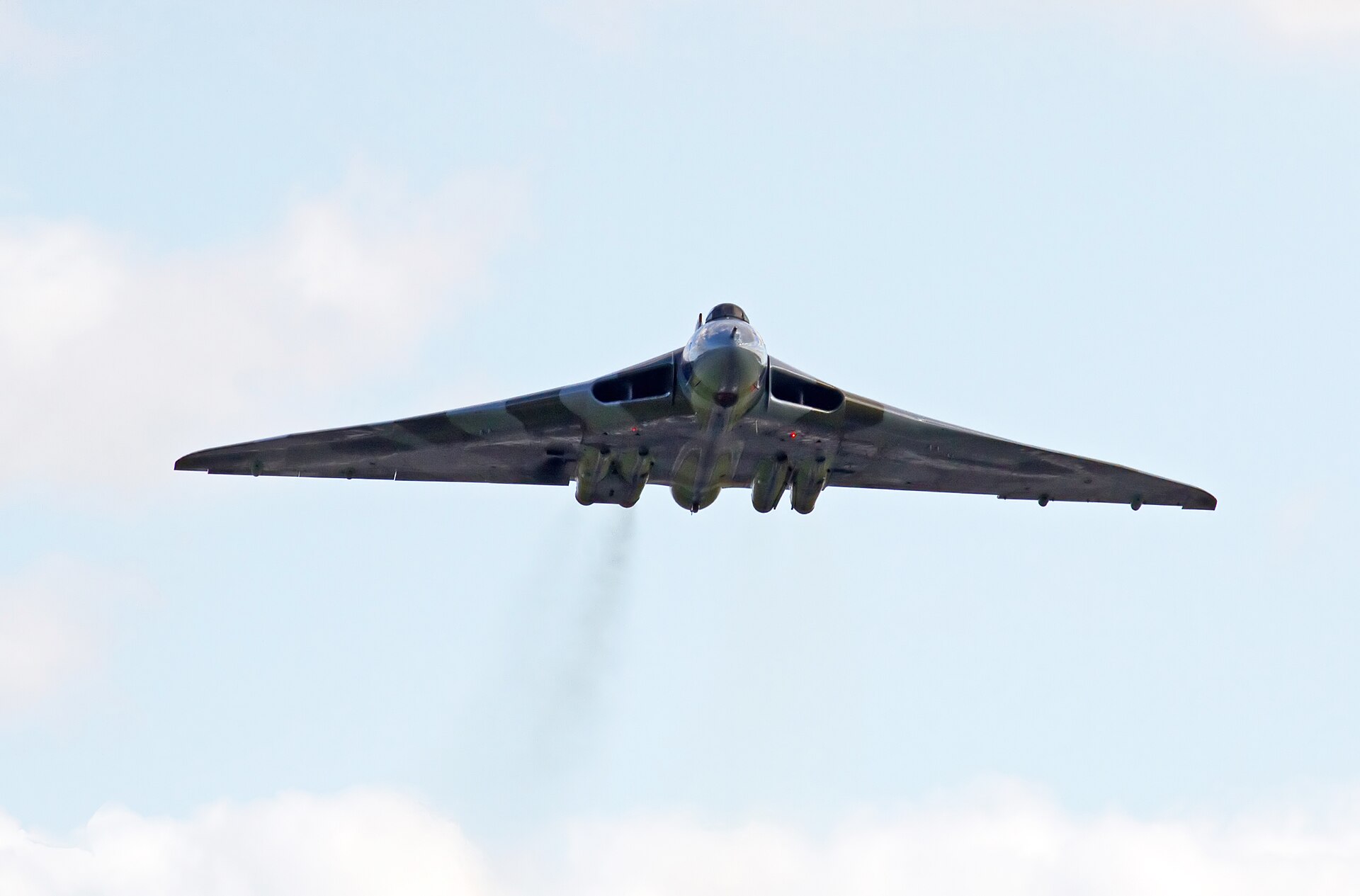
- The Avro Vulcan: the delta
- The Handley Page Victor: the crescent wing
- The three aircraft compared
- The weapons they carried
- Quick Reaction Alert, dispersal and the four-minute warning
- Going low: how a change in Soviet defences rewrote the plan
- Skybolt, Nassau and the end of the airborne deterrent
- Suez, 1956: the Valiant goes to war
- Black Buck, 1982: the Vulcan’s long war
- The Victor outlives them all
- The people behind the V-force
- Where to see a V-bomber today
- Photographing the V-bombers today
- Legacy
- Frequently asked questions
What the V-bombers were
The name is simple enough. All three types were given names beginning with V, and the force that operated them became the V-force. RAF Bomber Command ran it. At its height in the early 1960s the V-force fielded well over a hundred aircraft across the three types, spread across a network of bases and dispersal airfields, with a proportion held at readiness with live weapons aboard.
They were high-altitude, high-subsonic, four-engined jet bombers, designed to fly higher and faster than anything that could reach them, and to deliver a single very large free-fall nuclear weapon onto a Soviet target. That was the concept. The trouble with the concept, which nobody could have known in 1947 and everybody knew by 1961, was that the assumption underneath it, that height and speed equalled safety, had a shelf life.
The three aircraft were not equally successful and they did not have equal lives.
The Valiant entered service first, in 1955, went to war at Suez in 1956, dropped Britain’s first air-delivered thermonuclear device in 1957, and was grounded permanently in January 1965 with fatigue cracks in its wing spars. It served ten years.
The Vulcan entered service in 1956, carried the deterrent, went low, converted to conventional bombing, flew the extraordinary Black Buck missions to the Falklands in 1982, and left RAF service in 1984. It served twenty-eight years and it became the aeroplane the British public thinks of when anybody says V-bomber.
The Victor entered service in 1958, carried the deterrent, went low, and then had a second career nobody planned for. Converted into an air-to-air refuelling tanker, it flew on through the Falklands and the 1991 Gulf War and was not retired until 15 October 1993. It served thirty-five years and it outlasted both of its stablemates by nearly a decade.
Origins: the bomb, the specification and three answers
Britain came out of the Second World War with a heavy bomber force of piston-engined aircraft, the Lancaster chief among them, and an atomic programme that the Americans had just locked it out of. The McMahon Act of 1946 ended the wartime nuclear co-operation, and the British government decided, in the phrase attributed to Ernest Bevin, that it would have a bomb of its own with a Union Jack on it.
A bomb needs a means of delivery. The Lancaster and its successor, the Lincoln, could not survive over a defended Soviet target, and the early British atomic weapon was a very large object indeed. What was needed was a jet bomber that could carry a 10,000 lb weapon a long way, very high, very fast.
Specification B.35/46
That requirement became Air Ministry Specification B.35/46, issued at the beginning of 1947. It asked for something really at the edge of what was possible: a bomber able to carry a 10,000 lb bomb to a target 1,500 nautical miles away, cruising at around 500 knots at 45,000 to 50,000 feet, with no defensive armament at all. The gun turret was to be replaced by altitude. If you fly high enough and fast enough, the reasoning went, nothing can reach you.
Three companies produced serious answers, and the Ministry, in a decision that says a great deal about the industrial politics of the period, funded all of them.
Why three
The official logic was insurance. The Vulcan and the Victor were both radical: a large delta and a crescent-winged aircraft, neither of which had been built at that size before, and both of which carried real technical risk. If either failed, the country would have no deterrent.
So Vickers was allowed to build a more conservative aircraft to a slightly relaxed specification, B.9/48, which could be in service years earlier. That aircraft was the Valiant, and it was explicitly the insurance policy. George Edwards at Vickers pitched it as the aircraft that could be delivered on time, and he was right.
There was also a fourth, the Short Sperrin, an altogether conventional straight-winged bomber built as a fallback in case even the Valiant failed. It flew, it worked, and it was never ordered into production. Two were built. It is the forgotten member of the family and it tells you how nervous the Air Ministry was.
The result was a national bomber programme of remarkable ambition. Three front-line strategic bombers, in parallel, from a country that was rationing food until 1954.
The Vickers Valiant: the safe bet
The Valiant is the V-bomber people forget, and it is the one that did the most historically significant flying.
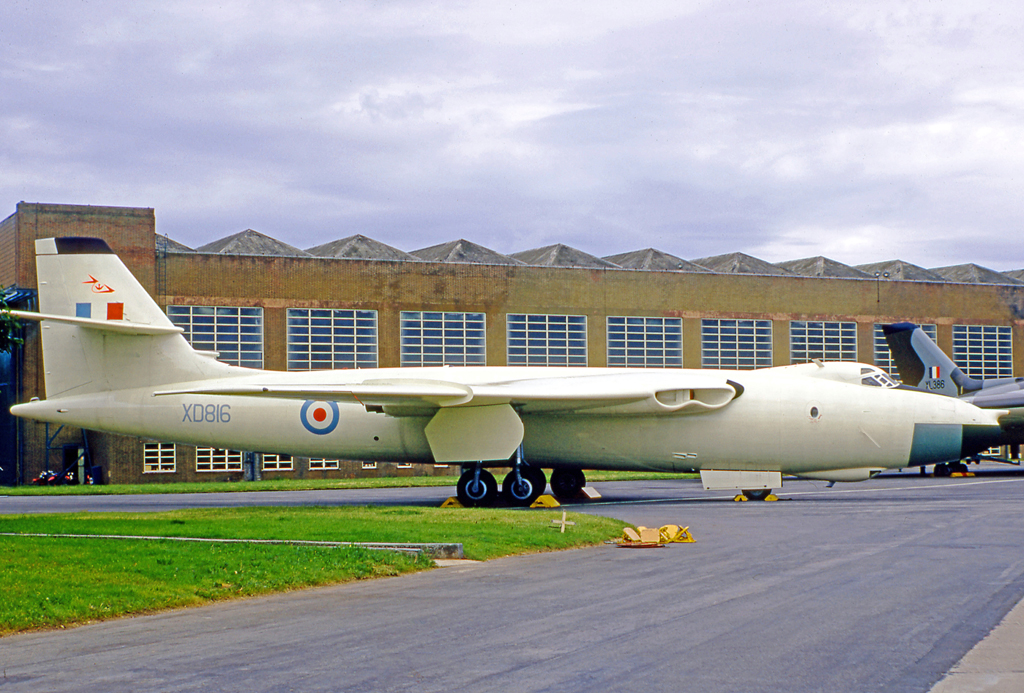
The prototype, WB210, first flew on 18 May 1951 from Wisley, in the hands of Vickers chief test pilot Mutt Summers with Jock Bryce alongside him. Summers is a name worth pausing on: he had also made the first flight of the Spitfire in 1936. There is a neat line running from the Supermarine Spitfire to Britain’s first nuclear bomber, and the same man is at the start of both.
The Valiant was deliberately unadventurous. A shoulder-mounted, moderately swept wing, four Rolls-Royce Avon turbojets buried in the wing roots, a conventional fuselage and a conventional tail. Nothing about it was going to frighten anybody at the Ministry, and that was the point. It was designed to be buildable and it was built. Just over a hundred were completed, in bomber, reconnaissance and tanker versions, and the type entered squadron service with 138 Squadron at RAF Gaydon in early 1955, the first of the V-bombers to reach the RAF.
What it did
Three things, and all three mattered.
It went to war at Suez in 1956, the only V-bomber to drop conventional bombs in anger until the Falklands, twenty-six years later. It dropped Britain’s first air-delivered thermonuclear device in the Pacific in 1957. And it did the ordinary, unglamorous work of standing the first British nuclear alert while the Vulcan and the Victor were still being worked up.
It also pioneered the RAF’s air-to-air refuelling capability, in tanker form, which is the thread that eventually gave the Victor its second life.
How it ended
Badly, and quickly. When the V-force switched from high-level to low-level flying in the early 1960s, the Valiant’s structure was asked to do something it was never designed for. Low-level flight means constant, violent turbulence loading, and the Valiant’s wing spars were not built for it. In 1964 cracks began appearing, and in August of that year a spar failed in flight on an aircraft that got home. An inspection of the fleet found the problem was general.
The decision was taken that repairing the fleet was not worth the money, and on 26 January 1965 the entire Valiant force was permanently grounded. Ten years of service, ended by metal fatigue in a matter of months.
The Avro Vulcan: the delta
If the Valiant was the sensible answer, the Vulcan was the one that made people stop and look up.
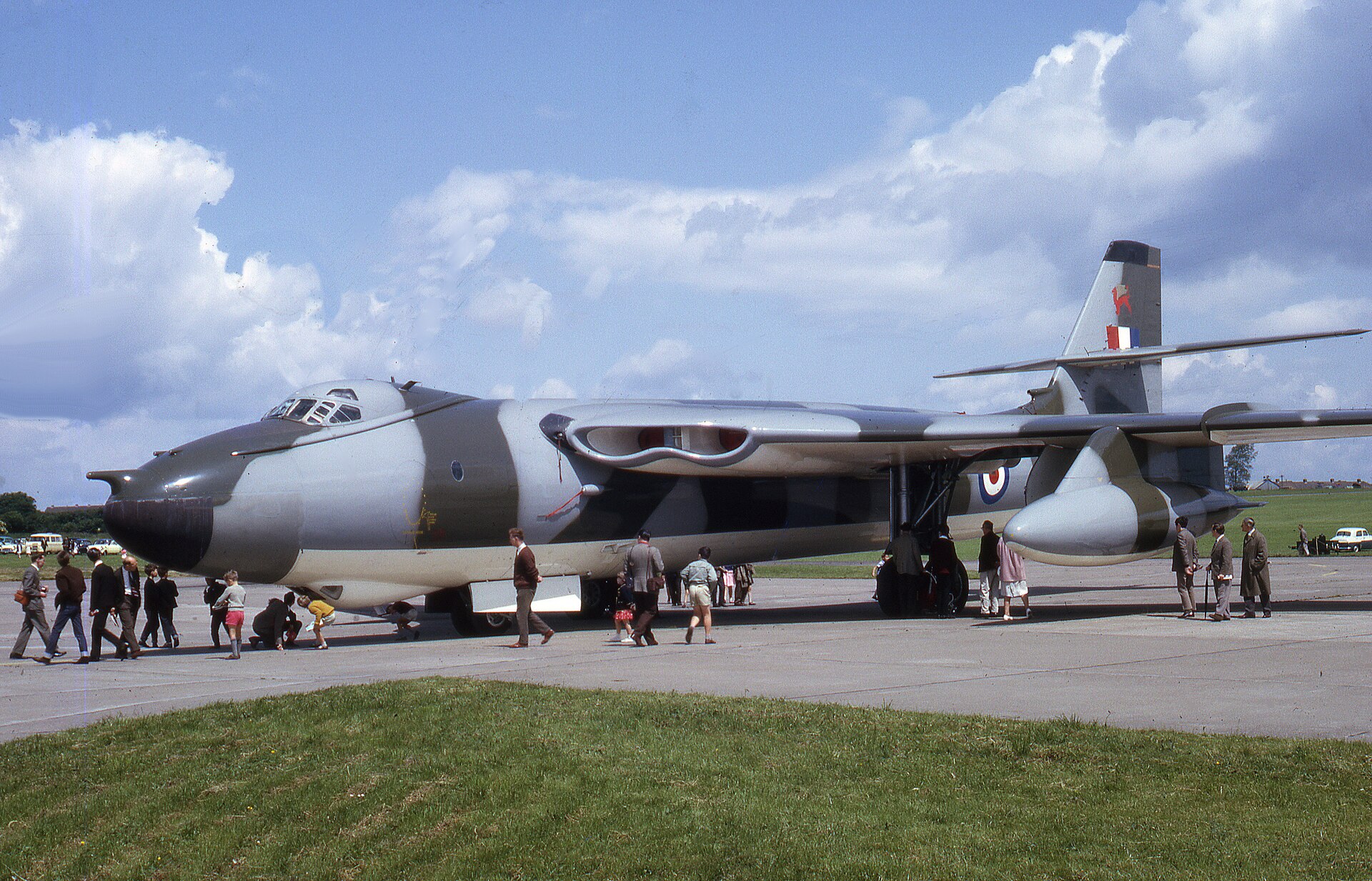
Roy Chadwick, the designer of the Avro Lancaster, began the work that led to the Vulcan and did not live to see it. He was killed in the crash of an Avro Tudor prototype at Woodford in August 1947. The design was carried forward by Stuart Davies and the Avro team, and the shape they arrived at was a huge, clean delta wing with four engines buried in the roots and almost nothing else.
The prototype, VX770, flew on 30 August 1952 from Woodford, flown by Roly Falk. Falk is central to Vulcan mythology, and one story about him is true and worth telling: at Farnborough in 1955 he rolled a production Vulcan B.1, XA890. A four-engined strategic bomber, rolled in front of the crowd. He was reportedly told not to do it again.
The delta was not chosen for the drama. It was chosen because a very thick, very large wing gives you enormous internal volume for fuel and a bomb bay, an excellent lift-to-drag ratio at high altitude, and a structure that is stiff and strong for its weight. What it also gave the Vulcan, entirely as a by-product, was a distinctive howl at certain power settings as air passes over the intakes, and a party trick of leaving vortices streaming from the wing in damp air.
B.1 and B.2
The Vulcan was built in two main marks. The B.1, of which 45 were produced, reached the RAF in 1956, with 83 Squadron becoming the first operational unit in 1957. The B.2, of which 89 were produced, was a substantially different aircraft: a larger wing of revised planform, more powerful Bristol Olympus engines, and the ability to carry the Blue Steel stand-off missile. With the two prototypes, that gives a total of 136 Vulcans built.
The B.2 was the aircraft that carried the deterrent through the 1960s and the one that took the force down to low level when the high-altitude plan collapsed.
The Handley Page Victor: the crescent wing
The Victor is the connoisseur’s V-bomber. It is also, by any measure, the strangest looking of the three.
Handley Page’s answer to B.35/46 was a crescent wing: a wing with three different sweep angles and three different thicknesses, sharply swept and thick at the root, less swept and thinner further out. The idea, worked out with the help of German aerodynamic research recovered after the war, was that every part of the wing should reach its critical Mach number at the same moment, giving a high cruising speed without a nasty surprise at the tip.
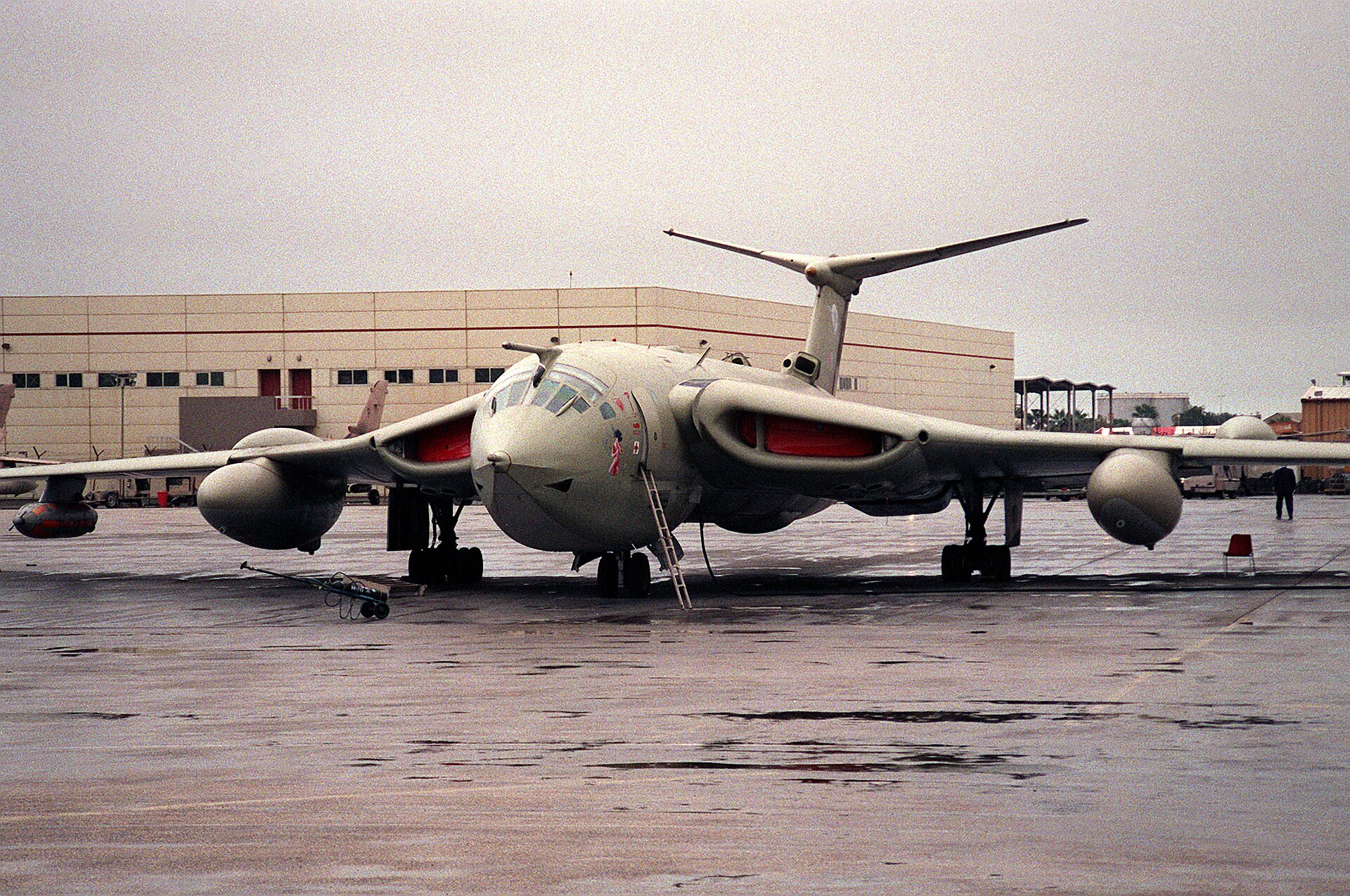
It worked. It also gave the aircraft an unmistakable profile, with a high T-tail, a drooping nose and a cockpit perched above a bulged fuselage in a way that made it look permanently slightly surprised.
The prototype, WB771, first flew on 24 December 1952. Handley Page built 86 Victors in total, including two prototypes: 50 of the B.1 and 34 of the B.2. The B.1 used Armstrong Siddeley Sapphire engines. The B.2 used the far more powerful Rolls-Royce Conway, an early turbofan, and could operate higher and heavier.
The fastest of the three, and the one nobody remembers
The Victor was fast, and in the early days it was quick enough to cause an argument. It carried the largest bomb bay of the three and it had one clear advantage over the Vulcan: it could lift more. What it did not have was the Vulcan’s public profile, and it never got it.
It also had the worst luck. The first prototype was lost in 1954 with the loss of its crew, and the type’s reputation suffered from a series of early problems. Handley Page itself, the last of the great independent British aircraft firms, refused to merge into the industry groupings of the 1960s and went into liquidation in 1970, which meant that for most of the Victor’s long career the company that built it no longer existed.
The three aircraft compared
Comparing V-bombers is harder than it looks, because each type changed substantially between marks. The figures below are representative of the main service versions and should be read as indicative rather than absolute. Published performance figures for these aircraft vary between sources, and some were classified for years.
| Vickers Valiant | Avro Vulcan | Handley Page Victor | |
|---|---|---|---|
| First flight | 18 May 1951 | 30 August 1952 | 24 December 1952 |
| Entered RAF service | 1955 (138 Squadron, RAF Gaydon) | 1956 (230 OCU; 83 Squadron 1957) | 1958 |
| Wing | Moderately swept, shoulder-mounted | Delta | Crescent, three sweep angles |
| Engines (main service marks) | Four Rolls-Royce Avon turbojets | Four Bristol Olympus turbojets (Olympus 301 in the later B.2) | Armstrong Siddeley Sapphire in the B.1, Rolls-Royce Conway in the B.2 |
| Total built | Around 107, including prototypes | 136, including two prototypes (45 B.1, 89 B.2) | 86, including two prototypes (50 B.1, 34 B.2) |
| Withdrawn | Grounded 26 January 1965 | RAF service ended 1984 | Tanker service ended 15 October 1993 |
| Combat | Suez, 1956 | Falklands, 1982 (Black Buck) | Tanker support: Falklands 1982, Gulf War 1991 |
| Service life | 10 years | 28 years | 35 years |
The weapons they carried
The V-force existed to deliver nuclear weapons, and the weapons changed a great deal over the fourteen years it held the deterrent.
Blue Danube
The first British operational nuclear weapon, and an enormous object: a free-fall fission bomb designed around the plutonium implosion device tested in Australia in 1952. It went to the Valiant squadrons first. It was cumbersome, it was slow to prepare, and the numbers actually available in the early years were smaller than the public assumed.
The thermonuclear weapons and Operation Grapple
Britain wanted a hydrogen bomb, and the test programme to get one was Operation Grapple, flown from Christmas Island in the Pacific by specially modified Valiants with anti-flash white finishes, cockpit blast curtains and bomb bay cameras.
On 15 May 1957 Valiant XD818, captained by Wing Commander Kenneth Hubbard, dropped the device codenamed Short Granite over Malden Island. It was announced as Britain’s first hydrogen bomb, and it made Britain, in the political sense, a thermonuclear power.
The technical truth is more complicated and it is worth stating plainly, because it is often glossed over. Short Granite was a two-stage device with a design yield of around a megaton, and it did not achieve it. The measured yield was in the region of 200 to 300 kilotons, most of it from fission rather than fusion. It was a partial proof of principle rather than the full result. The really successful megaton-class test came later that year with Grapple X in November 1957, which exceeded its predicted yield.
None of that diminishes what the Valiant crews did, and XD818 survives to this day because of it.
Blue Steel
By the early 1960s, flying a bomber directly over a Soviet target to drop a free-fall weapon was becoming a poor bet. The answer was a stand-off missile: something the bomber could launch from a distance and turn away from.
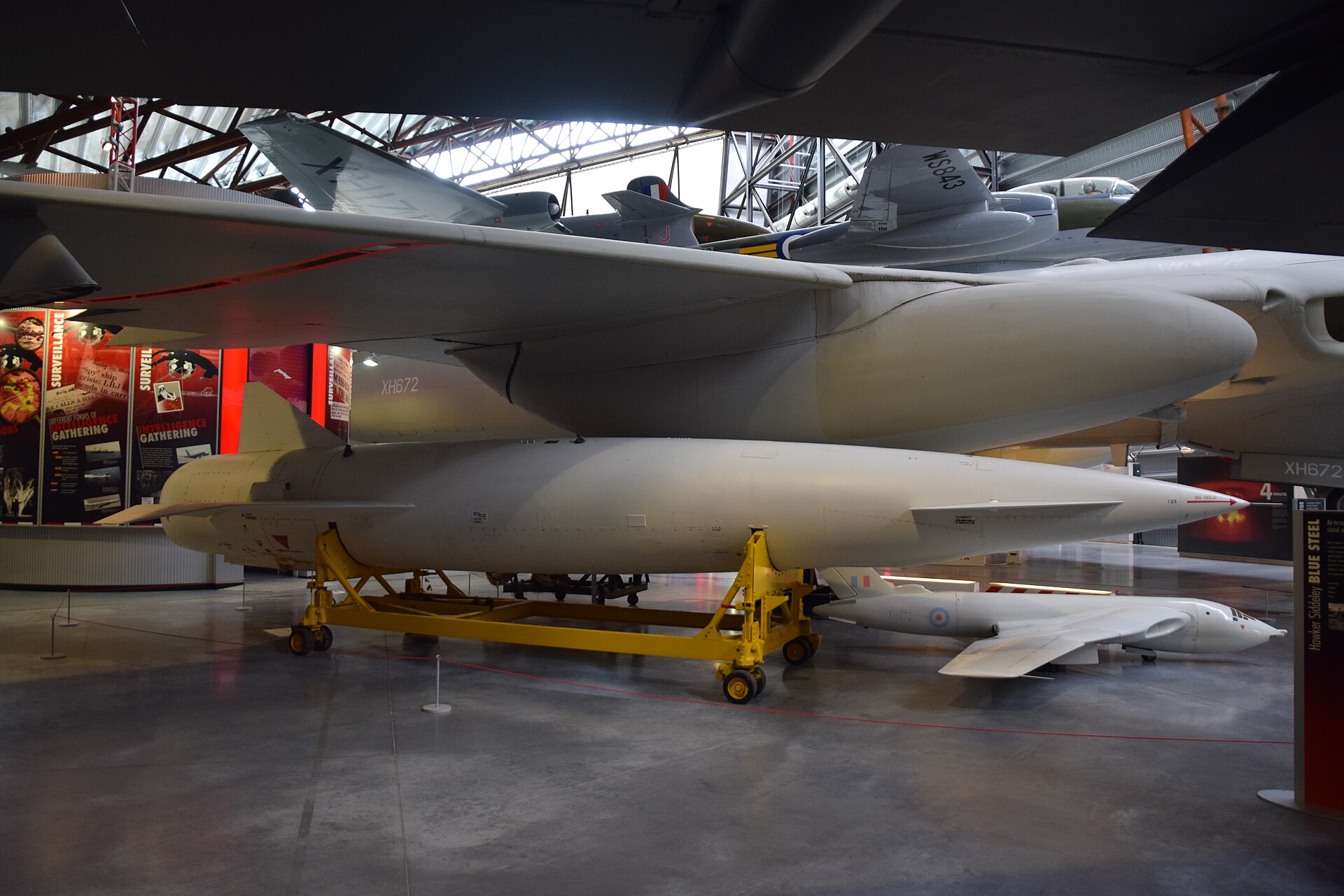
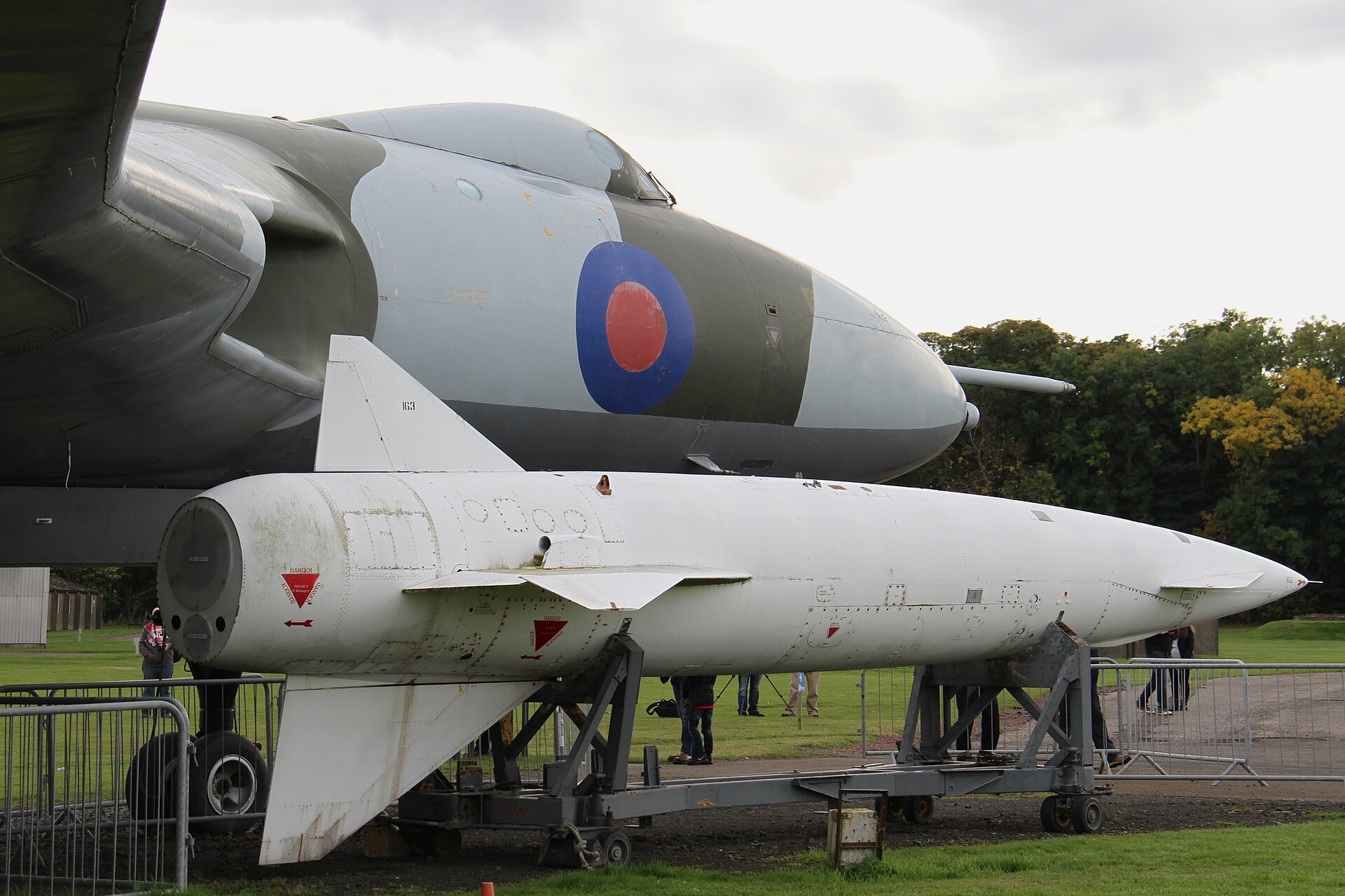
Blue Steel was that missile. Rocket-powered, carried semi-recessed under the Vulcan B.2 and the Victor B.2, it entered service in 1963. It gave the crew a chance of releasing their weapon without flying into the heart of the target’s defences.
Its life was short. Blue Steel was designed for high-level release, and the force went low. A low-level launch profile was developed, but it cut the missile’s range substantially, and by then the whole airborne deterrent was being wound up. Blue Steel was finally retired at the end of 1970, once the Royal Navy had taken the deterrent role.
WE.177
The weapon that saw the V-force out, and the one that carried on long after them. WE.177 was a family of much smaller, lighter free-fall weapons suited to low-level laydown delivery, and it armed the Vulcan force through its final years and then went on to equip other RAF and Royal Navy aircraft for decades.
Quick Reaction Alert, dispersal and the four-minute warning
The operational reality of the V-force is the part that tends to get lost behind the aeroplanes, and it is the part that would keep you awake.
QRA
Quick Reaction Alert meant that a proportion of the force sat, day and night, on a dedicated pan at the end of the runway, armed, fuelled, with the crew in a caravan or a nearby building and a target folder in the aircraft. The stated readiness was that they should be rolling within four minutes of the order.
Four minutes was not chosen for effect. It was roughly the warning time the early warning radars at Fylingdales and elsewhere could be expected to give of an incoming ballistic missile attack. The phrase “the four-minute warning” entered the language in Britain precisely because of this, and it means what it says: from detection to impact, four minutes, and the bombers had to be off the ground inside it.
The scramble
To make four minutes possible, the V-force developed the simultaneous engine start, using a bank of cartridge starters or a rapid-start system to light all four engines at once, and the mass scramble, in which aircraft rolled in pairs or in quick succession rather than one at a time. Anyone who has watched a Vulcan rapid start demonstration at Wellesbourne knows what that looks and sounds like, and it was designed under the assumption that the alternative was being destroyed on the ground.
Dispersal
Concentrating the entire deterrent on a handful of main bases made it an easy target. The answer was dispersal: a network of additional airfields around the country, each prepared with the concrete, the servicing and the security to take a small number of V-bombers at short notice. On an alert, aircraft would scatter from the main bases to the dispersal fields, in groups of two or four, so that no single strike could remove the force.
Dispersal exercises were flown regularly, and they were one of the few visible signs to the public that the deterrent existed at all. A Vulcan appearing at a civil airport for no obvious reason was, in the 1960s, a fairly ominous thing to see.
Going low: how a change in Soviet defences rewrote the plan
The entire V-bomber concept rested on one assumption: that a bomber at 50,000 feet was effectively untouchable. That assumption died publicly on 1 May 1960, when a Soviet surface-to-air missile brought down Gary Powers’s U-2 over Sverdlovsk at an altitude the Americans had believed was safe.
The message was not subtle. High-altitude Soviet SAM coverage was real, it worked, and every strategic bomber force in the West had to think again.
The British answer was to go low. Instead of cruising in the stratosphere, the V-force would come in underneath the radar, at a few hundred feet, using terrain to mask the aircraft until the last moment. The tactics changed, the training changed, the paint changed from anti-flash white to a disruptive camouflage on the upper surfaces, and the weapons changed to the laydown types that a low-flying aircraft can actually deliver and survive.
It also broke the Valiant. Low-level flying subjects an airframe to relentless gust loading, and the Valiant’s wing structure could not take it. The type that had been designed for the safe, easy, high-altitude job was destroyed by the change of job, and it was gone by January 1965.
The Vulcan and the Victor were tougher, and they adapted. But the change is one of the great turning points in British military aviation: an entire force, built at enormous expense around one idea, having to rebuild its whole reason for existing around the opposite idea, within a few years of entering service.
Skybolt, Nassau and the end of the airborne deterrent
Blue Steel bought a few years. The long-term British plan was Skybolt, an American air-launched ballistic missile with a range of around a thousand miles, which would have let a Vulcan launch from well outside Soviet airspace altogether. Britain committed to it, cancelled its own competing ballistic missile programme, Blue Streak, and waited.
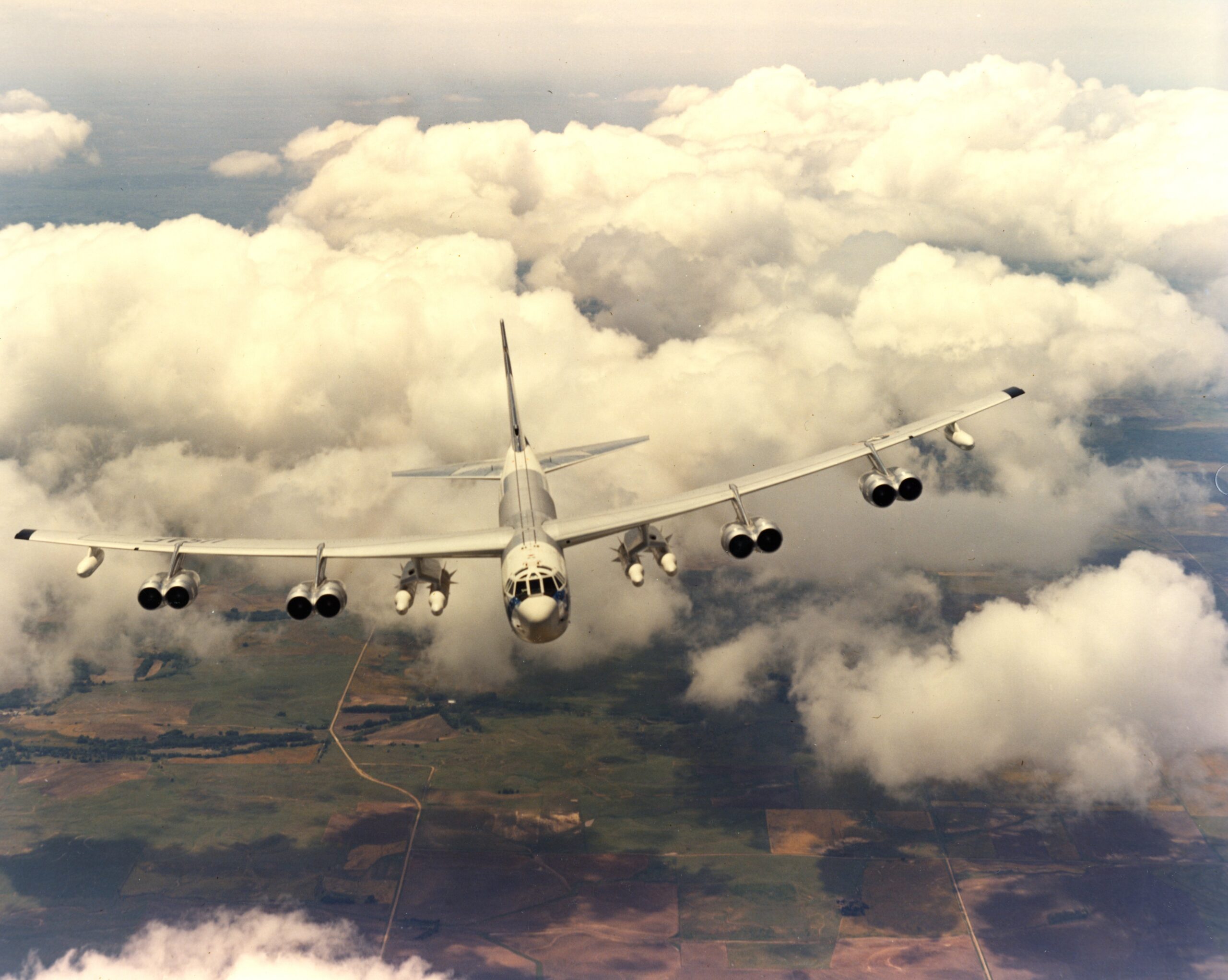
In December 1962 the Americans cancelled Skybolt. It was a decision taken on American grounds, for American reasons, and it left the British deterrent with no credible future weapon.
The political fallout was immediate. Harold Macmillan met John F. Kennedy at Nassau, and what came out of it was the Nassau Agreement: the United States would sell Britain the Polaris submarine-launched ballistic missile instead. Britain would build the submarines and the warheads.
That decision ended the V-force as a strategic deterrent, though it took years to work through. The Royal Navy took over the nuclear deterrent duty on 30 June 1969, when the third Polaris boat became operational, and the process of standing the Vulcan squadrons down from the nuclear alert ran through the second half of that year.
After fourteen years, the deterrent went under the sea, and it has stayed there ever since.
What the V-bombers did next
Losing the strategic role did not mean losing the aircraft. The Vulcan force turned to conventional bombing and, in a role that suited a big aircraft with a big radar, maritime radar reconnaissance. The Victor force went the other way and turned into tankers, which is where the story gets really interesting.
Suez, 1956: the Valiant goes to war
The only time a V-bomber dropped bombs in anger before 1982 was during the Suez crisis, and it was the Valiant that did it.
In October and November 1956, during the Anglo-French operation against Egypt, Valiants from 138, 148, 207 and 214 Squadrons operated out of RAF Luqa in Malta and bombed targets inside Egypt: principally Egyptian military airfields, along with communications and transport targets.
It did not go especially well. The Valiants had been built to deliver a single enormous weapon from very high altitude with a radar bombing system optimised for that job, and they were now being asked to put conventional bombs onto runways. The Egyptians did not seriously oppose the raids and no Valiants were lost, but the accuracy was poor. Of a considerable tonnage of bombs dropped across the campaign, only a minority of the airfields attacked were seriously damaged.
The lesson was one every air force has had to learn at some point: an aircraft optimised for one task does not automatically do a different task well. It would be twenty-six years before an RAF V-bomber dropped bombs in anger again, and when it did, the same lesson was waiting.
Black Buck, 1982: the Vulcan’s long war
By 1982 the Vulcan was months from retirement. Squadrons were disbanding. And then Argentina invaded the Falkland Islands, and somebody in the Ministry of Defence worked out that the only British aircraft capable of reaching Port Stanley with a bomb load was the aeroplane they were about to throw away.
The problem
The nearest usable British base was Wideawake airfield on Ascension Island, roughly 3,900 miles from the Falklands. A Vulcan could not remotely make that round trip on its own fuel. It needed air-to-air refuelling, and its refuelling probes had been out of use for years and had to be found, in some cases reportedly recovered from museums and scrapyards, and refitted.
It also needed tankers, and the tankers themselves needed tankers.
Black Buck 1
The first mission launched from Ascension late on 30 April 1982. Two Vulcans went, a primary and a reserve. The primary, XM598, suffered a cabin pressurisation failure and turned back, so the reserve, XM607, captained by Flight Lieutenant Martin Withers, took the mission on.
Behind and around it flew a fleet of Victor K.2 tankers. Eleven tankers and fifteen separate refuelling contacts were needed to get one Vulcan to Port Stanley and back, with Victors refuelling other Victors in a cascading chain across the South Atlantic, each one giving away fuel and turning for home.
In the early hours of 1 May 1982, XM607 attacked Port Stanley airfield with twenty-one 1,000 lb bombs laid diagonally across the runway. One of them hit the runway, close to the centre. The round trip took about sixteen hours and covered roughly 6,600 nautical miles, and at the time it was the longest-range bombing raid ever flown.
Did it work
This is where honesty is required, because Black Buck is one of the most argued-over operations in RAF history.
The strictly military result was one crater in a runway, which the Argentines repaired well enough to keep operating light transport aircraft from it. Black Buck did not close Port Stanley airfield to the Hercules flights that sustained the garrison.
The wider claims made for it are that it demonstrated the British could reach Argentine territory itself, and that this contributed to Argentina keeping its Mirage fighters back for home defence rather than committing them over the islands. That argument is made seriously by people who were there and it is disputed just as seriously by others. It is not a settled question and it should not be presented as one.
What is not in dispute is the flying. Seven Black Buck missions were planned and five were flown to completion, including anti-radar missions with Shrike missiles, and one of those, flown by XM597, ended with a broken refuelling probe and a diversion to Rio de Janeiro, where the aircraft and crew were interned for a week. Whatever you think of the strategic value, the airmanship involved in flying a 1950s bomber that distance, at night, over open ocean, with fifteen refuelling contacts, is not really open to argument.
The Victor outlives them all
The Victor’s second career is the quiet triumph of the V-force story.
Once the strategic role went to Polaris, the Victor B.2s were converted into K.2 tankers: three-point tankers with a huge fuel capacity, a hose drum unit in the bomb bay and pods under each wing. Twenty-four K.2s were converted, and they became the backbone of RAF air-to-air refuelling.
Everything the RAF did at long range for the next two decades depended on them. Black Buck was a Victor operation with a Vulcan attached to the end of it. In the Falklands the Victors also flew long-range maritime radar reconnaissance sorties in the South Atlantic before the retaking of South Georgia, using their bombing radar to search open ocean.
Nine years later they were still at it. Victor K.2s deployed to the Gulf for the 1991 war and refuelled coalition strike aircraft over the desert, which meant a bomber designed in the late 1940s to drop a fission bomb on Moscow finished its operational career supporting precision strikes in Iraq.
The last Victor was retired on 15 October 1993, and with it went the last of the V-bombers.
The people behind the V-force
The aeroplanes are easy to name. The people are not, and a few of them deserve to be.
Roy Chadwick
Avro’s chief designer, the man behind the Lancaster, and the originator of the thinking that produced the Vulcan delta. He was killed in the crash of an Avro Tudor prototype at Woodford on 23 August 1947, before the Vulcan existed as anything more than an idea. The aircraft was finished by Stuart Davies and the Avro team.
Roly Falk
Avro’s chief test pilot, and the man who flew the Vulcan prototype on its first flight on 30 August 1952. He flew the aircraft with a fighter pilot’s confidence, most famously rolling it at the 1955 Farnborough show, and he is a large part of the reason the Vulcan acquired the reputation of a bomber that behaved like something much smaller.
Mutt Summers and Jock Bryce
Summers made the first flight of the Valiant prototype on 18 May 1951, with Jock Bryce as co-pilot. Summers had made the first flight of the Spitfire fifteen years earlier. Bryce went on to become Vickers’s chief test pilot and to fly the Valiant, the Vanguard and the VC10.
Kenneth Hubbard
Commanded 49 Squadron and captained Valiant XD818 on the Grapple drop of 15 May 1957, the first British air-dropped thermonuclear test. The crews on those Pacific trials flew towards a weapon they had just released and turned away from a flash they had been briefed to expect but could not really be prepared for.
Martin Withers
Then a Flight Lieutenant, captain of Vulcan XM607 on Black Buck 1 on the night of 30 April to 1 May 1982. He was awarded the Distinguished Flying Cross. Withers later flew XH558 on the display circuit in its second life as a civilian-operated aircraft, which is a rather neat closing of the loop.
The crews nobody names
A V-bomber carried five: two pilots on ejection seats up top, and three rear crew, the navigator plotter, the navigator radar and the air electronics officer, sitting facing backwards on a lower deck with no ejection seats at all. If the aircraft had to be abandoned, the two pilots could go out through the roof and the three men behind them had to climb down and out through the entrance door.
That arrangement was known about, argued about and never fixed. It is the single most sobering fact about the V-force, and it applied on every QRA shift and every low-level sortie for decades.
Where to see a V-bomber today
None of the three flies. XH558’s return to the air between 2008 and 2015 was the last time any V-bomber flew, and it ended when the technical support that made it possible was withdrawn. What is left is a small number of very well-kept aircraft, some of which still run their engines and taxi. Locations change, so check before you travel.
Vickers Valiant
There is exactly one complete Valiant left in the world. XD818, the aircraft that dropped Short Granite at Grapple in May 1957, is on display at the RAF Museum at Cosford in Shropshire, in its anti-flash white finish. The rest of the fleet was scrapped after the 1965 grounding, quickly and almost completely.
Avro Vulcan
Several survive, and two are worth planning a trip around.
XH558 is at Doncaster Sheffield Airport, where the Vulcan to the Sky Trust operates it on the ground. It no longer flies, but it does run its engines, and the Trust has been running public engine ground runs and airside tours through 2026. The airport’s own future has been in question, and the Trust has been working towards a permanent home in the Doncaster area, so this is one to check before setting off.
XM655 is at Wellesbourne Mountford in Warwickshire, maintained in taxiable condition by the 655 Maintenance and Preservation Society. It is the youngest surviving Vulcan and it holds engine ground runs and taxi events, including a rapid start demonstration, which is the closest anybody now gets to seeing what a QRA scramble looked like.
XM597, one of the Black Buck aircraft, is at the National Museum of Flight at East Fortune in East Lothian. Other Vulcans are preserved at museums around the country and abroad.
Handley Page Victor
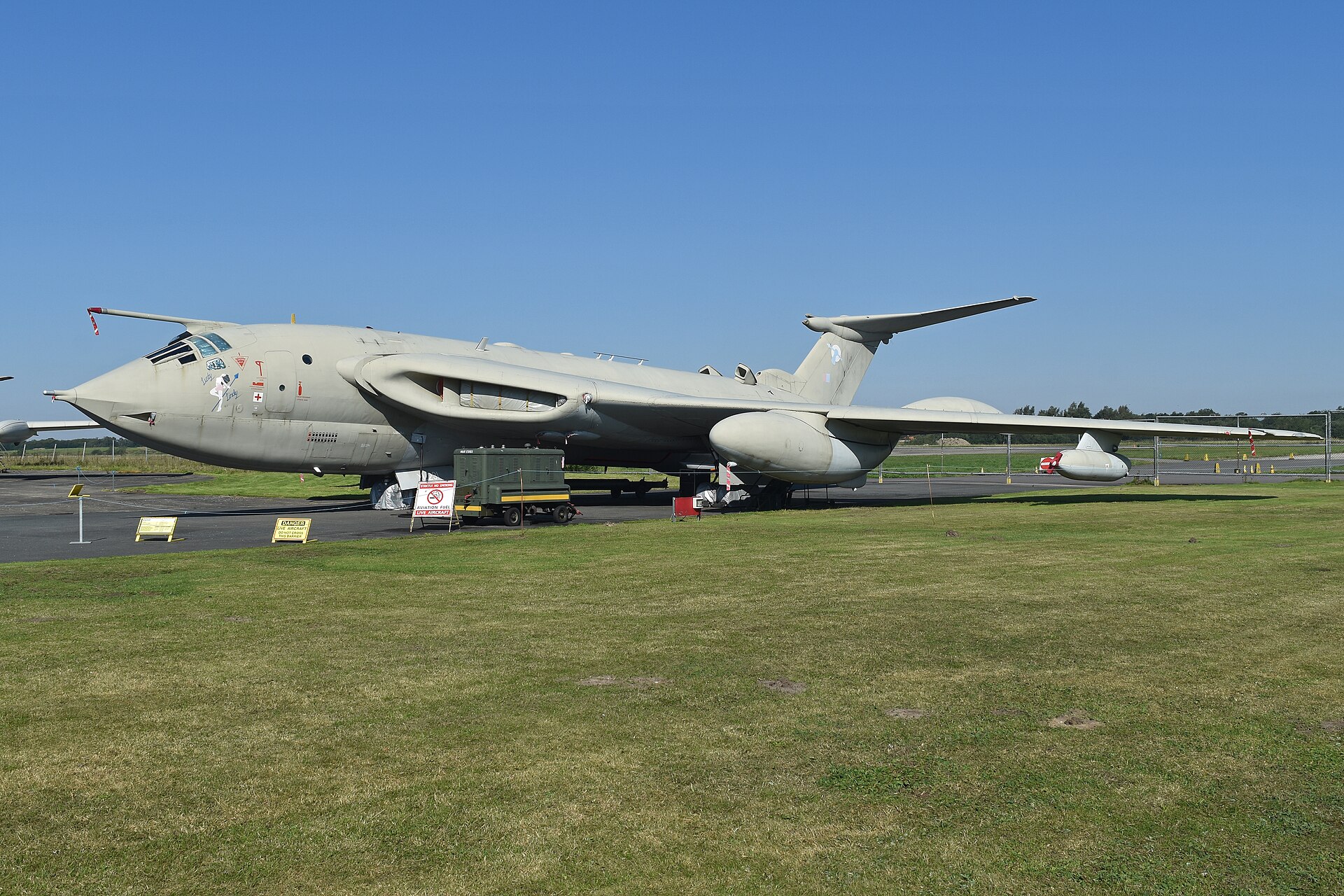
XL231, Lusty Lindy, is at the Yorkshire Air Museum at Elvington and is kept in running condition. XM715 is at Bruntingthorpe in Leicestershire, where it has historically been one of the very few Victors capable of fast taxi runs, although the airfield’s change of use to the motor trade has curtailed what can be done there and the old Cold War Jets open days are not what they were. Other Victors are on static display at museums including the RAF Museum at Cosford.
Photographing the V-bombers today
Since none of them fly, photographing a V-bomber is now a ground-based problem, and it is a more interesting one than it sounds.
Scale is the whole challenge
These are very large aircraft with very clean lines, and the standard museum three-quarter view flattens them into a shape with no sense of size. Get low. Put the camera close to the ground under the nose or at the wingtip and let the wing fill the top of the frame. A Vulcan’s delta from underneath, shot wide and close, gives you the scale that a polite record shot never will.
Shoot the details
The crescent wing kink on the Victor, the intake lips on a Vulcan, the refuelling probe, the bomb bay doors, the cockpit windows with their anti-flash shielding. Detail work is where a preserved aircraft rewards you, and it works in the flat indoor light of a museum hangar where a full aircraft shot does not.
Engine runs and taxi events
This is the real prize. An XM655 rapid start at Wellesbourne, or an XH558 ground run at Doncaster, gives you heat haze, smoke, noise and, if you are lucky, the vortices and the howl. These events are ticketed, they sell out, and they are effectively small airshows with one aircraft. Treat them exactly as you would a show day: get there early, work out where the sun will be, and read our guide to planning an airshow photography day before you go.
For the shooting itself, the techniques are the ones you would use on any large, slow-moving subject at a display: read the airshow photography guide, and if the aircraft is moving under power, the panning and tracking advice in our guide to photographing fast jets transfers directly, just at lower shutter speeds.
The historical context helps
The V-force did not exist in isolation. The interceptors that would have defended Britain while the bombers left are covered in our profile of the English Electric Lightning, and the aircraft that eventually took over the low-level strike role from the Vulcan is the subject of our Panavia Tornado history. For the Vulcan on its own, in much more detail, see our full Avro Vulcan history.
You can see the results of a great deal of this kind of photography in the Piemags aviation galleries, and if you want to use any of it, the terms are set out on our licensing page.
Legacy
The V-force is easy to romanticise and it deserves a clearer look than that.
Judged against the job it was built for, it was never used, which is precisely the outcome everybody wanted. Judged as an engineering programme, it was extraordinary: a country still recovering from a war built three world-class strategic bombers at once, two of them radical, and got all three into service within four years of each other.
Judged as strategy, it was expensive and it was overtaken. The high-altitude concept was obsolete within a few years of the aircraft entering service. Blue Streak was cancelled. Skybolt was cancelled by somebody else. Blue Steel worked but was overtaken. The deterrent went to sea after fourteen years, and the RAF has never held it since.
What survived is more interesting than any of that. The Victor became the tanker that made every long-range RAF operation for twenty years possible, including the one that made the Vulcan famous. The Vulcan became a national object, in a way very few military aircraft manage, and the sound of it at an airshow was enough to stop conversation across an entire crowd line. The Valiant, which did the most historically consequential flying of the three, is remembered by almost nobody outside the subject.
And the underlying idea, that Britain would maintain an independent nuclear deterrent, is still with us. It just lives under the Atlantic now instead of on a concrete pan at Waddington, four minutes from rolling.
Photographs of all three V-bombers together are rarer than most picture desks expect, and captions confusing the Victor with the Valiant are common. Researchers working on Cold War subjects may find our notes on sourcing and verifying aviation photographs useful.
Frequently asked questions
What were the three V-bombers?
The V-bombers were the Vickers Valiant, the Avro Vulcan and the Handley Page Victor. All three were four-engined British jet bombers built to Air Ministry requirements issued after the Second World War, and together they carried Britain’s airborne nuclear deterrent from 1955 until the Royal Navy’s Polaris submarines took over the role in 1969. They are called V-bombers simply because all three names begin with V.
Why did Britain build three V-bombers instead of one?
Insurance. The Vulcan’s delta wing and the Victor’s crescent wing were both technically radical and both carried real risk of failure, and if the chosen design had failed Britain would have had no way of delivering its nuclear weapon. The Valiant was funded to a slightly relaxed specification as a conservative design that could enter service years earlier, and a fourth aircraft, the Short Sperrin, was built as a further fallback but never ordered into production.
How many V-bombers were built?
Around 107 Valiants, 136 Vulcans including two prototypes, and 86 Victors including two prototypes. That gives a little over 320 aircraft across the three types. Not all were in service at once, and the front-line strength of the V-force at its height in the early 1960s was well over a hundred aircraft.
Which V-bomber served the longest?
The Handley Page Victor, by a wide margin. It entered RAF service in 1958 and the last Victor K.2 tankers were not retired until 15 October 1993, a career of thirty-five years. The Vulcan left RAF service in 1984 after twenty-eight years, and the Valiant was permanently grounded on 26 January 1965 after only ten.
Why was the Vickers Valiant retired so early?
Metal fatigue. The Valiant was designed for high-altitude flight, and when the V-force switched to low-level tactics in the early 1960s the constant turbulence loading at low level caused fatigue cracking in the wing spars. Cracks were found across the fleet in 1964 and one spar failed in flight in August of that year. Repairing the fleet was judged not to be worth the cost, and the whole force was grounded on 26 January 1965.
Did any V-bomber ever drop a nuclear weapon in anger?
No. No V-bomber ever released a nuclear weapon in combat. The only nuclear devices they dropped were test weapons, most notably during Operation Grapple in the Pacific, where modified Valiants dropped Britain’s first air-delivered thermonuclear devices in 1957 and 1958.
Was Operation Black Buck actually successful?
It depends what you count. Black Buck 1 put one 1,000 lb bomb into the runway at Port Stanley on 1 May 1982, and the Argentines repaired it well enough to keep flying transport aircraft in. Supporters argue the raids demonstrated that British bombers could reach Argentine territory and so influenced Argentine air defence decisions, but that claim is really disputed by serious historians and should not be stated as fact. The airmanship, a sixteen-hour round trip of roughly 6,600 nautical miles requiring eleven tankers and fifteen refuelling contacts, is not disputed by anybody.
Where can I see a Vickers Valiant?
There is only one complete Valiant left in the world. XD818, the aircraft that dropped Britain’s first air-launched thermonuclear device during Operation Grapple in May 1957, is on display at the RAF Museum at Cosford in Shropshire. The rest of the fleet was scrapped soon after the 1965 grounding.
Do any V-bombers still fly?
No. The last V-bomber to fly was Avro Vulcan XH558, which was returned to the air as a civilian-operated aircraft and flew its final display season in 2015. Several aircraft are kept in ground-running or taxiable condition, including Vulcan XM655 at Wellesbourne Mountford and Victor XL231 at the Yorkshire Air Museum, and XH558 itself still runs its engines at Doncaster.
What weapons did the V-bombers carry?
Initially the free-fall Blue Danube fission bomb, then thermonuclear free-fall weapons, then from 1963 the rocket-powered Blue Steel stand-off missile carried by the Vulcan B.2 and Victor B.2, and finally the smaller WE.177 laydown weapons suited to low-level delivery. The planned Skybolt air-launched ballistic missile was cancelled by the United States in December 1962 and never entered service.
For the low-level side of the British Cold War strike force, see the story of the Blackburn Buccaneer, the attack aircraft that served into the 1990s.
