On 18 December 1975 the Conseil de défense killed the aeroplane the French air force had spent three and a half years asking for. The ACF was a twin-engined, strongly swept, Mach 2.5 machine that some compared to the American F-15, only bigger, and it was reckoned to cost more than twice what a Mirage F1 cost. One prototype was on the shop floor. The contract was cancelled and that prototype was never finished.
At the same meeting, the same men launched its replacement. A bracket in the programme record describes it: delta, wing area 41 square metres, the M53 engine in its 02 or 5 mark. Production was to begin at the start of 1980 and the air force was to get at least 150 of them. Shortly before the meeting Marcel Dassault had gone to see Giscard d’Estaing and offered, by his own account, to develop that single-engined fighter at his own expense if the state carried on with the big twin. He was told it would be the other way round. Walking out, he said that all the same, it was not the same thing.
The thing he walked out on flew in March 1978 and is still flying now, over the Aegean, in Greek markings, forty-two years after the first squadron took it on charge at Dijon.
What is on this page
- The aeroplane that was cancelled to pay for it
- Why the delta wing came back
- An engine looking for an airframe
- The first flight, and the piece that came off
- Seven months in the shop at Cazaux
- Four prototypes, three production aircraft and a two-seater
- Dijon, 2 July 1984
- What Marcel Dassault saw in 1982
- The one built to carry a nuclear missile
- The one built to carry bombs
- The 2000-5, and the radar that finally arrived
- Who bought it
- Greece buys forty
- Tanagra, 331 and 332
- What the Gulf War sortie tables show
- Ebro 33
- Greece buys fifteen more and rebuilds ten
- What the Indian record actually says about Kargil
- Libya, the Sahel, Iraq and Afghanistan
- The Aegean, 8 October 1996
- The line closes
- Coming out of service
- Six to Ukraine
- What is left
- Frequently asked questions
- Sources and further reading
Dassault Mirage 2000: key facts
- Programme launched: 18 December 1975, at the Conseil de défense.
- First flight: 10 March 1978, at Istres, flown by Jean Coureau.
- Configuration: tailless delta, one engine, fully electric flight controls.
- Engine: SNECMA M53, in three marks across the programme.
- Development aircraft: four prototypes and three production aircraft, plus a two-seat prototype.
- Into French service: 2 July 1984, with EC 01/002 Cigognes at Dijon.
- Built: 600 in all, according to Dassault, half of them exported.
- Export customers: eight countries, on Dassault’s own count.
- Greek order: 40 aircraft, ordered 1985, first landing at Tanagra 27 April 1988.
- Greek squadrons: 331 and 332, both at 114 Combat Wing, Tanagra.
- Last new-build aircraft: delivered to Greece in 2007.
- Prototype 01: Musée de l’Air et de l’Espace, Le Bourget, since 28 June 1988.
The aeroplane that was cancelled to pay for it
France came at the Mirage 2000 backwards. Through the late 1960s Dassault had been building swing-wing prototypes, the Mirage G4 and G8, and on 8 May 1971 the G8 number 01 flew. Number 02 followed on 13 July 1972. Work on the first was stopped in June 1973 and on the second in September 1974, and by then the air staff had moved on to something else.
That something else was the ACF, avion de combat futur, sometimes called the Super Mirage. Its draft programme sheet went out on 1 June 1972 and asked for a single-seat aircraft with two M53 engines to do air defence, air cover, attack and reconnaissance. Out of the drawings came a heavy twin with fixed, strongly swept wings, long range and a top speed of Mach 2.5. COMAERO, the official-lineage history of French aeronautics written by the men who ran these programmes, records that some compared it to the F-15, only bigger, and that it was expected to cost more than twice the Mirage F1 that had just re-equipped the first two squadrons. All this was being costed as the first oil shock arrived.
For nearly two years the Centre de prospective et d’évaluation had been saying that the budgets anybody could foresee would not stretch to 450 twin-M53 aircraft in the front line. Plenty of other bodies agreed, and admitting it would have made the ACF’s cancellation certain, so nobody did. On 2 July 1975 the minister stopped work on ACF prototype 02 and slowed the programme. Over that summer the staffs went through alternative calendars and replacement programmes, one of which was listed as F1 M53, delta aircraft, single M53.
Marcel Dassault had meanwhile been paying for studies of a lighter, cheaper single-engined fighter out of his own pocket. His stated reason was the export market, for which he thought the ACF far too big. Fifteen hundred single-engined Mirages had already been sold abroad.
Both things came to a head on 18 December 1975. The ACF was stopped, the prototype still on the shop floor was abandoned and the contract torn up. In the same session the Mirage 2000 was launched. One sentence of the decision text says why: besides better export chances, the choice of a single-engined aircraft was dictated in particular by the possibility of having a greater number of them.
The Mirage 2000 was launched at the meeting that cancelled the ACF, on 18 December 1975, and the decision text gives the reason as numbers: besides better export chances, one engine meant the air force could have more aeroplanes. At least 150 was the figure written down.
Why the delta wing came back
Dassault had been building tailless deltas since the middle 1950s, the Mirage III first flying on 17 November 1956, and by the early 1970s the French air force had had enough of them. A tailless delta lands fast, floats, needs a long runway and bleeds energy hard in a turn.
When the air staff wrote the ACF sheet in June 1972 they refused to look at a delta at all. The refusal and the reason come down together in the official programme history: the air force did not want to meet again the drawbacks of the Mirage III and the Mirage IV, which electric flight controls did not yet allow it to avoid. Whoever compiled that passage put a cross-reference in brackets straight afterwards, pointing at the Mirage 2000.
Three and a half years later the same air force ordered a delta. What had changed was the flight control system. Studies of fully electric flight controls, with the safety architecture that goes with them, were first launched in 1975 with the Mirage 2000 in view. After the ACF stopped, what the state actually bought was written down as the single M53 delta-winged aircraft with electric flight controls.
Prototype 01 flew in 1978 with a mechanical back-up linkage still fitted. In 1979 that linkage came out and was replaced by an electrical last resort, and from then on nothing connected the stick to the control surfaces except wire. Stick and rudder pedals stayed where a pilot expected them. Four analogue computers ran each axis, checking one another continuously, with that final electrical back-up behind them. Digital flight control computers did not get launched in France until 1983, for the aircraft that became the Rafale.
What those computers carried was not only the pilot’s commands. Its equipment volume describes them as transmitting also all the orders for improving static and dynamic stability and for aerodynamic and structural protection, across the whole flight envelope and in particular in the transonic range. That wording stops short of the claim usually made for the aeroplane, which is that it was flown with a negative static margin, deliberately unstable in pitch. No source consulted for this article says so.
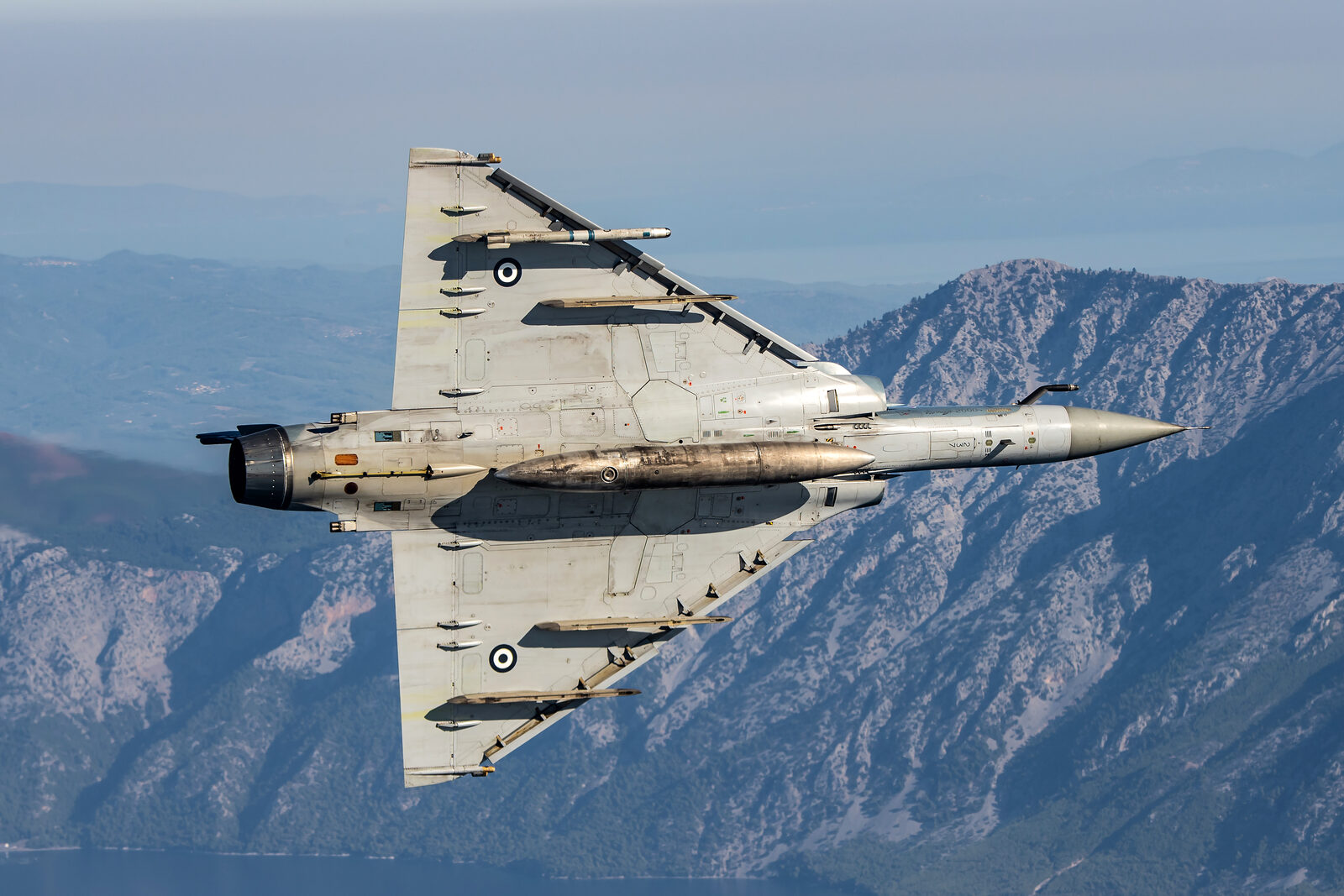
At the Musée de l’Air et de l’Espace, which has prototype 01 in the Hall de la Cocarde, the result is put in one line: the delta wing fitted with slats, together with the electric controls, gave a speed range from 185 km/h to Mach 2.2.
An engine looking for an airframe
SNECMA had begun the M53 at the end of 1968 for two reasons that both went away. One was to give the Mirage F1 something better than the Atar 9K50. Another was RAGEL, a twin-engined swing-wing long-range reconnaissance, attack and electronic warfare aircraft, which was abandoned. Then the ACF was abandoned as well, and the engine was left without an aeroplane to go in.
It had one near miss before the Mirage 2000. In 1973 Belgium, Denmark, the Netherlands and Norway went shopping for an F-104 replacement, and the French government offered a Mirage F1 with an M53 in it. That prototype, the F1 E for Europe, flew on 22 December 1974 against the General Dynamics YF-16 and the McDonnell Douglas YF-17 in what the papers were calling the contract of the century. On 14 November 1974 the French defence minister promised the four countries that France would buy fifty F1 M53s immediately. That promise met disbelief, and the air force backed it all the weaker because the ACF was itself under threat. At the end of 1974 the United States announced an initial order for 650 F-16s, the four countries chose the F-16 during 1975, and the F1 M53 was dropped. France bought the prototype back and used it as a flying testbed for the engine.
Industrialisation of the M53 was launched on 26 March 1976. Three marks went through the programme, one on the prototypes and two on production aircraft, and the thrust figures come out differently depending on whose paper you are holding, because the sources use three different units and do not convert between them.
| Mark | Where it was used | Thrust with afterburner | Whose figure |
|---|---|---|---|
| M53-2 | Prototypes | 7,500 daN | COMAERO |
| M53-2 | Prototype 01 as displayed | 8.5 t (5.6 t dry) | Musée de l’Air et de l’Espace |
| M53-5 | Production aircraft | 9,000 daN | COMAERO |
| M53-5 | Production aircraft | 9,000 kgp (5,540 kgp dry) | Safran |
| M53-P2 | From airframe C38 onwards | 9,700 daN | COMAERO |
| M53-P2 | In service | 9.5 t | Safran |
| M53-P2 | Mirage 2000-5F data sheet | 10 t | Armée de l’Air et de l’Espace |
| M53-P2 | Mirage 2000D data sheet | 9.7 t | Armée de l’Air et de l’Espace |
A decanewton and a kilogramme-force are within two per cent of each other, so the two 9,000 figures for the M53-5 are the same thrust rounded in different units. The M53-2 rows are ten per cent apart and stay that way. The M53-P2 first flew on prototype 01 on 1 July 1983 and was adopted for production aircraft from airframe C38.
Safran was still supporting the engine in July 2026, with 2.5 million cumulative flying hours behind it and eight customers on the books.
The first flight, and the piece that came off
Jean Coureau took Mirage 2000-01 off from Istres on 10 March 1978 and flew it for an hour and five minutes, up to 40,000 feet and Mach 1.3. Somewhere in that envelope part of the trailing edge of the left inner elevon came off. That piece was a composite one and the loss was put down to a manufacturing defect in that particular part rather than anything about the design.
Coureau was forty-nine when he flew it, and it was the last aircraft programme he worked on. He had joined Dassault in 1960 and taken the Mirage III C up for the first time that year, then the Mirage III E and the Mirage III R in 1961. He became chief pilot at Avions Marcel Dassault in 1967 and retired in 1992 with 6,000 hours.
Safran, which built the engine, records the same flight in metric units and without the pilot’s name: Mach 1.3, over 1,300 km/h, 12,200 metres, one hour five.
Prototype 02 followed on 18 September 1978, flown by Guy Mitaux-Maurouard, and did the first air-to-air refuelling trials. Prototype 03 went on 26 April 1979 and was given over to weapons, above all getting the Super 530 and the Magic to work with the aircraft. Prototype 04 came in 1980, on 12 April according to one chapter of the official programme history and 12 May according to another.
Seven months in the shop at Cazaux
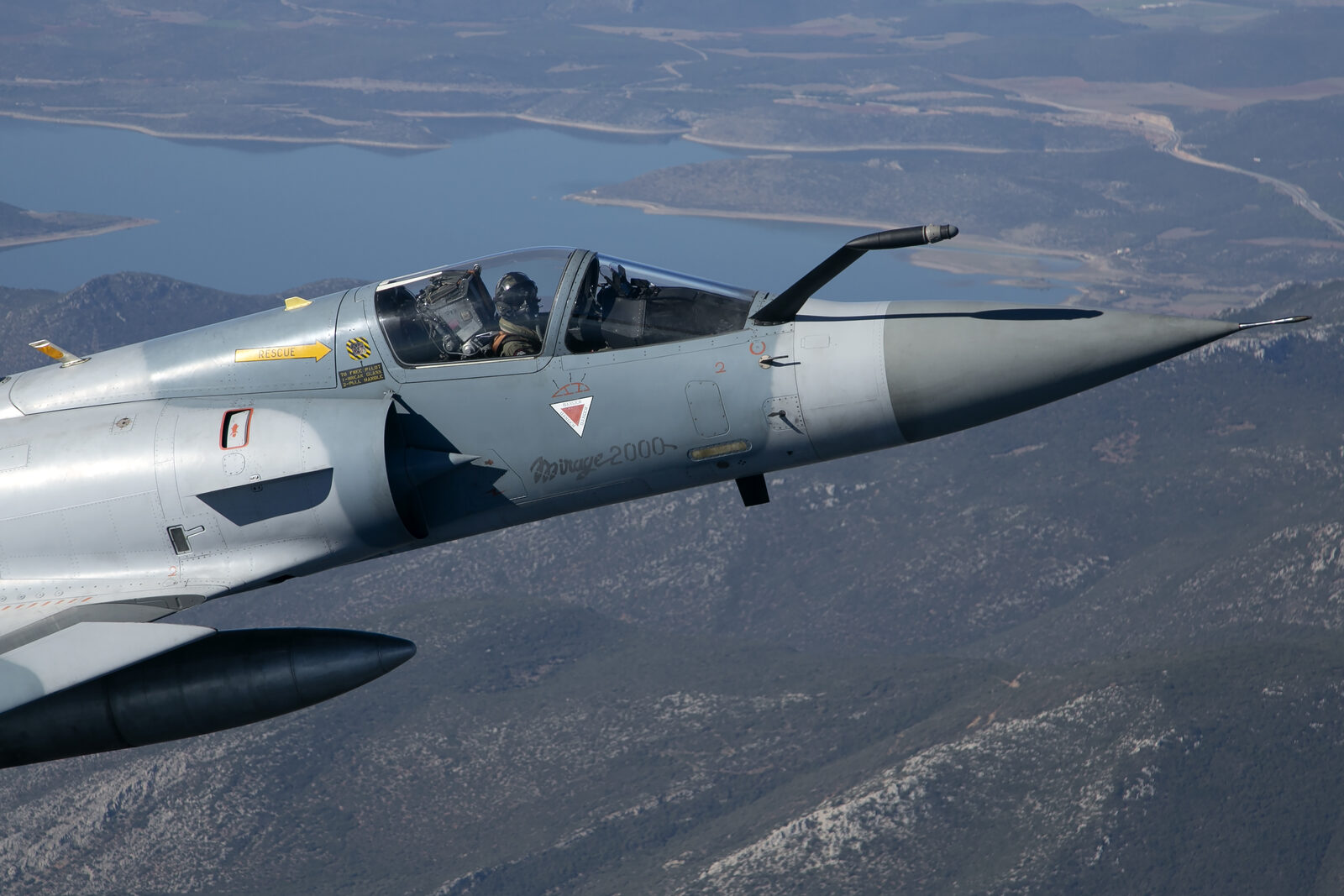
Supersonic performance in the first test phase came out appreciably below what had been predicted. From October 1978 to April 1979 the aeroplane sat in the shop at Cazaux having drag taken out of it. Fuselage and air intakes were altered and a new fin designed, lower and wider than the first one. Prototype 01 flew again on 2 May 1979.
Seven months out of the flight test programme cost the programme seven months. Delivery of the first production aircraft came on 3 December 1982, against a launch instruction that had asked for production to start at the beginning of 1980 and for service entry from the beginning of 1982.
At launch the Conseil de défense had said at least 150 aircraft. Hypotheses the programme was actually built on in 1977 assumed 200 for France, 180 single-seat and 20 two-seat. Orders placed for 1980, 1981 and 1982 were first sized at 23, 43 and 44 and then cut to 22, 22 and 25.
Seven months in the shop at Cazaux to cut drag, and a new fin out of it, lower and wider than the first. The first production aircraft went to the air force on 3 December 1982 instead of at the start of 1980.
Four prototypes, three production aircraft and a two-seater
Four prototypes and three production aircraft make up the development fleet in the official history, which then muddies its own count by calling the two-seat Mirage 2000B 01 the fifth prototype. Orders for that aircraft were notified on 29 December 1977, with the studies at state expense and the manufacture at the manufacturers’. It flew in October 1980, on the 10th according to one chapter and the 11th according to another.
Prototype 01 went on to fly 1,201 test flights. It went to the Musée de l’Air et de l’Espace on 28 June 1988 and is there now.
Prototype 02 had the shortest life. On its 513th flight, on 9 May 1984, Jean-Marie Saget lost thrust at low altitude through a fuel regulator fault and ejected. He was unhurt. His aircraft was completely destroyed. Because that flight was part of an export sales campaign, the firm replaced the aeroplane at its own expense in June 1987 with the Mirage 2000 X7, which was later given over to developing the MICA missile.
Prototype 03 flew 647 times between 26 April 1979 and 3 August 1988 and then went to the air force mechanics’ school at Rochefort at the end of May 1992. Prototype 04 prefigured the production standard and was on MICA trials from March 1990. Fitted with the M53-5 from the start, the two-seat prototype worked through the two-seater’s particular problems, then spent most of its life carrying weapons, including the ASMP, and demonstrating for export customers, before being converted into the testbed for the RDY radar.
Three production aircraft joined them. C1, C2 and B501 were used mainly to develop the RDI radar and the aircraft’s self-protection system, after C2 had done the work on the M53-P2. B501 was later reconverted again, this time as the testbed for the RBE 2 radar that went into the Rafale.
Dijon, 2 July 1984
The first squadron was declared operational at Dijon on 2 July 1984, the fiftieth anniversary of the French air force. Fifteen aircraft were on strength with EC 01/002 Cigognes, at standard S3, with the RDM radar. EC 03/002 lined up fifteen of its own on 19 July 1985 and EC 02/002 followed at the end of June 1986.
The air force’s own pages give the year and not the unit, and its 2025 anniversary article manages to give two years in one piece: the Mirage 2000 was put into service in the French air force for the first time in 1984, and on 17 September 2025 the type celebrated forty years of operational service at Luxeuil. Forty years before September 2025 is 1985. Against that, 2 July 1984 at Dijon comes with a unit, a base and an aircraft count attached to it, so that is the date used here.
From 1988, after a long argument about radar, aircraft were delivered with the RDI and the M53-P2, at standard S4. Standard S4.2 the air force then refused to put into operational service at all; the aircraft were retrofitted and went into service at S4.2a, which once it settled down quietly took back the name S4 at the end of 1993. Standard S5, mostly new versions of the RDI and of the self-protection fit, went onto aircraft coming off the line from the autumn of 1991. From 1994 the original S3 aircraft were brought up to S4.
Those letters come from surnames, and the official history tells it as a story rather than a fact, with the phrase that the small history has it. They are the surname of the armament directorate engineer running each family: S for the air-defence standards from Jacques Sandeau, K for the nuclear ones from Denys Caraux, since C would have been confused with the M.2000C, and R for the strike standards from Dominique Regnault.
| Designation | What it is |
|---|---|
| Mirage 2000C | The base version. Single-seat interceptor, with the RDM radar up to the late 1990s or the RDI. |
| Mirage 2000B | The two-seat trainer version of the 2000C. |
| Mirage 2000N | Two-seat air-to-ground, all-weather penetration, very low, very fast. Specialised for the nuclear mission, with a conventional secondary role. |
| Mirage 2000D | Two-seat air-to-ground, same penetration profile, for conventional attack. COMAERO’s footnote glosses the D as diversifié. |
| Mirage 2000-5 | Developed in the middle 1990s, at first for air-to-air work and then multirole. |
| Mirage 2000-9 | Multirole version developed in the early 2000s for the United Arab Emirates. |
| Mirage 2000E and 2000ED | Generic export single-seat and two-seat designations, declined per customer: EAD for the Emirates, EDA for Qatar, EG for Greece, EH for India, EI for Taiwan, EM for Egypt, EP for Peru. |
| Mirage 2000R and 2000S | A single-seat reconnaissance version and an export version of the 2000D. Both offered for export. |
What Marcel Dassault saw in 1982
By 1982 Marcel Dassault had worked out that exporting the aircraft was going to be very hard. Shortfalls against the F-16 are listed one by one in the programme history. The RDI radar was not going to be available in time for export customers and had no adequate air-to-ground or air-to-sea modes. There were no proper passive or active countermeasures. There was no IFF interrogator.
The RDM radar, which the early aircraft carried, was a stopgap put in to support export sales in the face of the F-16 and the F/A-18. Dassault ran its own development programme in parallel with the official French one, under the code name flex, and out of it came the internal designations Mirage 2000-3 and Mirage 2000-5. At Dassault’s insistence Thomson started work on a radar with high, medium and low pulse repetition frequencies and multi-target tracking, which COMAERO describes with an exclamation mark as being like the American competitors. That became the RDY, and the RDY is what made the Mirage 2000-5 possible.
Elsewhere the programme history calls the Mirage 2000 the first combat aircraft designed from the outset to have an internal self-protection system. It does not reconcile that with the 1982 list.
France was also selling into a market it had already lost once. Belgium, Denmark, the Netherlands and Norway had gone to the F-16 during 1975, before the Mirage 2000 had been launched at all. Read our history of the General Dynamics F-16 for what the Mirage was up against, and our history of the F/A-18 Hornet for the other American aircraft in the same catalogues.
The one built to carry a nuclear missile
On 10 February 1977 the Comité des armements nucléaires asked the armament directorate to study putting the ASMP missile on the Mirage 2000. A year later, on 1 February 1978, the air staff issued a programme sheet that opens by saying the Mirage 2000 is selected to carry out the penetration mission with the medium-range air-to-surface missile. In March 1978 the government decided to develop the missile so that it would fit the aircraft, as a priority, rather than the other way about.
Development of the ASMP was decided on 20 March 1978 and the launch of Mirage 2000N development was approved on 20 July. On 23 February 1979 the air staff chose a two-seat version derived from the air-defence aircraft. A new programme sheet was formalised on 12 July 1979 and the minister launched development on 10 September. By then it had been settled as a two-seater built around the Antilope 5 TC terrain-following and navigation radar, with the missile on the centreline fuselage pylon.
In March 1983 the air staff swapped the M53-5 for the M53-P2. A further programme sheet went out on 14 March 1984, and 2,000 litre drop tanks were adopted, which improved the radius. Series production was launched in July 1984. A first production aircraft flew on 3 March 1986 and was delivered on 19 February 1987. The first squadron was declared operational on 1 July 1988. An ASMP had already been fired from a Mirage 2000N in March 1985.
The 1984 to 1988 programme law provided for 85 aircraft and a top-up to 112 was considered. By the end of 1987, 75 had been ordered. Eight more were notified in 1988 and then converted, by the defence minister’s decision of 9 May 1989, into an order for the conventional aircraft instead. Seventy-five Mirage 2000N were delivered in the end.
On 1 September 1982 the air staff told the programme directorate that the conventional assault role had been dropped, and in April 1983 it removed the external gun pods and the panoramic camera. The aircraft stayed capable of carrying conventional stores, and in May 1987 and September 1988 the staff decided to make those fire-control functions operational across the whole fleet after all, which meant hardware changes from 1990.
The type went into the strategic air forces on 1 April 1988.
The one built to carry bombs
Jean-Pierre Chevènement launched the conventional strike version on 23 December 1988, as the Mirage 2000 N prime, a close derivative of the nuclear aircraft, with seventy planned to equip three squadrons from 1992. It became the Mirage 2000D in the middle of 1990 and the production launch dossier was approved on 24 October 1989.
A prototype flew on 19 February 1991 against a planned date of 1 September 1990. Both aircraft used were the Mirage 2000N prototypes 01 and 02 brought up to the new standard, and they flew about a hundred and thirty sorties between them for the new programme.
Quantities went up and then down: seventy at launch, 105 by ministerial decision on 9 May 1989, back to ninety in October 1992 of which fifteen came from converting an air-defence order, and finally limited to 86 in 1996 under the 1997 to 2002 programming work.
Six aircraft in an interim state, adapted at speed to carry the thermal-camera designation pod, were delivered on 29 July 1993. A first complete squadron at standard R1 was declared operational on 1 April 1995 and a squadron at R2 in July 2001. The last Mirage 2000D was delivered on 31 January 2002.
A mid-life upgrade ran from 2015 and finished on 16 June 2026, when the armament directorate handed over the last renovated aircraft. Fifty operational aircraft and two test aircraft went through it. That work put a 30 mm cannon pod on for close air support, replaced the Magic II with the MICA IR, and added a supplementary computing and communications system, with the simulators and mission planning brought up to match.
The 2000-5, and the radar that finally arrived
Three things came together in 1993. Taiwan looked likely to place a large order. France’s own first-batch aircraft, the S3 machines with the RDM radar, were going obsolete. And the Rafale’s entry into service had been announced as late. So the French authorities decided to modernise a limited number of their air-defence aircraft to a standard very close to the one being designed for Taiwan, which saved them the development costs. Approval of the realisation launch dossier came from the defence minister on 5 March 1993.
The standard added the RDY multi-target radar, multi-target fire control for the MICA, four MICA carried under the fuselage, and a cockpit rebuilt around five synthetic display units.
In March 1994 the air staff decided, for economy, to convert 34 aircraft at S4 and three at S5, drawn from airframes C38 to C77 except C64. A first advanced production aircraft flew in February 1996, the first production aircraft was delivered in December 1997, the last in February 2000, and the first squadron was declared operational on 15 February 2000. French air force data sheets say the 2000-5F entered service in 1999 at Dijon-Longvic. A capability for the infrared MICA went into service in 2006.
One contract covered the lot, with five main co-contractors: Dassault Aviation, Thomson-CSF, Matra Défense, Dassault Electronique and SNECMA. A further batch was considered several times and never ordered.
Who bought it
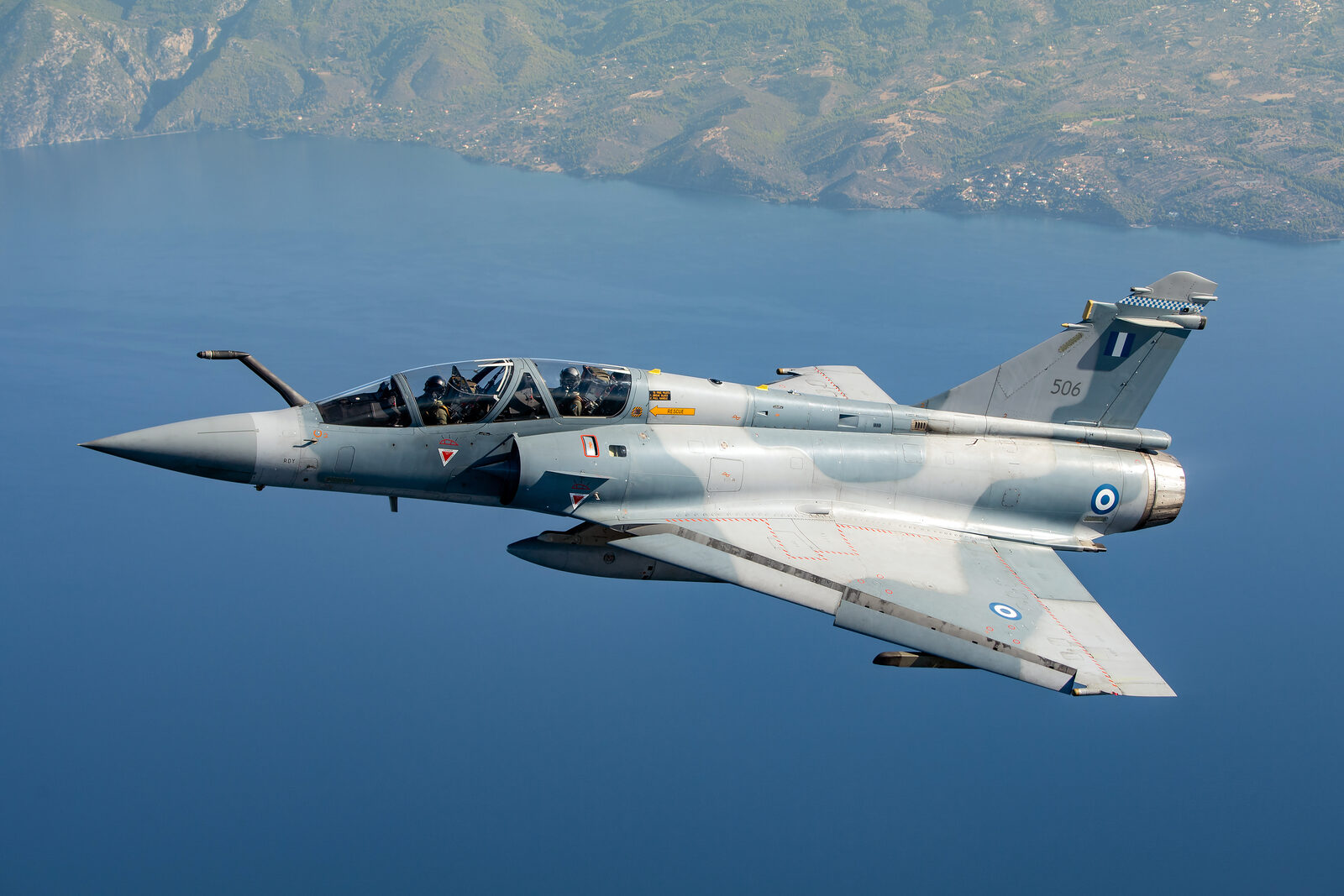
Dassault says 600 Mirage 2000 were produced and half of them exported, to eight countries: Brazil, Egypt, Greece, India, Peru, Qatar, Taiwan and the United Arab Emirates. The French programme history splits it differently: 293 new aircraft sold abroad, and about 300 in the French series. Those two numbers add to about 593, a total the history never prints. Both figures are here because they are not the same claim.
SIPRI’s arms transfers register records the year each order was placed and the years the aircraft arrived, and the table below comes out of that register as it stood on 28 September 2026. A question mark means SIPRI itself flags the figure as uncertain.
| Buyer | Version | Ordered | Order year | Delivered | SIPRI’s note |
|---|---|---|---|---|---|
| India | Mirage 2000H, including 4 two-seat | 40 | 1982 | 1985, 1986 | Option on 70 more built under licence in India, not used. Indian name Vajra. |
| Peru | Mirage 2000P, including 2 two-seat | 12 | 1982 | 1985, 1986, 1987 | Original order for 26 cut to 12 for financial reasons. |
| Egypt | Mirage 2000EM, including 4 two-seat | 20 | 1983 ? | 1986, 1987, 1988 | Billion dollar deal including component production in Egypt. |
| United Arab Emirates | Mirage 2000EAD, with reconnaissance and two-seat aircraft | 18 then 18 more | 1983 and 1984 | 1989 to 1991 | For Abu Dhabi. Delivery delayed by a refusal to accept some downgraded sub-systems. |
| United Arab Emirates | Mirage 2000EAD | 1 | 1990 | 1991 | For Abu Dhabi. |
| Greece | Mirage 2000EG, including 4 Mirage 2000BG | 40 | 1985 | 1988, 1989, 1992 | Offsets included assembly of engines. |
| India | Mirage 2000H, including 3 two-seat | 9 | 1986 | 1987, 1988 | Follow-on batch. |
| Taiwan | Mirage 2000-5Ei, including 12 two-seat | 60 | 1992 | 1997, 1998 | 2.6 billion dollar Flying Dragon deal. Option on 40 more, not used. |
| Qatar | Mirage 2000-5EDA, including 3 two-seat | 12 | 1994 | 1997, 1998, 1999 | Deal put at 1.2 to 1.6 billion dollars. |
| United Arab Emirates | Mirage 2000-9 | 62 ? | 1998 | 2003 to 2007 | 3.4 billion dollar Bader-21 deal, ordered after the United States refused to sell F-16s with a long-range air-to-surface capability. Includes 32 existing Emirati aircraft rebuilt. |
| India | Mirage 2000H, including 6 two-seat | 10 | 2000 | 2004, 2005 | Deal put at 312 to 353 million dollars. |
| Greece | Mirage 2000-5 Mk.2 | 25 | 2000 | 2007 | Part of a 1.6 billion euro deal. Includes 10 Greek aircraft rebuilt to the new standard in Greece. Option on 8 more. |
| Brazil | Mirage 2000C, including 2 two-seat | 12 | 2005 | 2006, 2007, 2008 | Second hand from France, modernised before delivery. An 80 million euro deal, an interim answer after the F-X programme slipped. |
| India | Upgrade of existing Mirage 2000H to Mirage 2000-5 | 49 ? | 2011 | 2015 onwards, 45 delivered | Two rebuilt in France, the rest in India with kits from France. |
| India | Mirage 2000-5 | 2 ? | 2021 | None recorded | Mirage 2000D two-seaters to be rebuilt to Mirage 2000-5 after delivery, with kits from France. |
| Ukraine | Mirage 2000-5F | Not stated | 2024 | 2025, 6 delivered | Aid after the 2022 Russian invasion. Second hand from France. |
SIPRI and the French programme history spell the Indian and Peruvian aircraft differently, 2000H and 2000P against 2000EH and 2000EP. Both forms appear in their own tables here.
India and Peru both placed their first orders in 1982 and SIPRI records only the year, so on that evidence the two cannot be separated and neither can be called the first export customer. Peru’s was the order that shrank most: 26 cut to 12. Two options on the register were never taken up, India’s for 70 more built under licence and Taiwan’s for 40 more.
One entry that looks like a Mirage 2000 and is not: SIPRI carries 27 MF-2000 aircraft for Morocco, which it describes as Moroccan Mirage F1 rebuilt to Mirage F1-2000.
Greece buys forty
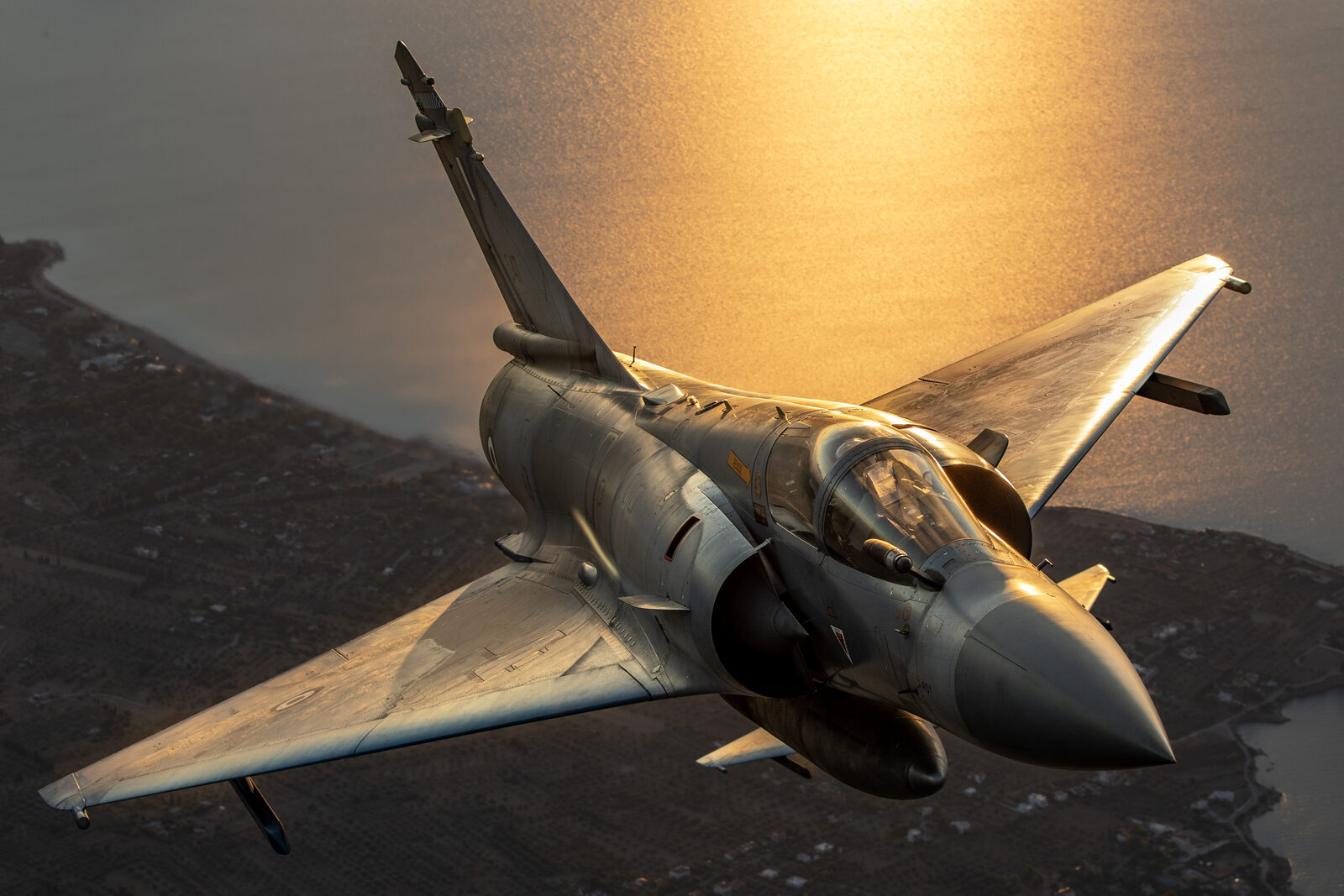
Greece announced the purchase in March 1985: 36 single-seat Mirage 2000EG and four two-seat Mirage 2000BG, alongside a separate buy of F-16C and D Block 30. SIPRI puts the order in 1985 and the deliveries across 1988, 1989 and 1992, and notes that the offsets included assembly of engines. Greece calls the deal the Talos contract, and the Hellenic Air Force says on its own website that the forty aircraft were controversially purchased. It does not say why.
Nothing on the record says what the Mirage 2000 beat in Greece. No competition, no evaluation, no fly-off and no stated reason for the choice appear in any source consulted for this article. Greece announced the Mirage and the F-16 together, so it bought both rather than choosing between them.
First aircraft landed at Tanagra on 27 April 1988 and French instructors began training the first Greek pilots at once. Serials in MILAVIA’s tables run 201 to 204 for the two-seaters and 210 to 245 for the single-seaters, which is forty airframes and reconciles with the 36 plus 4 split.
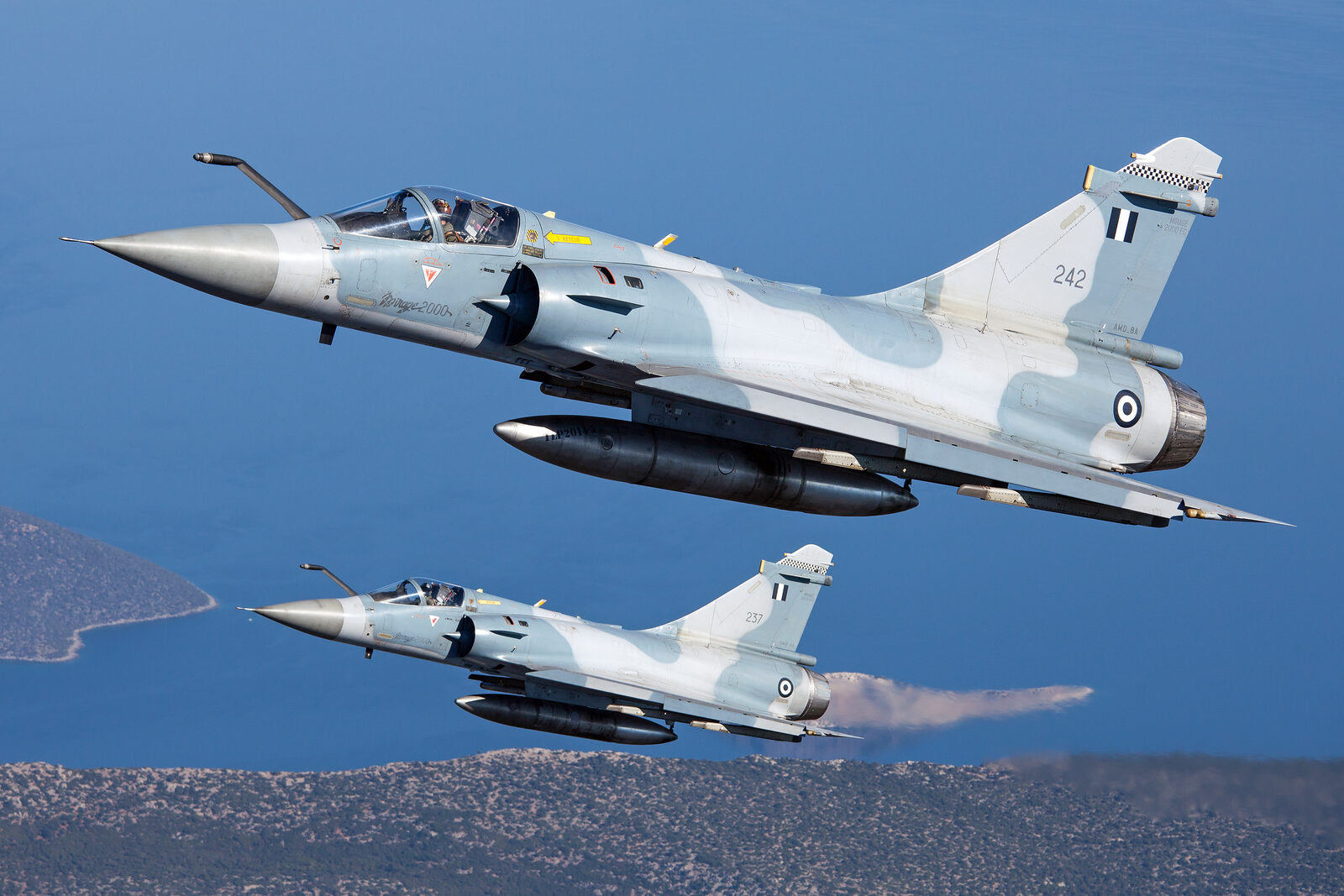
Weapons followed the aircraft. SIPRI records 360 Magic 2 short-range missiles ordered in 1986 and delivered from 1988, and 150 Super 530D ordered in 1994. Fifty Exocet anti-ship missiles were ordered in 1997 and delivered in 1998, 1999, 2002 and 2003. SIPRI flags both of those order years as uncertain. Adding the Exocet is why the Greek aircraft changed designation: the EG and BG became EGM and BGM when the anti-shipping role came with the missile.
In the designations, E is the export single-seat fighter, B the two-seater, and the second letter is the country, so G is Greece. That comes from one secondary source. Neither Dassault nor the Hellenic Air Force publishes a key.
Tanagra, 331 and 332
Both squadrons sit at 114 Combat Wing at Tanagra, and both were formed for the aircraft. 331 Squadron was founded on 18 April 1988 to take the Mirage 2000 on charge, nine days before the first one landed. 332 Squadron was established on 11 August 1989 and declared operational in November 1990, and took on the counter-maritime role in March 2007.
Even the squadron names are not fixed. The Hellenic Air Force’s aircraft page gives 331’s call sign as Thiseas; its squadron page gives Theseus and Thisseas. For 332 the aircraft page gives Geraki and the squadron page gives HAWK. All of those are the same two names in different transliterations, and the air force has not settled on one.
Formed on 22 August 1956 with three interception squadrons on F-86E Sabres, the wing went through the F-84F Thunderstreak, the F-102 Delta Dagger and the F-104 Starfighter. A Mirage F1CG landed at Tanagra on 4 August 1975, and the type served twenty-eight years before retiring in 2003. Hellenic Aerospace Industry has its plant at the end of runway 10, inside the base perimeter.
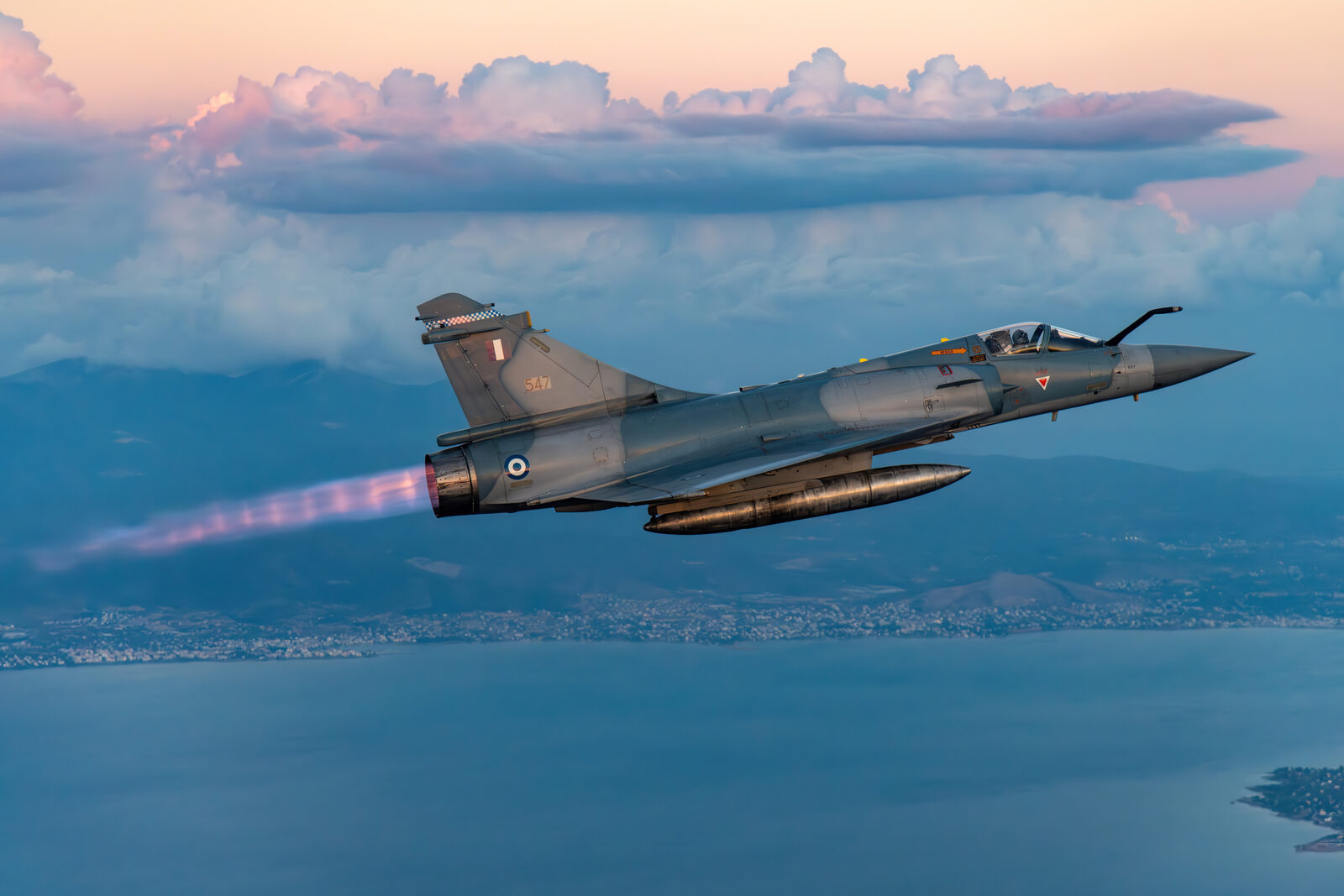
Air defence over the Aegean is the day job. Tanagra keeps two or three pairs of fully armed aircraft on standby, at readiness states running from sixty minutes down to five. Two aircraft and three or four pilots deploy on rotation to 133 Combat Group on Skyros to cover the central Aegean, and at Skyros the readiness is tighter still, with the pilot sitting in the aeroplane waiting for the order.
On Sunday 3 May 2020 the Hellenic Air Force released head-up display footage from a Greek Mirage 2000-5 engaging Turkish F-16s over the Aegean. Greek reporting at the time had the Mirages scrambled because two Turkish F-16s were harassing a Greek NH-90 carrying the defence minister. One analyst quoted at the time thought the footage looked more like a training engagement with a co-operative target than a real one.
Our own air-to-air expedition with the Hellenic Air Force Phantoms was flown from the same base with the same photoship arrangement as the Mirage pictures on this page.
What the Gulf War sortie tables show
The Gulf War Air Power Survey counted every coalition sortie between 16 January and 28 February 1991 and printed the result by country and aircraft type. France flew 512 Mirage 2000 sorties. The United Arab Emirates flew 64.
Table 102 of the same volume breaks the French figure into two mission columns and no others: 340 and 172, adding to 512. Those columns are headed DCA and OCA, the survey’s two counter-air categories. The Emirati total splits into air interdiction and reconnaissance, six of the 64 being reconnaissance. So the French Mirage 2000 flew the Gulf War purely as a fighter. There are no interdiction, close air support or strike sorties against it anywhere in the table.
French Mirage 2000s flew their first recorded sorties of the war on 17 January, six of them. Emirati aircraft first show up on 16 February.
They had been in the theatre for months before that. A chronology in the same volume has a strike package on 25 October 1990 running a mock attack on Al Dhafra, Taif and Al Ahsa with thirty-two F-16s, two EA-6s and two French Mirage 2000s in it. On 31 December 1990 two United States and Saudi strike packages flew against French Mirage 2000s acting as the opposing air defence.
Table 206 of the same volume is the coalition air-to-air kill matrix, and it lists all 41 kills with the shooting aircraft against each one. Every one is American except two Royal Saudi F-15C kills.
512 French Mirage 2000 sorties in the Gulf, split 340 and 172 between the survey’s two counter-air categories and nothing else. Of the 41 kills on the coalition air-to-air matrix, none belongs to a French aircraft.
Ebro 33
On 30 August 1995, the first day of Operation Deliberate Force, a French Mirage 2000 with the call sign Ebro 33 was hit by a shoulder-launched infrared missile about twenty nautical miles south-east of Pale, probably at or below three thousand feet. Both crew ejected. Mission reports that day recorded two good chutes. It was the only NATO aircraft lost in the whole campaign.
Three rescue attempts were flown on three days, nineteen sorties in all: three on 30 August, eight on 6 September and eight on 7 September. A package that went out from Brindisi met Bosnian Serb troops firing on the helicopters with heavy machine guns, wounded two crew and damaged an aircraft. Escorting A-10s returned fire and destroyed one of five Serb vehicles. That was the end of the active rescue effort. The United States Air Force’s own study of the campaign puts the final mission on 8 September in its narrative and on 7 September in its sortie counts, and does not reconcile the two.
Not until 27 September did the Serbs confirm to the rest of the world that they were holding the two French pilots. That study does not name them, does not give their unit and does not say when they came home.
It also cannot decide what aircraft it was. On page 217 the study calls it a Mirage 2000K. On page 301 it calls it a Mirage 2000C. In a chapter footnote it calls it a Mirage 2000D shot down by an SA-16. Those are three different aeroplanes with three different jobs, inside one official history.
France recalled seventeen Mirage 2000s on 18 August 1995 and, when Deliberate Force was ordered on 29 August, the recalled assets included four Mirage 2000Cs and six Mirage 2000Ds and Ks. Six 2000Cs deployed to Cervia in Italy with three more on call, launching and recovering four a day on average, sixty sorties in all, a fifth of the whole campaign’s combat air patrol. From the same base the 2000Ds flew ten strike missions and the 2000Ks flew thirty-six missions.
Of the 125 laser-guided GBU-12s dropped in Deliberate Force, French Mirage 2000D and K aircraft dropped ten, which the study calls their first combat use of laser-guided bombs. American aircraft dropped the other 115. Only one type of laser-guided missile was used in the campaign, the French AS-30L, and Mirage 2000s carrying pods to designate for themselves fired four of them.
Greece buys fifteen more and rebuilds ten
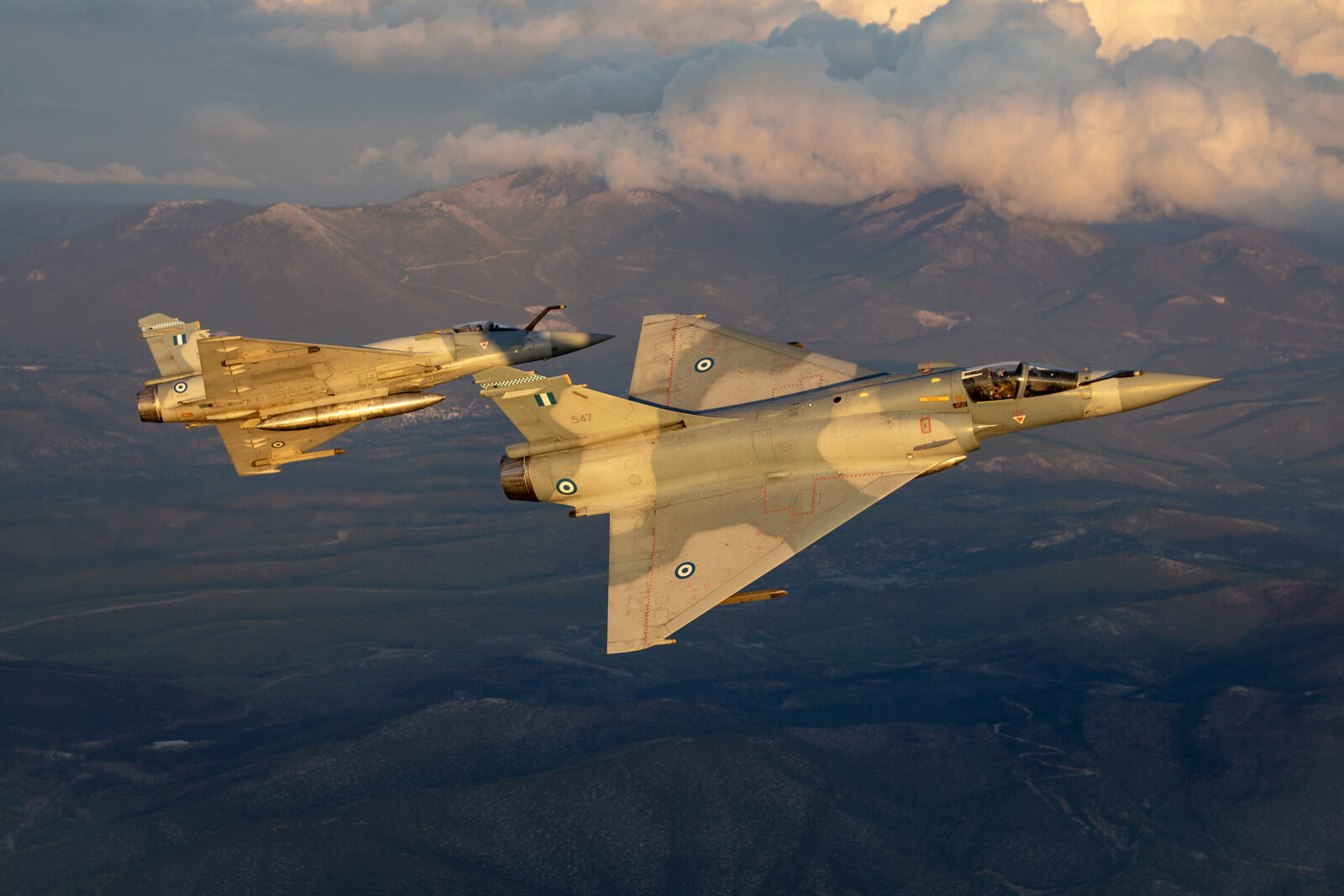
Dassault Aviation, Thomson-CSF Detexis, SNECMA Moteurs and Matra BAe Dynamics France announced in Athens on 20 June 2001 that they had signed contracts with the Greek defence ministry for fifteen Mirage 2000-5 Mark 2 aircraft and for the upgrade of ten existing Greek Mirage 2000 to the same standard. Rebuild work was to be done in Greece by Hellenic Aerospace Industry, at its plant inside the Tanagra perimeter.
Dates for the order do not agree. SIPRI puts it in 2000. Forecast International says late 2000. One aviation source says 2000, another says August 2000. All four manufacturers say the contracts were signed and announced on 20 June 2001. An agreement in 2000 and signature in June 2001 would reconcile all of it, and no source says so.
No single price is on the record either. SIPRI puts a 1.6 billion euro figure against the aircraft and a 1.4 billion dollar figure against the missiles in the same file, and does not explain the relationship between the two.
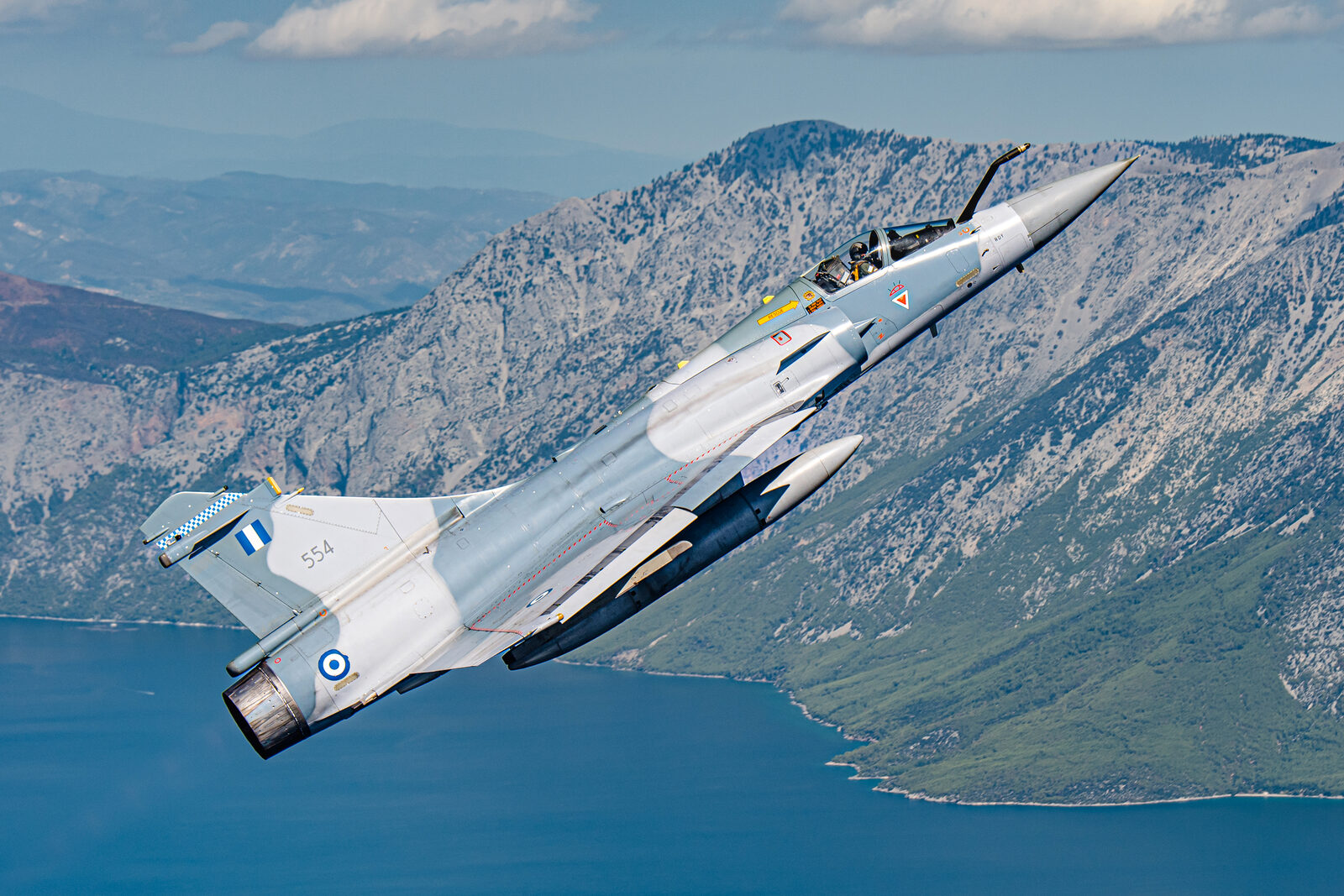
Fifteen new aircraft meant ten single-seaters, serialled 546 to 555, and five two-seaters, 505 to 509. Ten rebuilds followed, all single-seaters, picked on fuselage fatigue rather than anything else, and each took a new serial three hundred higher than its old one: 211 became 511, 245 became 545, and so on through the list.
| Batch | Version | Serials | Number |
|---|---|---|---|
| 1985 order, two-seat | Mirage 2000BG, later BGM | 201 to 204 | 4 |
| 1985 order, single-seat | Mirage 2000EG, later EGM | 210 to 245 | 36 |
| Rebuilt to Mark 2 | Mirage 2000-5EG Mk.2 | 511, 514, 527, 530, 534, 535, 536, 540, 543, 545 | 10 |
| New build, two-seat | Mirage 2000-5BG Mk.2 | 505 to 509 | 5 |
| New build, single-seat | Mirage 2000-5EG Mk.2 | 546 to 555 | 10 |
MILAVIA’s own body text says the original forty ran from 200 to 240, which its own tables contradict. The serials above come from the tables.
The Mark 2 standard brought the RDY-2 radar in place of the RDM, a glass cockpit in place of the analogue one, a TOTEM 3000 ring laser gyro navigation system in place of the ULISS 52, and the ICMS Mk3 electronic warfare fit. Two new weapons came with it: the MICA in both radar-guided and infrared versions, and the SCALP cruise missile, which was the first stand-off air-to-ground weapon the Greek Mirages had ever had. SIPRI records 100 MICA ordered in 2000 and delivered in 2003 and 2004, 100 more ordered in 2003, and 22 SCALP ordered in 2001 with 34 more in 2004, all delivered by 2007.
The Exocet did not make the transition. Integrating it on the newer aircraft was possible, and the Greeks decided against it because with SCALP aboard the anti-shipping job had become a secondary role. The Magic II stayed on the older EGM and BGM aircraft only.
331 Squadron took the new and rebuilt aircraft, twenty-five in all, and handed its remaining older Mirages to 332 Squadron on 1 March 2007. A first Mirage 2000-5 landed at Tanagra either on 3 March 2007, according to the Hellenic Air Force, or on 3 May 2007, according to two aviation sources that otherwise copy each other.
Fifteen new aircraft and ten rebuilt ones, the rebuilds done at Tanagra by Hellenic Aerospace Industry. Each rebuilt airframe was renumbered by adding three hundred to its old serial, so a Greek Mirage wearing a number in the 500s may be a new aeroplane from 2007 or one delivered in 1988 with a new radar in it.
What the Indian record actually says about Kargil
Search for the Mirage 2000 at Kargil and you will find laser-guided bombs on Tiger Hill, a strike at Muntho Dhalo, squadron numbers and dates. None of it is in the published Indian official record.
The Kargil Review Committee’s report says the Cabinet Committee on Security authorised the use of air power on 25 May 1999 and names the air force’s operation as Safed Sagar, separate from the army’s Operation Vijay. Mirage appears once in the whole published report, and it refers to Pakistan’s Mirage III and V in a chapter about nuclear delivery. The committee’s own annexes include the air force’s presentation on Safed Sagar, and the publisher’s note says the annexes and appendices were left out of the published edition, with deletions made in the interest of national security, so that presentation is not in the public text.
The Press Information Bureau says the Indian Air Force joined the campaign through Operation Safed Sagar on 26 May 1999 and that Tiger Hill was recaptured on 4 July 1999. Neither of its Kargil backgrounders mentions the Mirage 2000, laser-guided bombs or Muntho Dhalo.
The same pattern holds later. A Foreign Secretary’s statement on the Balakot strike of 26 February 2019 names no aircraft type at all. The Ministry of Defence release on Operation Sindoor of 7 May 2025 names no aircraft type either, and a longer official document on the same operation names the MiG-29K, Akash, Pechora, OSA-AK, shoulder-launched missiles and light anti-aircraft guns, and not the Mirage 2000.
Anything beyond that is press reporting and should be described as press reporting. India is one of the three biggest Mirage 2000 operators outside France, with Taiwan and the United Arab Emirates, and almost nothing about its combat use is in the public official record.
Libya, the Sahel, Iraq and Afghanistan
France ran Operation Harmattan over Libya from 19 March to 31 October 2011. Its own account of it names Rafale, Mirage 2000, C-135 tankers and an E-3F, and among the Mirages names the 2000-5, the 2000D and the reconnaissance Mirage F1. Six bases were mobilised at the start: Avord, Nancy, Saint-Dizier, Dijon, Istres and Évreux, with Orléans, Solenzara in Corsica, Souda in Crete and Sigonella in Sicily added later. A first mission, on Saturday 19 March, was a reconnaissance run along the Libyan coast around Benghazi, about seven hours with several refuellings. Around twenty aircraft flew that afternoon and by the end of the day the French had logged more than 130 flying hours. Within three days they had flown more than 55 sorties.
NATO’s own pages on Operation Unified Protector name Sweden, Qatar, the United Arab Emirates, Jordan and Morocco as partner nations and give the campaign totals, 222 days and some 26,000 sorties, without naming a single aircraft type. Whether Qatari or Emirati Mirage 2000s flew over Libya is not something NATO establishes, and no Qatari or Emirati official source does either.
In the Sahel, French forces were engaged from 2013 to 2022, under Serval and then Barkhane. A ministry weekly operations report for late May and early June 2022 puts both Mirage 2000D and Mirage 2000C at the deployed air base at Niamey, flying reassurance missions for partner forces, including support on 1 June when a United Nations convoy was attacked near Kidal. That same report gives 520 sorties across the whole of May 2022, of which 110 were fighter sorties, and does not break those down by type.
Against Islamic State, three Mirage 2000Ds from Nancy-Ochey flew to Jordan on 28 November 2014 to join Operation Chammal. Two of them flew the first armed reconnaissance mission over Iraq on the morning of 6 December 2014. Plans called for a fighter detachment of six in Jordan with the maintenance and mission-planning behind it; a later Senate report gives eight Mirage 2000D operating from the deployed base there.
Afghanistan is documented more thinly. A French Senate report on external operations says France deployed six combat aircraft there, three Rafales and three Mirages, at Kandahar, and does not say which Mirage. The ministry’s current Operation Pamir page carries no aircraft types at all.
The Aegean, 8 October 1996
A Turkish F-16D came down over the Aegean on 8 October 1996. One crew member was killed and the other ejected and was picked up by Greek forces. Every source gives that date and none gives another. Where they came down is less agreed: one account puts it in international airspace north of Samos, a Turkish report puts it south of Chios, a third says near Chios.
Writing seven years afterwards, in 2003, one aviation news report says that at first there were only rumours that the F-16 had been shot down. In May 2003 a retired Turkish naval commander said publicly that a Greek warplane had shot it down and that the Greeks removed all the evidence. He was retired, and that is not a government statement. In the same month a Greek government spokesman said the defence ministry had not confirmed any such incident, and that a sworn inquiry at the time had not confirmed the shooting down of a Turkish aircraft.
In 2012 the Turkish defence minister answered a written parliamentary question about Turkish military aircraft brought down by other states and listed three since 1965, the second being the 8 October 1996 F-16. A Turkish newspaper account of that answer describes the jet as coming down in a dogfight with Greek aircraft and attributes the shootdown claim not to the minister but to a Greek magazine that had written it up years later. In 2014 Turkish prosecutors considered charges, and in 2016 an Ankara prosecutor sought help in bringing a compensation suit against a Greek pilot. An appeals council in Athens rejected the claim.
The detail everyone repeats, that it was a Mirage 2000EGM of 331 Squadron firing an R.550 Magic II, comes from a 2012 aviation blog piece whose own subject is a different incident thirty years earlier. That piece does not say the Turkish minister supplied any of it. That 2003 report, closest to the event, names no Greek aircraft type at all: it says a Greek jet, and a Greek warplane. English Wikipedia carries the type, the squadron, the missile and a Turkish serial, and Wikipedia’s own editors have flagged two of its citations as needing verification.
No Greek government has confirmed it at any date. The nearest thing to an official Turkish confirmation is a written parliamentary answer from 2012, sixteen years afterwards, whose reported wording stops short of the claim made in its name. Attributing the shot to a Mirage 2000 rests on press reporting and nothing else. It may well be true. It is not established.
Almost thirty years after 8 October 1996, neither Athens nor Ankara has issued a statement naming the Greek aircraft involved. A Greek government spokesman said in 2003 that the ministry had not confirmed it. The Mirage 2000EGM, the squadron number and the missile all come from press reporting.
The line closes
Dassault kept trying with India. Negotiations ran from 2003, and at the end of 2005 the firm announced that the Mirage 2000 line would close for good. Aircraft kept coming out of it for two years more, because the Greek order was still being filled, and the last new Mirage 2000 is reported to have rolled off on 23 November 2007. Forecast International, writing early the following year, put it the same way: production ended when the last of the fifteen aircraft ordered by Greece were delivered in 2007.
Production of a sort carried on in India. In 2011 it contracted to bring its existing Mirage 2000H fleet up to the -5 standard, two rebuilt in France and the rest in India with kits shipped out from Dassault, 45 of them delivered between 2015 and 2025.
Coming out of service
France retired the Mirage 2000C RDI on 23 June 2022, when the last one flew with escadron de chasse 02.005 Île-de-France at Orange. Two single-seat Rafales had taken over the alert commitment a fortnight earlier, on 9 June. The 2000C RDI had been in service since 1989.
Nuclear aircraft went first. France’s armament directorate says the Mirage 2000N came out of operational service in 2017; the air force’s own 2025 anniversary article says 2018. Its last aircraft flew on Tuesday 22 February 2022 and went to Nancy-Ochey.
Greece retired its older Mirage 2000EGM and BGM as the Rafale came in. Six Rafale F3R landed at 114 Combat Wing on 19 January 2022. Mirages went about the same time, and the date depends on who you read: January 2022 in one account, mid-2022 in another, progressively across 2021 and 2022 in a third. No Greek government has stated a date, and the Hellenic Air Force’s own 332 Squadron page still lists the Mirage 2000 EGM and BGM as the squadron’s aircraft while its Rafale page says 332 Squadron flies Rafales.
Retired airframes have been sitting at Tanagra since. Greek press reporting says the air force hoped to sell eighteen of them, that many are stored on the base and that some have been cannibalised for spares. SIPRI’s register recorded no export of a Greek Mirage 2000 to anyone as of 28 September 2026.
Six to Ukraine
A French parliamentary report of 30 October 2024 said that six Mirage 2000-5 were to be transferred to the Ukrainian armed forces, and warned that the transfer plus the support package would further impoverish an already tightly cut fighter force. It was written before anything had been handed over. SIPRI’s register now records six Mirage 2000-5F delivered to Ukraine in 2025 against an order placed in 2024.
France’s own ministry names the variant and the year and no number. Mirage 2000-5s transferred in 2025 have made it possible to face the missile attacks, one page says. Another says the transfer came with training for pilots and mechanics.
The ministry’s annual key figures give the Mirage 2000-5F on strength as 28 at 31 December 2023, 23 at 31 December 2024 and 22 at 31 December 2025. That is a fall of five across 2024 and one more across 2025. Those subtractions are not in the document and the ministry nowhere attributes the fall to the transfer. Fleets fall through accidents and withdrawals as well as gifts.
That same 2024 report set out what the transfers do to the plan. France wants to hold 185 combat aircraft to meet its operational commitments. Its programming law provides 137 Rafale by 2030. The report’s rapporteur, Frank Giletti, expected the total to sit below 185 for ten years, from 2026 to 2036, and an all-Rafale force to be possible only from 2035.
What is left
At 31 December 2025 the French air force held 50 Mirage 2000D, 22 Mirage 2000-5F and 7 Mirage 2000B2. Those seven two-seaters are used to train Mirage 2000D crews. Withdrawal dates on the books in October 2024 were 2029 for the 2000-5 and 2035 for the renovated 2000D.
| Version | 31 Dec 2023 | 31 Dec 2024 | 31 Dec 2025 |
|---|---|---|---|
| Mirage 2000D, conventional strike | 64 | 55 | 50 |
| Mirage 2000-5F, air defence | 28 | 23 | 22 |
| Mirage 2000B, two-seat trainer | 7 | 7 | 7 |
The Ministère des Armées prints the three lines and no total, and prints the trainer as B1 in its 2024 edition and B2 in the two later ones, with the count unchanged at seven. Neither the 2000C nor the 2000N appears in any of the three columns.
Safran, which supports the engine, said in July 2026 that the aircraft will stay in service beyond 2035 in France and until at least 2045 with export customers. It listed eight countries still on its support books: Egypt, the United Arab Emirates, France, Greece, India, Peru, Qatar and Taiwan.
Nobody publishes a current worldwide total. Dassault’s own promotional material says close to 600 in service, which is undated and sits awkwardly beside Dassault’s own figure of 600 built in total. Greek strength is press reporting only: 25 Mirage 2000-5 in October 2025, or 24 plus 19 stored older aircraft in April 2026. The Hellenic Air Force does not publish a fleet figure and both its Mirage pages sit in the historical aircraft section of its website.
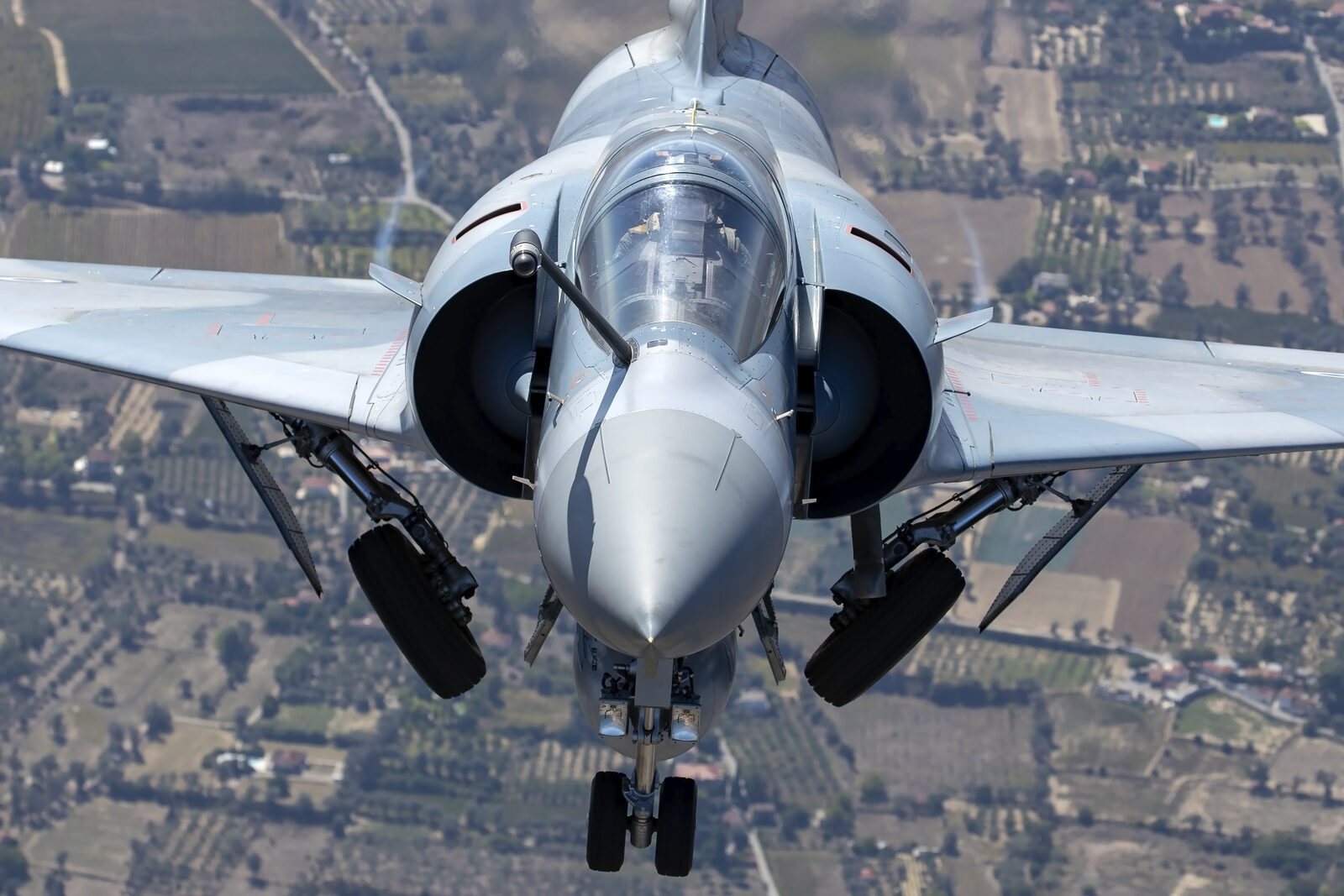
What the aeroplane turned out to be is not quite what the 1975 decision text described. It was bought as a cheap interceptor, in numbers, because the expensive twin was unaffordable. It spent the Gulf War as an interceptor. Then the export customers wanted a radar France had not built, and the answer was a bigger radar, a new cockpit and a new missile, and the cheap single-engined fighter finished its career as a multirole aircraft carrying cruise missiles. The delta wing the air force had refused to look at in 1972 outlasted every argument anybody had about it.
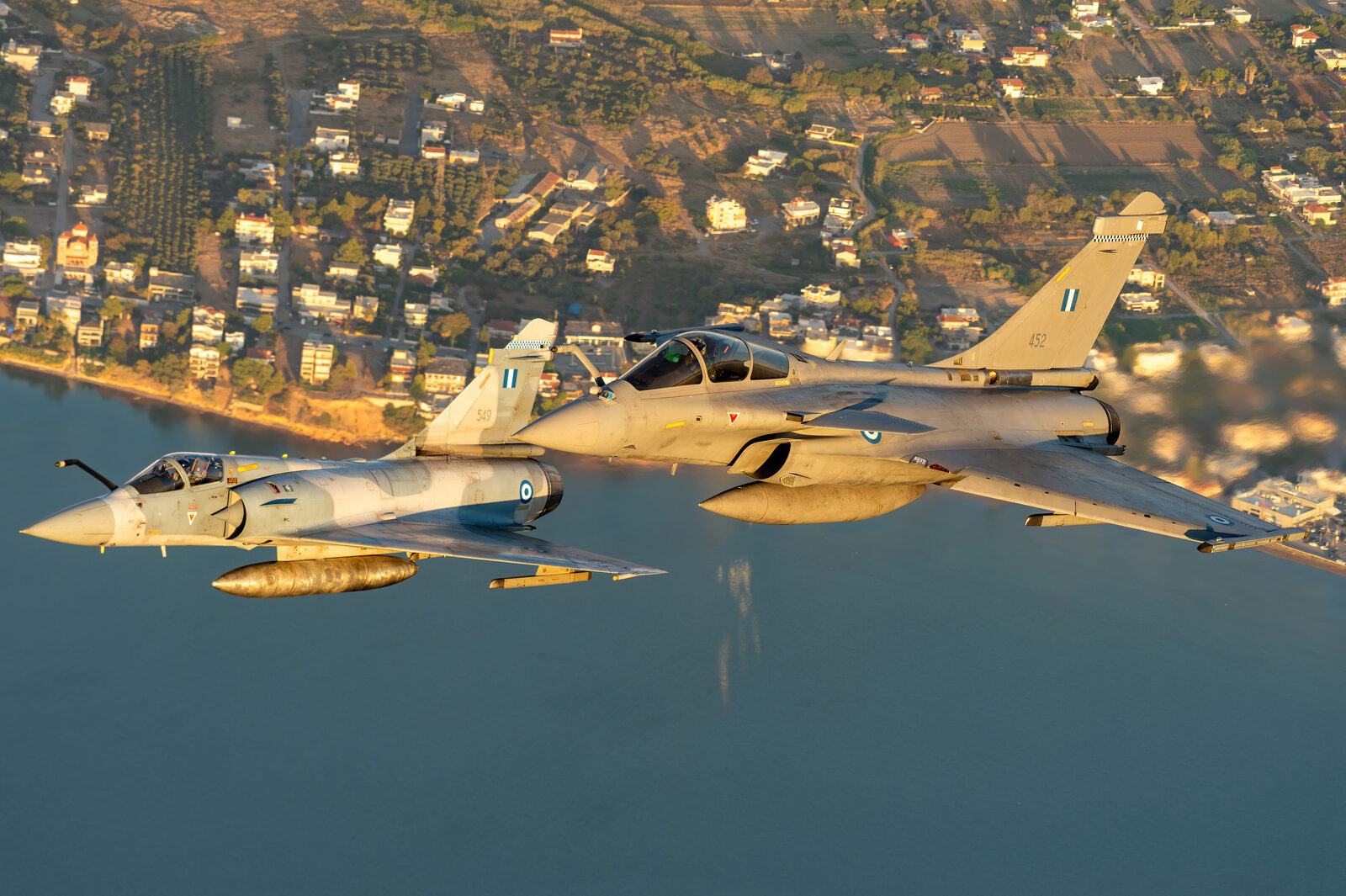
For the other European fighters of the same generation and the same arguments, see our histories of the Saab JAS 39 Gripen, the Panavia Tornado and the SEPECAT Jaguar, the last of which was the previous Anglo-French answer to the same problem. For the delta wing before the computers could fly one, there is the Avro Vulcan, and for the other Hellenic Air Force type we have photographed from a photoship, the McDonnell Douglas F-4 Phantom II.
Frequently asked questions
Why does the Mirage 2000 have a delta wing when the Mirage F1 did not?
Because by 1975 the flight control system could handle one. When the French air force wrote the requirement for the cancelled ACF in June 1972 it refused to consider a delta, on the grounds that it did not want the Mirage III and Mirage IV drawbacks back and that electric flight controls did not yet allow those to be avoided. Three and a half years later it ordered a delta with fully electric flight controls, and the official programme history cross-references that 1972 refusal directly to the Mirage 2000.
When did the Mirage 2000 first fly?
On 10 March 1978, at Istres in the south of France. Jean Coureau flew it, for one hour and five minutes, up to 40,000 feet and Mach 1.3. Part of the trailing edge of the left inner elevon came off during the flight; it was a composite part and the loss was blamed on a manufacturing defect in that particular piece. That aircraft was Mirage 2000-01 and it is now in the Musée de l’Air et de l’Espace at Le Bourget.
How many Mirage 2000 were built?
Dassault says 600, half of them exported. COMAERO, the official-lineage French programme history, gives 293 new aircraft sold abroad and about 300 in the French series, which adds to about 593 by arithmetic COMAERO does not print. Those two accounts are close but they are not the same claim, so there is no single agreed total to quote.
When did it enter French service?
The first squadron was declared operational at Dijon on 2 July 1984, the fiftieth anniversary of the French air force, with fifteen aircraft at standard S3 on the strength of EC 01/002 Cigognes. The air force’s own pages give the year and not the unit, and its 2025 anniversary article implies 1985 by celebrating forty years of operational service in September of that year.
What engine does the Mirage 2000 have?
One SNECMA M53, in three marks over the production run: the M53-2 in the prototypes, the M53-5 in production aircraft and the M53-P2 from airframe C38 onwards. Thrust figures vary by source because the sources use daN, kilogrammes-force and tonnes and do not convert between them. COMAERO gives 9,700 daN for the M53-P2, Safran gives 9.5 tonnes and the French air force’s own data sheets give 10 tonnes for one variant and 9.7 for another.
What are the main Mirage 2000 variants?
The 2000C is the single-seat interceptor and the 2000B its two-seat trainer. A 2000N is the two-seat nuclear strike aircraft, built around the ASMP missile, and the 2000D is its conventional equivalent. The 2000-5 is the later multirole standard with the RDY radar, MICA missiles and a glass cockpit, and the 2000-9 is the Emirati development of it. Export aircraft take an E or a B and a country letter, so EG and BG are Greek and EI is Taiwanese.
How many Mirage 2000 does Greece have?
No Greek government or Hellenic Air Force document publishes a current fleet figure, so the honest answer is that nobody outside the service knows. Press reporting in October 2025 gave 25 Mirage 2000-5, and in April 2026 gave 24 Mirage 2000-5 plus 19 stored older aircraft. Greece ordered 40 in 1985 and 25 more in 2000 or 2001, the second batch being 15 new aircraft and 10 of the original ones rebuilt.
Which Greek squadrons fly the Mirage 2000?
331 Squadron and 332 Squadron, both at 114 Combat Wing, Tanagra. 331 was founded on 18 April 1988 to receive the type and now has the Mirage 2000-5. 332 was established on 11 August 1989, took the older aircraft over from 331 on 1 March 2007, and has since re-equipped with the Rafale F3R, the first six of which landed at Tanagra on 19 January 2022.
Did a Greek Mirage 2000 shoot down a Turkish F-16 in 1996?
No government has confirmed it. A Turkish F-16D came down over the Aegean on 8 October 1996 and one of its two crew was killed. A Greek government spokesman said in 2003 that the defence ministry had not confirmed any such incident, and no Greek statement to the contrary was found at any date. A Turkish written parliamentary answer of 2012 listed the aircraft among three brought down by other states, and the newspaper account of it attributes the shootdown claim to a Greek magazine rather than to the minister. Details naming a Mirage 2000EGM, 331 Squadron and a Magic II missile come from press reporting.
Has the Mirage 2000 been in combat?
Yes, repeatedly, and mostly in French hands. France flew 512 Mirage 2000 sorties in the 1991 Gulf War, all of them counter-air. One was shot down over Bosnia on 30 August 1995 by a shoulder-launched missile, the only NATO aircraft lost in Operation Deliberate Force, and both crew were captured. French Mirage 2000s flew over Libya in 2011, in the Sahel until 2022 and over Iraq from December 2014. Emirati aircraft flew 64 Mirage 2000 sorties in that Gulf War of 1991.
Did Indian Mirage 2000s bomb Tiger Hill in the Kargil war?
Nothing in the published Indian official record says so. A Kargil Review Committee report mentions the Mirage 2000 nowhere, and the air force’s own presentation on Operation Safed Sagar is an annexe that was left out of the published edition. Government press releases on Kargil, on Balakot in 2019 and on Operation Sindoor in 2025 name no strike aircraft type at all. Everything in circulation about laser-guided bombs on Tiger Hill is press reporting, and should be read as such.
Is the Mirage 2000 still in service?
Yes. At 31 December 2025 the French air force held 50 Mirage 2000D, 22 Mirage 2000-5F and 7 Mirage 2000B2. Safran, which supports the engine, said in July 2026 that it expects the type to fly beyond 2035 in France and until at least 2045 with export customers, and listed eight countries still on its support books: Egypt, the United Arab Emirates, France, Greece, India, Peru, Qatar and Taiwan. Six Mirage 2000-5F went to Ukraine in 2025.
When did Mirage 2000 production end?
Dassault announced the definitive closure of the line at the end of 2005, after negotiations with India came to nothing. Aircraft kept coming off it until the Greek order was finished, and the last new Mirage 2000 is reported to have been completed on 23 November 2007. Indian aircraft were still being rebuilt to the -5 standard with French kits as late as 2025.
Sources and further reading
- Jacques Bonnet (dir.), Un demi-siècle d’aéronautique en France: les avions militaires, tome II (COMAERO). The French official-lineage programme history, written by the men who ran the armament directorate. Carries the ACF’s cancellation, the 18 December 1975 decision text, the prototype histories, the standards and the variant annex.
- COMAERO, Un demi-siècle d’aéronautique en France: les équipements de bord, tome I. The flight control system in detail: four analogue computers per axis, the mechanical linkage removed in 1979, and what the electric chains actually carried.
- Dassault Aviation, biography of Jean Coureau. Gives the first flight as Mirage 2000-01 at Istres on 10 March 1978, in a photograph caption.
- Dassault Aviation, Mirage 2000 customer support. The manufacturer’s own production total of 600 and its list of eight export countries.
- Safran, support en service du M53, 17 July 2026. The engine’s in-service picture in 2026: eight supported customers, 2.5 million flying hours, and the horizons of 2035 in France and 2045 for export.
- Armée de l’Air et de l’Espace, Mirage 2000-5F data sheet. Official French dimensions, load factors and stores for the air-defence aircraft.
- Ministère des Armées, Les chiffres clés de la Défense 2026. The French inventory at 31 December 2025, type by type.
- Assemblée nationale, rapport N° 527, tome VI, Air, 30 October 2024. The six aircraft for Ukraine, the planned withdrawal dates of 2029 and 2035, and the arithmetic of the 185-aircraft fighter force.
- Direction générale de l’armement, retirement of the last Mirage 2000N, 28 February 2022. Gives 2017 as the operational retirement and 22 February 2022 as the last flight.
- Musée de l’Air et de l’Espace, Dassault Mirage 2000. The surviving prototype, its wing area and the speed range the slats and the electric controls bought.
- SIPRI Arms Transfers Database, trade register. Order years, quantities, delivery years and SIPRI’s own notes for every Mirage 2000 export, including the cut Peruvian order and the unused Indian and Taiwanese options.
- Gulf War Air Power Survey, Volume V, A Statistical Compendium and Chronology. Sortie counts by country and type, the mission-type breakdown, and the coalition air-to-air kill matrix.
- Robert C. Owen (ed.), Deliberate Force: A Case Study in Effective Air Campaigning, Air University Press. The loss of Ebro 33, the rescue attempts, and the French Mirage sortie and weapon counts. Calls the lost aircraft three different variants in three places.
- Kargil Review Committee, From Surprise to Reckoning. The published Indian report on the 1999 war, with the publisher’s note explaining which annexes were withheld.
- Hellenic Air Force, Mirage 2000 EGM and BGM. The Greek service’s own page on the type, including the word controversially.
- George Karavantos, HAF 114 Combat Wing Tanagra AB, MILAVIA. Serial tables for the Greek fleet, the renumbering of the rebuilt aircraft, and the base itself. Its body text and its own tables disagree about the original serial range.
- Joint press release of Dassault Aviation, Thomson-CSF Detexis, SNECMA Moteurs and Matra BAe Dynamics France, 20 June 2001. The manufacturers’ own announcement of the Greek Mark 2 contracts.

Leave a Reply