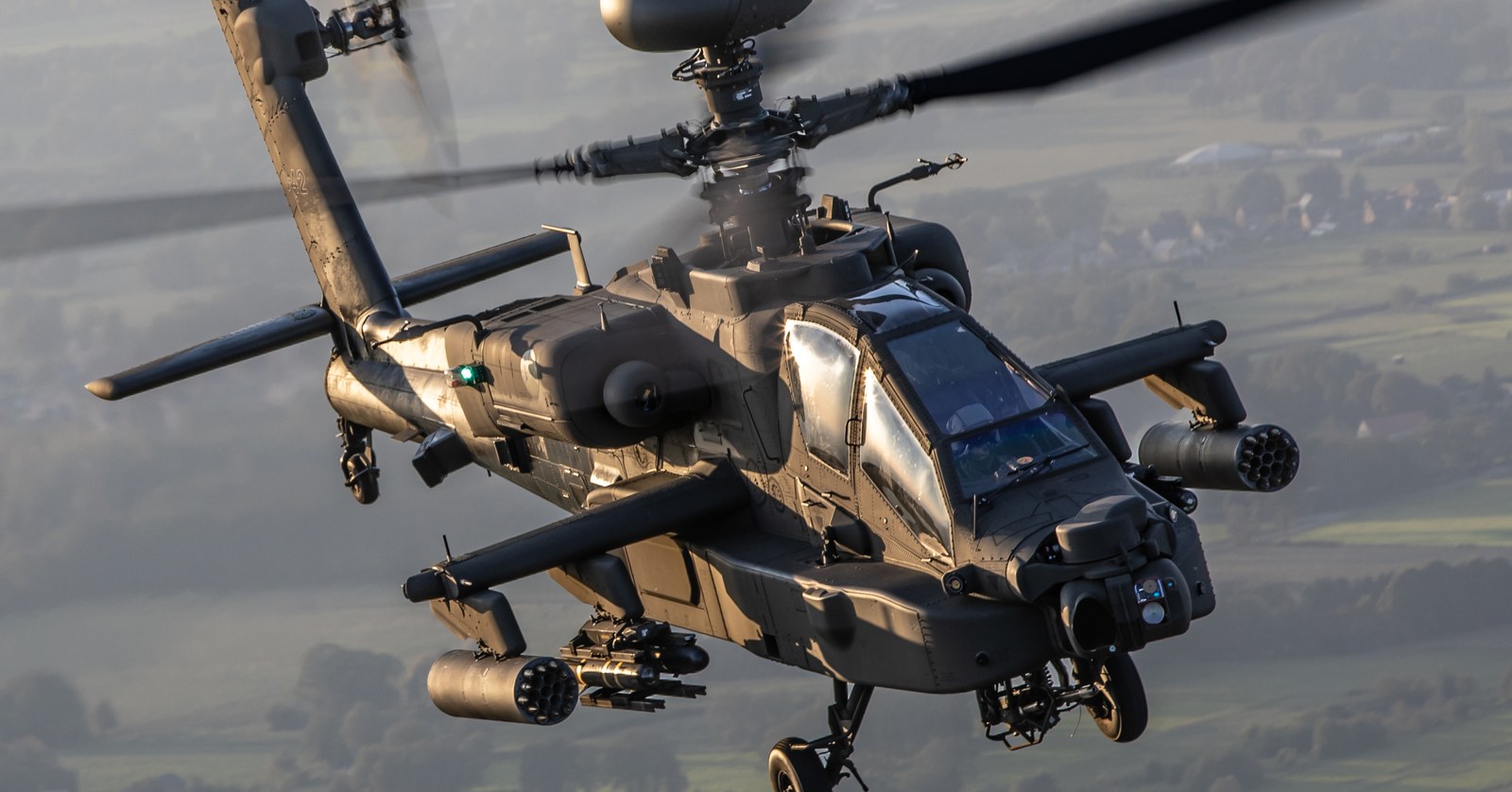
At about one in the morning on 24 March 2003, over farmland south of Baghdad, every light in the district went out at once. Al Haswah and Al Iskandariyah went dark together, for roughly two seconds, and then the sky filled with gunfire. Thirty AH-64 Apaches were flying through it, blacked out and low. In each cockpit one man could see the tracer and the other could not, because one was on night vision goggles and the other was looking through a thermal sight slaved to his own head, with the gun following it. So one had to talk the other onto the guns while it was happening. Twenty-nine of the thirty came home, and every one of them had holes in it.
The Boeing AH-64 Apache was designed in the 1970s to kill Soviet tanks at night, in weather, from standoff range, in the gap between the hills at Fulda. It has never done that. What it has done for thirty-five years is fly low over towns and villages into small-arms fire, which is the one thing nobody designing it had in mind.
Before it, helicopters carried troops and sometimes shot back. After it, a helicopter was a weapon system with an aircraft attached.
What is on this page
- The aeroplane that nearly killed the whole idea
- Hughes against Bell, and nine years of waiting
- The officer who said the numbers were being dressed up
- Inside the AH-64 Apache: the gun, the missile and the sight
- Built on the assumption it would be hit
- Panama, and ninety seconds at Rio Hato
- 17 January 1991, and who actually fired first
- The war it was built for, almost
- A radar on a stick
- Britain buys it and changes the engines
- Task Force Hawk: the war it never flew
- Karbala, and the four days afterwards
- Four minutes and thirty-three seconds
- What is flying now
- Frequently asked questions
- Sources and further reading
The AH-64 Apache: key facts
- Maiden flight: YAH-64 prototype, 30 September 1975, Palomar Airport, Carlsbad, California.
- Chosen: 7 December 1976, over the Bell YAH-63. Announced 10 December.
- In service: 22 July 1986, nine and a half years after the fly-off ended.
- Crew: two in tandem, pilot in the back, copilot gunner in front.
- Engines: two General Electric T700-GE-701 turboshafts in the AH-64A; T700-GE-701D of 1,994 shaft horsepower in the AH-64E.
- Rotor: 48 feet across, four blades, metal on the A model.
- Gun: M230 chain gun, 30 mm, set for 600 to 650 rounds a minute, 1,200 rounds carried.
- Missiles: up to 16 Hellfire on four pylons. Eight was the usual combat load in 1991.
- Weight: 17,650 lb maximum for the AH-64A, 21,000 lb with auxiliary tanks; 23,000 lb for the AH-64E.
- Built: 937 AH-64A delivered by late 1996; more than 2,875 of all marks.
- Makers: Hughes, then McDonnell Douglas from 1984, then Boeing from 1 August 1997.
The aeroplane that nearly killed the whole idea
The US Army had tried this before and it had gone badly. In March 1966 Lockheed got a contract for ten prototypes of the AH-56, named Cheyenne at its rollout in April 1967. It was a compound helicopter with a pusher propeller and stub wings, Lockheed promised a top speed of 220 knots at sea level, and it was meant to be the answer to everything.
On 12 March 1969 a Cheyenne crashed and the test pilot, David Beill, was killed. On 19 May the Army cancelled the production contract for non-performance. In September a second airframe was destroyed in the wind tunnel at NASA Ames, without injury. The programme itself limped on for another three years and was finally killed on 9 August 1972, by which point more than four hundred million dollars had gone into it and the unit cost had reached about four million.
The Army did not wait for the Cheyenne to die before starting again. A task force under General Marks sat from January to August 1972, while the Cheyenne was still flying, and wrote a requirement for something deliberately less ambitious: a two-seat helicopter, not a compound aircraft, built round the ability to find and kill tanks at night and survive being shot at while doing it. The requirement was approved that autumn and the request for proposals went out in November.
Five firms bid. Sikorsky, Boeing-Vertol, Bell, Hughes and, in the face of everything, Lockheed. On 22 June 1973 the Army gave competitive development contracts to two of them, Hughes and Bell.
Hughes against Bell, and nine years of waiting
The Hughes YAH-64 flew first, on 30 September 1975 at Palomar Airport in Carlsbad, California. The Bell YAH-63 followed a day later. The prototypes were handed to the Army in the middle of 1976 for a competitive evaluation, and on 7 December 1976 the Defense Systems Acquisition Review Council approved entry into full-scale development with the Hughes design. The decision was made public three days later.
Then nothing happened for a very long time. The aircraft the Army had chosen could not yet see at night, because the sight it was supposed to use did not exist. Contracts for the Target Acquisition Designation Sight and Pilot Night Vision Sensor went to Martin Marietta and Northrop in March 1977, and the two systems were not flown against each other at Yuma Proving Ground until the winter of 1979 into 1980. Martin Marietta won, and got its long-lead contract on 30 January 1981. Hughes got its own three weeks later.
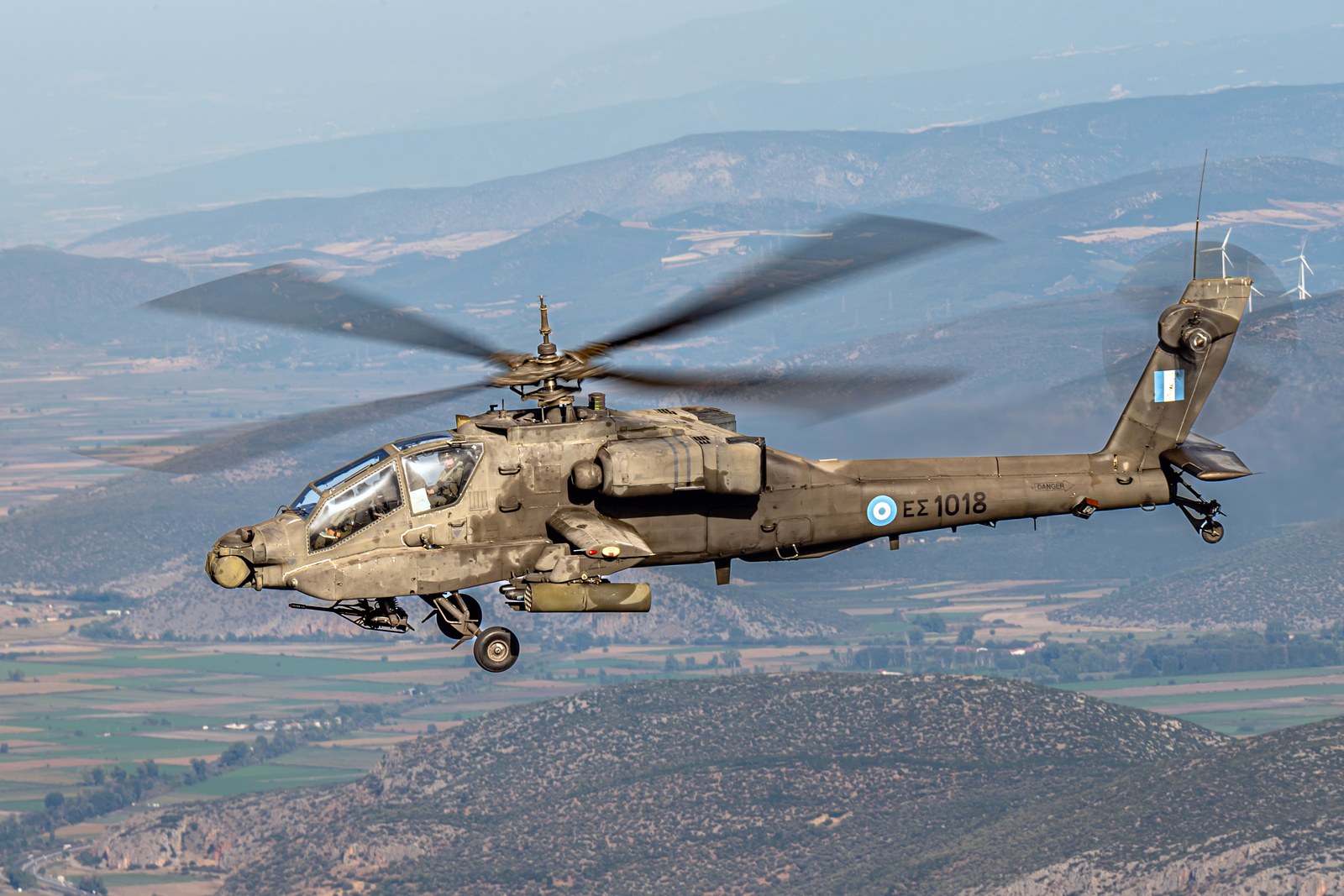
Production was approved on 26 March 1982. The first production Apache, PV01, was rolled out at Mesa, Arizona on 30 September 1983, ahead of schedule. It flew on 9 January 1984 and the Army accepted it on 26 January. The helicopter had not been formally named until 1981.
| Date | What happened |
|---|---|
| 23 March 1966 | Lockheed contracted for ten AH-56 Cheyenne prototypes |
| 19 May 1969 | Cheyenne production contract cancelled for non-performance |
| January to August 1972 | Marks task force writes the Advanced Attack Helicopter requirement |
| 9 August 1972 | Cheyenne programme cancelled |
| 22 June 1973 | Competitive development contracts to Hughes and Bell |
| 30 September 1975 | Hughes YAH-64 maiden flight, Palomar Airport, California |
| 1 October 1975 | Bell YAH-63 maiden flight |
| 7 December 1976 | Hughes design selected; announced 10 December |
| March 1977 | TADS/PNVS development contracts to Martin Marietta and Northrop |
| Winter 1979 to 1980 | TADS/PNVS fly-off at Yuma Proving Ground |
| 14 June to 28 August 1981 | Operational Test II, Fort Hunter Liggett |
| December 1981 | General Accounting Office recommends against production |
| 26 March 1982 | Production approved |
| 30 September 1983 | First production aircraft, PV01, rolled out at Mesa |
| 26 January 1984 | Army accepts its first Apache |
| 22 July 1986 | Initial operational capability |
Between the fly-off and the aircraft reaching a unit there were nine and a half years.
The Apache took nine and a half years to get from a won competition to a squadron. Most of that went on the night sight, which did not exist when the Army chose the aircraft that was supposed to carry it.
The officer who said the numbers were being dressed up
Brigadier General Grail Brookshire ran Operational Test II at Fort Hunter Liggett from 14 June to 28 August 1981, with three prototype aircraft. He wrote about it in Army magazine in May 1992, and the piece was entered into the Congressional Record, which is why it survives.
The aircraft did not work well. Maintenance crews struggled to produce two flyable helicopters out of three on any given day. Brookshire sat in on the reliability scoring conferences as an observer with no vote, and wrote that there was “a definite attempt by the AMC project manager’s office to portray the RAM results as better than they actually were”. He reported it to TRADOC and went on feeling throughout the test that the data was being scored optimistically. In December 1981 the General Accounting Office recommended against starting production at all.
The Army started production anyway, three months later. Congress approved low-rate initial production in the 1982 financial year at $444.5 million for eleven aircraft, which is a little over forty million dollars each in the money of the day, for an aircraft that would eventually cost the Army about $14.4 million apiece across a buy of 807.
His description of what the machine was for is narrower than the slogan the Apache later acquired. The aircraft, he wrote, “was designed to take hits from weapons in the 23-mm and 12.5-mm categories and below, and not only survive but stay in the fight”.
Inside the AH-64 Apache: the gun, the missile and the sight
The airframe is built round the gun, the missile and the sight, rather than the other way about.
The gun. The M230 is a chain gun, which means it is not gas operated or recoil operated. A three horsepower electric motor turns a chain that drives the bolt through its cycle. The advantages are that a dud round does not stop the weapon, the rate of fire does not vary with the ammunition, and the whole thing weighs 127 lb. The operator’s manual puts the rate at “600 to 650 rounds per minute”, which is a set rate rather than a cyclic one. It swings 100 degrees either side of the centreline and from eleven degrees up to sixty degrees down, and its maximum range is about 4,000 metres.
Then there is the duty cycle. Six fifty-round bursts, five seconds apart, and then ten minutes to cool. The Apache carries 1,200 rounds and cannot fire them in one go.
The missile. The AGM-114 Hellfire is a hundred pounds of missile with an eighteen pound shaped charge, and on the A model it rode a laser. Somebody has to put a laser spot on the target and hold it there until the missile arrives. That somebody can be the launching aircraft, another aircraft, or a man on the ground. The operator’s manual gives authorised engagement ranges out to 8,000 metres.
When the shooter is also the designator, which is the usual case, the aircraft has to hold its own laser on the target for the whole flight time of the missile.
The sight. The system that took four years longer than the airframe does two separate jobs with two separate sensors. The Pilot Night Vision Sensor is a thermal imager on the nose that projects a picture onto a monocle in front of the pilot’s right eye, so he can fly. The Target Acquisition Designation Sight is a second turret below it with television, direct-view optics, thermal imaging and the laser, and it belongs to the gunner. Either man can slave the gun to his own helmet: look at something and the barrel goes there.
| Weapon | Carried | Reach |
|---|---|---|
| M230 chain gun, 30 mm | 1,200 rounds; rate set for 600 to 650 a minute | about 4,000 m |
| AGM-114 Hellfire | up to 16 on four M272 launchers, four to a launcher | out to 8,000 m |
| 2.75-inch folding-fin rockets | up to 76, in M261 nineteen-tube pods | fire control solution to 6,000 m with the MK-40 motor, 7,500 m with the MK-66 |
| Typical Gulf War load | 8 Hellfire and 38 rockets per aircraft |
Built on the assumption it would be hit
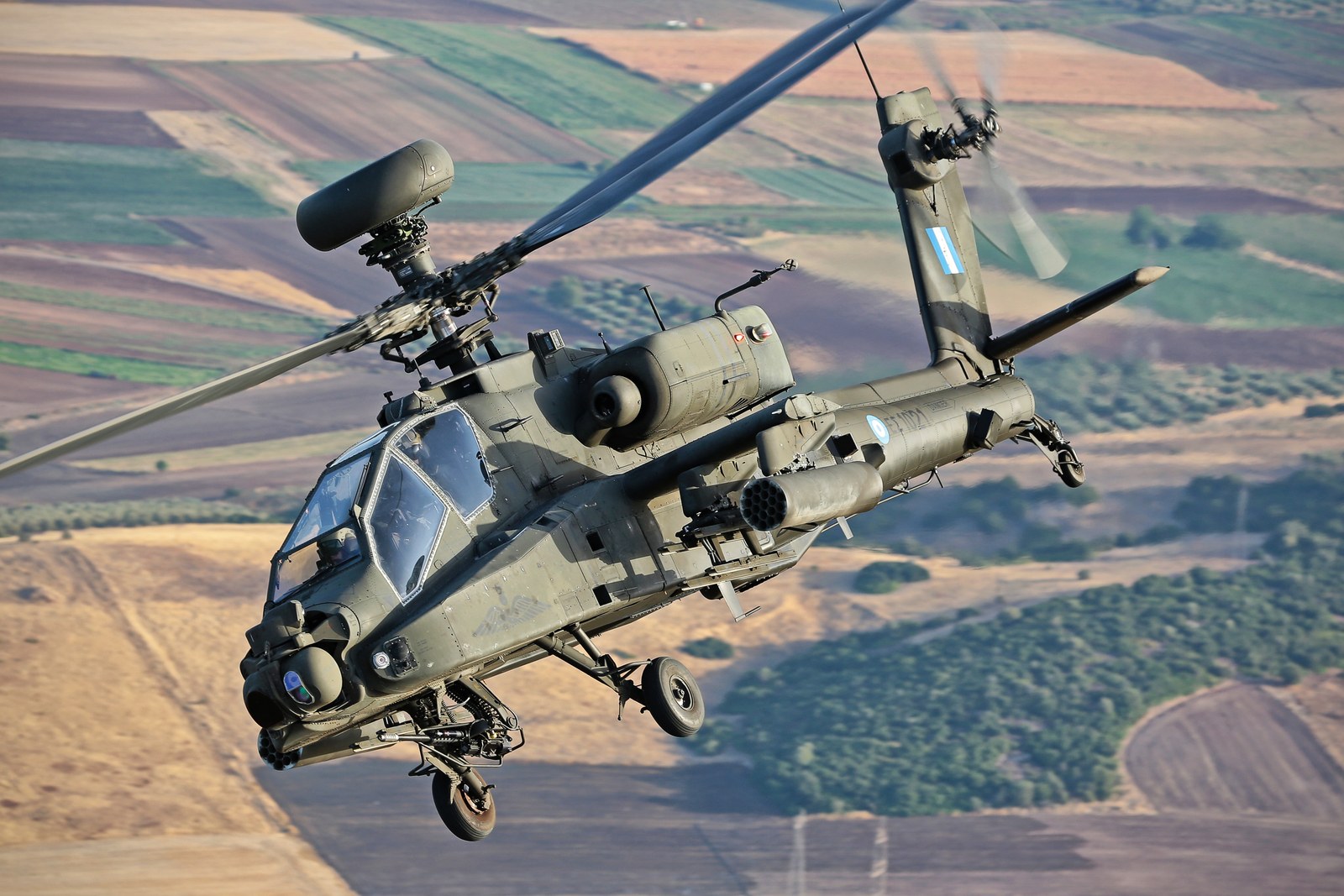
The requirement that shaped the airframe was not a blanket figure, though it is usually written as one. The rotor had to remain flyable after taking a 23 mm high explosive incendiary round. The airframe had to withstand rounds up to 23 mm in critical areas.
It is why the AH-64A main rotor blade was metal, with four interlocked spars, when the industry was going composite everywhere else. No composite blade of the period could meet that requirement at an acceptable weight.
The transmission had to run for thirty minutes with no oil in it. The crew sit in one-piece armoured seats of boron carbide ceramic on a Kevlar backing, developed at the Army Materials Laboratory at Watertown. Between the two cockpits is a transparent ballistic shield of glass and polycarbonate laminate, patented by Army researchers, so that one round cannot kill both men. The canopy frame and that shield together form a rollover structure. And the whole aircraft was built to MIL-STD-1290, which required a 95 per cent chance of surviving an impact at 42 feet per second of vertical closure without spinal or thermal injury.
The demand that shaped the aeroplane was that the rotor survive a 23 mm high explosive incendiary round. No composite blade of the period could do it at an acceptable weight, so the AH-64A flew on metal blades with four interlocked spars while the rest of the industry went the other way.
Panama, and ninety seconds at Rio Hato
The Apache first fired a shot in anger at one o’clock in the morning on 20 December 1989, over Panama. B Company of 1st Battalion, 82nd Aviation, operating as Task Force Wolf, had been at Howard Air Force Base, kept under cover in the hangars, since mid-November.
At Rio Hato, in the minutes between the F-117A bombs falling and the Rangers jumping, two Apaches worked with an AC-130 and four Little Birds against the ZPU-4 anti-aircraft guns covering the drop zone. The fire lasted ninety seconds and accounted for at least one, and perhaps two, of the three guns. That afternoon two Apaches reached the Comandancia in Panama City at a quarter to four and attacked the headquarters building with Hellfires and 2.75-inch rockets.
Over the operation the Apaches flew 246 hours, 138 of them at night. Three aircraft were hit, taking eight, fifteen and twenty-three rounds apiece. All three flew home and all three were back in combat inside thirty-six hours.
17 January 1991, and who actually fired first
Task Force Normandy went in as two teams of Apaches, led by Air Force MH-53J Pave Lows for the navigation, crossing the Saudi border at seventy-five feet and dropping to fifty on the run-in, to take out two Iraqi early warning radar sites and open a corridor for the air campaign. The Hellfires struck at 0238.
The raid is usually described as the first shots of the Gulf War. The Department of Defense’s own final report to Congress says otherwise, in plain terms: “Commitment to hostilities occurred at approximately H-90 minutes when US warships launched TLAM cruise missiles toward targets in Baghdad.” The Navy fired its first Tomahawk from USS San Jacinto in the Red Sea at about half past one, just over an hour before the Apaches shot.
What the Apaches did do is deliver the first ordnance to hit Iraqi soil. The Tomahawks did not begin striking Baghdad until shortly after three. The first bomb fell from an F-117A at about 0251. The DoD report picks its words carefully and says the AH-64s “struck the opening blow of the conflict”, which is not the same claim.
How many Apaches went is a question with four published answers. The DoD report says nine Apaches and three MH-53Js. The General Accounting Office says eight. The Army’s own staff ride packet says eight firing aircraft, one spare, four Pave Lows, two MH-60s for rescue and a UH-60 carrying mechanics. Robert Dorr’s widely copied account says twelve aircraft in total.
Apaches did not fire the first shots of the Gulf War. The Navy did, ninety minutes before H-Hour. What the Apaches did was put the first ordnance on Iraqi soil, twenty-two minutes before it.
The war it was built for, almost
The Gulf was the closest the Apache has come to the war it was designed for, and even then it was not quite that war. There were Soviet tanks and open ground and a lot of night. There was no Fulda Gap and no air defence worth the name after the first week.
The numbers that came out of it have been argued over ever since. The GAO went and counted and arrived at 278 tanks destroyed plus about 900 other targets. Army aviation’s own reporting gave figures above 500, and sometimes above 600 when armoured personnel carriers and artillery were counted in. The Gulf War Air Power Survey records that the larger claim was not reported or verified by Central Command.
One Apache was lost to enemy action and its crew came back uninjured. Eight were hit by enemy fire. Readiness rates were reported at between 80 and more than 90 per cent depending on who was doing the reporting and over what period.
An Apache can carry sixteen Hellfires. In the Gulf it usually did not. A Company, 3rd Battalion, 1st Aviation went into the Adnan Division on the night of 26 February with eight Hellfires and thirty-eight rockets per aircraft, and the aircraft’s own weight and balance tables are built around an eight-missile fit.
A radar on a stick
The thing most people picture when they picture an Apache, the drum above the rotor head, arrived twelve years after the aircraft entered service.
The AN/APG-78 Longbow is a millimetre-wave fire control radar working at 35 GHz, mounted above the rotor so the aircraft can sit behind a ridge with only the radome showing. It classifies what it finds by type and prioritises it. As first fielded in 1998 it saw out to eight kilometres. The current system reaches sixteen.
The missile that goes with it is the AGM-114L, which carries its own millimetre-wave seeker and does not need a laser held on the target. The aircraft can unmask, shoot and drop back behind the ridge without waiting for the missile to arrive.
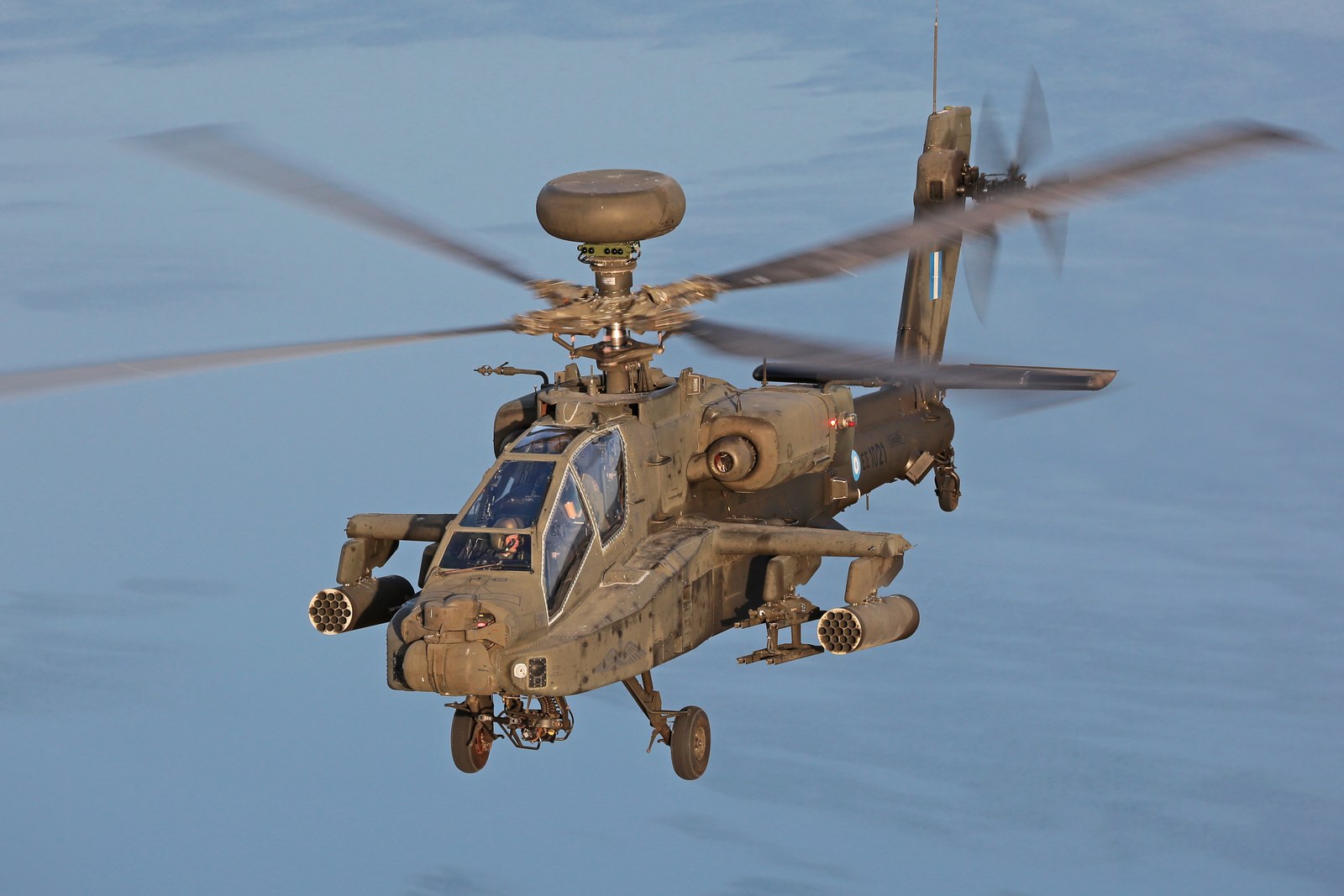
Longbow-capable and Longbow-equipped are not the same thing. The programme was restructured in May 1993 to upgrade the entire fleet of 758 helicopters to Longbow configuration but to fit only 227 of them with the radar itself. In the end the US Army remanufactured 501 AH-64As into AH-64Ds, completing in August 2006, and 227 of those carried a radar. The other 274 did not. A radar-equipped Apache was meant to work with radar-less ones, passing targets to them.
Of the 501 AH-64As the US Army remanufactured into AH-64Ds, 227 got the radar and 274 did not. The ones without it were meant to be fed targets by the ones with it.
Britain buys it and changes the engines
Michael Portillo announced the British choice in the Commons on 13 July 1995. Six bids had gone in: the Agusta A129, the Boeing-Sikorsky Comanche, the Atlas Rooivalk, the British Aerospace and Eurocopter Tiger, a GEC-Marconi and Bell Cobra Venom, and Westland’s Apache. Westland won, with an order for 67 aircraft at about £2.5 billion, at least half the work in the United Kingdom, assembly and transmissions at Yeovil and around 180 British companies involved.
The British aircraft got Rolls-Royce Turbomeca RTM322 engines built in Bristol instead of the American T700, and the reason given to the House was commonality with the engines in the Merlin.
The first production aircraft flew at Mesa on 25 September 1998. The first Westland-built machine, ZJ173, was delivered on 31 July 2000. The in-service date was contracted for December 2000 and achieved in January 2001, two weeks late, on the delivery of the ninth aircraft. All 67 had been accepted by the summer of 2004 and initial operating capability was declared on 14 October 2004.
The National Audit Office put the total acquisition cost, training included, at £4.117 billion. Its report also recorded that the full mission simulator was accepted in December 2001, seventeen months late, and that the requirement for a squadron of eight Apaches to work from amphibious shipping was expected to cost about £30 million more.
| Date | What happened |
|---|---|
| 13 July 1995 | Michael Portillo announces 67 Westland Apaches, about £2.5 billion, beating five other bids |
| April 1996 | Prime contract to GKN-Westland |
| 25 September 1998 | First production aircraft flies at Mesa |
| 31 July 2000 | First Westland-built aircraft, ZJ173, delivered |
| January 2001 | In-service date achieved on the ninth aircraft, two weeks late |
| December 2001 | Full mission simulator accepted, seventeen months late |
| 14 October 2004 | Initial operating capability |
| April to August 2006 | First Afghanistan tour, 656 Squadron, Operation Herrick 4 |
| April 2014 | 50,000 operational hours in Afghanistan announced |
| 11 July 2016 | 50 AH-64E ordered |
| 26 November 2020 | First two AH-64E arrive at Wattisham |
| 23 October 2023 | 3 Regiment Army Air Corps declared ready for duty on the AH-64E |
| 25 March 2024 | Apache AH Mk 1 retired |
| March 2025 | Fiftieth and last AH-64E handed over in Arizona |
The British aircraft went to Afghanistan in April 2006 with 656 Squadron, to Kandahar and then Camp Bastion. Over that first tour the squadron fired 7,305 cannon rounds, eighteen rockets and eleven Hellfires.
It came back in November for a second tour, and early in that one it changed its callsign from Wildman, which kept being confused with American callsigns on the radio, to Ugly. It took ninety-eight people to support the aircraft, more than six of them for every pilot. Its forward arming and refuelling point was a dry lake bed in southern Helmand, seventy kilometres from the nearest water, and the ground crew lived in shell scrapes among wild camels for five days until torrential rain solved the water problem. That is the tour Jugroom Fort happened on.
British Apaches passed 50,000 operational hours in Afghanistan in the spring of 2014, on a sortie flown by Major Simon Wilsey of 664 Squadron. In between they had gone to sea off Libya in 2011 and engaged regime targets thirty-nine times in their first month.
The old aircraft was the Apache AH Mk 1 and it retired on 25 March 2024, with a farewell tour of fifteen locations flown by 656 Squadron. Its replacement is called the AH-64E Apache, with no British mark number.
Fifty were ordered on 11 July 2016 and the programme cost £1.7 billion. The first two arrived at Wattisham in Suffolk on 26 November 2020, the first regiment was declared ready for front-line duty on 23 October 2023, and the fiftieth and last was handed over in Arizona in March 2025. The operational fleet is at Wattisham, with 3 and 4 Regiments Army Air Corps under the 1st Aviation Brigade Combat Team, and the training fleet at the Army Aviation Centre, Middle Wallop.
Britain paid £4.117 billion for 67 Apaches. The simulator arrived seventeen months late, pilot throughput was cut from an estimated 72 a year to 48, and conversion training for all three regiments slipped from April 2004 to February 2007.
Task Force Hawk: the war it never flew
In 1999, during the Kosovo campaign, the Army sent 24 Apaches to Albania. They never flew a combat mission.
The reason the force was enormous was not the helicopters. Albania had no established American base camps and was not judged a stable security environment, so engineering and force protection had to come too. By the time it was assembled, Task Force Hawk had 24 Apaches, 31 support helicopters, 27 multiple launch rocket systems and around 5,100 people, and it had taken on the protection of everyone at Tirana airfield including the Air Force personnel running refugee relief. Rinas airfield could handle about twenty sorties a day. Moving the task force was estimated at two hundred sorties and took more than five hundred C-17 loads, and it had cost $254 million by the end of May.
Two aircraft crashed in training. On 26 April one landed short through pilot error, with no one killed. On 5 May a second went in and both crew died: Chief Warrant Officer 3 David A. Gibbs, aged 38, of Massillon, Ohio, and Chief Warrant Officer 2 Kevin L. Reichert, aged 28, both of 6th Squadron, 6th Cavalry.
The GAO’s report says the force “trained for the mission but was not ordered into combat”. Its focus shifted to using its radars to find targets for other people’s aircraft. And it generated 107 separate remedial action items, of which 47 had been recommended for closure by January 2001 and 60 were still open.
Karbala, and the four days afterwards
The 11th Attack Helicopter Regiment went into Iraq on the night of 23 March 2003 to attack the Medina Division’s 2nd Armoured Brigade south of Baghdad. It is the largest single Apache deep attack the US Army has flown, and it did not work.
The regiment had already had one mission taken off it, aborted for haze and dust, and the Army’s official history records what that had done: “After the aborted mission, morale sank. Some pilots had compared this attack to the 101st Aviation Brigade’s legendary deep attack in Operation DESERT STORM; they, too, were going to be heroes.”
The intelligence was thin and everyone knew it. Captain Karen Hobart, the regimental intelligence officer, had no digital communications forward at the assembly area. She had a satellite telephone, and the history has her standing round it in the open with the regimental commander and the operations officer, listening to the latest intelligence read out loud. Her liaison officer at corps could give her only thousand-square-metre estimates of where company-sized units sat. The corps’ one dedicated unmanned aircraft was on a road move and would not fly. She told Colonel Wolf she had a 75 per cent picture. Wolf had grids for twenty or twenty-five targets and thought he could find the brigade, but only by what he called search and attack techniques.
Then there was the fuel. Fewer than half the planned fuel trucks had arrived. One squadron was fully fuelled, the other partly. Thirty-one aircraft got fuel. The launch slipped two and a quarter hours while crews worked out who had enough, and Wolf found his own command aircraft did not, and waited another forty-five minutes while machines were swapped round so that the leaders were in the ones that could fly. The ground was six inches of what the pilots called moon dust. One aircraft crashed on take-off in the brownout. Thirty got away.
Major Kevin Christensen, the operations officer of 6th Squadron, 6th Cavalry, said this about it afterwards: “But with all the problems, they felt they could get the job done. Everyone was past the point of ‘can’t.’ It did not matter; every ounce of energy was devoted to making the mission work.”
Then the lights went out, and the ground fire came up, and because the aircraft were silhouetted against the town lights it was not the blind shooting it should have been. The history calls it a wall between the aircraft and their objectives.
Chief Warrant Officer 2 John Tomblin, flying the second aircraft out, knew he had been hit because he could smell electrical equipment burning. He looked down, saw a man firing a rifle at him, killed him with the 30 mm and hit a fuel tanker behind him, and the explosion lit the sky. Then a round came into the cockpit and went through the throat of First Lieutenant Jason King in the front seat. Tomblin asked if he was all right and got nothing back, because King’s throat had filled with blood and he could hear everything and answer none of it.
Before the flight King had taken his pressure bandage out of his equipment and put it on the dash where he could reach it. He got it onto his own throat, and eventually said: “I am ok, I am ok, you’re taking fire from the right.” He spent the rest of the flight calling tracer for the man behind him and for the other aircraft. On the ground he would not let the medevac leave in case other pilots had been shot, until the crew told him they had to go now. The surgeon told him the bullet had missed his windpipe. He talked a sergeant major into a ride back to his unit instead of a flight to Germany and went on flying.
Thirty aircraft left. Twenty-nine came back, every one of them damaged, the battalion averaging fifteen to twenty holes per aircraft and one with twenty-nine. The thirtieth force-landed and was destroyed by American forces to stop it being compromised; both its pilots were captured. Two aircraft were flying again inside 24 hours, twelve of seventeen within 96 hours, fifteen within a week and the last two in thirty days. Lieutenant General William Wallace, who ordered the attack, said afterwards that attack aviation “performed a significant role during the fight, but I must admit it didn’t perform the same role that I had envisioned”.
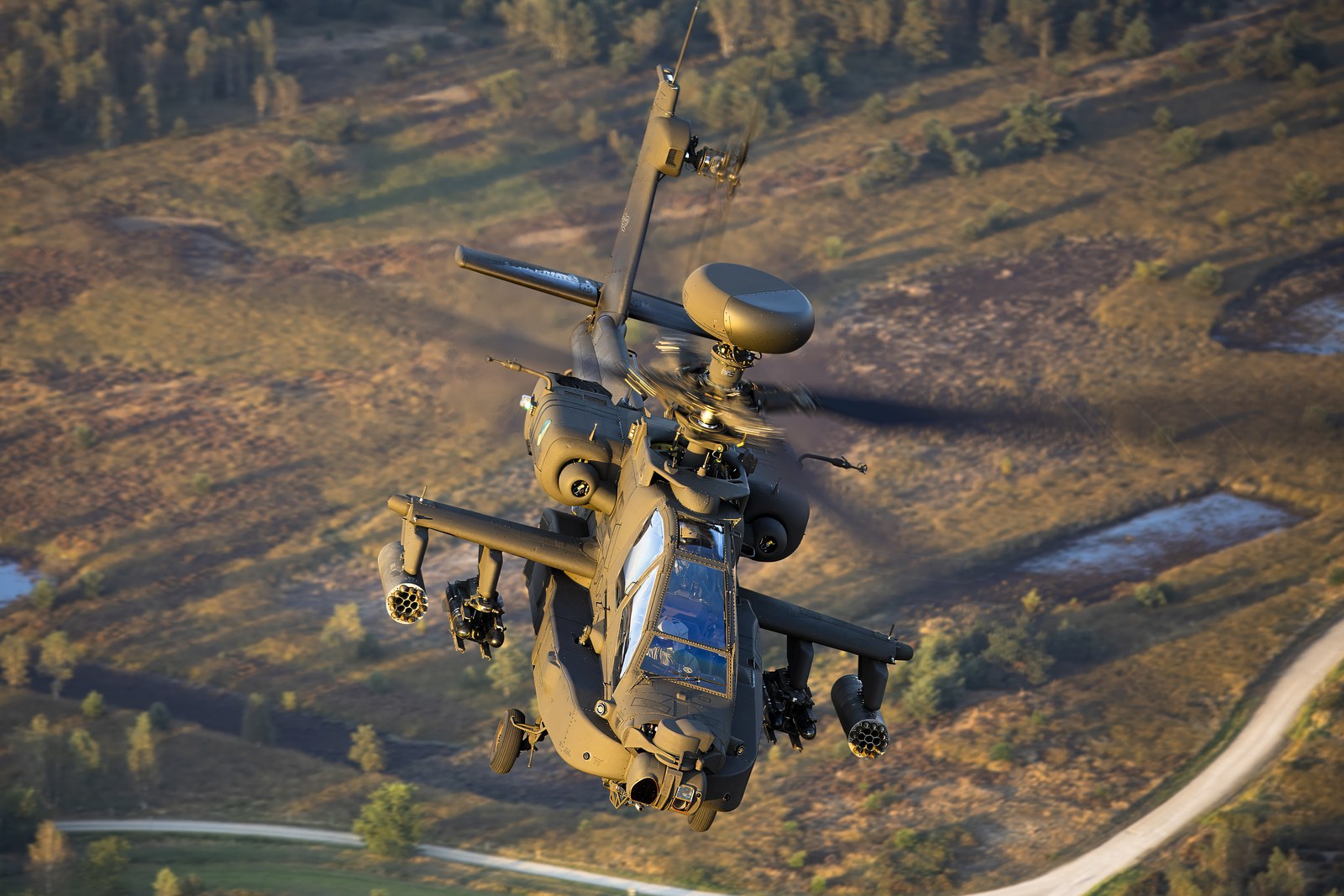
The day after, while the aircraft were being patched, the command group got on a conference call with the 101st Airborne Division’s aviators and handed over everything they had learned, in eleven areas from airborne security to the rules of engagement. On the night of 28 March the 101st flew the same kind of mission against the same division.
Major Bill Gayler of the 101st built a plan in which the rocket artillery fired four minutes ahead of the helicopters rather than thirty, close air support stayed on station instead of leaving, an airborne forward air controller talked the fast jets directly to the Apache crews, the aircraft never hovered and never held a steady airspeed, and every formation kept one aircraft to the rear and one on each flank doing nothing but watching while the others hunted. They assumed they were in a fight from the moment the wheels left the ground.
Aviators are trained to fly over the darkest ground. The Iraqis knew that and had put their guns there. So on the 28th the 101st crews decided that flying over the villages might not be a bad idea.
The lights over Karbala went out and came back on again exactly as the 11th Regiment had reported, and this time it did not matter, because the Apaches were already shooting. The night’s tally, Apaches and fast jets together, was six armoured personnel carriers, four tanks, five trucks, a fibre-optic facility and about twenty men, which the official history says is not a high count by exercise standards, and which mattered because it showed deep attack working against an enemy that had already learned how to beat it. Two of the 101st’s aircraft were wrecked in brownout on take-off.
Four minutes and thirty-three seconds
On 15 January 2007, 45 Commando attacked Jugroom Fort in southern Helmand, the main Taliban forward base in that part of the province, took casualties, withdrew, and then found they were one man short.
An unmanned aircraft found Lance Corporal Mathew Ford lying near the fort, apparently unconscious but, it seemed, alive. A Nimrod and the Apache crew overhead confirmed the sighting. The Chinooks were lifting the first casualties and a second group of critically injured men elsewhere in southern Afghanistan.
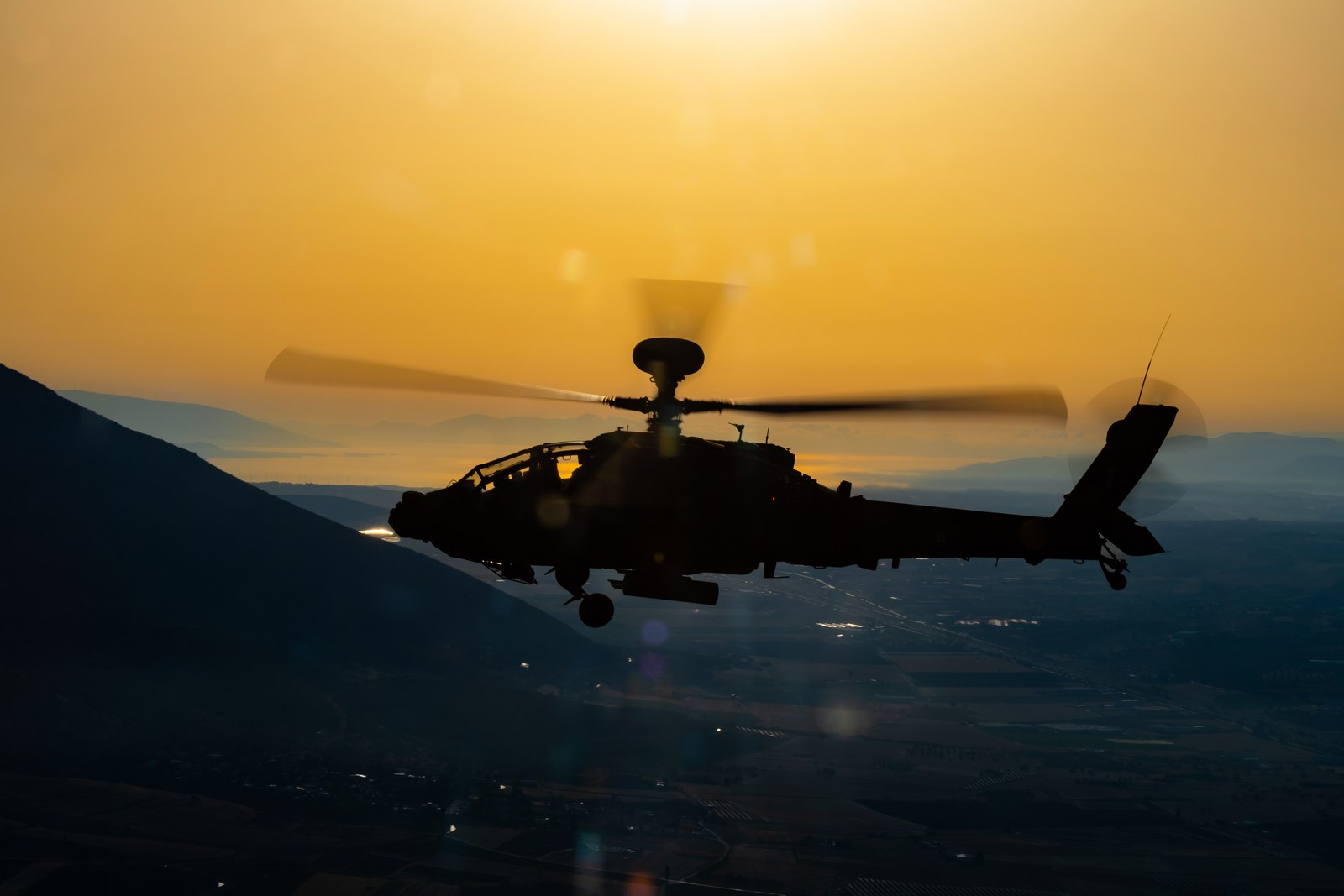
So two Apaches of 656 Squadron’s headquarters flight landed beside the Royal Marines’ command post out in the desert, and four men took hold of the grab handles on the sides of the aircraft and were flown to the fort strapped to the outside: Captain Dave Rigg of the Royal Engineers, the regimental sergeant major of 45 Commando, Warrant Officer Class 1 Colin Hearn, and Marines Chris Fraser-Perry and Gary Robinson. Two more Apaches worked overhead and spent nearly all their ammunition. The men found Ford and strapped him to the side of ZJ224. They were on the ground for four minutes and thirty-three seconds.
Ford was already dead. The Ministry of Defence’s casualty statement says he was shot and killed instantly. The Board of Inquiry reported on 15 August 2008 that it was probable he had been killed by friendly fire and that it could not identify which weapon had fired the shots. It made sixteen recommendations. Jerry Thomas, who commanded 3 Commando Brigade at the time, called the recovery “exemplary and in the best traditions of the UK’s Armed Forces”.
Rigg and Warrant Officer Ed Macy, who was flying ZJ224 with Staff Sergeant Carl Bird, both received the Military Cross. Captain Charlotte Madison, who was there, wrote afterwards: “Watching our gun tape again, I’m shocked to see how many RPGs and volleys of tracer fire miss our aircraft by inches. It’s a small miracle that, of all the aircraft that left Bastion that day, not a single one came back with a bullet hole in it. No physical damage was sustained, but the emotional battering was enormous.”
ZJ224 is now in the Army Flying Museum. It had gone into service with 656 Squadron on 18 August 2003, later worked in Norway, Estonia and Oman, did trials aboard HMS Queen Elizabeth, and was unveiled at the museum by King Charles III on 13 May 2024.
What is flying now
The current aircraft is the AH-64E, called Apache Guardian, which started life as Block III and was renamed in 2012. The engines are T700-GE-701Ds of 1,994 shaft horsepower, the main rotor blades are composite, and the transmission is a split-torque face-gear design that pushes more than 20 per cent more power through the same envelope. Top speed is 164 knots against the D model’s 145, and it grosses 23,000 lb against 20,260.
It can also control unmanned aircraft. There are five defined levels of that, running from simply receiving the drone’s video at one end to flying the aircraft and working its sensors from the cockpit at the other.
Initial operational capability came in November 2013. The US Army’s remanufacture programme is for 622 aircraft, with 478 delivered by the end of 2023, and a separate new-build programme for 79 more. Boeing put the total across all marks at more than 2,875 in 2025, with over 891 E models delivered, nineteen countries flying the type and more than 5.3 million hours on the fleet, of which over 1.3 million are combat hours.
| AH-64A | AH-64D Longbow | AH-64E Guardian | |
|---|---|---|---|
| In service | 22 July 1986 | 1998 | November 2013 |
| Engines | T700-GE-701, later T700-GE-701C | T700-GE-701C on most | T700-GE-701D, 1,994 shp |
| Mast radar | none | AN/APG-78 on 227 of 501 | AN/APG-78 |
| Maximum speed | 145 kt | 145 kt | 164 kt |
| Maximum weight | 17,650 lb; 21,000 lb with auxiliary tanks | 20,260 lb tactical; 23,000 lb ferry | 23,000 lb |
| Rotor blades | metal, four spars | metal | composite |
| Controls drones | no | video only, from 2008 | yes, five levels |
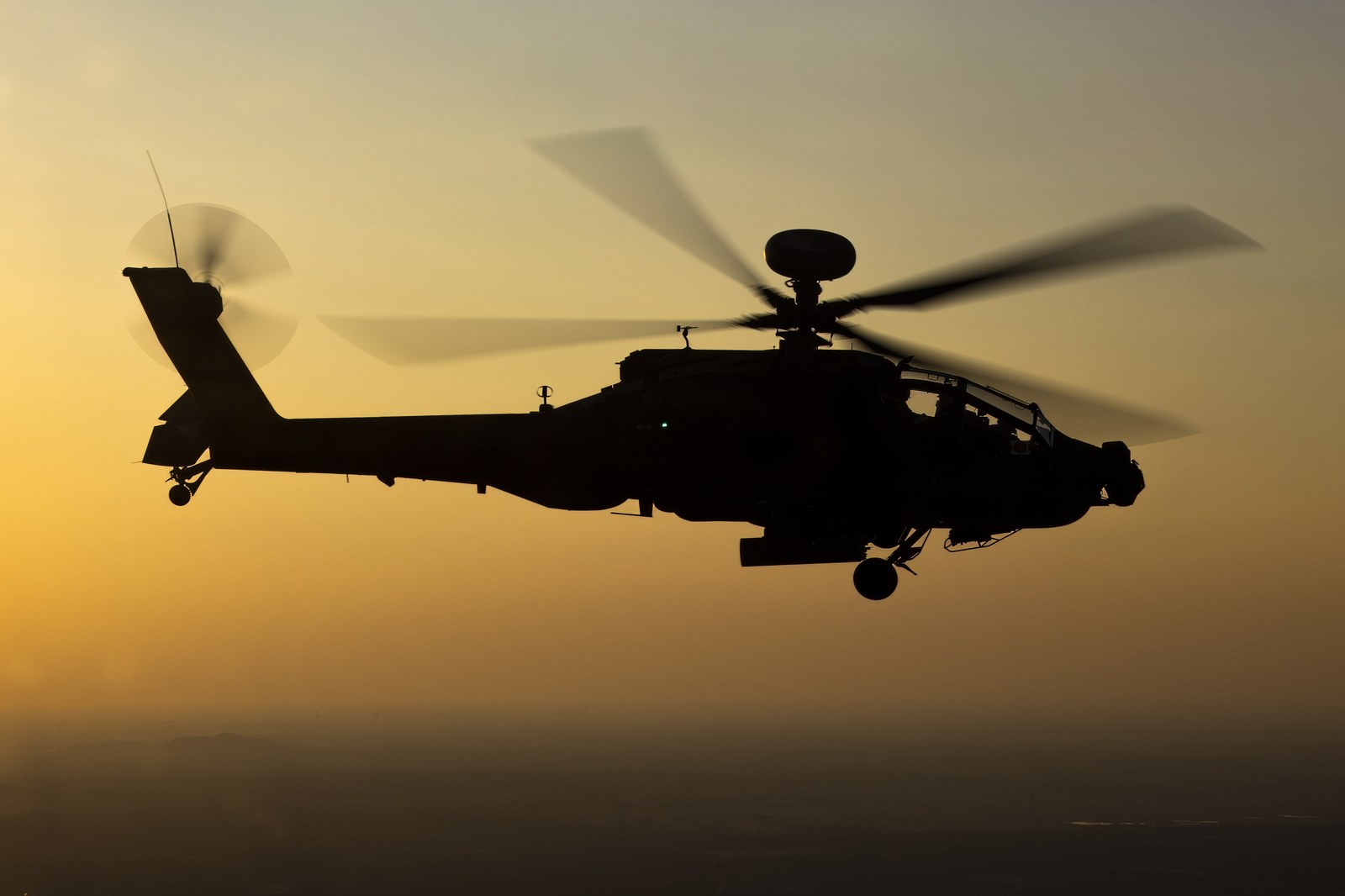
Poland has the largest export order in the programme’s history: ninety-six AH-64E, signed on 13 August 2024 and worth over $10 billion, with deliveries from 2028 and eight American AH-64Ds leased in the meantime to train on. Australia is taking twenty-nine for the 1st Aviation Regiment at Townsville, replacing the Tiger, with deliveries running to 2029. The Netherlands is putting its twenty-eight AH-64Ds through the same remanufacture to Version 6 standard that produced the aircraft photographed on this page.
The US Army is going the other way. Under the Army Transformation Initiative it is divesting the AH-64D and standardising on the E, and Apache procurement funding in the budget request falls from $361.7 million in the 2026 financial year to $1.5 million the year after. Boeing says the E model stays in production into the 2030s and expects the aircraft to serve into the 2060s.
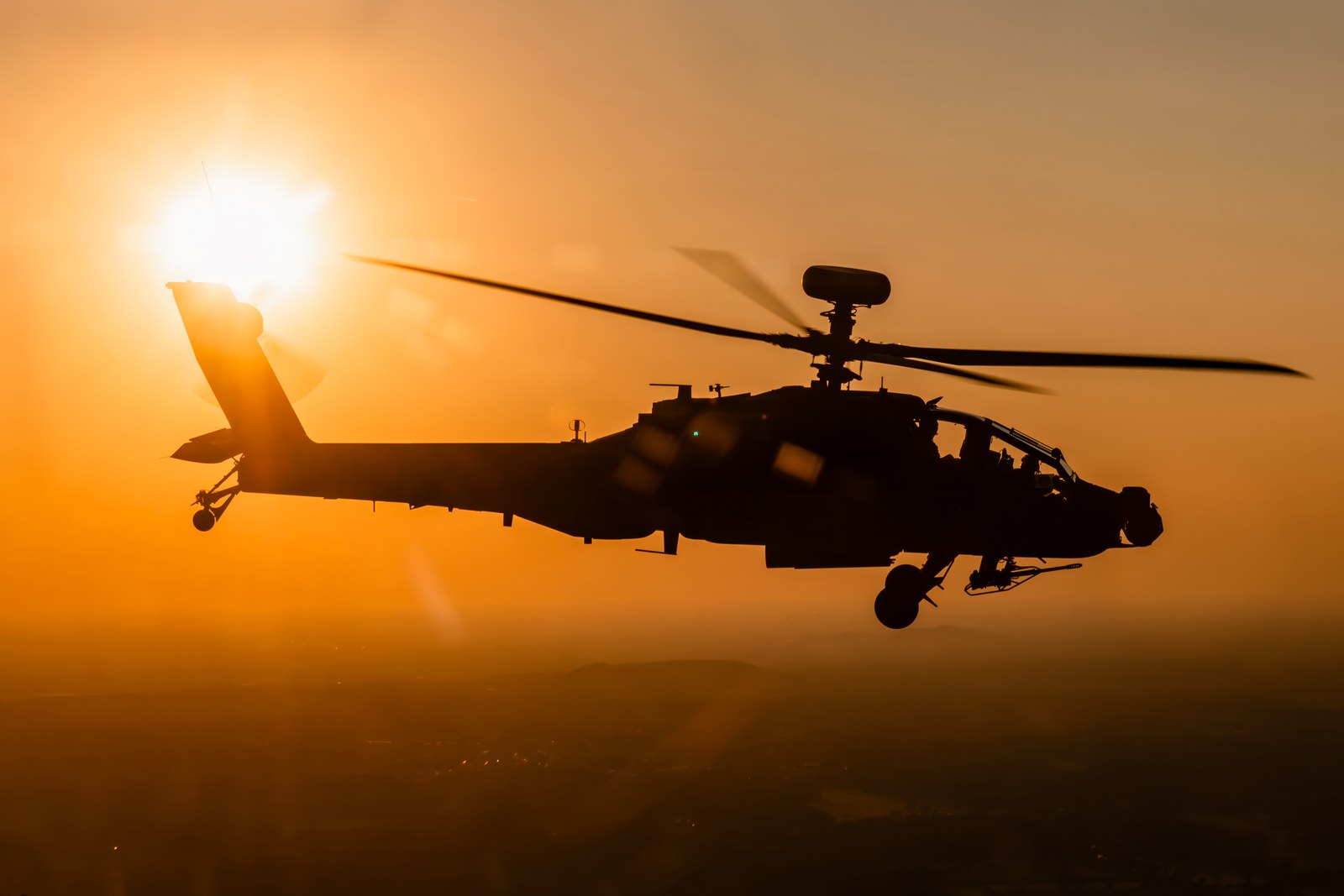
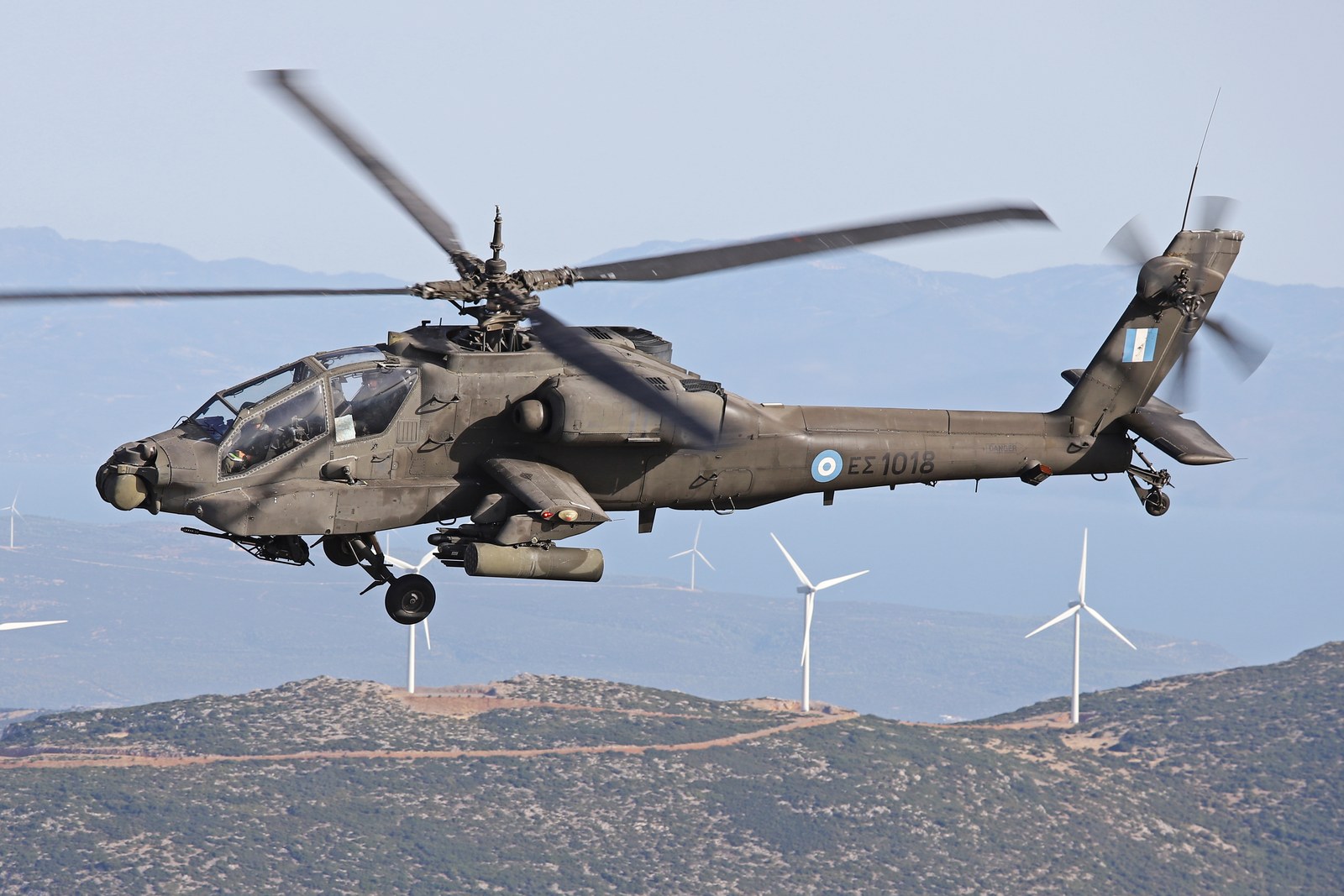
Greece has flown the Apache since 1995, when the Hellenic Army began taking 20 AH-64As, and added 12 AH-64DHA Longbows delivered from 2007. They belong to the Army, not the Navy, and flew for years from Stefanovikio in Thessaly. Storm Daniel wrecked the place on 8 and 9 September 2023 and it lost its airbase status permanently.
Our helicopter photographs cover the type across several operators, and if you shoot rotary yourself the mechanics of photographing helicopters and of air-to-air work are where the Apache frames on this page came from. The registrations and codes on the aircraft above are explained in our guide to military markings and serials. For the fixed-wing side of the same job, the A-10 Thunderbolt II was built to the same Cold War problem and solved it a different way, and the F-35 is what now feeds targets to an Apache’s radar. The Piemags aviation archive is searchable by type, and the terms are in our licences.
Frequently asked questions
Who makes the Apache?
Boeing makes the Apache at Mesa, Arizona. It was designed and first built by Hughes Helicopters, which was sold to McDonnell Douglas in 1984, and McDonnell Douglas merged with Boeing on 1 August 1997. British Apaches were assembled by Westland at Yeovil under licence.
When did the Apache first fly?
The Hughes YAH-64 prototype made its maiden flight on 30 September 1975 at Palomar Airport, Carlsbad, California. The Army chose it over the Bell YAH-63 on 7 December 1976 and announced the decision three days later. The first production aircraft was rolled out at Mesa on 30 September 1983 and handed to the Army on 26 January 1984, and the type reached initial operational capability on 22 July 1986.
What gun does the Apache carry?
The Apache carries one M230 chain gun of 30 mm calibre under the nose, with 1,200 rounds. The rate of fire is set for 600 to 650 rounds a minute. It is driven by a three horsepower electric motor rather than by gas or recoil, traverses 100 degrees either side of the centreline, and reaches about 4,000 metres. It cannot fire continuously: the published duty cycle is six fifty-round bursts five seconds apart, then ten minutes to cool.
How many missiles can an Apache carry?
Up to sixteen Hellfire missiles on four wing pylons, four to a launcher, or up to 76 unguided 2.75-inch rockets, or a mixture. Sixteen is the maximum rather than the normal load. In the Gulf War a typical fit was eight Hellfires and thirty-eight rockets.
What is the Longbow radar?
The Longbow is the AN/APG-78 millimetre-wave fire control radar, working at 35 GHz, carried in a drum above the rotor head so the aircraft can look over a ridge with the rest of the helicopter hidden. It was first fielded in 1998, saw out to eight kilometres then and sixteen now, and works with the AGM-114L Hellfire, which has its own radar seeker and needs no laser held on the target.
Do all Apaches have the Longbow radar?
No. The US Army remanufactured 501 AH-64As into AH-64Ds, finishing in August 2006, and only 227 of those carried a radar. The other 274 were Longbow-capable without being Longbow-equipped, and were meant to be fed targets by the ones that had it.
When did the Apache first go into combat?
Panama, at one in the morning on 20 December 1989, with B Company of 1st Battalion, 82nd Aviation. Two Apaches joined an AC-130 and four Little Birds against the anti-aircraft guns at Rio Hato in the minutes before the Rangers jumped, a ninety-second burst of fire that accounted for at least one of the three ZPU-4s. That afternoon two Apaches attacked the Comandancia in Panama City with Hellfires and rockets. Over the operation the Apaches flew 246 hours, 138 of them at night, and three aircraft were hit without loss.
Did Apaches fire the first shots of the Gulf War?
No. US warships launched Tomahawk cruise missiles at about half past one, an hour before the Apaches fired, which the Department of Defense’s own report to Congress states plainly. What the Apaches of Task Force Normandy did at 0238 on 17 January 1991 was put the first ordnance onto Iraqi soil, because the Tomahawks did not begin striking Baghdad until shortly after three and the first bomb fell from an F-117A at about 0251.
How many tanks did Apaches destroy in the Gulf War?
The General Accounting Office counted 278 tanks and about 900 other targets. Higher figures of more than 500 come from Army aviation’s own reporting, and the Gulf War Air Power Survey records that those were not verified by Central Command. One Apache was lost to enemy action, with its crew recovered uninjured, and eight were hit by enemy fire.
How much damage can an Apache take?
The design requirement was that the rotor remain flyable after a 23 mm high explosive incendiary hit and that the airframe withstand rounds up to 23 mm in critical areas. The transmission had to run for thirty minutes with no oil. The crew sit in boron carbide seats behind a transparent ballistic shield that separates the two cockpits. At Karbala in March 2003 twenty-nine of thirty aircraft came home damaged, one battalion averaging fifteen to twenty holes per aircraft and one machine with twenty-nine.
What is the British Apache?
Britain ordered 67 in July 1995 for about £2.5 billion, built by Westland at Yeovil with Rolls-Royce Turbomeca RTM322 engines instead of the American T700, chosen for commonality with the Merlin. That aircraft was the Apache AH Mk 1 and it retired on 25 March 2024. Its replacement is the AH-64E Apache, with no British mark number. The National Audit Office put the total acquisition cost, training included, at £4.117 billion.
What happened to Task Force Hawk?
Twenty-four Apaches were sent to Albania in 1999 during the Kosovo campaign and never flew a combat mission. Because Albania had no existing American bases, the force grew to about 5,100 people with its own rocket artillery, took more than 500 C-17 sorties to move and cost $254 million by the end of May. Two aircraft crashed in training and two crew were killed on 5 May. The General Accounting Office recorded that the force trained for the mission but was not ordered into combat, and that 107 remedial action items came out of it.
What went wrong at Karbala in 2003?
The 11th Attack Helicopter Regiment attacked the Medina Division on the night of 23 March 2003 with thin intelligence, not enough fuel and a delay of two and a quarter hours. The Iraqis used the town lights to silhouette the aircraft and fired massed small arms from populated ground. Thirty aircraft left the assembly area, twenty-nine returned and all of them were damaged; one force-landed and was destroyed by American forces, with both pilots captured. On the night of 28 March the 101st Airborne flew the same kind of mission with revised tactics and it worked.
What happened at Jugroom Fort?
On 15 January 2007 four men rode strapped to the outside of two Apaches of 656 Squadron to recover Lance Corporal Mathew Ford of 45 Commando from the Taliban base at Jugroom Fort in Helmand. They were on the ground for four minutes and thirty-three seconds. Ford was already dead; the Board of Inquiry reported in August 2008 that he had probably been killed by friendly fire. Captain Dave Rigg and Warrant Officer Ed Macy received the Military Cross. The aircraft, ZJ224, is in the Army Flying Museum.
What is the AH-64E Apache Guardian?
The AH-64E is the current model, renamed from Block III in 2012 and in service from November 2013. It has T700-GE-701D engines, rotor blades of composite instead of metal, and a split-torque face-gear transmission passing more than 20 per cent more power through the same space. It will do 164 knots against the D model’s 145 and grosses 23,000 lb against 20,260, and it can control unmanned aircraft at up to five defined levels of involvement.
How many Apaches have been built?
937 AH-64As had been delivered by late 1996, 821 of them to the US Army. Boeing gives the total across all marks as more than 2,875, with over 891 E models delivered as of late 2025. The US Army bought 807 A models at a total acquisition cost of $11.6 billion, about $14.4 million each.
Which countries fly the Apache?
Besides the United States, operators include the United Kingdom, the Netherlands, Greece, Israel, Egypt, Saudi Arabia, the United Arab Emirates, India, Japan, South Korea, Singapore, Indonesia, Qatar, Morocco, Australia and Poland. Greece’s aircraft belong to the Hellenic Army, not the Navy.
Sources and further reading
- US Department of Defense, Conduct of the Persian Gulf War: Final Report to Congress, April 1992, which carries the AH-64 system appendix and the account of the opening night, including the Tomahawk timing.
- Robert H. Scales, Certain Victory: The US Army in the Gulf War, the official Army history, for Task Force Normandy and the Medina Division attack.
- TM 1-1520-238-10, the AH-64A operator’s manual, for the gun, the Hellfire ranges, the duty cycle and the weights.
- GAO, Operation Desert Storm: Apache Helicopter Was Considered Effective in Combat, but Reliability Problems Persist, NSIAD-92-146, for the counted target figures and the cost per aircraft.
- Fontenot, Degen and Tohn, On Point: The United States Army in Operation Iraqi Freedom, the official history, chapters three and four, for the whole of the Karbala attack.
- Grail Brookshire, “The Birthing of the AH-64A”, Army, May 1992, entered in the Congressional Record, by the officer who ran Operational Test II.
- Chait, Lyons and Long, Critical Technology Events in the Development of the Apache Helicopter, National Defense University, for the survivability requirements and the seat armour.
- Army Historical Foundation, the AH-56 Cheyenne, for the programme the Apache replaced and the two cancellation dates.
- Hansard, House of Commons, 13 July 1995, Michael Portillo announcing the British order, the six competing bids and the engine choice.
- National Audit Office, Ministry of Defence: Building an Air Manoeuvre Capability, the Introduction of the Apache Helicopter, HC 1246, for the British in-service dates, the simulator and the total cost.
- GAO, Kosovo Air Operations: Army Resolving Lessons Learned Regarding the Apache Helicopter, GAO-01-401, 2 March 2001.
- 656 Squadron Association, the Apache era, written by people who were at Jugroom Fort.
- Ministry of Defence, the death of Lance Corporal Mathew Ford.
- Army Flying Museum, Apache AH Mk 1 ZJ224, the aircraft that carried Ford out.
- Boeing, the AH-64 Apache, for the production totals and the E model figures.
- Andreas Parsch, Directory of US Military Rockets and Missiles, the AGM-114 Hellfire.
