Rolls-Royce did not go bankrupt in 1971. It went into receivership on its own board’s application, over a fixed-price contract that sold each RB211 to Lockheed for about £350,000 against a production cost nearer £460,000, and the engines never stopped being made. That is the hinge of a story running from the Eagle of 1915, through the Merlin and the supercharger that made it work at altitude, through jet engines sold to Moscow under a commercial contract, to the Trent that grew out of the engine that had broken the company.
What is on this page
- The Eagle, and the first crossing
- Kestrel, Buzzard, and the racing engine that mattered
- The Merlin
- The two-stage supercharger, and the man who drew it
- Whittle, and what the record actually says
- The deal that made them a jet company
- Welland, Derwent, and the first British jet in service
- The engines that were sold to Moscow
- The Avon, the Conway and the Dart
- Buying the competition, 1966
- The Pegasus, and thrust that points where you want it
- The Olympus, and the only supersonic airliner that worked
- The engine that was sold too cheaply
- The fourth of February
- Two companies called Rolls-Royce
- The Trent, and what the company is now
- Questions people ask
The Eagle, and the first crossing
A Vickers Vimy crash-landed in a bog near Clifden, County Galway, on 15 June 1919. It had left Newfoundland the day before and the crossing had taken 15 hours 57 minutes. Alcock and Brown had made the first non-stop aeroplane flight across the Atlantic Ocean, and they had won the £10,000 the Daily Mail had put up for it, a prize offered in 1913 for a crossing inside 72 consecutive hours and then shelved for the war. What carried them was a pair of Rolls-Royce Eagle VIIIs, running the best part of sixteen hours over open ocean with nowhere to put down.
Four years earlier the company had never built an aero engine. It built motor cars, to a standard of finish that had nothing obvious to do with aviation. What changed that was an Admiralty requirement of 1914 for an engine of about 250 hp. Henry Royce took it on with Albert Elliot and Maurice Olley, and because his health kept him at his home in Kent the work was done at a distance, drawings and wooden patterns going backwards and forwards. The first experimental Eagle ran at Derby in February 1915 at 225 hp. It was past its 200 bhp target almost at once, then at 300 bhp at 2,000 rpm, and the Eagle VIII that came out of that development gave 350 bhp from 20.32 litres on Museums Victoria’s figures, with forged aluminium pistons and pressed steel water jackets.
The point about the Eagle is not the power but how quickly a car firm with no aero experience became the engine everybody wanted. Look at what it went into: the D.H.4 and D.H.9A, the Felixstowe flying boats, the Handley Page O/400 and the enormous V/1500, the F.E.2d, and the Vimy. That is most of what British military aviation did with a big engine in the second half of the war. The Smithsonian puts Eagle production at 4,681, every one built at Derby, of which 3,302 were Eagle VIIIs turned out between 1917 and 1922.
Both of the engines that crossed the Atlantic survive, in the Science Museum, catalogued alongside the Vimy itself, and they very nearly went in as an afterthought. Vickers and Rolls-Royce had asked that the aircraft be displayed near Stephenson’s Rocket, and the museum’s Keeper of Machinery and Inventions, Colonel Parkinson, was unimpressed: it was ridiculous, he wrote, to compare this aeroplane with the Rocket, and future generations would find the Henson and Stringfellow and Maxim models of more interest than a machine which crossed the Atlantic. The Under-Secretary of State for Air, General John Bernard Seely, thought it a far more interesting relic than many other things which have been kept, such as the Rocket. Seely was right, and the two Eagles are still there.
Kestrel, Buzzard, and the racing engine that mattered
The engine that carried Rolls-Royce into the 1930s was the Kestrel of 1927. Grace’s Guide has it answering the American Curtiss D-12 with cast cylinder blocks, drawn by Arthur Rowledge, who had designed the Napier Lion and moved from Napier to Rolls-Royce to do it, and cooled by a pressurised system holding the coolant’s boiling point at around 150 degrees Celsius. Neither decision is glamorous. Both let an engine be built in quantity and run hot without boiling its own water away, and everything after the Kestrel rests on them.
The Buzzard was the Kestrel scaled up for bigger aircraft. From the Buzzard came the R, the engine built to win the Schneider Trophy. Grace’s Guide gives the R as a 36.7-litre V12 developed from the Buzzard and rated at over 2,500 hp, a startling figure for the early 1930s and one no institutional catalogue online will confirm.
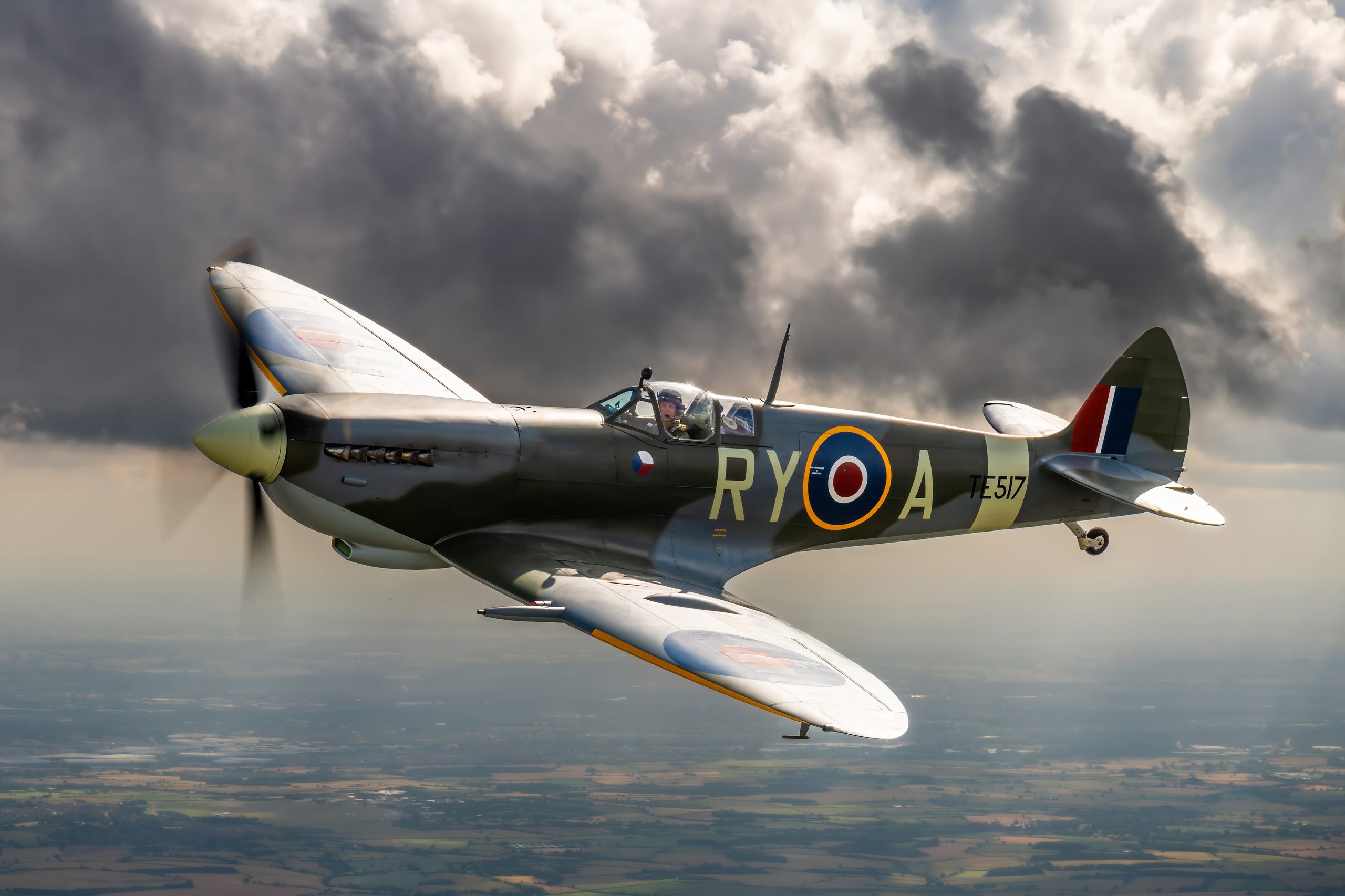
What the institutions carry is the racing. The Science Museum holds R engine number 27, catalogued as an engine developed for the 1931 Schneider Trophy seaplane and flying boat races, flown at Calshot Spit on Southampton Water. It also holds Supermarine S.6B S1595, the aircraft that won that contest, designed by R J Mitchell and powered, in the museum’s own words, by a supercharged Rolls-Royce R V-12 of 1900 hp. Two weeks after the race the sister airframe, S1596, set an absolute speed record of 407.5 mph. The two aeroplanes get merged into one in almost every retelling.
This part is routinely told backwards. The R did not become the Merlin. The Merlin came from the PV-12, a private venture design of the early 1930s in the 1,100 hp class, and the engine that actually descends from the R, at the same capacity, is the Griffon. What the R gave the Merlin was not architecture but knowledge: how to supercharge an engine hard, what fuel chemistry would tolerate it, and which materials would survive maximum output for the length of a race. A Schneider engine had to hold together for minutes, which is a poor test of endurance and an excellent test of limits, and the limits were what Rolls-Royce needed to know. Racing did not hand the company a war engine. It handed it the education to design one.
The Merlin
The PV-12 was privately funded, which is what the letters stand for, and the company took no government money to start it. It made its maiden flight in 1935 in the nose of a Hawker Hart, using an evaporative cooling system that proved unreliable; conventional liquid cooling replaced it once ethylene glycol became available from the United States. By 1936 the Air Ministry wanted a fighter capable of well over 300 mph. Both aircraft that answered, the Hurricane and the Spitfire, had been designed around the PV-12 as private ventures before anybody ordered them, and production contracts for both were let that year. The engine and the two airframes arrived together, which is rarer and luckier than it sounds.

The early marks were not good. The Merlin I had a one-piece block and crankcase with a ramp head intended to control detonation, and the expected benefits did not materialise; 172 were ordered anyway, for the Fairey Battle, while a conventional flat head was drawn. The Merlin II got that flat head, with the cylinder blocks separated from the crankcase and the heads integrated, partly so an engine could be repaired more cheaply after a serious failure. It was delivered at 1,030 hp from 1938. The Merlin III was the mark cleared for the 100-octane fuel that arrived from the United States in June 1940, and it is the engine the Science Museum describes as fitted to the Spitfires and Hurricanes of the Battle of Britain. The Merlin XX took the higher boost that better fuel allowed and reached 1,300 hp, and it changed the coolant from pure glycol to a 70/30 water and glycol mixture, which let the engines run some 70 degrees cooler and removed a fire hazard, ethylene glycol being flammable. The Merlin 45 went into the Spitfire V. At the far end of the line the Merlin 130 and 131, for the de Havilland Hornet, gave over 2,070 hp.
Reliability was the real achievement, and it was engineered rather than inherited. Early Merlins broke. Rolls-Royce answered with a programme of taking production engines at random, running them flat out until something let go, then finding the cause and modifying the part. Do that for long enough and you end up with an engine that will hold full power for an eight-hour bombing mission, which is where the Merlin finished the war.
One famous weakness was never designed out. The Merlin was carburetted rather than fuel-injected, a deliberate choice calculated to give higher specific power because the cooler, denser mixture packed more into the cylinder. The cost was that a Spitfire or Hurricane could not bunt into a negative-g dive the way a Bf 109E could, so RAF pilots half-rolled first. The palliative arrived in March 1941, a holed diaphragm fitted across the float chambers, the work of Beatrice “Tilly” Shilling of the Royal Aircraft Establishment at Farnborough. It is one of the few pieces of wartime engineering everybody remembers by the name of the person who did it.
The Merlin’s other career was American. The British Air Purchasing Commission had specified and ordered the P-51 from North American Aviation in 1940, powered by an Allison V-12. In April 1942 Ronnie Harker, a Rolls-Royce service liaison pilot, flew one, was impressed by its aerodynamics and proposed putting a Merlin 61 in it. Hucknall made the trial installation and the aircraft made its maiden flight from there on 13 October 1942, the American Packard-Merlin installation following a few weeks later.
Packard’s build was a licence production, and “the same engine made in America” is not quite what that means. The substantive differences were in the fuel supply arrangements and in the drive to the two-speed supercharger. Rolls-Royce had tried an epicyclic two-speed drive with freewheel clutches in 1931, for the Kestrel, found it unsatisfactory, and licensed the French Farman system instead, at a cost of three inches of engine length. The Farman gearchange clutches then gave trouble on engines rated above the Mk X, cured by attending to the flatness of the clutch plates. Packard went back to epicyclic gears, beginning with the V-1650-3. That is the real distinction: not that the Americans made it better, but that they took a different route round a gearing problem Rolls-Royce had already been down once.
The Ford shadow factory at Trafford Park in Manchester attracts a story every reader of aviation history has met. Ford, it is said, looked at Rolls-Royce’s Merlin drawings, found the tolerances looser than Ford was prepared to work to, and declined to build the engine until every part had been redrawn to Ford’s own standard. Take that as folklore, because that is what it is: it appears on no institutional source, not in the museum records, not in Grace’s Guide, not in the scholarly literature, and its likely origin is a printed heritage account nobody online has cited. It is suspect on its own terms too: a mass-production tolerance and a hand-fitted tolerance are different specifications for different purposes, and looser is not the same as worse. What is documented is the bare fact: Merlins were originally made at Derby, and new lines were established at Crewe, Glasgow, Manchester and later in the United States.
Which brings up the numbers, and one thing has to be said plainly and once: no institutional source online publishes a precise itemised total for the Merlin, which is the one engine where the number is most often quoted to the unit. The authoritative breakdowns are in print, principally in A. Harvey-Bailey’s The Merlin in Perspective: the combat years. Of what is online, the Science Museum Group says over 150,000 Merlins were manufactured; Grace’s Guide, citing Wikipedia, gives 168,176, with a breakdown across Rolls-Royce, Packard, Ford at Manchester and Continental at Muskegon that does not sum to its own total, and says “over 150,000” elsewhere on the same page. The span is over 150,000 to a little under 169,000, and anyone quoting a confident round number is repeating somebody rather than counting.
The Griffon followed because the Merlin was being pushed. It had been driven into the 1,500 hp range and beyond, and the two other big Rolls-Royce piston projects, the Peregrine and the Vulture, were cancelled in 1943. The Griffon offered 36.75 litres against the Merlin’s 27 in a comparable installed size, with the R’s development history behind it. Rolls-Royce then fed the Merlin’s supercharger work back into it, the Griffon 61 taking a two-speed two-stage supercharger with after-cooler on the pattern of the Merlin 61, and later Griffons a two-stage, three-speed arrangement. It powered the later Spitfires, the Firefly and the Spiteful, and stayed in service longest in the Avro Shackleton. These Griffon details come from Grace’s Guide and are carried by no institutional record.
The two-stage supercharger, and the man who drew it
Stanley Hooker was born on the Isle of Sheppey in Kent on 30 September 1907 and took a first in mathematics at Imperial College in 1931. In 1938 he became head of Rolls-Royce’s Supercharger and Engine Performance Section at Derby, a job title that undersells what happened next. The Merlin’s power at height was set by how well it was supercharged, and the supercharger was the part with the most left in it.
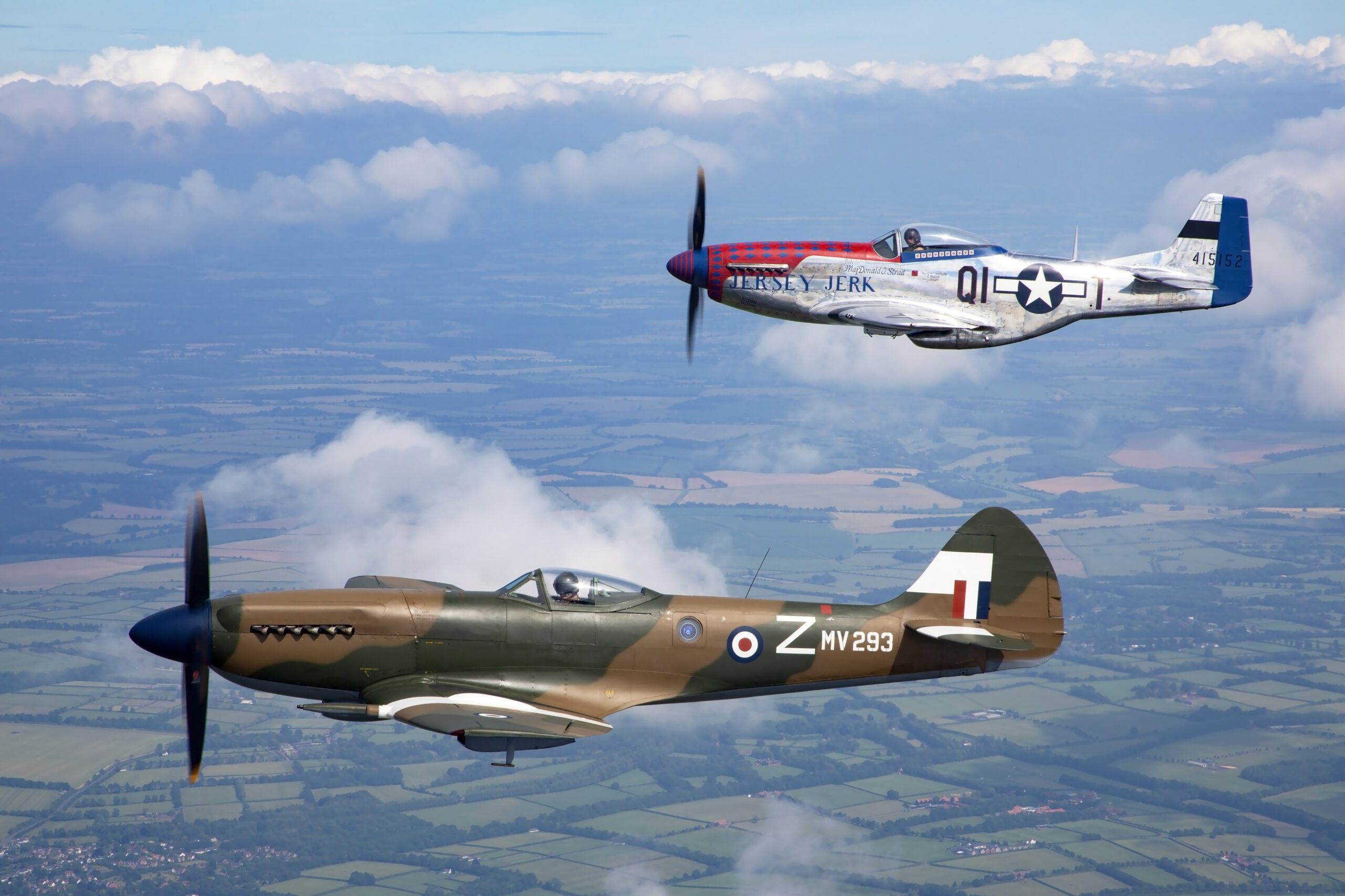
The answer was the Merlin 61, and The Engineer described it on 18 December 1942, while it was still news. Two superchargers in series on a common shaft, the charge passing from the first stage through a cooled passage into the inlet of the second, and then out of the second stage into a cooler supplied from an air-cooled radiator before it reached the main induction pipe. There is a water-jacketed passage between the two stages as well, and two speeds, so the drive ratio could be changed as the aircraft climbed. The Engineer put the result in the terms a 1942 reader would care about: at 40,000 feet the charge reaches six times the pressure of the surrounding atmosphere; the engine doubled the power output of the original Merlin III; and at 20,000 feet the output was 50 per cent larger than the original’s.
Read that again, because it is easy to skim. The same 27 litres, the same bore and stroke, a compression ratio of 6.0:1, 1,600 lb dry, and half as much power again at 20,000 feet as the engine that fought the Battle of Britain. Nothing was added to the cylinders. The gain came from what was fed into them, and operationally it moved the fight upstairs: a fighter that keeps its power at height arrives above the one that does not.
Hooker’s efficiency figures for the Merlin blowers are quoted everywhere and belong to his own memoir; what his peers said about him is better sourced and says more. The American National Academy of Engineering’s memorial tribute after Hooker’s death in 1984, written by Gerhard Neumann, quotes Ronald Smelt crediting him as the engineer who industrialised Whittle’s concepts and so established the aircraft turbine industry in England. Hooker met Whittle in 1940 and was instrumental in Rolls-Royce entering jet engine development, and in January 1943 he went to Barnoldswick as chief engineer. The man who got the last of the altitude out of the Merlin spent the second half of the war on the engine that would make it obsolete.
The Merlin’s second life was won in front of the cylinders, in a two-stage supercharger that gave the same 27 litres half as much power again at 20,000 feet. Rolls-Royce learned how on a racing engine.
Whittle, and what the record actually says
Frank Whittle’s WU first ran on a test bench on 12 April 1937. Power Jets Ltd had been formed the year before, with British Thomson-Houston at Rugby contracted to build the thing, and that run is where the British jet engine stops being paper and becomes hardware. The paper is where the familiar story goes wrong.
The version most people carry runs thesis, patent, engine, in a clean line from a cadet at Cranwell to a Meteor over Kent. The first link does not hold. Whittle submitted “Future Developments in Aircraft Design” at the end of his fourth and final term as a pilot cadet at the RAF College, Cranwell, in June 1928. The staff tutor thought it showed much careful and original thought and a good deal of private reading. What it does not contain is the jet engine. Fred Starr, writing in the Royal Aeronautical Society’s Journal of Aeronautical History, puts it flatly: contrary to what most people think, the thesis “does not describe the jet engine, or even give any real recognition of jet propulsion as a viable means of powering aeroplanes”.
The thesis is a systems argument: fly very high and very fast, pressurise the cockpit, and drive a high-speed propeller with a gas turbine. What Whittle invented, on Starr’s reading, was a way of combining the best characteristics of the piston engine with the gas turbine while avoiding materials problems that were then insuperable. The turbojet came the following year, and the patent, “Improvements relating to the propulsion of aircraft and other vehicles”, was filed on 16 January 1930. A year is nothing in a life and everything in a narrative.
The second thing the tidy version gets wrong is Griffith. A. A. Griffith of the Royal Aircraft Establishment is cast as the man who blocked the jet, and he is the wrong villain. His 1926 RAE report, classified Secret and kept that way for years, was described by Hayne Constant in a lecture of 1945 as the first practical proposal to use a gas turbine as an aeroplane powerplant. His turbo-compressor rig, a single-stage turbine driving a single-stage compressor with a rotor tip diameter of four inches, was under test from early 1929 and reached a stage efficiency of about 91 per cent; it is in the Science Museum. And in early 1935 Griffith himself proposed a simple turbojet of Whittle’s type as the powerplant for an unmanned bombardment aircraft. F. W. Armstrong says that probably makes it the first specific gas turbine scheme put forward in Britain for a particular aircraft, and that it shows Griffith was not basically prejudiced against the pure jet, as some have implied.
What did happen is colder and more ordinary. Whittle was interviewed in 1929 by W. L. Tweedie of the Directorate of Scientific Research and by Griffith, then head of the Air Ministry Laboratory. It did not go well: Griffith appears to have thought the young officer’s assumptions too optimistic, Whittle thought Griffith could have been more supportive, and the two never generated a close rapport. On 5 December 1929 Tweedie wrote to say that no support would be forthcoming and that the patent would be regarded as not being of official interest, meaning there was no restriction on open publication. Publication followed, and the patent became available internationally. That is the documented consequence of a bad meeting, and more serious than a snub.
The Aeronautical Research Committee then considered Griffith’s own proposals. Its panel, chaired by H. T. Tizard, reported in April 1930 that the superiority of the turbine over the reciprocating engine could not be predicted at the present state of knowledge, and that it had no intention of advocating the large expenditure development would probably involve. It recommended further research all the same, and nothing was done. Griffith returned to Farnborough in 1931 in charge of engine research, and no further RAE experimental work on gas turbine powerplants was done for more than six years. Armstrong says the reasons are not firmly known because no relevant documentation has come to light.
The fair reading is not that a great man was obstructed by small ones. Britain had two independent routes to the gas turbine, Whittle’s centrifugal turbojet and Farnborough’s axial compressor line, and both stalled in the early 1930s. Both restarted from 1936, and the country was fortunate to have kept hold of both. Whittle’s achievement is not in question. The line drawn through it is.
The deal that made them a jet company
Rolls-Royce did not invent the jet engine and did not build the first British one to fly. It bought its way in. In early 1943 the company took over the W.2 from the Rover Company, and with the design came the works at Barnoldswick, 32 W2B engines, and four of the straight-through W2B/26 engines that Adrian Lombard had developed at Rover. Lombard went with them, and in time became chief engineer of Rolls-Royce.
What changed hands was not a paper scheme. The W2B was 43.5 inches in diameter, with a 19-inch double-sided impeller, ten reverse-flow combustion chambers and a single-stage turbine, and it weighed about 850 lb. One had already flown in the tail of a Wellington test bed, Z8570/G, out of Hucknall on 9 August 1942. What it was not was reliable, and the proximate reason it moved was that relations between Power Jets and Rover had broken down.
Jakob Whitfield, whose history of the British gas turbine is built on the National Archives files, is unambiguous about what the transfer did. What saved the W.2 was the intervention of Rolls-Royce, which had the development resources to turn it into a reliable engine and soon began a complete redesign for greater power. He is equally clear that Rover has been under-credited, its part overlooked because of the company’s fractious relationship with Whittle. Rover’s staff had been redesigning Whittle’s engines for production, and Lombard’s later career is the evidence that the talent was there.
The Ministry of Aircraft Production had created a gas turbine deputy directorate under Harold Roxbee Cox in December 1942, upgraded to a full directorate the following year. The machinery for managing exactly this kind of transfer had just been built, and then a transfer occurred.
The version everybody tells is a dinner. Ernest Hives of Rolls-Royce invited Spencer Wilks of Rover to eat with him and proposed a swap, Rover’s jet works at Barnoldswick for the Rolls-Royce tank engine plant at Nottingham, and that is a story Stanley Hooker told in his memoir long afterwards, with no archival account of the negotiation published to set beside it. The exchange itself is real: Barnoldswick went one way and the tank engine work the other. It is worth being exact about what that means. The company that would build the Welland, the Derwent, the Nene and the Avon entered the business by taking on somebody else’s engine in somebody else’s factory, and then out-developing everyone who got there first.
Welland, Derwent, and the first British jet in service
The Welland was the W2B/23, the Whittle layout with its reverse-flow combustion chambers, cleaned up and made to hold together. It was the first British production turbojet, and 167 were dispatched from Barnoldswick from October 1943. The first production Gloster Meteor Mk.1, EE210/G, flew on a pair of them on 12 January 1944 with Michael Daunt at the controls.
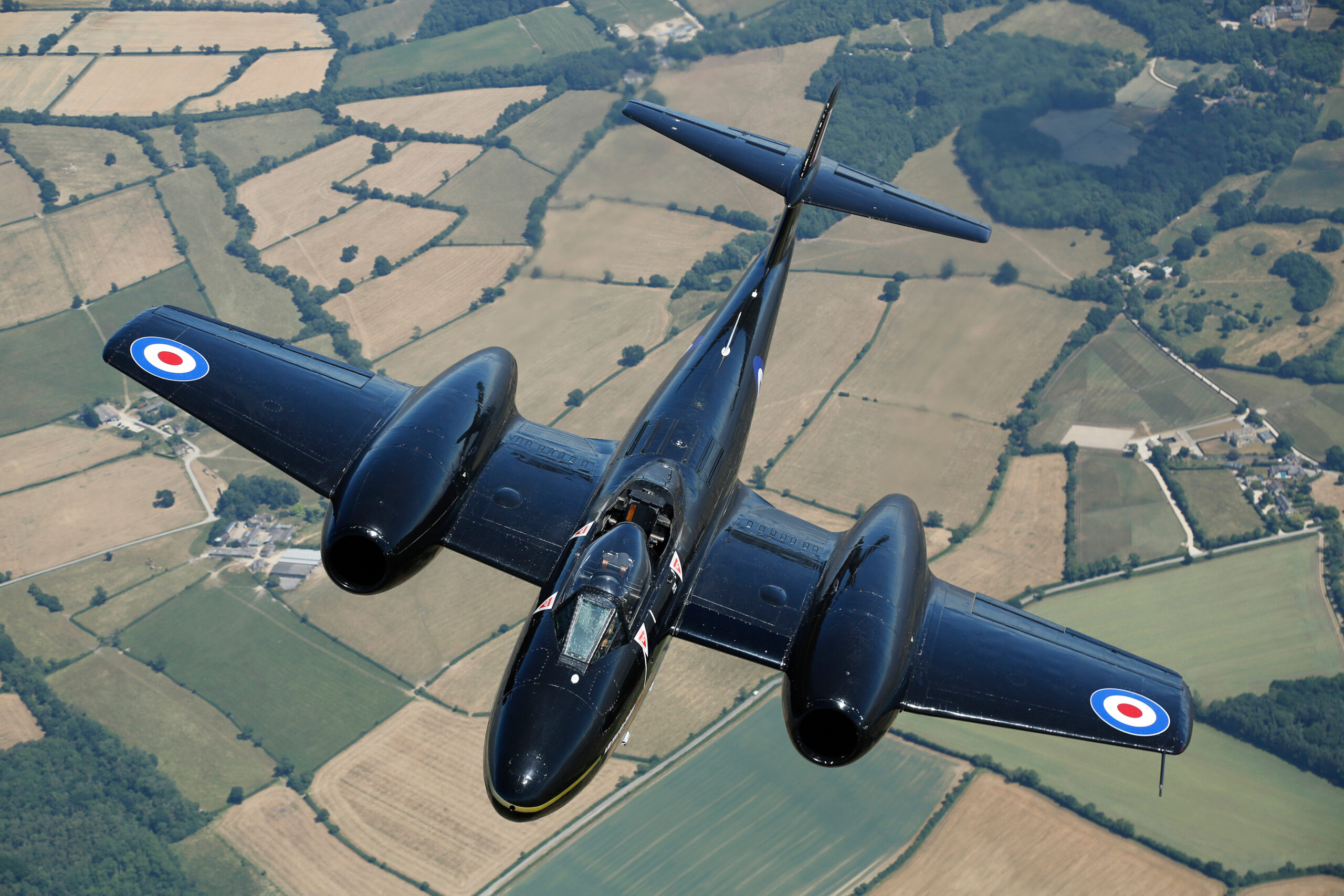
One correction belongs here. The first Gloster F.9/40 prototype to fly did not fly on a Whittle-derived engine at all. It flew on Frank Halford’s de Havilland H.1, contracted by the Ministry of Aircraft Production in 1941 and tested in April 1942. Britain’s first jet fighter prototype went into the air on another firm’s engine, and the Whittle line caught it up afterwards.
What No. 616 Squadron received from 1944 gave 1,600 lb of thrust and was rated at 180 hours between overhauls, which says as much about the state of the art as any thrust rating. From Manston the squadron first engaged V-1s on 27 July 1944 and destroyed the first of thirteen on 4 August. EE210/G itself crossed the Atlantic, traded for a Bell YP-59 Airacomet with General Electric J31s, and was flown at Muroc by John Grierson on 15 April.
The Derwent was the answer to the Welland’s layout. Drawings started in April 1943 and it passed a 100-hour type test at 2,000 lb thrust in November of the same year; it flew in a Meteor in April 1944, rated at 1,800 lb and weighing 920 lb. The change was in the gas path. The Welland turned the flow back on itself and the Derwent ran it straight through, and the Derwent I was held to the Welland’s diameter because it had to fit the same Meteor nacelle. By the Derwent V there were so many changes that the RAF Museum calls it virtually a new engine. The Smithsonian puts total Derwent production at over 9,700, ending in 1954 with the Mark 8.
Then the record. On 7 November 1945 Wing Commander Hugh Joseph Wilson flew Meteor F Mk.IV EE454 four times over an eight-mile course between Herne Bay Pier and Reculver Point on the Thames Estuary. Vintage Aviation News gives his average as 606.26 mph. Eric Greenwood followed an hour later in EE455 and averaged 603.122, and both were credited with official world records. It was the first time a jet-powered aircraft had taken the world air speed record. In September 1946 a Meteor raised it to 616 mph. The engines were Derwent Vs, which Grace’s Guide has as scaled-down Nenes, and the Nene is where this story turns strange.
The engines that were sold to Moscow
On 22 November 1948 Mr Donner asked the Minister of Supply when the decision had been taken to sell the Rolls-Royce Nene to the USSR, how many had gone, at what price, and whether further deliveries were intended. The answer is the whole of the accessible record, and it is not the story that gets told.
G. R. Strauss replied that Rolls-Royce had been given permission in September 1946 to sell ten Nene engines to Russia, and in March 1947 to sell a further fifteen. None had gone to Czechoslovakia or to any other country that could be described as under Soviet influence. No further sales were contemplated. Then the sentence that settles the matter: the selling price of the engines was fixed under a commercial contract.
Donner pressed. Did the Minister realise the sale had saved Russia years of research, and how did he justify it? Strauss gave a licensing answer rather than a strategic one, which was that none of these engines was on the secret list. Edgar Granville asked him to confirm it, and he did. Asked separately how many British jet engines had gone to the USSR and when, Strauss said fifty-five during 1947. Asked why the policy had changed, he said one of the reasons was that inquiries had not been completed.
Fifty-five engines went in 1947 and at most twenty-five were Nenes, so thirty are unaccounted for in the debate. The Rolls-Royce Heritage Trust’s own history of the episode is titled for the Nene and the Derwent in the Soviet Union, which is as near an answer as the public record offers. And by November 1948 the policy had already reversed, with an investigation running in public two years after the first permission was granted.
Which disposes of the version most readers will have met, that the Nenes were handed over as a gesture of goodwill, because a Minister of Supply told the House of Commons that the selling price was fixed under a commercial contract. The goodwill story reaches people through Wikipedia and the sites that copy it, and it travels well because the number attached to it, twenty-five, is correct.
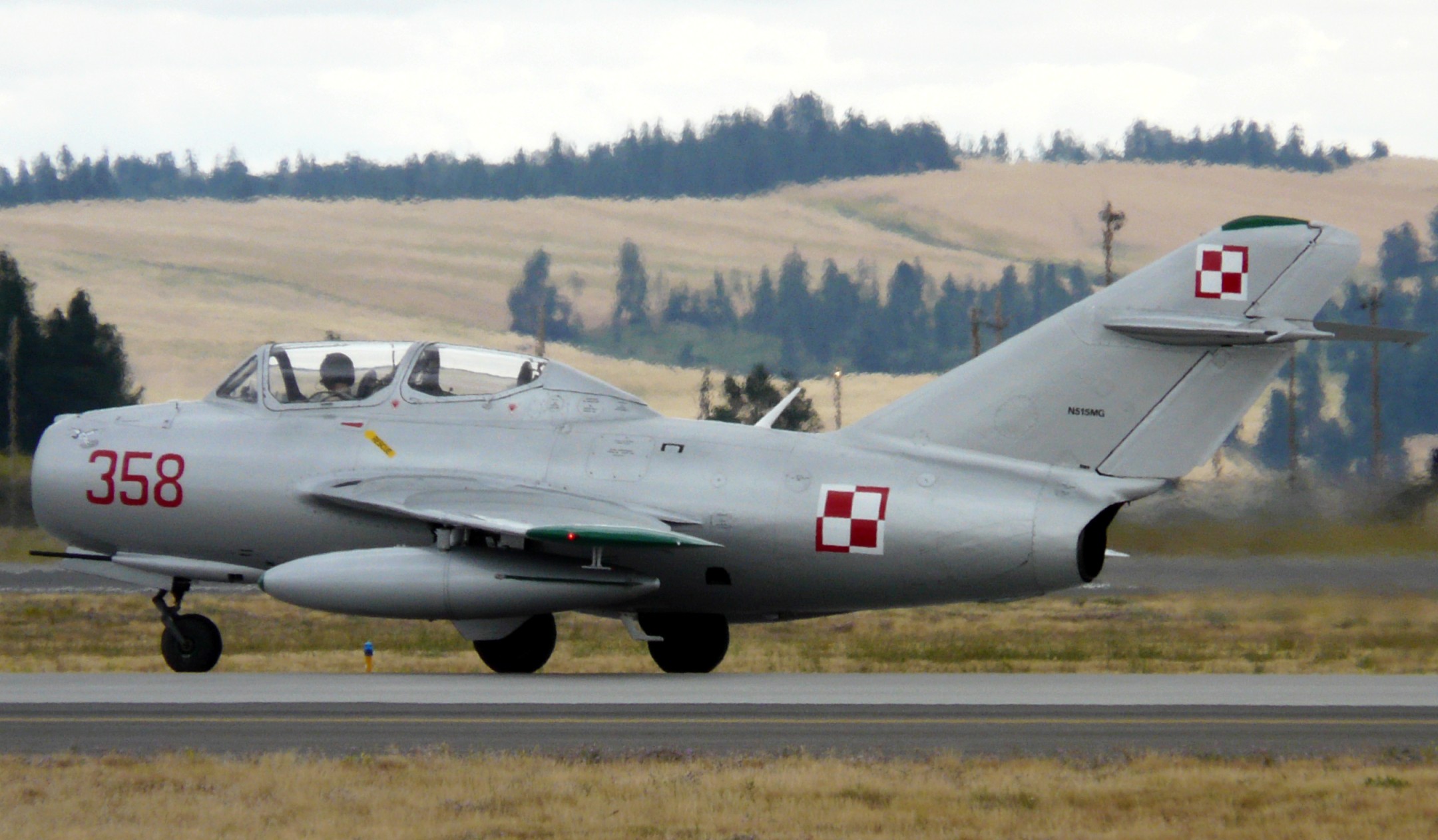
What the Soviet Union did next is not in dispute and has nothing to do with goodwill either. The design went into production without a manufacturing licence, as the Klimov RD-45 and then the enlarged VK-1, and it powered the MiG-15. Starr, in the Royal Aeronautical Society’s journal, writes that the design was pirated and improved as the VK-1, and puts production by the Russians and their Chinese allies at around 50,000.
One coda says more about the record than any of it. In 1976, while negotiating the sale of the RB211 to the same customer, Rolls-Royce asked the Foreign and Commonwealth Office for official information on the sale of twenty five Nene aero engines to the Soviet Union in 1947. The correspondence is in The National Archives. The firm that sold the engines had to ask the government what had happened. No scholarly account of who took the decision, or why, has been published; the fullest treatment is a Rolls-Royce Heritage Trust volume drawn from British and Russian archives, and it exists only in print.
Twenty-five Nenes went to the Soviet Union as a commercial sale with government permission, not as a gift, and the engine was not on the secret list when they went. What the buyer then did with them, without a licence, was a separate matter entirely.
The Avon, the Conway and the Dart
Rolls-Royce began work on the AJ.65 in 1945, and the designation is a specification rather than a name: axial jet, 6,500 lb thrust. After the Welland, the Derwent and the Nene, all centrifugal, the company was going axial, and the man who took it there was the one the Whittle story casts as the obstacle. F. W. Armstrong records that in mid-1945 A. A. Griffith produced the proposal that led to the first Rolls-Royce axial-flow jet engine, the Avon.
The first production engines, the 100-series RA.3, were delivered in June 1950, with a twelve-stage compressor and cannular combustion chambers, and they did not work properly. Armstrong is specific about the cure: the compressor was substantially fixed by a redesign of the front stages in the early 1950s, using blading more like that of the rival Armstrong Siddeley Sapphire. The civil RA.29 gave 10,250 lb for the Comet and the Caravelle and the RB.146 300-series gave 17,110 lb with afterburning. Grace’s Guide, whose Avon page comes from Wikipedia, has A. Cyril Lovesey heading the design team after running Merlin development, production ending in 1974 with over 11,000 built, and the type still in RAF service until 23 June 2006 in the Canberra PR.9.
The Conway came out of the same office. Armstrong quotes Griffith coming forward in 1946 with a scheme for a larger jet engine incorporating the bypass principle, and reproduces the drawings from his own office. Design started in October 1947, the first engine ran in 1952 or 1953 depending on which record you take, and the government type test was completed in 1955.
Most readers will have met the claim that this was the world’s first turbofan, and it does not hold. Metropolitan-Vickers had an aft-fan F.3 on test from August 1943, and Power Jets had a bypass engine under construction before 1944. The Smithsonian’s wording survives contact with the record and is still a serious claim: the Conway was the first production bypass engine, and the Smithsonian’s own phrasing puts turbofan in brackets after bypass, because they are the same thing. The word doing the work is production. The gap between having the idea and getting it into service is most of what an engine company is for.
It was a two-shaft engine giving 17,500 lb at 9,990 rpm, bypassing about 30 per cent of its total airflow. Modern high-bypass engines send more than 90 per cent of their air around the core, so nobody should picture a Trent. The Conway went into the Victor B.2 and K.2, the VC10 and Super VC10 and the Boeing 707-420, and the Conway 12 entered service in April 1960. Pratt and Whitney’s JT3D flew on a 707-120 that June, and the Smithsonian’s record of it says the American engine fended off the Conway, which had a lower bypass ratio. Rolls-Royce got there first and lost the market.
The Dart is the engine in this group that made money. Design began in April 1945, it first ran in July 1946, and it flew in the nose of a Lancaster test bed in October 1947. The Viscount 630 prototype went up in July 1948 on four Dart Mk. 504s of 1,250 shp each, and the engine was eventually taken beyond 3,000 shp. The Smithsonian records production ending in 1987 with 7,100 engines delivered, which is a forty-year run.
Why a turboprop mattered is commercial rather than technical, and the Science Museum’s record of the Viscount answers it: the aircraft’s success was largely due to its Dart engines, which transmitted little vibration or noise to the passenger compartments compared with reciprocating engines. That is what sold seats. The Viscount entered sustained scheduled service in April 1953 with British European Airways, and the Dart went on to power the Fokker F.27 Friendship, the Hawker Siddeley 748, the Handley Page Herald and the Armstrong Whitworth Argosy. On routes where a jet made no sense, a quiet turboprop made a regional airliner pay.
Buying the competition, 1966
Bristol Siddeley Engines was formed in 1958 from the merger of Bristol Aero Engines and Armstrong Siddeley Motors, with Bristol Cars joining the following year. By 1961 it employed 25,000 people, with its works at Filton. It was the other British aero engine company, and it held two engines that would define British aviation for the next half century. In 1966 Rolls-Royce took it over. The Minister of Aviation told the Commons of it on 21 November 1966, calling it a commercial merger which the Government welcomed and saying the resulting aero engine organisation should ensure that Britain kept her lead in the field.
What arrived is more interesting than the deal. The Olympus came with it, an engine that had first run in 1950 and entered service on the Vulcan B.1 in 1956 at 10,000 lbf, reaching 17,000 lbf in the Vulcan B.2 and 20,000 lbf in the 301; its reheated TSR-2 version gave 19,610 lb dry and 30,610 lb with reheat, on Grace’s Guide’s figures. So did the Pegasus, and the Orpheus that fathered it, and the Bristol radials that had powered Wellingtons and Lancaster IIs.
So did the Viper, which deserves better than it gets. The Smithsonian describes an engine designed in 1948 as an expendable 1,575 lb thrust turbojet for an Australian target drone, meant to be used once and thrown away. In 1952 the Viper 5 dropped the expendable features and, on the same record, gave the Royal Air Force the world’s first all-through jet training system with the Jet Provosts.
One other thing happened in the same period and it should be stated rather than joined up. On 5 April 1967 John Stonehouse, Minister of State at the Ministry of Technology, told the Commons that Bristol Siddeley had overestimated costs on Government overhaul contracts and had charged twice for stripping and rebuilding the same assemblies. A refund of £3,960,000 was agreed in February 1967, of which £500,000 was repayment of the double-charging. The debate mentions neither Rolls-Royce nor any takeover.
The consequence is what to carry forward. Britain had spent forty years with real competition between engine firms, and the Avon’s compressor had been fixed by copying a rival’s blading. After 1966 there was effectively one British aero engine company, holding the military jets, the airliner engines, the vectored-thrust engine and the supersonic engine at once. Everything that happened five years later happened to all of it.
The 1966 purchase of Bristol Siddeley left Britain with a single aero engine company holding the Avon, the Conway, the Olympus and the Pegasus together. There was no longer anyone else to fall back on.
The Pegasus, and thrust that points where you want it
The idea was French. In March 1956 the aviation consultant Michel Wibault submitted to the Mutual Weapons Development Programme a proposal for a short take-off strike fighter he called the Ground Attack Gyropter. It used a Bristol BE25 Orion turboprop of about 8,000 hp driving four large centrifugal fans whose casings rotated, so the thrust could be pointed. Stanley Hooker at Bristol saw the merit in the vectoring and none at all in the machinery.
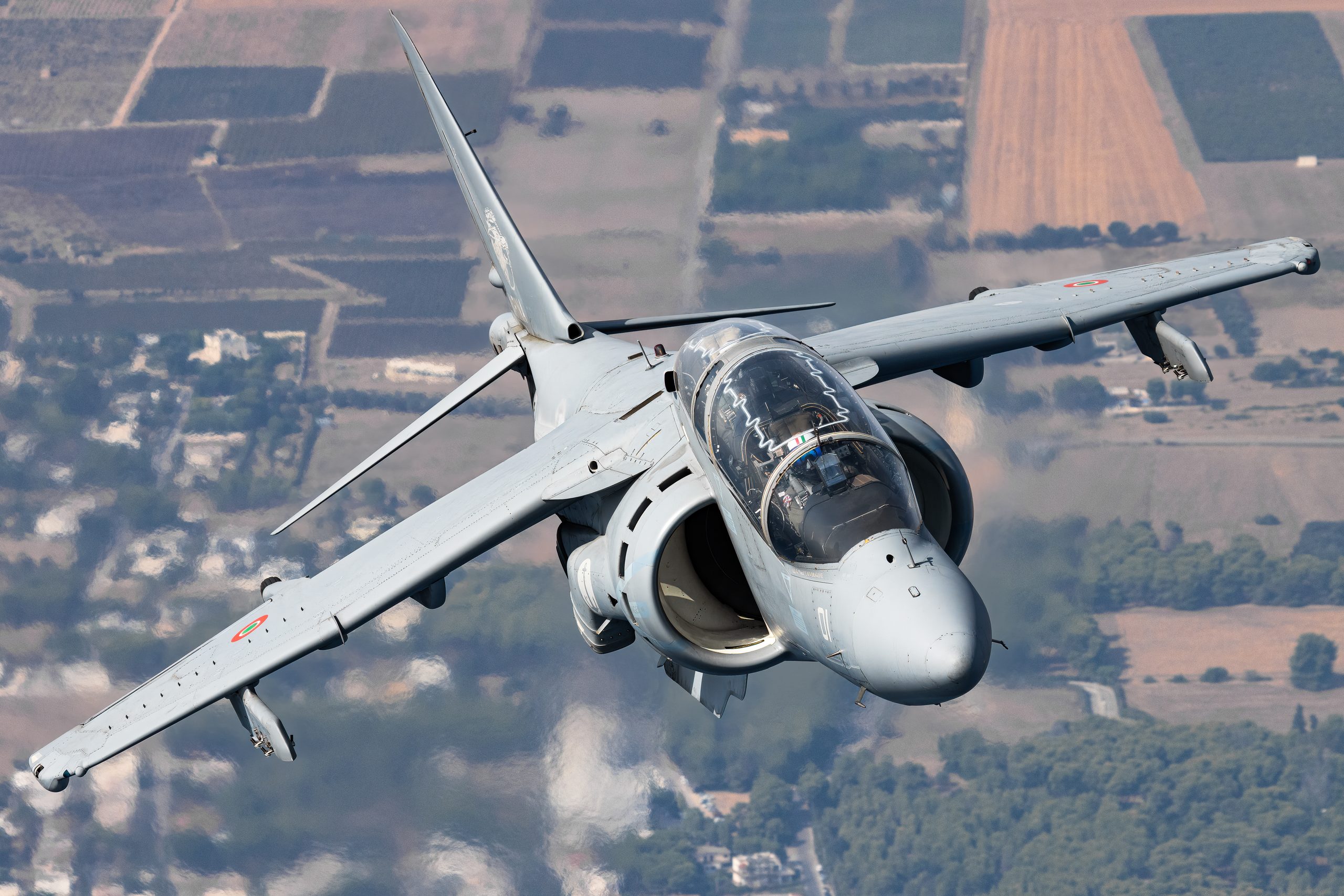
Bristol’s answer was to throw away the fans and use the first two stages of the Olympus low-pressure axial compressor instead, vectoring the thrust through two rotating nozzles. The design went through the BE48, still with the Orion and its reduction gear, then the BE53 with three Olympus stages, then the BE53/2, which was the Pegasus 1. By April 1959 the compressor had become the Orpheus 12. All of it is set out by Dr Gordon Lewis, the Bristol engineer who did the work, in the Royal Air Force Historical Society’s 2005 seminar proceedings on the Harrier.
The move that made it an aeroplane came from the other side of the industry. Ralph Hooper at Hawker proposed a rear thrust deflector close-coupled to the engine rather than at the end of a conventional jet pipe, with rotating nozzles like those already vectoring the fan exhaust. That is how two nozzles became four, and it gave much increased rear thrust while keeping the aircraft in balance. The four-nozzle Pegasus is a joint invention of an engine company and an airframe company, and the decisive step was the airframe man’s.
The arrangement is simpler than it sounds. The front pair of nozzles discharge cold air from the low-pressure fan and the rear pair discharge hot exhaust, and all four swivel together, so one lever rotates the whole thrust line. John Coplin, speaking for Rolls-Royce at the same seminar, made the point that this is also what saved the surface underneath: the jet is directed at the ground only very briefly while the aircraft surges forward into wing-borne flight. Our history of the Hawker Siddeley Harrier covers what pilots did with it.
The engine grew a long way, on the Royal Air Force Historical Society’s figures.
| Mark | Thrust | Note |
|---|---|---|
| Pegasus 1 | 9,000 lb | first ran September 1959 |
| Pegasus 3 | 13,500 lb | ran April 1961 |
| Pegasus 5 | 15,500 lb | Kestrel standard |
| Pegasus 6 (Mk 101) | 19,000 lb | Harrier GR1 standard |
| Pegasus 11 (Mk 103) | 21,500 lb | GR3 standard |
| Pegasus 11-61 | 24,000 lb | first run |
The Smithsonian’s record of a Pegasus Mk 5 gives the same 15,500 lb independently. Flight trials in the P.1127 and Kestrel prototypes began in October 1960 and the engine entered operational RAF service in 1969; the United States Marine Corps knew it as the F402. And the money was American. The Orpheus was funded by the Mutual Weapons Development Programme, a United States agency with an office in Paris, and in mid-1958 an MWDP contract paid for development engines and two flight-cleared prototypes, with Bristol finding a quarter of the cost.
The Olympus, and the only supersonic airliner that worked
The Olympus 593 project started in 1964, using the TSR-2’s Olympus 320 as the basis for development. The TSR-2 was cancelled the following year. Its engine, descended from a 1950 Bristol turbojet by way of the Vulcan, then flew at Mach 2 with passengers aboard for twenty-seven years, which is a fair summary of British aerospace in the period.
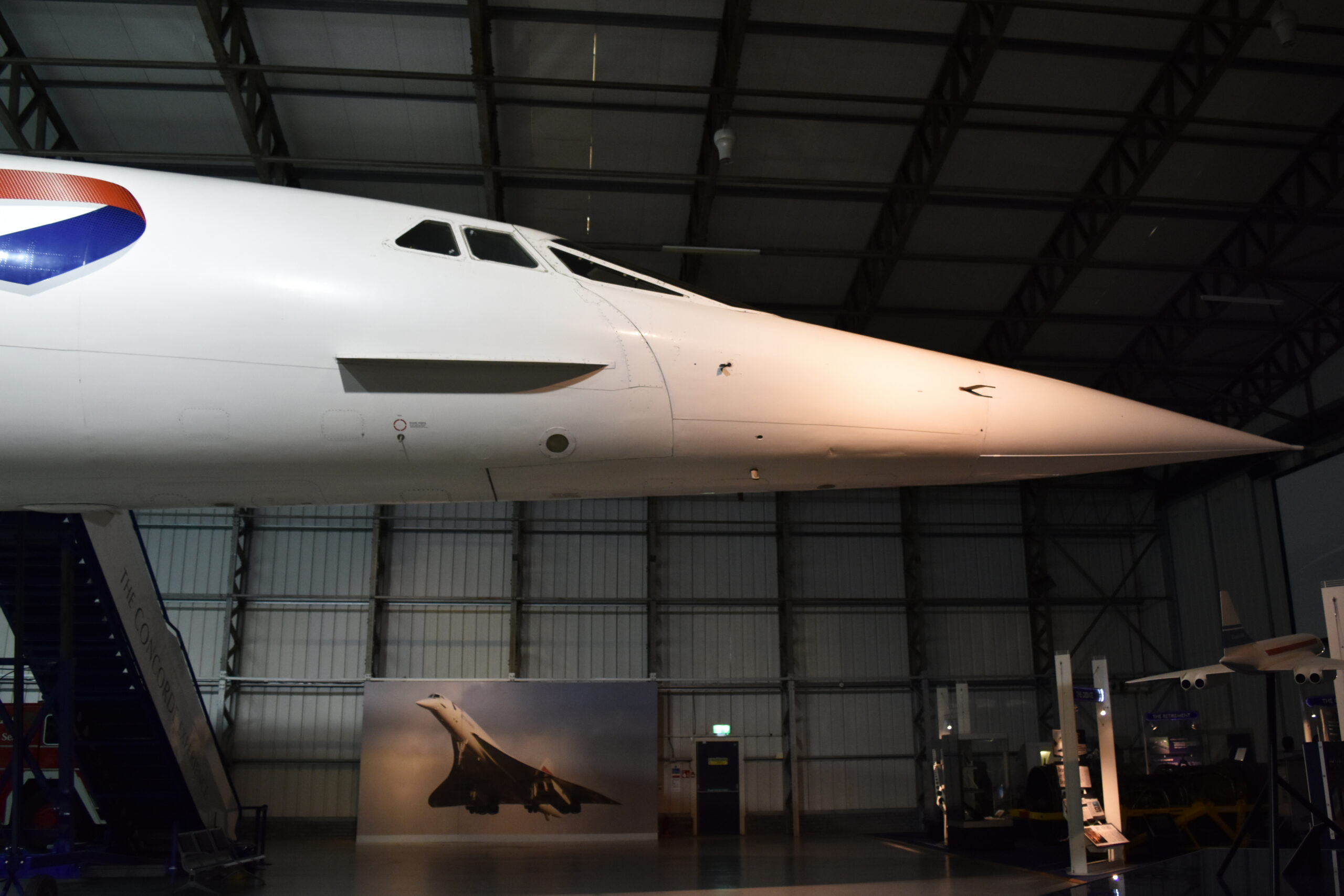
How the Anglo-French programme was divided is only half documented. Heritage Concorde, a specialist site written by people who worked on the aircraft, gives the engineering split as the core engine and its accessories to the British side and the variable intake, the exhaust nozzle and thrust reverser, the afterburner and the noise attenuation system to SNECMA. That is the best account available and it is one side’s. No treaty text, contract or government statement covering the arrangement has been published.
The same source carries the numbers. A complete 593 with its variable-geometry exhaust first ran at Melun-Villaroche in June 1966. Flight testing followed on an RAF Vulcan test bed, limited to Mach 0.98, where the engine made 35,190 lbf, and by January 1968 the Vulcan had flown 100 hours with it and the exhaust assembly was cleared for the prototypes. At 15:40 on 2 March 1969, André Turcat began prototype 001’s take-off run with the afterburners lit.
| Version | Dry thrust | With reheat |
|---|---|---|
| Olympus 593, original | 20,000 lbf | 30,610 lbf |
| 593-22R, prototypes | 34,650 lbf | 37,180 lbf |
| 593-610-14-28, production | 32,000 lbf | 38,050 lbf |
The reheat is where the difference from a military engine shows. Fuel is sprayed forwards against the jet stream until it strikes an anvil, and the impact blows it back and atomises it across the spray ring. Heritage Concorde puts its contribution at approximately 22 per cent of thrust at take-off and 30 per cent at climb power. It was used on every departure and switched off at 500 feet, then lit again at climb power at Mach 0.95 and shut down at Mach 1.7, a run of ten to fifteen minutes. Reheat on Concorde was not for combat. It was for getting through the transonic drag rise, after which the aircraft cruised supersonically without it, which is what no other airliner has managed in service.
The best fact about the powerplant is not about the engine. Concorde’s intakes carried two moving ramps in the top surface that set up a shockwave system converging on the lower lip, slowing the air from about 1,350 mph to about 500 mph before it reached the compressor face. Heritage Concorde calls the intake assemblies the most critical part of the whole powerplant, and states that at cruise they produce 63 per cent of its net positive thrust.
The same site says the Mk 610 engines remain the most efficient jet engines in the world at Mach 2 in terms of thermal efficiency, and then concedes the rest: at slower speeds the engine uses fuel in a most inefficient way. Both halves are true, and the qualifier counts, since almost nothing else has ever had to work at Mach 2 for hours at a time. Four engines gave 152,200 lb of thrust at take-off and 27,160 lb in cruise at 60,000 feet, and the cruise figure is the achievement. Our history of Concorde follows the aircraft that carried them.
The engine that was sold too cheaply
On 8 February 1971 the Chancellor of the Exchequer told the House of Commons what Rolls-Royce had agreed to. Anthony Barber gave the figures plainly: 540 engines to be delivered to Lockheed for the L-1011 TriStar, at a contract price of £350,000 an engine, against an estimated production cost of £410,000 in November 1970 and approximately £460,000 by the day he was speaking. In the Lords a week later, Lord Kings Norton translated it into aircraft: a loss of about £330,000 per aircraft set.
That is what took the company down, and no engineering detail is needed to see it. The contract was fixed-price, in a period of rapid inflation, with penalty payments of £50 million if delivery ran six months late. The engine’s fan technology had not yet been made to work, and Lockheed could not raise the price of the TriStar to absorb any of the difference. The launching cost told the same story on a longer scale: £65 million estimated in 1969, £135 million by the autumn of 1970, and at least £170 million by February 1971, with estimated production losses of £60 million on top.
The engineering half of that failure is the fan blade, and it is the part everybody remembers. Hyfil was a carbon fibre composite developed at RAE Farnborough and chosen for the original RB211, and the Royal Aeronautical Society’s own account of it is exact: the matrix failed after birdstrike tests. A composite blade is fibre held in a resin, and it was the resin that gave way under impact, not the carbon. That distinction carries the whole engineering point. The much-repeated version, in which a single chicken fired into the fan in May 1970 destroyed a blade that had passed every other test, rests on Hooker’s memoir and on Pugh’s history rather than on any contemporaneous record and cannot be confirmed from an independent source.
What is on the record is better. On 25 March 1971, seven weeks after the receiver was appointed, the Commons debated the company. William Whitlock, member for Nottingham North, said the Hyfil plant had been closed the week before last, and that all the problems of Hyfil associated with the aero engine were virtually over. Norman Fowler raised the break-up of the carbon fibre team itself, whose members had been approached by other firms. Leslie Huckfield offered a cause of the cost overrun that no retelling since has improved on: that Rolls-Royce had been running a dual research project into titanium blades and Hyfil blades at once.
The same debate records what the engine was doing while its makers were in the receiver’s hands. Sir David Price, the Parliamentary Secretary, told the House that RB211 engines had run 4,073 hours and that the latest performance had been to 42,300 lb, a figure given in the same debate. The blade was replaced by hollow titanium, first honeycombed and later superplastically formed and diffusion bonded, and the engine went on to do what it had been sold to do, for a company that no longer existed in the form that had signed the contract.
The fourth of February
The word people use is bankrupt, and even the Royal Aeronautical Society’s own magazine has written that the composite blade bankrupted the company. It is not what happened. On 4 February 1971 the board of Rolls-Royce Ltd applied for the appointment of a Receiver and Manager. There was no liquidation, the state bought the aero-engine, marine gas turbine and industrial gas turbine divisions, and the engines never stopped being made.
Frederick Corfield, the Minister of Aviation Supply, told the Commons the same day that the board had decided it was not possible to proceed with the RB211 under the present contract, and that the resources already committed plus the losses arising on termination were likely to exceed the net tangible assets of the company. The Government, he added, had no liability in respect of the contract between Rolls-Royce and Lockheed.
The idea that the Government had refused to help is the other thing to put down. Hansard records launching aid of £47 million in October 1969, being 70 per cent of the estimated £65 million launching cost at that time, and a further £42 million approved in November 1970 with the banks to contribute £18 million. That is £89 million of public money committed to one engine. The November tranche was conditional on an independent accountants’ report and had not been paid by 4 February, and neither had the banks’ £18 million, though their facility had been drawn on to £20 million by that date.
The Cabinet record shows a government that watched it coming. Rolls-Royce reported on 17 September 1970 that it needed a £60 million additional long-term loan, and by 21 January 1971 the cash requirement had grown by £47 million to £107 million. On 22 January the board said it would stop work on the RB211 unless the Government supported continuation in the wider national interest. On 29 January, at an emergency ministerial meeting he chaired himself, Edward Heath concluded that the only practical course was to face up to the appointment of a receiver and acquire the relevant parts. That was six days before the board applied. The business historian Takeshi Sakade, working from the Cabinet papers, reads the sequence as a deliberate bail-in rather than an abandonment: public money alongside pressured private money, then receivership, then a state acquisition confined to what defence and collaborative programmes needed.
Parliament then moved at a speed it has rarely matched. The Rolls-Royce (Purchase) Bill was introduced by 8 February, read a second time in the Commons on 11 February and in the Lords on 15 February, and was in force by 8 March. By that date £20 million had been advanced from the Contingencies Fund, and the company that took the acquired divisions was Rolls-Royce (1971) Ltd.
None of that reached the people who worked there for months. In March 1971 the Receiver announced 4,000 redundancies, approximately 1,700 in Glasgow, 2,000 in Derby and 240 at Barnoldswick, which Corfield attributed to overstaffing rather than to the RB211’s position. Had the engine been abandoned, he told the House on 8 March, between 12,000 and 18,000 direct employees would have gone. The damage ran down the supply chain: 125 creditor firms were owed £8 million between them, and 45 firms in Derby alone reported redundancies of 25 to 30 per cent.
The rescue was settled between London and Washington. The Government offered £60 million towards the RB211’s development costs with Lockheed bearing anything above that, a mean price increase per engine capped at £150,000, and delivery penalties waived. The United States Congress then passed the Emergency Loan Guarantee Act on 9 August 1971, providing up to $250 million in guaranteed loans to Lockheed. Corfield had told the House five days earlier what that meant at home: some 30,000 or more people at Rolls-Royce and in the company’s supplier firms could now expect to continue work.
Rolls-Royce did not go bankrupt in 1971. It went into receivership on its board’s own application, the state bought the engine business, and the RB211 was finished and sold. What was lost was jobs, in Derby, Glasgow, Barnoldswick and 125 supplier firms.
Two companies called Rolls-Royce
Rolls-Royce plc has not made a motor car since 1973. The receivership is what separated the two businesses, and the separation has held ever since.
| Date | What happened |
|---|---|
| 4 February 1971 | Rolls-Royce Ltd goes into receivership on its board’s application |
| February to March 1971 | The Rolls-Royce (Purchase) Act authorises the state to acquire the aero, marine and industrial gas turbine divisions, vested in Rolls-Royce (1971) Ltd |
| May 1973 | The car division, left with the Receiver, is floated separately as Rolls-Royce Motors Ltd. Two companies from that day |
| 1980 | Vickers buys Rolls-Royce Motors |
| April to May 1987 | The engine company is privatised at £1.70 a share |
| 1998 | Volkswagen buys Crewe and Bentley; BMW buys the Rolls-Royce name from the engine company |
| 2003 | BMW begins building Rolls-Royce cars at Goodwood |
| 23 May 2011 | The engine company lists as Rolls-Royce Holdings plc |
The 1973 flotation was not the outcome anyone had wanted. The car business had failed to attract sufficiently high offers in a sale by tender, so it was floated instead, the prospectus issued on 21 March 1973. The flotation was valued at about £38 million, and Anthony Wedgwood Benn attacked it in the Commons on 15 May with £2 million in City fees, and objected that Rolls-Royce Motors would now make a profit out of sub-contracting to the nationalised Rolls-Royce (1971) Ltd.
The engine business stayed in public ownership for another fourteen years. It returned to the private sector in 1987 at £1.70 a share, with applications closing at ten o’clock on the morning of 7 May. The Government kept a special share, capped foreign shareholding at 15 per cent and required that 75 per cent of the board be British citizens.
Then the part almost everyone gets backwards. In 1998 Volkswagen bought Rolls-Royce Motor Cars from Vickers for $712.7 million. It then found that it had not bought the right to call the cars Rolls-Royces, because the trade mark had never left the engine company in 1973. Rolls-Royce plc, the maker of aero engines, licensed and transferred the marks for cars to BMW, an arrangement the engine company still describes in terms of its own ownership of the marks for $66 million, as United Press International reported on 29 July 1998. Volkswagen kept the Crewe factory and Bentley, and BMW has built at Goodwood since 2003. Note the direction of travel in the other transaction too, because the two are constantly reversed: Vickers bought Rolls-Royce Motors in 1980, and Rolls-Royce plc bought Vickers plc in 1999, for its marine business.
The Trent, and what the company is now
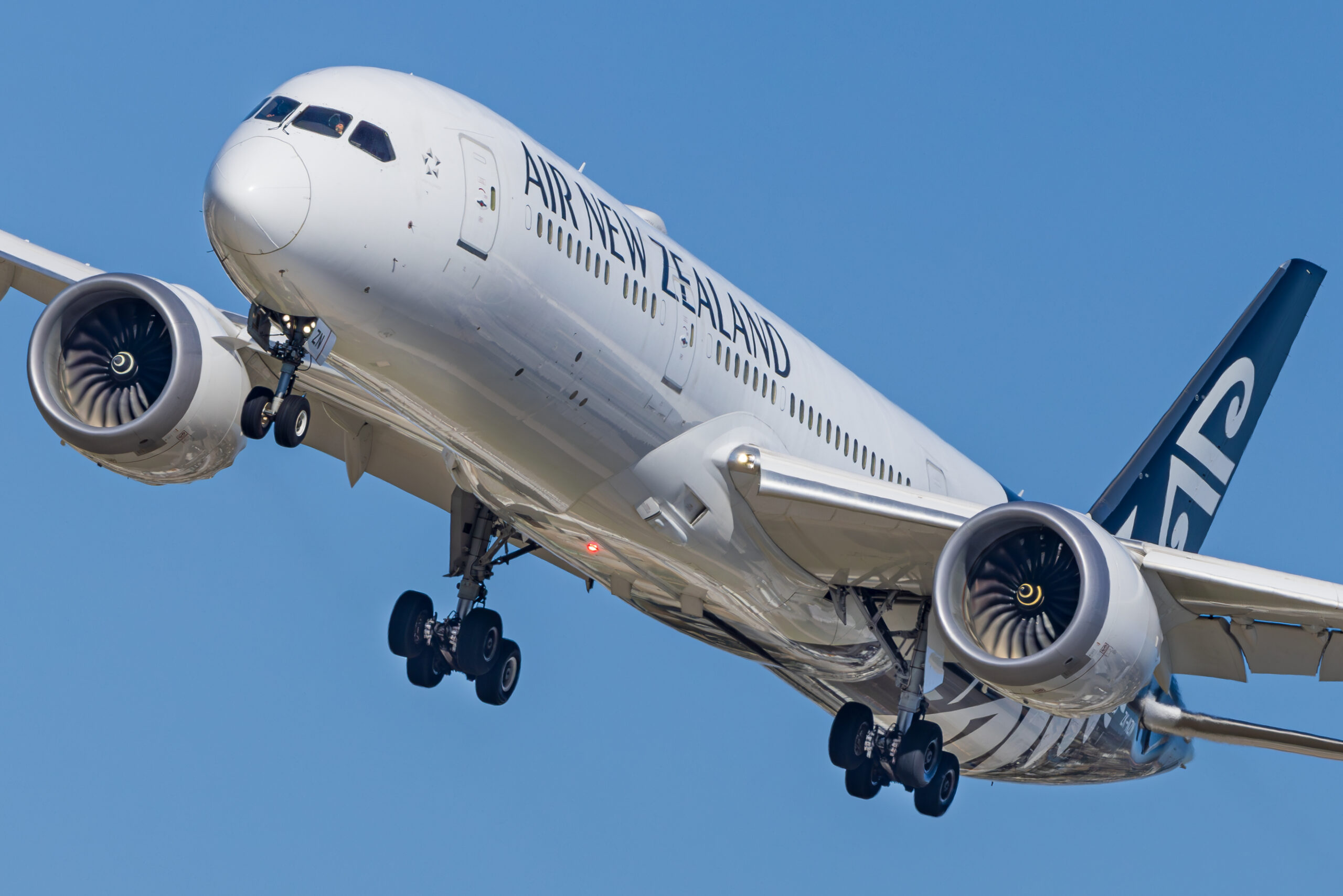
The engine that put Rolls-Royce into the receiver’s hands is the foundation of everything the company sells today, and the mechanism of that turn is architectural. The Smithsonian’s record of the RB211-22 states it cleanly: the RB211 differed from other engines in its class in having three instead of two shafts, each shaft carrying a compressor on its forward end and a turbine on its aft end. That was the expensive, difficult idea in 1971. It was certificated by the FAA in 1973 and became, on the same record, the first foreign-made engine chosen as the basic power plant for a major American-built airliner. Every large Rolls-Royce engine since has been built on it, and the company said in 2026 that the architecture had by then accumulated more than 380 million hours of service.
Authorship of the RB211 resists a single name. The Science Museum calls Geoffrey Wilde the originator of the engine that assisted the development of all Rolls-Royce’s large engines; the Smithsonian names Dr S. G. Hooker as its designer, the same Stanley Hooker who had run Merlin supercharger development at Derby thirty years before. They are describing different roles in the same machine.
The Trent family took the three-shaft layout and grew it. Rolls-Royce marked thirty years of the Trent in 2025 and lists seven of them: the Trent 700, 800, 500, 900, 1000, XWB and 7000. The Trent 700 entered service on the Airbus A330 in 1995. The Trent 900 powers the A380, with a 116-inch swept fan of 24 blades and titanium fan containment in place of Kevlar, and our history of the Airbus A380 covers the inspection issue that engine met in service. The Trent 1000 entered service on the Boeing 787 in 2011, and the Trent XWB-84 on the A350 in 2015, followed by the XWB-97 in 2018. On the company’s own 2025 figures, about 6,000 Trents were in service against 1,500 in 2010, having flown more than 200 million hours.
The Trent 1000 also carries the family’s hardest episode. On 13 April 2018 Rolls-Royce stated that components in specific parts of the compressor were not lasting as long as originally expected, affecting 380 Package C engines then in service, about eight per cent of the fleet. It is not closed. An airworthiness directive published in the Federal Register on 16 March 2026, adopting a European directive of 7 January 2025, requires repetitive borescope inspection of the intermediate-pressure compressor variable inlet guide vanes across eleven Trent 1000 variants, for high-cycle fatigue cracking. In its full-year results of 26 February 2026 the company set a target of more than a 100 per cent increase in durability across its in-production Trent engines by the end of 2027, and said over half of that had been achieved.
The company today runs four businesses: civil aerospace, defence, power systems under the mtu name, and small modular reactors. In the half-year results published on 30 July 2026, for the six months to 30 June, Rolls-Royce Holdings plc reported underlying revenue of £11,279 million and underlying operating profit of £2,534 million, with large engine flying hours at 113 per cent of 2019 levels and a large engine order book of 2,266 engines. Its own pages, read on 28 August 2026, put more than 4,860 engines in commercial service. On 24 February 2026 it announced that the F130 engine for the B-52J had completed altitude and operability testing at the United States Air Force’s Arnold complex in Tennessee. It also builds the EJ200 for the Typhoon and provides nuclear propulsion for Royal Navy submarines. Its reactors are designed for 470 megawatts each. It was contracted on 13 April 2026 by Great British Energy Nuclear for three units at Wylfa on Ynys Môn, signed with ČEZ in Czechia on 24 April, and was selected in Sweden on 15 June for three units on the Värö peninsula. Nothing has yet been built.
The demonstrator engine is called UltraFan, and it closes a circle. It is geared, with a planetary gearbox built at Dahlewitz in Germany rated at 50 megawatts and tested to 64, and a 140-inch fan the company calls the largest in the world. It first ran at Testbed 80 in Derby on 18 May 2023, on sustainable aviation fuel. The release called it the first new engine architecture tested by Rolls-Royce in 54 years, which puts the previous one in 1969 and names the RB211 without naming it. It ran to maximum power on 13 November 2023 at 85,000 lb. A second build was defined after a forensic inspection, with further testing planned during 2026, and on 17 March 2026 the company announced European funding for a narrowbody demonstrator, the UltraFan 30, for ground test in 2028. No UltraFan has been announced as selected for any aircraft. Its fan blades are carbon composite with titanium leading edges. The material that failed the bird-strike tests on the original RB211 is the material in the company’s flagship demonstrator.
That is the shape of it. A car company began building aero engines in 1915 because the Admiralty asked for 250 horsepower, and its first engine crossed the Atlantic four years later. It built the Merlin, took over Whittle’s jet at Barnoldswick and turned it into the Welland, the Derwent and the Nene, then bought its only British rival in 1966 and inherited the Olympus and the Pegasus. Then it signed a fixed-price contract it could not meet and went into the hands of a receiver on 4 February 1971. It was bought by the state, kept building engines throughout, and sold the car name to BMW twenty-seven years later. The three-shaft engine that did the damage is the one it still builds. Our own aviation photographs are catalogued in the Piemags aviation archive, and the terms for reproducing one are set out on the licences page.
Questions people ask
Did Rolls-Royce go bankrupt in 1971?
Not in the way the word suggests. On 4 February 1971 the board of Rolls-Royce Ltd applied for the appointment of a Receiver and Manager, and the state then bought the aero, marine and industrial gas turbine divisions. The engines never stopped being made. Bankrupt is the word almost everybody uses, including at times the Royal Aeronautical Society’s own magazine, but receivership on the board’s own application is what actually happened.
What caused the 1971 collapse?
The contract, not the fan blade. Anthony Barber told the House of Commons on 8 February 1971 that Rolls-Royce had agreed to deliver 540 engines to Lockheed for the L-1011 TriStar at a contract price of £350,000 an engine, against an estimated production cost of £410,000 in November 1970 and approximately £460,000 by the day he was speaking. An engine sold below what it costs to build, 540 times over, is a commercial failure whatever the engineering does.
Did a chicken really bankrupt Rolls-Royce?
The story should be treated with care. The Hyfil carbon fibre fan blade did fail bird-strike testing and the failure mode is documented: the resin matrix failed rather than the fibre. But the tale of a single chicken in May 1970, after the blade had passed everything else, rests on Stanley Hooker’s memoir and on Peter Pugh’s history rather than on any contemporaneous record. What is in the contemporaneous record is the debate of 25 March 1971, in which the Hyfil plant had closed the week before last, the carbon fibre team was being poached by competitors, and an MP named the parallel Hyfil and titanium development as a cause of the overrun.
Did the Government refuse to help Rolls-Royce?
No. Hansard records £47 million of launching aid in October 1969 and a further £42 million approved in November 1970 with the banks to contribute £18 million, which is £89 million of public money committed to one engine. On 29 January 1971, at an emergency ministerial meeting he chaired himself, Edward Heath concluded that the only practical course was to face up to the appointment of a receiver, six days before it happened.
Are Rolls-Royce cars and Rolls-Royce aero engines the same company?
Not since 1973, and the engine company has not made a motor car since. The receivership separated them: the aero, marine and industrial gas turbine divisions were vested in state-owned Rolls-Royce (1971) Ltd, and the car division was left with the Receiver and floated separately in May 1973 as Rolls-Royce Motors Ltd. Vickers bought the car company in 1980. In 1998 Volkswagen bought Crewe and Bentley, but the Rolls-Royce marks had never left the engine company, which arranged their transfer for cars to BMW. BMW has built Rolls-Royce cars at Goodwood since 2003.
How many Merlins were built?
Nobody publishes a precise itemised total online, which is worth knowing before you quote one to the unit. The Science Museum Group says over 150,000 were manufactured. Grace’s Guide, citing Wikipedia, gives 168,176 with a breakdown across Rolls-Royce, Packard, Ford at Manchester and Continental at Muskegon, while its own body text says over 150,000 and the breakdown does not sum to its own total. The authoritative breakdowns are in print, principally in Harvey-Bailey, rather than on the web.
Were the Nene engines given to the Soviet Union?
They were sold, under a commercial contract, with the British government’s permission. Hansard of 22 November 1948 records that Rolls-Royce were given permission in September 1946 to sell ten Nene engines to Russia and in March 1947 to sell a further fifteen, that the price was fixed under a commercial contract, and that none of these engines was on the secret list. The same debate records fifty-five British jet engines supplied during 1947, thirty more than the Nenes. The design then went into production without a manufacturing licence as the Klimov RD-45 and the enlarged VK-1, and it powered the MiG-15.
Was the Conway the world’s first turbofan?
Not the first of its kind, though it was the first into production. Metropolitan-Vickers had the F.3 aft-fan engine on test from August 1943. The claim that survives checking is the Smithsonian’s, that the Conway was the first production bypass engine, and the Smithsonian puts turbofan in brackets after bypass because they are the same thing. The word carrying the claim is production.
Did Whittle’s 1928 thesis describe the jet engine?
It did not, and the Royal Aeronautical Society’s own journal says so: the thesis does not describe the jet engine, or even give any real recognition of jet propulsion as a viable means of powering aeroplanes. The related story that A. A. Griffith blocked Whittle also sits awkwardly with the record, because Griffith proposed a Whittle-type turbojet himself in 1935. None of that diminishes what Whittle built; it corrects a narrative that grew up around him.
How did Rolls-Royce become a jet engine company?
By a transaction rather than an invention. In 1943 it took on Rover’s jet work at Barnoldswick, in exchange for Rolls-Royce’s tank engine business. The exchange itself is documented. The often-told version in which Ernest Hives and Spencer Wilks settled it over dinner comes from Stanley Hooker’s memoir and is absent from the archive-based scholarship, so it is worth telling as Hooker’s story rather than as the record.
What engines powered Concorde?
Four Rolls-Royce Olympus 593s with reheat, an engine that reached Rolls-Royce through the Bristol Siddeley acquisition of 1966 and began as the Bristol Olympus. The Anglo-French workshare is less well documented than people assume: an engineering split is described, with the core British and the intake, nozzle, reheat and noise suppression French, but no treaty, contract or government statement setting it out has been published, so the division of labour is not something to state as settled.
What does Rolls-Royce make now?
As at August 2026, civil aerospace, defence, power systems and small modular reactors. In civil aerospace the Trent family is the core: the Trent 1000 entered service on the Boeing 787 in 2011 and the Trent XWB-84 on the A350 in 2015. The demonstrator engine is UltraFan, which is geared, with a planetary gearbox built at Dahlewitz in Germany. Anything about a trading company changes, so treat these as the position on that date rather than a permanent one.
Sources and further reading
- Hansard, House of Commons, “Jet Engines (Foreign Sales)”, 22 November 1948, the contemporaneous record of the Nene sale to the Soviet Union. api.parliament.uk
- Hansard, House of Commons, the statement on Rolls-Royce and the receivership, 8 February 1971. api.parliament.uk
- Hansard, House of Commons, debate on Rolls-Royce and the RB211, 25 March 1971, including the Hyfil plant closure and the carbon fibre team. api.parliament.uk
- Fred Starr, “Whittle, the thesis and the patent”, Journal of Aeronautical History, Royal Aeronautical Society, 2019. aerosociety.com
- F. W. Armstrong on Griffith, Whittle and the two routes to the turbojet, Journal of Aeronautical History, Royal Aeronautical Society, 2020. aerosociety.com
- Sakade, on the 1971 Rolls-Royce crisis from the Cabinet papers, European Business History Association. ebha.org
- The Engineer, December 1942, on the Merlin 61 and its two-stage supercharger. theengineer.markallengroup.com
- Science Museum Group collection records for the Merlin, the R type and the Dart. collection.sciencemuseumgroup.org.uk
- Smithsonian National Air and Space Museum, engine collection records including the Conway as the first production bypass engine and the Pegasus. airandspace.si.edu
- Royal Air Force Museum, engine and aircraft collection records. rafmuseum.org.uk
- Aerospace Bristol, on the Bristol engine lineage, the Olympus and the Pegasus. aerospacebristol.org
- National Academy of Engineering, memorial tribute to Sir Stanley Hooker. nae.edu
- Rolls-Royce plc, company material on the Trent family, UltraFan and the present-day business, read 28 August 2026. rolls-royce.com
- The National Archives, Discovery catalogue, for the Rolls-Royce and Foreign Office files referenced. discovery.nationalarchives.gov.uk
- Grace’s Guide, used for engine specifications where nothing institutional exists. Its engine pages cite Wikipedia and are not independent corroboration. gracesguide.co.uk
