Tirpitz never once fired her main guns at an enemy warship. She spent almost the whole war at anchor in a Norwegian fjord, and she still cost the Allies more than almost any target of the war. Every Tirpitz raid, and there were more than twenty of them across three years, went after a ship whose entire value to Germany lay in existing. It took two navies, a bomber force and a handful of midget submarines to kill her.
On this page
- A ship named for an admiral
- The arithmetic of a ship that did nothing
- Churchill, the Beast and the unsinkable ship
- Norway: the geography of a hiding place
- The first Tirpitz raid attempts, 1940 to 1941
- Fættenfjord, 1942: four attacks and a frozen lake
- What the threat alone did: convoy PQ17
- North to Kaafjord, March 1943
- Operation Source: six small submarines
- The winter of the repairs
- Operation Tungsten, 3 April 1944
- The armour and the bomb: why the Fleet Air Arm could not sink her
- Seven minutes: the fog that ended the strike campaign
- Operation Mascot, 17 July 1944
- The Goodwood operations, August 1944
- The verdict on the carrier campaign
- Barnes Wallis and the earthquake bomb
- Operation Paravane, 15 September 1944
- The move to Håkøya, October 1944
- Operation Obviate, 29 October 1944
- Operation Catechism, 12 November 1944
- The men inside the hull
- What her loss meant, and where the ship went
- The site today
- A note on the photographic record, and on licensing it
- Frequently asked questions
A ship named for an admiral
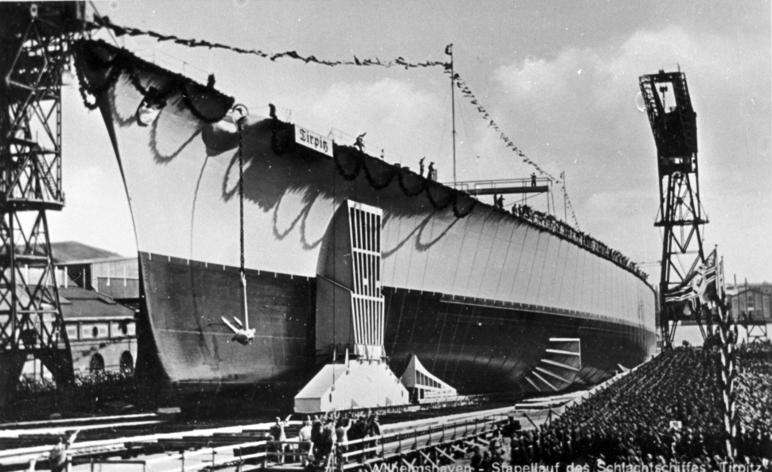
She was ordered from the Kriegsmarinewerft at Wilhelmshaven on a contract placed on 14 June 1936, and she was the yard’s number 128. She was laid down on slipway 2 on 2 November 1936, launched and christened on 1 April 1939, and commissioned on 25 February 1941.
Her name was Tirpitz. Not Admiral von Tirpitz, and not a courtesy title of any kind: the ship was named Tirpitz, for Grossadmiral Alfred von Tirpitz, and the single word is the whole of it. The distinction matters more than it sounds, because a great deal of what was later written about her was written by people working from second hand impressions of a ship almost nobody outside her own crew and a handful of reconnaissance photographers ever saw properly.
On paper, when the papers were filed, she displaced 35,000 tonnes. That was the treaty declaration. Her standard displacement was 42,900 tonnes and her full load displacement 52,600 tonnes. She was 251.0 metres long overall, 241.6 metres at the waterline and 36 metres in the beam, drawing about 9.3 metres standard and 10.6 metres at maximum. She was the heaviest battleship ever built in Europe, and the largest battleship ever built by Germany.
The margin at the top of that list is thin. HMS Vanguard is recorded at 51,420 long tons full load and 248.2 metres in length; Tirpitz, at 52,600 tonnes and 251.0 metres, comes out roughly 350 tonnes heavier and 2.8 metres longer once the units are reconciled. Bismarck, Richelieu and Jean Bart were all lighter. The RAF Museum says as much in almost these words, calling her the heaviest ship ever built by a navy in Europe.
Twelve Wagner high pressure boilers fed three Brown Boveri geared turbines on three shafts. The design figure was 138,000 horsepower; on trials she made 163,026 shaft horsepower. Her maximum speed was 30.8 knots and her range 8,870 nautical miles at 19 knots.
The armament was eight 38 centimetre guns, 380 mm L52 SK C/34, in four twin turrets, able to throw a shell just over 35 kilometres. Under them sat twelve 150 mm secondary guns. For air defence she carried sixteen 105 mm heavy guns and sixteen 37 mm medium guns, and, as built, twelve 20 mm light guns. By 1942 the light battery had grown from twelve barrels to fifty eight. That single line of figures is the whole history of the war at sea in miniature: a ship designed to fight other ships, being progressively rebuilt to fight aeroplanes. She also carried eight 533 mm torpedo tubes in two quadruple mounts, and four to six Arado Ar 196 floatplanes served by a single double ended catapult. The catapult and the aircraft on it are worth remembering, because they were among the first things a bomb would find. The top of a battleship is where the fragile equipment lives, and a great deal of what was later done to Tirpitz from the air was done to the top of her.
The armour was the Bismarck class scheme, and it was formidable in the particular way that German capital ship design was formidable. The main belt was 320 mm of face hardened KC steel, 4.8 metres deep and 170.7 metres long, covering approximately 70 per cent of the waterline. Above the belt the upper deck carried 50 to 80 mm of Wh steel, and below that the main armoured deck, centre and slopes together, carried 80 to 120 mm. Turret armour ran from 130 to 360 mm, barbettes 340 mm above the upper deck and 220 mm below it, and the forward conning tower had 350 mm walls under a 220 mm roof. Inboard of the hull, between 3 and 5.4 metres in from the shell plating, ran a 45 mm torpedo bulkhead on each side. All of it together weighed 19,082 metric tonnes, approximately 40 per cent of a designed combat weight of 47,870 tons.
Two of those figures decide the entire story that follows. The first is the pair of armoured decks, 50 to 80 mm above and 80 to 120 mm below, in two separate layers with ship’s structure between them; that is what a bomb had to beat, and for two and a half years nothing dropped on her came close to beating it. The second is the design resistance of the torpedo defence system, which was 660 pounds of explosive. Every weapon aimed at her before the autumn of 1944 was, in effect, being asked to do something the ship had been specifically engineered to survive.
| Builder and yard number | Kriegsmarinewerft, Wilhelmshaven; yard number 128 |
|---|---|
| Laid down, launched, commissioned | 2 November 1936 (or 24 October 1936); 1 April 1939; 25 February 1941 |
| Displacement | 35,000 tonnes declared; 42,900 tonnes standard; 52,600 tonnes full load |
| Length, beam, draught | 251.0 m overall, 241.6 m waterline; 36 m beam; 9.3 m standard, 10.6 m maximum |
| Machinery and speed | 12 Wagner boilers, 3 Brown Boveri turbines, 3 shafts; 138,000 hp designed, 163,026 shp on trials; 30.8 knots |
| Main armament | 8 x 380 mm L52 SK C/34 in four twin turrets; range just over 35 km |
| Secondary and anti aircraft | 12 x 150 mm; 16 x 105 mm; 16 x 37 mm; 12 x 20 mm as built, 58 x 20 mm by 1942 |
| Belt and decks | 320 mm KC belt, 4.8 m deep, covering approximately 70 per cent of the waterline; upper deck 50 to 80 mm; main armoured deck 80 to 120 mm |
| Torpedo protection | 45 mm bulkhead each side, 3 to 5.4 m inboard; system designed to resist 660 lb of explosive |
| Complement | designed approximately 108 officers and 2,500 enlisted; 2,065 widely quoted in service |
The designed complement was 103 officers and 1,962 enlisted men, raised in wartime to about 108 officers and 2,500 men. Her first commanding officer was Kapitän zur See Karl Topp, who had her from commissioning in February 1941 until February 1943, when Kapitän zur See Hans Karl Meyer relieved him.
What made her different from Bismarck was not the steel. The armour scheme was the class scheme; the guns were the same guns; on the displacement figures she was the heavier of the two. What made her different was what was done with her. Bismarck’s name is the one everybody knows, and it is known because of what she did and what happened to her. Tirpitz was kept. She was moved to a fjord, netted in, camouflaged, ringed with guns, wrapped in smoke, and left there. She became less a warship than a fact on a map, and the whole of the air campaign that followed was an argument with that fact.
The arithmetic of a ship that did nothing
The doctrine of the fleet in being is old and it is not complicated: a fleet that stays in harbour still has to be watched, and watching costs more than being watched. Tirpitz was the purest example the Second World War produced. She was never sunk in a fleet action because there was no fleet action. She never engaged an enemy warship with her main armament. She spent the bulk of her operational life moored, and the correct measure of her is not what she destroyed but what she consumed.
That consumption can be counted. There were nineteen attempted attacks on her in 1940 and 1941, and thirteen major attacks between January 1942 and November 1944: bombing attacks directed at the ship by the Royal Air Force and by Soviet aircraft, seven attacks by Fleet Air Arm aircraft, one at sea in 1942 and six in harbour in 1944, and one attack by midget submarines. Bomber Command went at her repeatedly while she was still working up in German waters, attacked her four times in Norway in the spring of 1942 alone, and came back to her in 1944 with the heaviest bomb in operational service. Two navies built and lost midget submarines to get at her. A Soviet submarine claimed hits on her. Combined Operations tried human torpedoes. None of that was in response to anything she had done. All of it was in response to what she might do.
Six separate categories of attacker, over four years, against one moored ship. Yamato and Musashi were both sunk, but in single actions rather than in a campaign lasting years; Gneisenau and Scharnhorst were bombed repeatedly at Brest, but over a shorter period. Against Tirpitz the Allies mounted at least twenty four separate operations between 1940 and 1944, at a cost of more than two hundred lives.
She sat, moreover, in exactly the wrong place for the Allies.
From a Norwegian anchorage she was within reach of the Arctic convoy route, which meant that every convoy sailing for the Russian ports had to be covered against the possibility of her coming out. Cover of that kind is not cheap and it is not optional; it is capital ships, cruisers and destroyers held in northern waters and unavailable anywhere else, month after month, against a ship that did not come out. The Royal Navy had wars to fight in other oceans and a finite number of hulls with which to fight them. Tirpitz was a claim on the Home Fleet that could not be refused and could not be discharged, and the only way to discharge it was to destroy her.
The argument for killing her was therefore never about tonnage sunk. It was about releasing everything that was pinned in place by the possibility of her. That argument was made at the highest level, and it was made early.
Churchill, the Beast and the unsinkable ship
Churchill called her the Beast, a word repeated by the Australian Naval Institute, and it stuck. On 25 January 1942 he wrote that the destruction or even crippling of this ship was the greatest event at sea at the present time, and that no other target was comparable to it. The shape of that thought recurs in everything the British did about her for three years. She was not one target among many. She was the target, and while she floated the naval balance in northern waters was wrong.
On the other side, the RAF Museum records that Hitler deemed her unsinkable. There is nothing implausible in the sentiment. She was a modern capital ship, protected by two armoured decks and a torpedo bulkhead, moored in a landscape that had been chosen for the difficulty it presented, surrounded by nets and guns and, before long, by a chemical fog that could put a thousand feet of opaque air over her.
The obsession, if that is the word, was rational. It was also, for a long time, expensive and entirely fruitless.
Norway: the geography of a hiding place
Norway’s coast is a defensive work made by ice. The fjords are deep, narrow and steep sided, they run inland for tens of kilometres, and their walls stand up hundreds of metres from water that is deep enough to float anything. For a ship, a fjord provides a berth with rock on both sides. For an aircraft, it provides a target at the bottom of a trench, approachable along one axis, defended by ground the pilot cannot fly through and cannot see over until the last moments of the run.
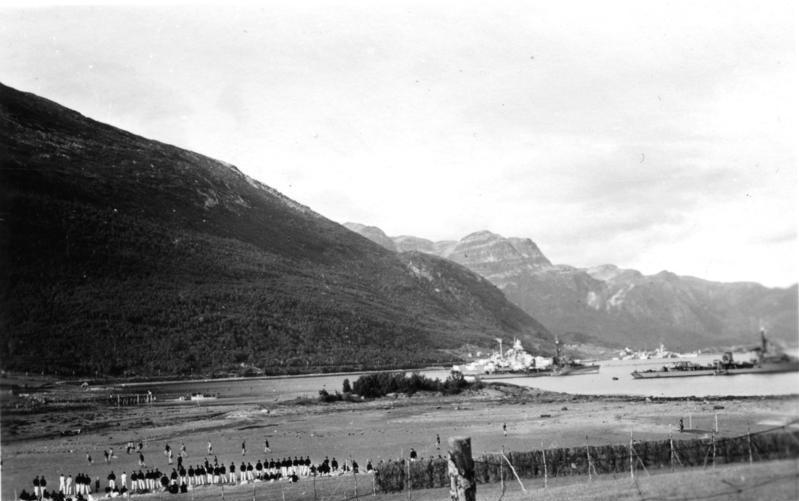
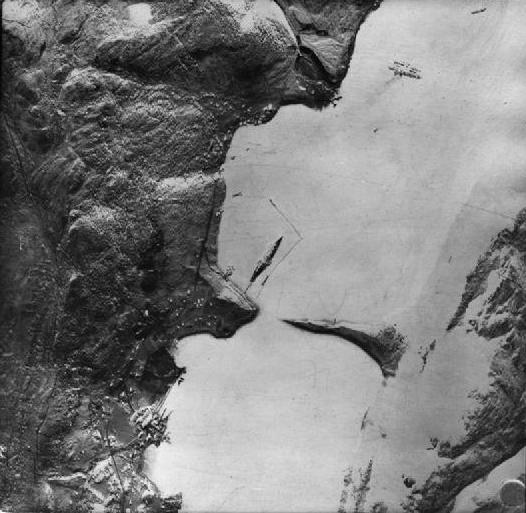
The first Norwegian anchorage was Fættenfjord, a small arm branching off Trondheimsfjord to the north east of Trondheim, on the boundary between the municipalities of Stjørdal and Levanger. It is an arm of Åsenfjorden, not Åsenfjorden itself, and the distinction is one Norwegian sources keep. She lay in the innermost part of the inlet, moored under the steep hill on the northern side, which put high ground directly between her and any bomber approaching from the north.
The berth was ringed with torpedo nets, camouflage, anti aircraft guns, searchlights and smoke installations. Every element of that did a distinct job. The nets denied the water immediately around the hull to a torpedo or an underwater charge. The camouflage denied the ship’s outline to a bomb aimer working from a photograph and a stopwatch. The guns and the searchlights made a low approach expensive. And the smoke denied the target itself, which turned out to be the most effective of the four by a considerable margin. The result was a set of geometrical constraints on any attack: the RAF raids of March and April 1942 had to come in low, up the fjord, under the hills, at night.
Consider what that asks of a crew. The aircraft must find a specific inlet on a coastline of thousands of inlets, in darkness, having crossed several hundred miles of open water on dead reckoning. It must then descend into a fjord whose sides are higher than the aircraft is flying and run the length of it, which means the approach direction is not a choice but a consequence of the terrain, which means the defenders know where to point their guns. The ship at the end of that run has been camouflaged to break up her outline against the hillside behind her. The bomb aimer has a few seconds of visual contact, in the middle of a barrage, at the end of a flight of several hours, and he is being asked to place a weapon on an armoured deck that his weapon cannot pierce in any case. The wonder is not that the 1942 raids failed. It is that anybody thought a different result was available.
The netting deserves a note of its own, because it is the one part of the defensive arrangement that outlived everything else. Anti torpedo and anti submarine nets are simply steel mesh hung from floats and anchored, forming a curtain in the water some distance out from the hull. Anything running shallow is caught in the mesh, and anything trying to come in underneath has to find a way through or under it.
In March 1943 she moved north to Kaafjord, an arm at the head of Altafjord, in Alta Municipality, in Finnmark. Kaafjord is deep, steep sided and surrounded by high ground, which is precisely what made it a good berth and a bad target. It is also a very long way from anywhere the Royal Air Force could take off. Measured as great circle distances, RAF Lossiemouth lies 627.7 statute miles from Fættenfjord and 1,147.5 statute miles from Kaafjord. The move north added 547.8 statute miles between the ship and Trondheim and put her at the outer edge of what any British aircraft could reach and return from.
| From | To | Kilometres | Statute miles | Nautical miles | Initial bearing, true |
|---|---|---|---|---|---|
| Lossiemouth | Fættenfjord | 1,010.2 | 627.7 | 545.5 | 044.0 |
| Lossiemouth | Kaafjord | 1,846.6 | 1,147.5 | 997.1 | 032.2 |
| Fættenfjord | Kaafjord | 881.6 | 547.8 | 476.0 | 031.4 |
Then there was the fog. The smoke apparatus around the Kaafjord anchorage burned chlorosulfuric acid, and the choice of chemical is the reason the system worked as well as it did. Chlorosulfuric acid is hygroscopic: it pulls water out of the air and forms a dense, persistent aerosol. In a cold, damp Arctic fjord that is close to ideal, and the screen it produced could reach up to a thousand feet. The men who operated the generators had to work in protective suits. The generators stood on the shoreline immediately around the ship rather than out at the fjord mouth, and it is the trees that say so.
That evidence is one of the strangest footnotes in the whole story. In a study by Claudia Hartl, pines sampled around the fjord showed that 60 per cent of the trees nearest the mooring laid down no growth ring at all in 1945. Some produced nothing for several years. The stand took about twelve years to recover, against about five years for a natural drought. Whatever else the German navy achieved at Kaafjord, it poisoned a forest, and the forest kept the record.
The first Tirpitz raid attempts, 1940 to 1941
The Royal Air Force began attacking Tirpitz in July 1940, while she was still fitting out, months before she was a commissioned warship and years before she was a threat to anything. The RAF Museum records nineteen attempted attacks across 1940 and 1941. Bomber Command went at her again and again while she lay in German waters, and achieved nothing of consequence.
| Date | Force | Target area and result |
|---|---|---|
| July 1940 onwards | RAF Bomber Command, mixed types | Attacks begin. Nineteen attempted attacks recorded across 1940 and 1941; no damage of consequence |
| 8 to 9 October 1940 | 17 Hampden | Wilhelmshaven; no damage to Tirpitz |
| January 1941 | Wellington and Whitley | Wilhelmshaven; no damage |
| 28 February to 1 March 1941 | 116 bombers | Wilhelmshaven; no damage |
| 28 to 29 May 1941 | not established | Kiel; aborted on weather |
| June 1941 | 100 plus bombers | Kiel; target not found |
Two words recur in that table, and they are the two words that define the first four years of the campaign: no damage. A battleship is an enormous object, and a battleship alongside in a defended naval port at night, under cloud, under camouflage and under a barrage, is an object that a crew flying a twin engined bomber at the limit of its navigational accuracy may never see at all. The bomb loads of 1940 and 1941 could not have hurt her if they had hit. The point is largely academic, because they did not hit.
Fættenfjord, 1942: four attacks and a frozen lake
When she moved to Norway the problem changed shape but did not get easier. The first air attack on her in Norway was Operation Oiled, on the night of 29 to 30 January 1942, flown by seven Short Stirlings of Nos. 15 and 149 Squadrons and nine Handley Page Halifaxes of Nos. 10 and 76 Squadrons. In poor weather, and against camouflage, the target was not located. No damage was done.
On 9 March 1942 the Fleet Air Arm had its first attempt. Twelve Fairey Albacores of 817 and 832 Naval Air Squadrons flew from HMS Victorious with Mark XII torpedoes set to run at twenty five feet. Every torpedo missed. The closest passed within thirty feet of her. Two Albacores did not come back.
It is one of the hardest passages in the campaign to read: biplane torpedo bombers, in daylight, against the anti aircraft armament of a modern battleship, and the margin between the whole enterprise and a different history was thirty feet of Arctic water. Her light battery had by then grown to fifty eight 20 mm barrels, on top of sixteen 37 mm and sixteen 105 mm guns, and the aircraft attacking her were flying at torpedo dropping height and torpedo dropping speed on a predictable line. It was also the first time in the campaign that anybody had put a weapon anywhere near her at all.
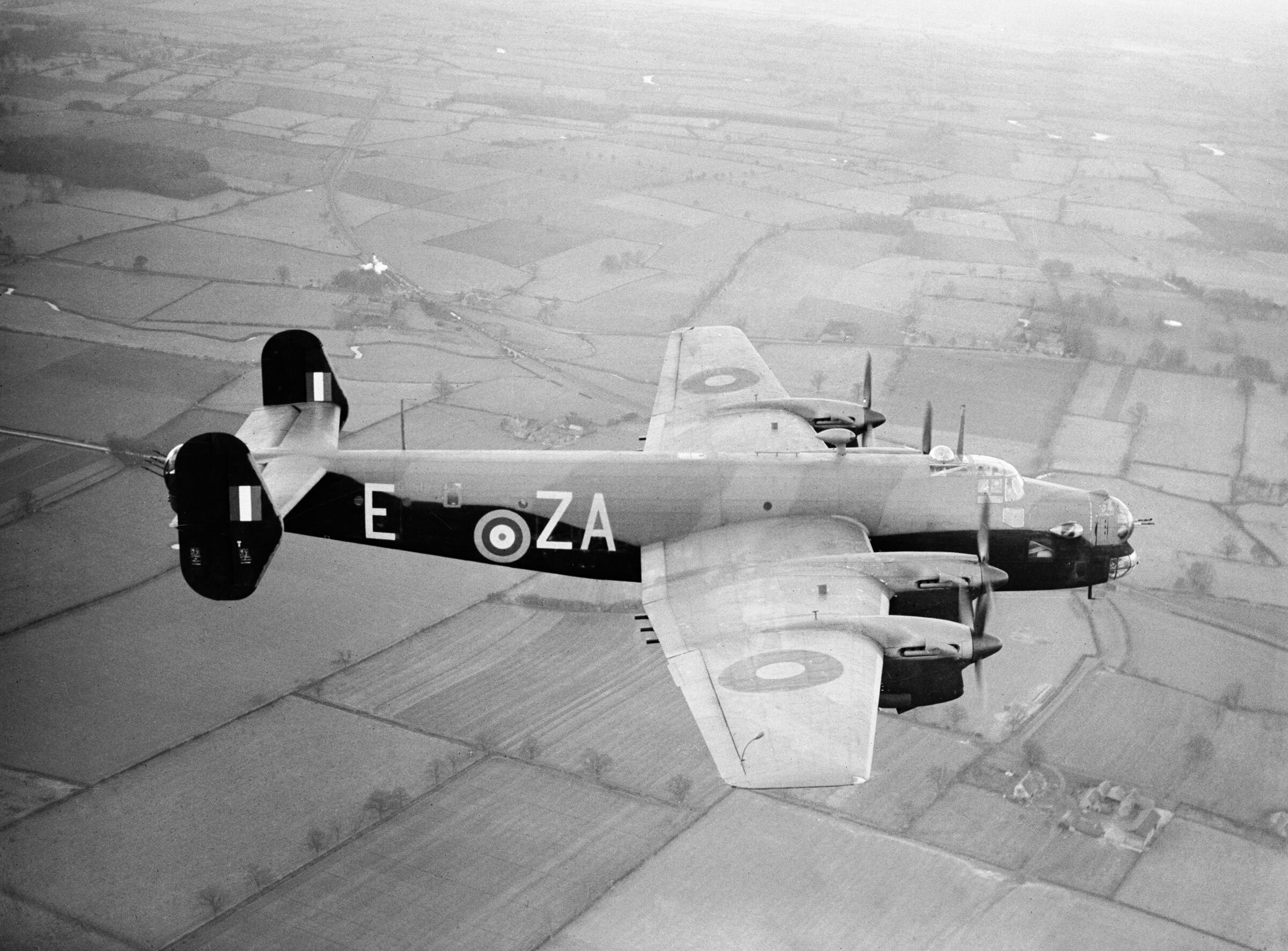
Three weeks later Bomber Command tried again. On the night of 30 to 31 March 1942, thirty three Halifaxes went for her at Fættenfjord with high explosive and mines. There were no hits. Six aircraft were lost, and eight of the dead were Royal Canadian Air Force aircrew.
Then came the two April nights, which were the worst of the year. On 27 to 28 April and again on 28 to 29 April 1942, Halifaxes of Nos. 10, 35 and 76 Squadrons and Lancasters of Nos. 44 and 97 Squadrons attacked with high explosive and mines. Across both nights the force flew seventy seven sorties. There were no hits. Seven aircraft were lost, nineteen aircrew were killed and nineteen were taken prisoner. Nineteen dead and nineteen captured, in two nights, for nothing.
One of the aircraft lost on the first of those nights has an afterlife. Halifax W1048 of No. 35 Squadron, one of eleven aircraft and crews the squadron put up that night, was hit by light flak over Trondheim and came down at about 0050 on 28 April 1942 on the frozen surface of Lake Hoklingen. The pilot was Donald Philip MacIntyre. His crew were Ian Hewitt, the observer; David Lionel Perry and Joseph Pierre Gaston Blanchet, wireless operators and air gunners; Ronald Horace David Wilson, air gunner; and Victor Charles Stevens, the flight engineer. Five of the six evaded to Sweden. Stevens was taken prisoner. The aeroplane went through the ice and lay on the bottom of the lake until 1973, when it was recovered. It is on display at the RAF Museum at Hendon, in London, and it is the only substantial airframe from the Tirpitz campaign on public display in Britain.
| Date | Force | Aircraft | Result | Losses |
|---|---|---|---|---|
| 29 to 30 January 1942, Operation Oiled | RAF Bomber Command | 7 Stirling, 9 Halifax | Target not located in poor weather and under camouflage; no damage | not established |
| 9 March 1942 | Fleet Air Arm, 817 and 832 Naval Air Squadrons, from HMS Victorious | 12 Fairey Albacore | All Mark XII torpedoes missed; closest passed within 30 feet | 2 Albacores |
| 30 to 31 March 1942 | RAF Bomber Command, 4 Group units | 33 or 34 Halifax | No hits | 6 aircraft; 8 RCAF aircrew killed |
| 27 to 28 April 1942 | RAF Bomber Command, Nos. 10, 35, 76, 44 and 97 Squadrons | Halifax and Lancaster | No hits; Halifax W1048 down on Lake Hoklingen at about 0050 | 5 aircraft (of 7 across both nights) |
| 28 to 29 April 1942 | RAF Bomber Command, Nos. 10, 35, 76, 44 and 97 Squadrons | Halifax and Lancaster | No hits. Across both nights: 77 sorties, 7 aircraft lost, 19 killed, 19 captured | 2 aircraft |
Nor was it only the air forces. On 5 July 1942 the Soviet submarine K21 attacked her and claimed hits; no damage is recorded. In October 1942, Combined Operations mounted Operation Title, an attempt to get human torpedoes, the Chariots, up the fjord to her. The Chariots were lost in heavy weather before they reached her. By the end of 1942 the score stood at four air attacks in Norway, one carrier strike, one submarine attack and one Chariot operation, and not a scratch on the ship.
What the threat alone did: convoy PQ17
The clearest measure of what Tirpitz cost the Allies is not a raid at all. It is a convoy she never touched.
PQ17 sailed for the Russian ports with thirty five merchant ships. Eleven reached them. One hundred and fifty four merchant seamen were killed. That is the arithmetic the RAF Museum sets out in its account of the campaign, and it sets it out in the context of Tirpitz, because the possibility that she would come out was the fact around which everything about that convoy turned. She did not come out. She did not fire a shell at a merchant ship or at an escort. Two thirds of a convoy were destroyed, and a battleship that never left her anchorage was credited, in the accounts written afterwards, with a share of it.
One hundred and fifty four men is more than the aircrew killed in all the Fættenfjord raids of that spring put together, and the men of PQ17 were merchant seamen in ships not built to be shot at. Twenty four of the thirty five ships that sailed never reached the Russian ports. Tirpitz did not fire at one of them.
That is the fleet in being, expressed as a body count. Whatever else the Admiralty took from the experience, one lesson was unarguable, which is that as long as Tirpitz was afloat in a Norwegian fjord every Arctic convoy would be planned around her, and some of them would be planned around her badly. From that point onwards the campaign against her had a logic that had nothing to do with proportionality. It did not matter what she was doing. It mattered that she was there.
North to Kaafjord, March 1943
In March 1943 she left Fættenfjord and moved to Kaafjord, at the head of Altafjord, and the problem changed shape once more. Kaafjord put another five hundred and forty seven statute miles of the Norwegian coast between her and Trondheim, and it placed her deep inside the Arctic. The high ground around the anchorage that made it defensible also made it dark for much of the winter and, for a bomber crew, made the run in a matter of threading a valley system rather than crossing a coast. Kapitän zur See Hans Meyer had taken command in February 1943, and it was under him that she spent the year that followed.
Somewhere in this stretch of the story sits one of the more persistent myths about her, which is that she never fired her guns in anger at all. In September 1943, under the codename Zitronella, she and Scharnhorst shelled and burned the Norwegian settlements at Barentsburg, Grumant and Longyearbyen on Spitsbergen; the Svalbard Museum records the operation. The narrower statement is the one the myth is groping towards: she never fired her main guns at another warship in a surface action. Eight 38 centimetre guns, four years in commission, and not one round at an enemy ship.
Watching her was a business in itself, and much of it was done by Norwegians. Egil Lindberg, born in 1906 and died in 1952, was a radio operator and an agent of the Secret Intelligence Service who had previously worked at weather stations on Jan Mayen and Bjørnøya. From 1943 he operated a station in Tromsø under the codename Upsilon, and its primary purpose was reporting on German warships, Tirpitz and Scharnhorst in particular. Torstein Raaby, later famous as a member of the Kon-Tiki expedition, reported Tirpitz’s movements from the Alta area and provided the intelligence that made the attack of September 1943 possible.
Operation Source: six small submarines
By the autumn of 1943 the record of air attack on Tirpitz stood at rather more than twenty attempts and zero hits. What happened next was not an air operation at all, and no account of the air campaign makes sense without it, because it removed her from the board for six months and it changed what everybody thought was possible.
On 22 September 1943 the Royal Navy sent six X craft, X5 to X10, against her at Kaafjord. They were midget submarines, four man boats, designed to be towed to the operational area by a parent submarine and then to work their way through the defences of an anchorage and lay side charges on the seabed under the target. X6 was commanded by Lieutenant Donald Cameron RNR, X7 by Lieutenant Godfrey Place RN, DSC, and X5 by Lieutenant H. Henty-Creer.
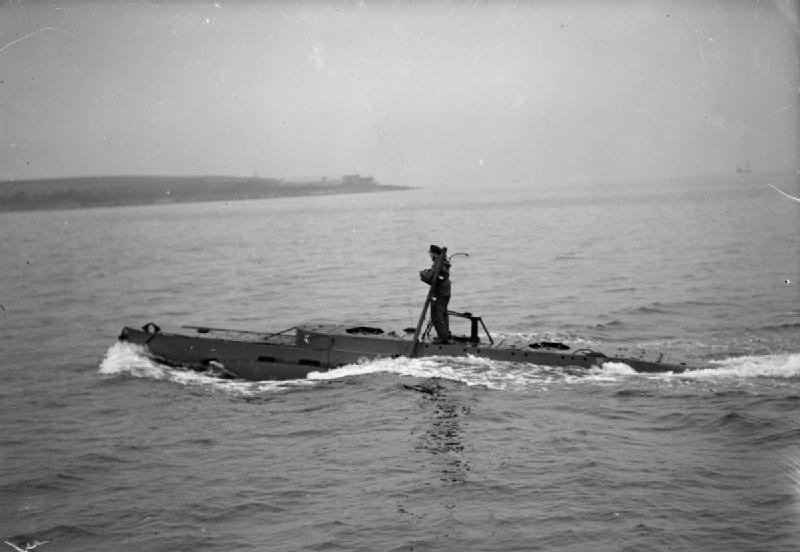
X6 and X7 got through and laid their charges. X5 was sunk by gunfire. At 0812 two heavy explosions lifted the ship almost three feet out of the water. Turrets, hull and engines were damaged. The repairs were assessed at six months.
Almost three feet. It is a small number and it is the most consequential number in the story so far. More than fifty thousand tonnes of ship, at her moorings, behind her nets, under her guns, inside the fjord that had been selected for her, lifted bodily out of the water by two charges laid on the seabed beneath her by men in a four man submarine. Everything the Royal Air Force had dropped on her since July 1940 had not moved her an inch. Two boats crewed by a handful of volunteers had shaken her hard enough to distort her machinery and put her out of action for half a year.
The cost was all six X craft: X8 and X9 lost on passage, X5, X6 and X7 lost at the target, X10 scuttled on the return tow. None came home. Nine men were killed and six taken prisoner. Cameron and Place were both awarded the Victoria Cross. Two Victoria Crosses for one operation, from a force of six boats and a couple of dozen men, is a measure of what the Admiralty thought had been achieved and of what it had cost.
Set against three years of bombing, Source was a revelation in two directions at once. It proved that Tirpitz could be hurt, which nothing dropped from an aeroplane had yet proved. And it proved how she had to be hurt: not by hitting her deck armour, which had defeated everything so far, but by putting a very large quantity of explosive into the water underneath her, on the side where her armour was not. The engineering logic of the whole 1944 campaign is present in embryo in the two charges laid by X6 and X7, though nobody at the time framed it that way, and the weapon that would eventually make the point at scale was still being argued about in England.
The winter of the repairs
Six months of repairs, assessed from 22 September 1943, meant a ship out of action through the Arctic winter and back in service in the spring of 1944. That was the arithmetic in front of the Admiralty at the end of 1943, and it framed everything that followed. Tirpitz was damaged but not destroyed. She lay in the most defensible anchorage yet chosen for her, at Kaafjord, more than eleven hundred statute miles from the Scottish airfields, ringed by nets and by a smoke system that could put a thousand feet of chemical fog over her. She had not been touched by a bomb in three years of trying. And she would be seaworthy again, and therefore a claim on the Home Fleet again, within months.
What the record of 1940 to 1943 had established, at a cost of dozens of aircraft and well over a hundred lives, was almost entirely negative. Level bombing at night against a camouflaged ship under high ground did not work; the target could not reliably be found, let alone hit. Torpedoes dropped from carrier aircraft in daylight had come within thirty feet and no closer, and had cost two aircraft out of twelve. Human torpedoes had been lost in weather before they reached her. A submarine attack had achieved nothing. Only the X craft, which had gone underneath the problem rather than over it, had put a mark on her, and X craft were not a repeatable instrument against a target the Germans would now watch even more closely.
There was one weapon the Allies possessed that had not yet been tried against her, and it belonged to the Fleet Air Arm. A carrier force could bring aircraft within striking distance of Kaafjord from the sea, which solved the range problem that had defeated the RAF. It could attack in daylight and in numbers, which solved the target acquisition problem that had defeated the night bombers. And it could carry armour piercing bombs designed for exactly the job of beating a battleship’s deck. The Home Fleet had the carriers and it had the aircraft. What it did not have was any evidence on the one question that mattered: whether a bomb released from a naval aircraft in a dive could arrive with enough velocity to punch through fifty to eighty millimetres of upper deck and then eighty to a hundred and twenty millimetres of main armoured deck below it.
In the winter of 1943 the planners of the Home Fleet began work on the operation that would answer that question. It would be the largest carrier strike the Royal Navy had yet mounted against a single ship, and it would be given the codename Tungsten.
Operation Tungsten, 3 April 1944
What the Home Fleet assembled for Tungsten was not a raid in the sense the word had carried at Fættenfjord. Six carriers went north for it: Victorious, Furious, Emperor, Pursuer, Searcher and Fencer. Between them they put up about 131 aircraft. Forty Fairey Barracudas flew the strike, drawn from Nos. 827, 829, 830 and 831 Naval Air Squadrons; forty two were ranged, one ditched on take off and one turned back with engine trouble. Eighty fighters went with them, Corsairs, Wildcats, Hellcats and Seafires, flown by Nos. 800, 801, 804, 842, 880, 881, 882, 896, 898, 1834 and 1836 Naval Air Squadrons. Nine Swordfish and twenty five fighters were held back for the defence of the Fleet.
Set that beside what had gone before. On 9 March 1942 the Fleet Air Arm had sent twelve Albacores at her from one carrier. On 3 April 1944 it sent eleven fighter squadrons and four squadrons of strike aircraft from six flight decks at a single ship lying at a single set of moorings. The escort outnumbered the strike by nearly two to one. Nobody involved in the planning was under the impression that this was going to be easy, or that a small force would do.
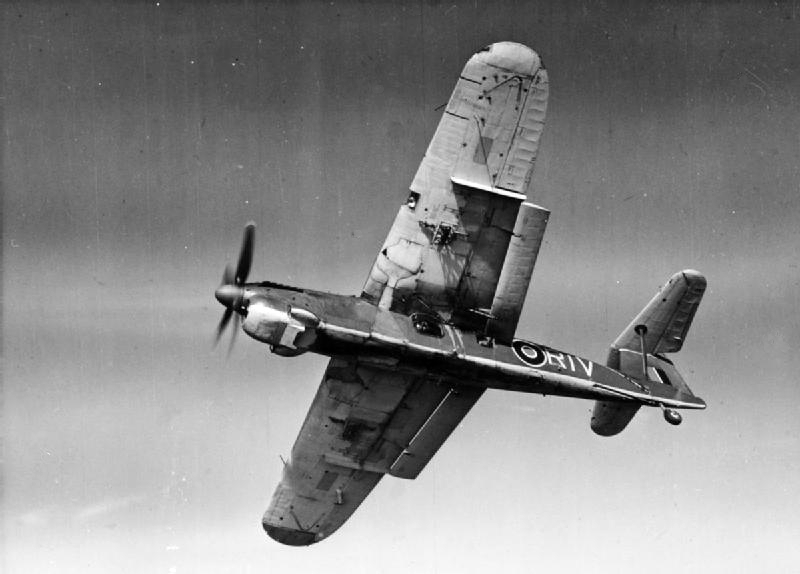
The bomb loads repay the closest attention. In the first wave, seven Barracudas carried the 1,600 lb armour piercing bomb and fourteen carried bombs of 500 to 600 lb. In the second wave, two carried the 1,600 lb armour piercing bomb and the remainder carried 500 lb semi armour piercing. Nine aircraft in all, out of forty, were loaded with the heaviest armour piercing weapon in the strike. Everything else in the air over Kaafjord that morning was carrying something a good deal lighter. The mix was not an oversight. The lighter weapons had abundant work to do on a ship whose upper deck was crowded with guns, boats, rangefinders, aircraft and men. But it does mean that the question on which the whole operation turned, whether a naval aircraft could put a bomb through a battleship’s armour, was being asked by nine aeroplanes out of forty.
The approach was built around the terrain. The strike crossed the Norwegian coast at fifty feet, climbed to 7,000 feet before landfall, came in from the west over the southern hills, turned south and then looped to the north, and dived on the ship out of the high ground. Kaafjord is deep and steep sided and surrounded by mountains, which is exactly what had made it a good berth and a bad target, and Tungsten’s planners turned the same feature against its occupants. An aircraft that comes over a ridge line into a fjord is visible for a very short time before it is in its dive. High ground that shelters a ship from a level bomber crossing a coast at night gives her nothing at all against an aeroplane that appears above the skyline already pointing down at her.
Fifty feet over the sea reads as a technicality. It is a description of an experience. Forty strike aircraft and eighty fighters, in formation, in the Arctic, at a height where a moment’s inattention and a swell put an aeroplane in the water. Then a climb to 7,000 feet, then a coastline, then mountains, then a turn, then a second turn, then the dive. The first strike went in at about 0530 and the second at about 0636. Between those two times, most of a British naval air arm passed through the anti aircraft envelope of a ship carrying sixteen 105 mm guns, sixteen 37 mm guns and fifty eight 20 mm barrels, twice.
What the bombs did
Fifteen bombs hit her, three of them 1,600 lb armour piercing weapons.
Her superstructure was wrecked. The catapult and the aircraft on it were destroyed. Some of her turrets were disabled. Sections of the hull flooded. One hundred and twenty two of her crew were killed and three hundred and sixteen were wounded. Her complement was 2,065 in service, reduced to 1,600 by 1944, so four hundred and thirty eight casualties in a morning was a very large proportion of a ship’s company, and by a wide margin the worst she had suffered from the air in four years of being attacked from it.
And she could still steam within the fjord.
That sentence is the whole result of Operation Tungsten. No bomb penetrated the armoured deck. Not one of the fifteen, and not one of the three 1,600 lb weapons among them. Everything that had been done to her had been done to the parts of her that lay above two layers of armour plate: the boats, the light guns, the rangefinders, the aircraft, the bridgework, the men working in the open. Below the armour she was intact. Her machinery was intact. Her hull, apart from the flooded sections, was intact. She had been comprehensively disfigured and she had not been structurally beaten, and the difference between those two things is the difference between an operation and a result.
The British loss was four aircraft and nine aircrew killed. Nine men against a hundred and twenty two German dead is, by the arithmetic of the air war, a favourable exchange, and it was the first time in the entire campaign that the Fleet Air Arm had come back from Tirpitz with anything to show at all. Kapitän zur See Hans Meyer commanded her until 30 April 1944, when Kapitän zur See Wolf Junge took over, so it was Meyer who was aboard on the morning of 3 April.
Why the Home Fleet thought it had done more
The strike crews did not overclaim in the crude sense. The Commander in Chief Home Fleet’s War Diary records the assessment as eight certain hits and five probables, and calls the result considerably greater than had been expected. If anything the Home Fleet counted the hits generously. What it could not assess, from a cockpit in a dive over a fjord filling with smoke and cordite and flame, was what those hits had achieved once they arrived.
Consider what she looked like from above in the minutes after the first strike went in. A battleship on fire along much of her length, her upper works torn open, her aircraft burning on a ruined catapult, one or more of her turrets out of action, smoke pouring off her, and something over four hundred of her people dead or wounded. Every visible index of destruction was at its maximum. The one index that mattered was invisible, because it was two decks down and consisted of an absence. Armour that has not been penetrated does not look like anything from the air. It photographs as an undamaged deck underneath a great deal of wreckage, and the wreckage is what the camera sees.
There was a structural reason for the optimism as well. The Fleet Air Arm had no way of inspecting the inside of the ship. Everything the Home Fleet knew about the state of Tirpitz after 3 April 1944 came from what its aircrew had seen in a few seconds, from photographic reconnaissance of a fjord that could be fogged at will, and from whatever the Norwegian reporting networks in the area could observe from a distance. None of those instruments can see an intact armoured deck. Reconstructing what a bomb had and had not done to that ship was work for people standing on the wreck, and there would be no wreck to stand on until 1945.
Notice which way the error ran, because it is the opposite of the direction popular history usually assumes. The Home Fleet did not believe it had hit her more often than it had. It believed it had hit her less often than it had, and it believed those hits had done far more than they did.
Tungsten is sometimes described as having crippled her, and on the damage list that description is defensible. But the ship the Fleet Air Arm left behind on 3 April 1944 had lost her fittings and kept her structure, and structure was what the Home Fleet needed to take away from her. She would be repaired where she lay, in a fjord the Royal Air Force could not usefully reach, by a navy that had every reason to hurry.
| Carriers | Victorious, Furious, Emperor, Pursuer, Searcher, Fencer |
|---|---|
| Strike aircraft | 40 Fairey Barracuda flew the strike, 42 having been ranged, Nos. 827, 829, 830 and 831 Naval Air Squadrons |
| Fighters | 80, Corsair, Wildcat, Hellcat and Seafire, from Nos. 800, 801, 804, 842, 880, 881, 882, 896, 898, 1834 and 1836 Naval Air Squadrons |
| Other aircraft | 9 Swordfish; about 131 aircraft in total |
| First wave loads | 7 aircraft with 1,600 lb AP; 14 with 500 to 600 lb |
| Second wave loads | 2 aircraft with 1,600 lb AP; the remainder with 500 lb SAP |
| Strike times | approximately 0530 and 0636 |
| Hits | 15 bombs, including three 1,600 lb AP (German record: 10 x 225 kg and 4 x 775 kg) |
| Claimed at the time | 8 certain, 5 probable |
| Bombs through the armoured deck | none |
| German casualties | 122 killed, 316 wounded |
| British losses | 4 aircraft, 9 aircrew killed (alternative breakdown: 3 Barracudas and 1 fighter) |
The armour and the bomb: why the Fleet Air Arm could not sink her
This is the centre of the year, and it is a question of physics rather than of courage, skill or planning, all three of which the Fleet Air Arm supplied in quantity.
The armour that had to be beaten is worth having in front of the eye again. Above, an upper deck of 50 to 80 mm of Wh steel. Below it, separated by ship’s structure, the main armoured deck of 80 to 120 mm at its centre and on its slopes. Two plates, not one, with a gap between them. That is a considerably harder proposition than a single plate of the combined thickness, because a projectile that has been slowed, deflected or broken up by the first layer arrives at the second in no condition to defeat it.
An armour piercing bomb beats a deck of that kind by kinetic energy, and kinetic energy comes from the height it is dropped from. That is the entire mechanism. The bomb is a hardened steel body carrying a comparatively small charge behind a delayed fuse. It is not designed to blow a hole in armour. It is designed to arrive fast enough to punch through and then to function inside the ship. If it arrives slowly it does neither. It expends itself on the outside of the plate, and what it destroys is whatever happens to be standing above the plate at the moment of impact.
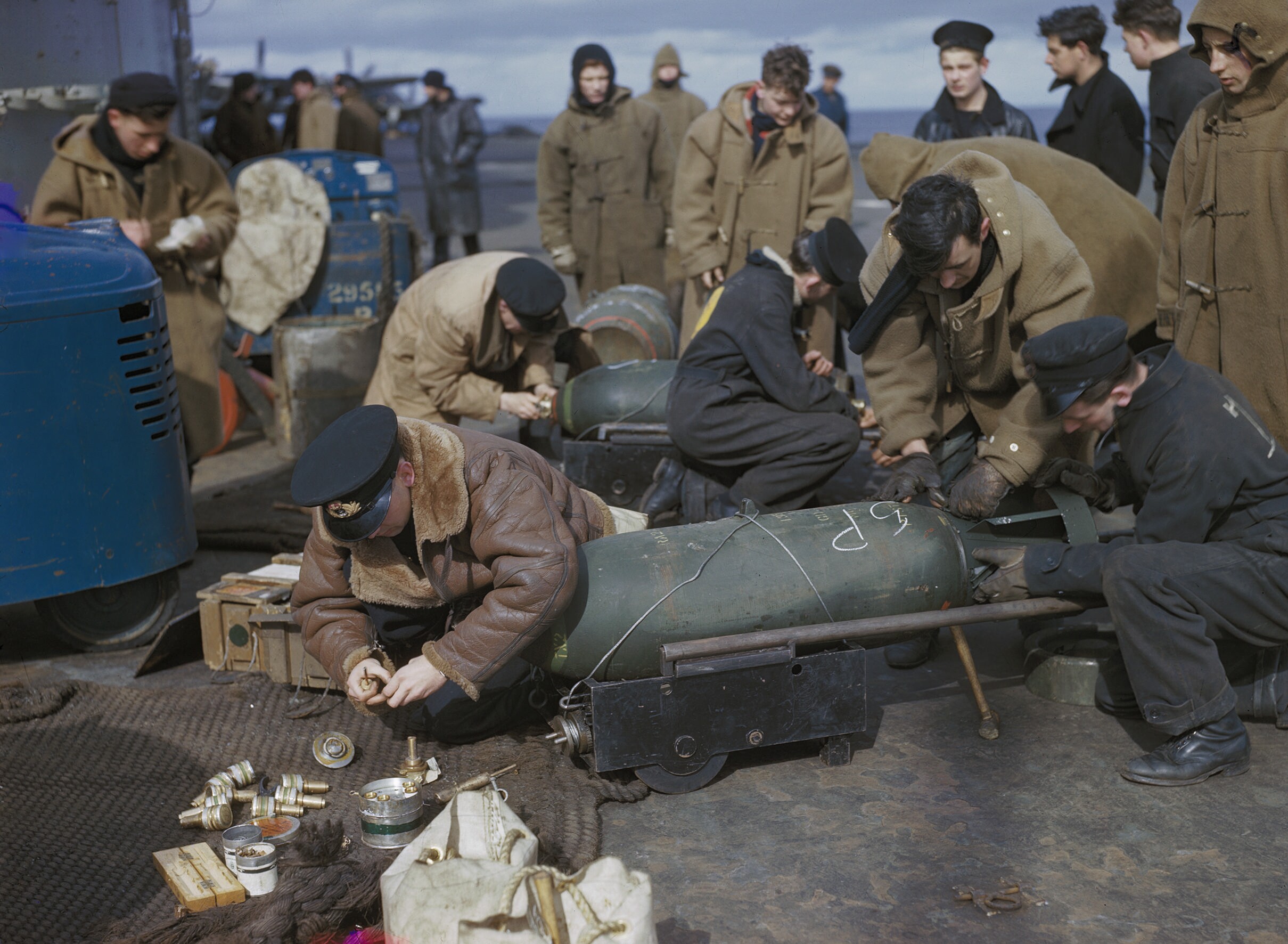
A dive bomber gains speed from the dive, and a steep dive adds a good deal to a bomb’s velocity. But the aircraft is still releasing far lower than a heavy bomber, and no amount of dive angle recovers that difference. A 1,600 lb armour piercing bomb released too low arrives without the striking velocity to punch two armoured decks. It arrives with ample velocity to smash a rangefinder, a catapult, a boat deck, a light gun mounting and the people serving it.
That is precisely the damage pattern Tungsten produced, and the pattern is the evidence. Fifteen hits, three of them by the heavy armour piercing weapon, and every one of them stopped above the armour. The outcome and the theory fit each other exactly. The ship’s protective scheme performed as designed, against exactly the class of threat it had been designed against.
The relationship at the heart of it is short enough to hold in the head. Penetration depends on striking velocity. Striking velocity depends on release height. A naval strike aircraft diving into a fjord operates at a fraction of the height available to a heavy bomber, and the difference is not marginal.
There is a further pressure on that relationship which any aircrew will recognise, and it is the reason the problem was insoluble rather than merely difficult. Every foot of extra release height buys penetration and costs accuracy, and it costs it against a target 36 metres in the beam lying inside a ring of mountains, at the end of a run that has already covered several hundred miles. Every foot given up buys accuracy and costs penetration. On 3 April 1944 the Barracudas hit her fifteen times, which settles the accuracy question about as firmly as it can be settled. None of the fifteen got through, which settles the other one. The Fleet Air Arm was being required to be accurate and high at the same time, with an aeroplane and a weapon that would not do both.
Look at the ship’s protective scheme as a whole and the shape of the problem becomes plainer still. The belt was 320 mm of face hardened steel covering approximately 70 per cent of the waterline. The decks were the two layers above. Inboard of the shell plating, between 3 and 5.4 metres in, ran a 45 mm torpedo bulkhead on each side, part of a system designed to resist 660 lb of explosive. She was armoured against gunfire on the beam, against torpedoes on the beam and against bombs from above, and the whole scheme rested on an assumption about how much energy any single weapon of the period could deliver. What the X craft had demonstrated on 22 September 1943, by lifting more than fifty thousand tonnes of ship almost three feet with charges laid on the seabed underneath her, was that the assumption had a hole in it. But that hole was in the ground below the hull, not in the sky above the deck, and no aircraft of the Fleet Air Arm could reach it.
The proof of the whole argument came on 24 August 1944, in the form of a single bomb that did exactly what the tacticians had wanted: a 1,600 lb armour piercing weapon that went through the armoured deck and then failed to explode. One weapon, out of everything dropped by the Fleet Air Arm in 1944, arrived with the energy to do its work, and its fuse or its filling let it down. Had it functioned, nobody can now compute what a functioning armour piercing bomb detonating below that armoured deck would have done. It did not function. That is the closest the Fleet Air Arm came in four years, and it is one of the reasons the campaign eventually passed to somebody else.
Seven minutes: the fog that ended the strike campaign
The other reason was chemical.
The Germans drew their own conclusions from 3 April 1944, and they drew them quickly. What Tungsten had proved to them was not that their armour was adequate, though it was. It was that a carrier strike could arrive over Kaafjord in strength, in daylight, and put fifteen bombs into a battleship at her moorings while killing or wounding four hundred and thirty eight of her crew. The answer to that was not thicker armour or more guns. It was to make certain that nobody could see her.
The apparatus was already installed around the anchorage: chlorosulfuric acid, which pulls water out of the air and forms a dense and persistent aerosol, in a cold damp Arctic fjord that could hardly have suited it better, producing a screen that could stand up to a thousand feet. What changed across the summer of 1944 was not the chemistry but the speed of the response. By late August 1944 the Germans could put a screen over the anchorage on seven minutes’ notice.
Seven minutes is the number the whole Fleet Air Arm campaign turns on, and it does so for a reason that has nothing to do with the quality of the aircrew. A strike detected on its way in gave the defenders more than seven minutes. That was all it took. By the time the aircraft arrived over the fjord, the fjord was full of chemical fog and the ship was somewhere underneath it, and a bomb aimer cannot correct for a target he cannot see.
Admiral Moore, commanding the Home Fleet at the time of the Goodwood operations, made the judgement in exactly those terms. There was, he concluded, no purpose in continuing to attack Tirpitz with the Barracuda, precisely because the aircraft was slow enough to give the smoke apparatus the time it needed to work. That is a fleet commander writing off an aircraft type as a weapon against a specific target. It is also an admission that the problem was no longer tactical. No approach route, no diversion and no amount of aggression alters the arithmetic of an aeroplane that takes longer to arrive than the defender takes to disappear.
What that meant in practice was the loss of surprise. Surprise, for a carrier strike, is not a matter of the last minute; it is a matter of the whole approach. A force that has flown from its carriers across the Norwegian Sea, crossed a coast, climbed, threaded a valley system and turned onto its attack heading has been in the air for a long time before anybody in it can see the target, and every part of that sequence is an opportunity for the defender to be told that something is coming. There was no route long enough to be safe and no route short enough to beat the clock.
The screen had a second life as evidence, and a strange one. The corrosive aerosol did lasting damage to the forest around the anchorage. In the tree ring study by Claudia Hartl, 60 per cent of the pines nearest the mooring laid down no growth ring at all in 1945; some produced nothing for several years; the stand took about twelve years to recover, against about five for a natural drought. Anyone who wants to know how thoroughly the Germans fogged Kaafjord can go and count rings.
Between Tungsten and the next attack flown, three further Fleet Air Arm operations were laid on and cancelled on weather: Planet on 24 April 1944, Brawn on 15 May 1944 and Tiger Claw on 28 May 1944. It is the pattern of the whole northern war. The Arctic weather cancelled a great many more operations than it ever ruined.
Operation Mascot, 17 July 1944
The next attack flown was Operation Mascot, on 17 July 1944, mounted by three carriers, Formidable, Indefatigable and Furious, under Rear Admiral R. R. McGrigor. The strike was forty four Barracudas, with eighteen Corsairs, twelve Fireflies and eighteen Hellcats. The Barracudas carried the 1,600 lb armour piercing bomb and the 500 lb medium capacity bomb. The Fleet Air Arm went back with the same two answers it had taken in April, and with a larger strike than the one that had produced fifteen hits.
It made no difference at all. The force arrived to find dense smoke over the target. It bombed blind. There were no hits. A second attempt was frustrated by fog. One Corsair was lost.
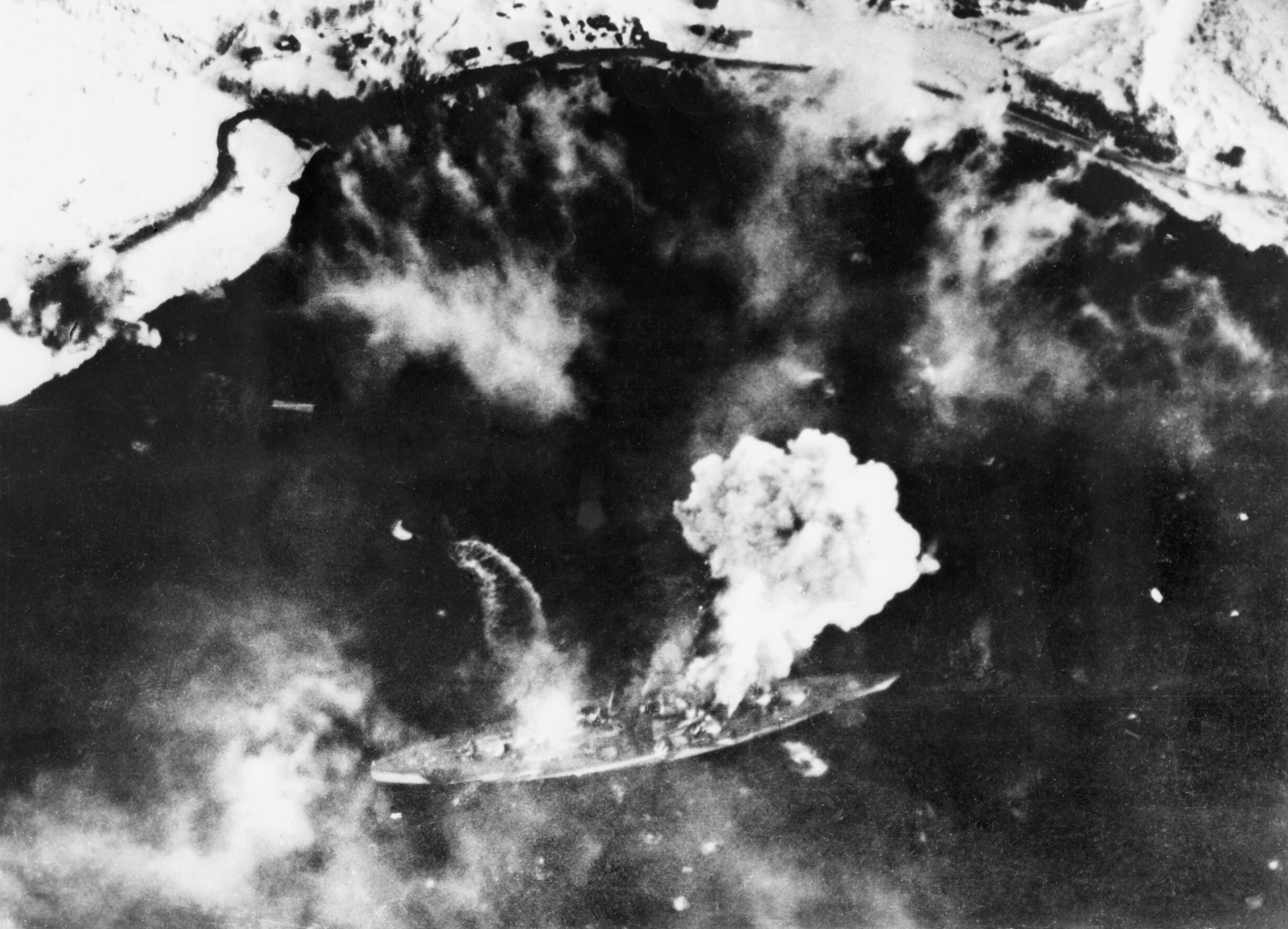
Mascot is the operation that contains no drama whatever. Forty four strike aircraft, forty eight fighters, three carriers, an approach across the Norwegian Sea, and a target that was not there when they arrived. No epic defence, no swirling combat, no gallant last run at a burning ship. A chemical had removed a battleship from the visible world, and forty four Barracudas dropped their bombs into a grey ceiling and turned for the sea. The men who flew it accepted the same risks as the men who flew Tungsten and received a proportion of nothing in return, which is very much harder on a squadron than a bad day with casualties and a result.
Mascot was a Royal Navy carrier operation flown by Fleet Air Arm squadrons. So was every one of the Goodwoods. They were not Royal Air Force operations, they were not flown by Bomber Command, and no Lancaster took part in any of them.
The Goodwood operations, August 1944
Four attacks were flown under the Goodwood name between 22 and 29 August 1944. Taken together they are the end of the Fleet Air Arm’s attempt on Tirpitz, and taken in sequence they read like a force working steadily through the last of its options.
Goodwood I, 22 August 1944
Thirty one Barracudas went, with twenty four Corsairs, eleven Fireflies and nine Hellcats, carrying semi armour piercing and armour piercing bombs. It was a partial strike only, and its effect on Tirpitz was minimal. One Hellcat and one Corsair were lost. The escort carrier HMS Nabob was torpedoed.
That last sentence changes the character of the argument. By August 1944 the Fleet Air Arm’s problem was no longer only that it could not hurt the ship. The operations were costing more than they were returning. A carrier force operating off northern Norway to strike a target it had already failed to damage twice was itself exposed, and one of its own carriers was torpedoed for a result assessed as minimal. There comes a point in any campaign where the ledger stops being about the enemy at all.
Goodwood II, 22 August 1944
On the evening of 22 August 1944 a much smaller effort went in: seven Fireflies and seven Hellcats with 500 lb semi armour piercing bombs. There were no hits and no losses. Fourteen fighters carrying the lightest weapon in the whole sequence, against armour that had already stopped fifteen bombs in April, is a measure of how far the operation had drifted from its object. Nothing that force could lift could have penetrated anything, and the men who flew it will have known it.
Goodwood III, 24 August 1944
Goodwood III was the largest of the four and the only one that achieved anything at all. Thirty three Barracudas flew the strike, with twenty four Corsairs, ten Hellcats and ten Fireflies. The loads were the 1,600 lb armour piercing bomb, the 1,000 lb armour piercing bomb and the 500 lb medium capacity bomb. Two bombs hit.
One of them was a 1,600 lb armour piercing bomb, and it penetrated the armoured deck.
Then it failed to explode.
There is no other sentence quite like that in the story of the air campaign against Tirpitz. Everything the Fleet Air Arm had attempted since 9 March 1942 had been an effort to get a weapon through her protection, and on 24 August 1944 a weapon went through her protection and then lay there, inert, somewhere inside a battleship that had absorbed Albacore torpedoes, four years of high explosive and fifteen bomb hits in a single morning without ever once being opened up. Had it functioned, the effect would have been beyond calculation. It did not function. Five aircraft were lost on the operation, two Hellcats and three Corsairs, the heaviest loss of any of the four Goodwoods, and the return on them was one bomb in the right place with nothing inside it.
Goodwood IV, 29 August 1944
Twenty six Barracudas flew the last of them on 29 August 1944, with two Corsairs and three Hellcats in the strike itself, fifteen Corsairs escorting and ten Fireflies. They carried the 1,600 lb and 1,000 lb armour piercing bombs, and they dropped fifty two tons of them.
They dropped it blind, through smoke. The effect was unclear and assessed as none. One Firefly and one Corsair were lost.
Fifty two tons is not a trivial weight of ordnance. It is more than nine times the weight of a single 12,000 lb Tallboy, delivered by an experienced strike force flying its fourth operation of the month against a target its crews knew by heart, and its recorded effect on the ship is nothing whatever. That is what seven minutes of warning and a thousand feet of chlorosulfuric fog were worth, and it is the last entry in the Fleet Air Arm’s account against Tirpitz.
| Date and operation | Force | Weapons | Result | British losses |
|---|---|---|---|---|
| 3 April 1944, Tungsten | 42 Barracuda in two waves, 80 fighters, 9 Swordfish, from six carriers | 1,600 lb AP; 500 to 600 lb; 500 lb SAP | 15 bombs hit, including three 1,600 lb AP; superstructure wrecked, catapult and aircraft destroyed, some turrets disabled, hull sections flooded; no bomb through the armoured deck; she could still steam within the fjord | 4 aircraft, 9 aircrew killed |
| 17 July 1944, Mascot | 44 Barracuda, 18 Corsair, 12 Firefly, 18 Hellcat, from Formidable, Indefatigable and Furious | 1,600 lb AP; 500 lb medium capacity | Bombed blind through dense smoke; no hits; German assessment of between one and seven near misses; a second attempt frustrated by fog | 1 Corsair |
| 22 August 1944, Goodwood I | 31 Barracuda, 24 Corsair, 11 Firefly, 9 Hellcat; partial strike only | SAP and AP | Minimal effect | 1 Hellcat, 1 Corsair; escort carrier HMS Nabob torpedoed |
| 22 August 1944, Goodwood II | 7 Firefly, 7 Hellcat | 500 lb SAP | No hits | none |
| 24 August 1944, Goodwood III | 33 Barracuda, 24 Corsair, 10 Hellcat, 10 Firefly | 1,600 lb AP; 1,000 lb AP; 500 lb medium capacity | Two bombs hit; one 1,600 lb AP penetrated the armoured deck and failed to explode | 2 Hellcats, 3 Corsairs |
| 29 August 1944, Goodwood IV | 26 Barracuda, with 2 Corsair and 3 Hellcat in the strike, 15 Corsair escorting, 10 Firefly | 1,600 lb AP and 1,000 lb AP, 52 tons dropped | Dropped blind through smoke; effect unclear, assessed as none | 1 Firefly, 1 Corsair |
The verdict on the carrier campaign
Add it up. Six operations flown against the ship by the Fleet Air Arm in 1944. One of them, the first, put fifteen bombs into her, killed a hundred and twenty two of her crew, wounded three hundred and sixteen more and destroyed everything standing above her armour. One of them, on 24 August 1944, put a single armour piercing bomb through the armoured deck, where it failed to explode. The other four achieved nothing. Across all six the cost was fourteen aircraft, and on Tungsten alone nine aircrew killed, together with a torpedoed escort carrier. Between July 1940 and August 1944 the Fleet Air Arm put almost four hundred aircraft of all types into the effort against her.
Put that beside the wider count and the proportions come clear. Of thirteen major attacks between January 1942 and November 1944, five were the Fleet Air Arm’s, something over a third of the major attacks made on her across those three years. The ship was the object of at least twenty four separate Allied operations between 1940 and 1944, and the campaign against her cost more than two hundred Allied lives. Of everything flown at her from 1940 onwards, the carrier strikes of 1944 bought the most. They still left her afloat.
The verdict has to be given in two halves, because either half on its own is a distortion.
The first half is that this was not a failure of the men who flew it. They found a ship that had defeated Bomber Command’s navigators for four years, and they found her repeatedly, across hundreds of miles of open water, in an Arctic fjord ringed by mountains, and they placed fifteen bombs on her decks under the concentrated fire of sixteen 105 mm guns, sixteen 37 mm guns and fifty eight 20 mm barrels. The accuracy achieved on 3 April 1944 is remarkable by any standard of the war, and it was achieved by young men in an aircraft type their own fleet commander would shortly declare unfit for the task. It was not enough, and it was not enough for reasons no amount of flying skill could have altered.
The second half is the one that decided the campaign. The Fleet Air Arm hit her repeatedly and hurt her badly, but it never sank her. That was done by Bomber Command.
The reason sits in the physics set out above and in the seven minutes it took to fog the fjord. A naval strike aircraft could reach Kaafjord, which was more than the Royal Air Force could do in any practical sense from Scotland while she lay there, 1,147.5 statute miles from Lossiemouth on the shortest possible track. But a naval strike aircraft could not carry a weapon heavy enough, or release it high enough, to defeat two armoured decks, and from the summer of 1944 onwards it could not be relied upon to see the target at all. The carriers had solved the range problem and could not solve the armour problem. Bomber Command had a weapon that could solve the armour problem and, as things stood, could not solve the range problem.
That weapon was already in service by August 1944, and it was a different order of object from anything a Barracuda could lift. The Tallboy weighed more than seven times the heaviest bomb the Fleet Air Arm had been able to put on Tirpitz, and it did not work by blowing a hole in a target. It worked by burying itself and detonating in a medium that would carry the shock. Every one of its characteristics is an answer to a question the Fleet Air Arm had spent 1944 failing to answer.
The difficulty was that the aircraft which carried it was the Lancaster, and Kaafjord was a very long way from Moray.
That was the position at the end of August 1944. The Royal Navy had done what could be done with the aircraft and the weapons it had, and had been told by its own commander that there was no purpose in continuing. Nine aircrew were dead from a single April morning, fourteen aircraft had been lost across the year, an escort carrier had been torpedoed, and the ship was still afloat in her fjord with her armoured deck unbroken. The task passed to No. 5 Group of Bomber Command, to Nos. 9 and 617 Squadrons, and to Barnes Wallis’s bomb.
Barnes Wallis and the earthquake bomb
The man who designed the weapon that finally settled the matter was, at the time of the Tirpitz operations, plain Mr Barnes Wallis of Vickers Armstrong at Brooklands. The knighthood came much later. He had already given the Royal Air Force the Upkeep mine of the Dams Raid, and he would give it the 22,000 lb Grand Slam, but the weapon that mattered in the autumn of 1944 was the one in between.
Tallboy was nominally a 12,000 lb bomb and actually weighed 11,855 lb. It was twenty one feet long overall, of which the bomb body accounted for 10 feet 4 inches and the tail section for the rest. The body was 3 feet 2 inches in diameter and the overall diameter including the tail was 3 feet 8 inches. It was a cast steel body with a metal alloy tail, and inside it sat 5,200 lb of Torpex D1. More than seven hundred were dropped during the war.
At 12,000 lb, Tallboy was the heaviest bomb in operational use by any air force in November 1944. The 22,000 lb Grand Slam, its successor, was 26 feet 6 inches long and was not used until the following spring. The Royal Air Force had fielded an earlier 12,000 lb High Capacity blast bomb of the same nominal weight, made of three 4,000 lb sections bolted together, and it was a completely different object from the thing Wallis built.
Tallboy was the first of Barnes Wallis’s earthquake bombs to be used in action, first dropped on the Saumur railway tunnel on the night of 8 and 9 June 1944.
Why a near miss does more than a hit
The principle is not difficult and it runs completely counter to the way most people imagine a bomb working. Tallboy was designed to penetrate deep into the ground, where the explosion created an underground cavern into which the surrounding area, and any nearby structure, would collapse. The RAF Museum’s Robert Owen puts it the same way: the bomb was made to penetrate deep into the ground before exploding, and so to cause an earthquake effect.
The mechanism underneath that description is a question of what the energy has to push against. A conventional bomb that detonates on a target, or in the air above it, dissipates most of its energy into the atmosphere. Air is compressible and a poor transmitter of shock, so a very large proportion of the explosion goes into moving air about and is simply wasted on the thing you were aiming at. A bomb that buries itself first and then detonates has no such escape route. Nearly all of its energy is coupled into the medium around it, and rock and water are not compressible. They carry the shock, and they carry it efficiently.
Applied to a warship, that turns the arithmetic of accuracy inside out. A Tallboy that strikes the deck and passes through does its work below the waterline or in the seabed alongside. A Tallboy that misses by a short distance and detonates on the seabed inside the torpedo net produces a shock and a cavity into which the hull is driven, and around which the ship’s structure is bent and sprung. The damage is not delivered to the armour. It is delivered underneath the armour, through the water, to the parts of the ship that were never designed to take it.
The popular version of this has hardened into something Wallis did not say. It is often written that he intended Tallboy to miss. That is half right at best. The bomb was aimed at the target with the SABS bombsight to a very tight tolerance, and the crews trained hard to put it exactly where they were told to put it. The design point was that a close miss remained lethal, which is a different proposition altogether from a weapon aimed to miss.
Set that against the two armoured decks. Tirpitz carried an upper deck of 50 to 80 mm and a main armoured deck of 80 to 120 mm below it, and her torpedo defence system, with a 45 mm bulkhead on each side, was designed to resist 660 lb of explosive. A Tallboy carried 5,200 lb of Torpex D1. There was no arrangement of steel plate available to a 1936 design office that answered that.
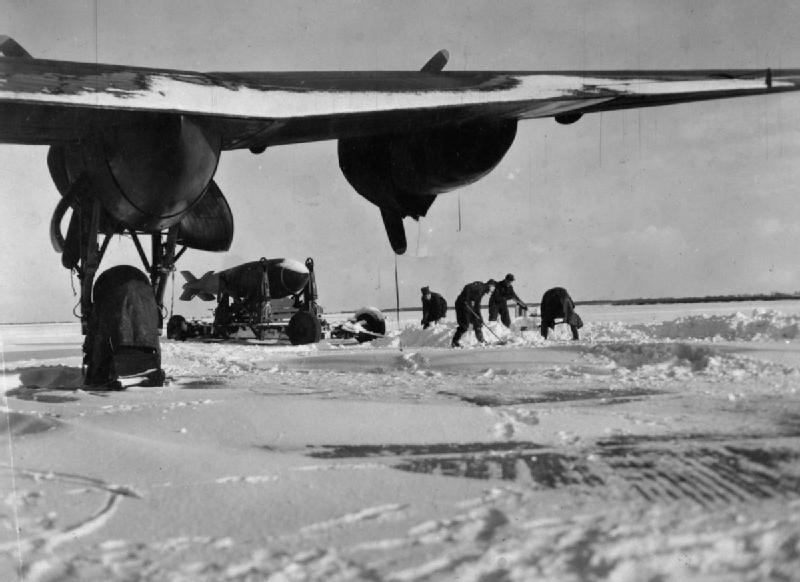
Why it had to be dropped from height
Everything Tallboy could do rested on how fast it was travelling when it arrived, and how fast it was travelling depended entirely on how far it had fallen. The design release altitude was 18,000 feet, from which the bomb reached a terminal velocity of 750 miles per hour, about 1,100 feet per second. At that speed it would go through 16 feet of concrete and leave a crater 80 feet deep and 100 feet across.
Drop it lower and every part of that collapses. The bomb arrives slower, penetrates less, and detonates shallower, which converts an earthquake weapon into an expensive ordinary bomb. That single relationship explains almost everything about how the three Bomber Command attacks on Tirpitz went, and it explains why weather in the Arctic in October and November was not an inconvenience but the operative variable.
Operation Paravane, 15 September 1944
The problem in September 1944 was not the weapon. It was that the weapon was in Lincolnshire and the ship was in Finnmark. Kaafjord lies 1,846.6 km from Lossiemouth, which is 1,147.5 statute miles or 997.1 nautical miles on the shortest possible track, and a Lancaster carrying a 12,000 lb bomb that far and back was not an operation anyone could plan with confidence. So No. 5 Group went the long way round.
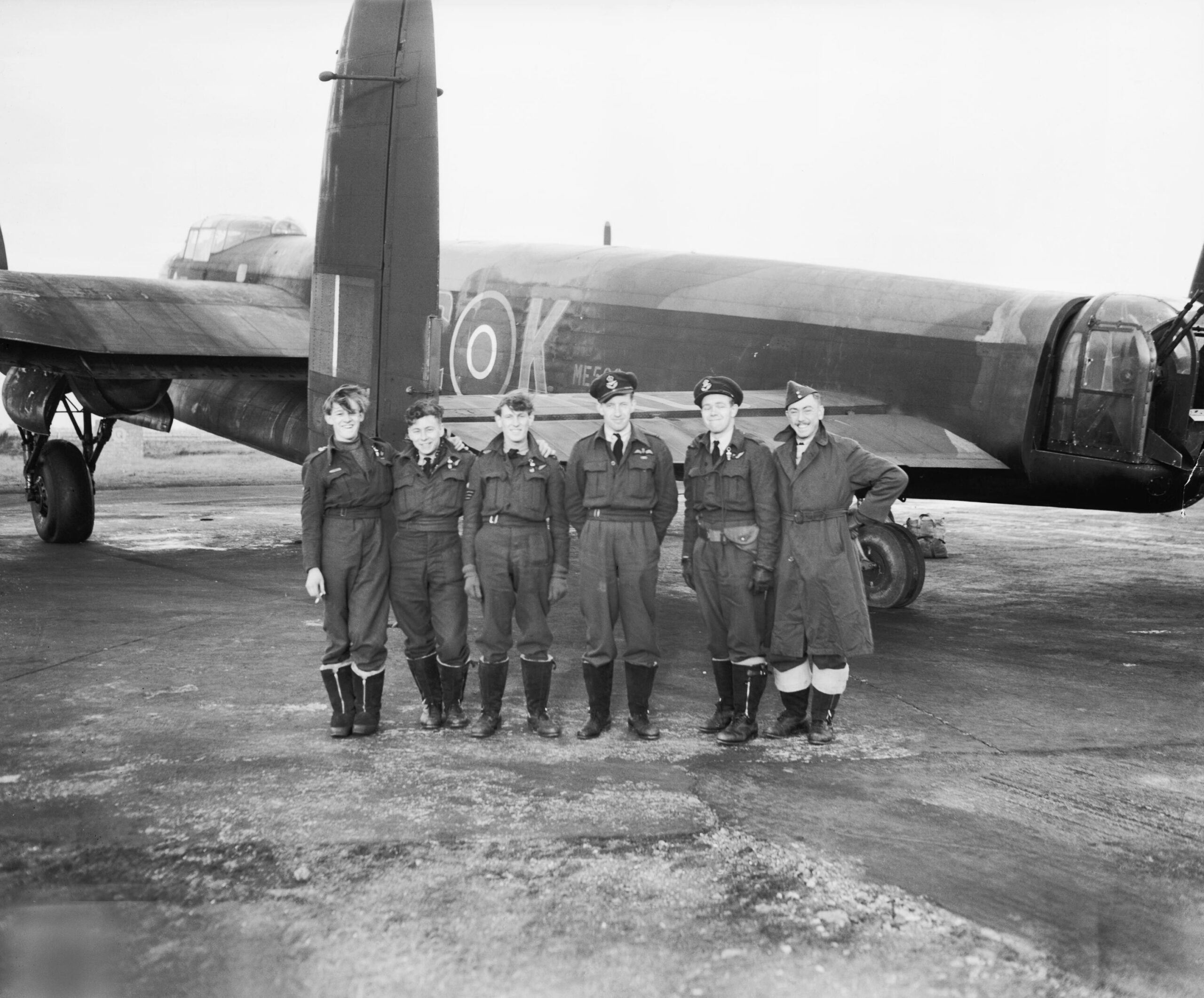
No. 9 Squadron put up eighteen Lancasters and No. 617 Squadron twenty, thirty eight aircraft in all, drawn from RAF Bardney and RAF Woodhall Spa. They flew from Lossiemouth on the evening of 11 September 1944 for Yagodnik, a Soviet airfield near Archangel, with a Mosquito of No. 540 Squadron, two Liberators of No. 511 Squadron and a Royal Air Force Film Unit Lancaster in support. Lossiemouth to Yagodnik is 2,436.1 km, 1,513.7 statute miles, 1,315.4 nautical miles, on an initial bearing of 053.9 degrees true.
The reason for going is in the next pair of figures. From Yagodnik, Kaafjord is 980.0 km away, 608.9 statute miles, 529.2 nautical miles, on a bearing of 316.6. That is barely more than half the distance from Lossiemouth. Everything about the Russian deployment, the diplomacy, the fuel, the maintenance in a place with none of the squadrons’ own equipment, follows from that single comparison.
What it cost was aircraft. Six Lancasters were written off during the deployment, two from No. 617 Squadron and four from No. 9, and the strength that got airborne on the day was reduced accordingly. Twenty seven aircraft bombed on 15 September 1944. Of a force built around thirty eight aeroplanes and twenty Tallboys, more than a quarter never reached the target area at all, and none of that attrition was caused by the enemy.
The attack was flown in two forces with two different weapons. Force A came in from the south in four groups of five aircraft, releasing Tallboys from 14,000 to 18,000 feet. Force B ran from the south east to the north west with six Johnnie Walker mines, 400 lb weapons, released from 10,000 to 12,000 feet. The mines achieved nothing; none detonated near the target.
Set the release altitudes for Force A against the design figures. Fourteen to eighteen thousand feet brackets the design release altitude rather than clearing it. Only the top of that band gave the bomb the fall it was built for, and everything below it was the earthquake bomb being asked to work at a discount, with the discount coming out of penetration.
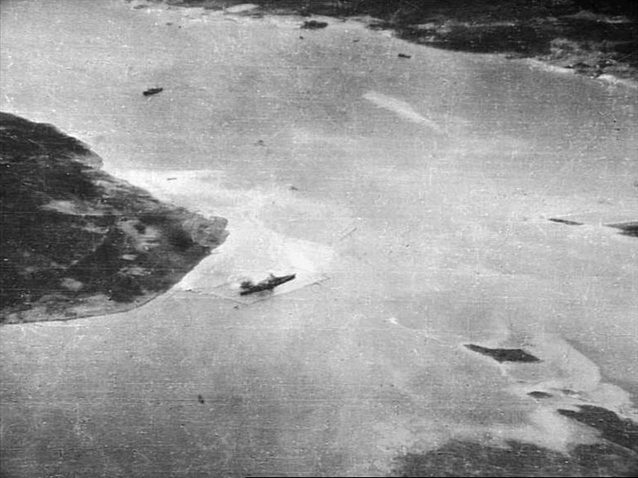
One Tallboy hit her. It struck the starboard bow, passed clean through the foredeck and out through the hull, and detonated in the water off the starboard bow. One Tallboy hit.
What that one bomb did is out of all proportion to anything achieved in the previous four years. She took in between 850 and 1,500 tons of water. Her draught increased by eight feet. The hole in the bow was 32 feet by 48 feet. Her fire control was damaged and a propeller shaft was distorted. The repair estimate was nine months, and the practical consequence was final: she was never again fit for sea.
Set that beside the Fleet Air Arm’s account of 1944, in which fifteen bombs hit her in a single April morning and not one of them got below the armour. One weapon, released from a height a Barracuda could not reach, went straight through the ship and did its work in the water on the far side. That is the entire argument of the earthquake bomb, delivered once, at the first attempt.
The single hit on the bow has been credited to more than one crew. Flight Lieutenant Doug Melrose of No. 9 Squadron is named for it in some accounts and Wing Commander Tait of No. 617 in others, and the dispute is the same one that follows Catechism.
No aircraft was lost on the operation itself. The cost came afterwards. The force flew home on 17 September 1944 and one aircraft went into the mountains of southern Norway; eleven aircrew were killed. Across the whole deployment, each Lancaster covered 4,905 miles.
| Squadrons and strength | No. 9 Squadron, 18 Lancasters; No. 617 Squadron, 20 Lancasters; 38 deployed in all |
|---|---|
| Support | Mosquito of No. 540 Squadron, 2 Liberators of No. 511 Squadron, 1 Film Unit Lancaster |
| Departure and staging | From Lossiemouth on 11 September 1944 to Yagodnik, near Archangel; home bases RAF Bardney and RAF Woodhall Spa |
| Aircraft that bombed | 27 |
| Weapons | 20 Tallboy, 6 Johnnie Walker mines of 400 lb |
| Release altitudes | Force A, 14,000 to 18,000 feet; Force B, 10,000 to 12,000 feet |
| Result | One Tallboy hit the starboard bow, passed through the foredeck and hull and detonated in the water; 850 to 1,500 tons of water taken in; draught increased 8 feet; hole 32 by 48 feet; fire control damaged, propeller shaft distorted; nine months of repairs assessed; never again fit for sea |
| Losses | No aircraft lost on the operation; 6 written off during the Russian deployment; 11 aircrew killed in a crash in the mountains of southern Norway on 17 September 1944 |
The move to Håkøya, October 1944
A ship that cannot go to sea is not a fleet in being. In October 1944 Tirpitz was moved from Kaafjord to the bay on the south eastern side of the small island of Håkøya, off Kvaløya, south west of Tromsø, to serve as a floating coastal battery. The water there is shallow. That was deliberate, and it was the choice of a navy that had accepted the ship would never steam again and was trying to make her useful where she lay.
It was also, from the German point of view, the single worst decision of the whole affair, and the reason is pure geometry.
Håkøya lies 164.8 km from Kaafjord, which is 102.4 statute miles or 89.0 nautical miles, on a bearing of 260.9 degrees true, very nearly due west. Lossiemouth lies to the south west of both anchorages, so moving her west moved her towards the aeroplanes. Lossiemouth to Kaafjord is 1,846.6 km, 1,147.5 statute miles, one way. Lossiemouth to Håkøya is 1,698.6 km, 1,055.4 statute miles, one way. The saving is 148.1 km, 92.0 statute miles, each way, and 296.2 km, 184.0 statute miles, on the round trip. The round trip great circle distance fell by about 8 per cent.
Eight per cent does not sound like a decisive quantity until you consider what it was being subtracted from. The great circle round trip from Lossiemouth to Håkøya is 3,397 km, 2,111 statute miles, and a great circle is a floor rather than a route. The track actually flown was deliberately indirect. On a Lancaster stripped of armour, fitted with extra fuselage tanks and more powerful engines, and flying a routing already at the outer limit of endurance, 184 miles of round trip fuel is the difference between a one way trip with a Swedish internment at the end of it and an operation you can plan to bring home.
The move brought her inside the practical radius of Lancasters operating from Scotland. She had always been theoretically reachable, in the sense that a sufficiently determined staff can put an aeroplane anywhere once. Only after the move to Håkøya was a return flight from Moray a practical operation of war. It is why Paravane had to be staged through Yagodnik in September 1944, and why the two attacks that followed could be flown out and back from Scotland.
| From | To | Kilometres | Statute miles | Nautical miles | Initial bearing, true |
|---|---|---|---|---|---|
| Lossiemouth | Kaafjord | 1,846.6 | 1,147.5 | 997.1 | 032.2 |
| Lossiemouth | Håkøya | 1,698.6 | 1,055.4 | 917.2 | 029.8 |
| Kaafjord | Håkøya | 164.8 | 102.4 | 89.0 | 260.9 |
| Lossiemouth | Yagodnik | 2,436.1 | 1,513.7 | 1,315.4 | 053.9 |
| Yagodnik | Kaafjord | 980.0 | 608.9 | 529.2 | 316.6 |
| Yagodnik | Håkøya | 1,112.7 | 691.4 | 600.8 | 311.2 |
There is one further consequence of the new berth that the Germans appear not to have weighed. At Kaafjord the smoke apparatus had been in place for a long time, its generators sited on the surrounding shore and hillsides, its crews practised, its response time down to seven minutes by late August 1944. At Håkøya the installation was new.
Operation Obviate, 29 October 1944
The first attempt from Scotland was flown on 29 October 1944 by Nos. 9 and 617 Squadrons, roughly eighteen to twenty aircraft each, with one film Lancaster of No. 463 Squadron RAAF. The force is given as thirty eight Lancasters, though the RAF Museum says thirty seven, flying from Kinloss, Lossiemouth and Milltown, each aircraft carrying one 12,000 lb Tallboy.
The routing is the part of Obviate that repays attention, because it was repeated exactly. The force transited at 1,500 feet, low enough to stay under radar cover across the Norwegian Sea, and crossed the coast between Mosjøen and Namsos through a gap in the German radar chain. It then went inland and across the frontier into Sweden, rendezvoused over Lake Torneträsk, climbed, and came at Tromsø from the south east. The Lancasters did not arrive off the sea, which is where every defender in northern Norway was accustomed to looking. They came over the mountains from neutral territory, on the ship’s landward side.
All of which worked, and none of which mattered, because of the weather.
Cloud closed over the target as the bombing run began. Most crews bombed on an estimated position rather than on a sighted ship, which is precisely the condition under which a weapon of Tallboy’s sort has no chance at all. The whole value of the bomb is that it goes where the bombsight puts it, and a bombsight cannot be pointed at an inference. There were no direct hits. One near miss damaged the port propeller shaft and the rudder and caused flooding. The damage was assessed as slight and three Germans were wounded.
One Lancaster of No. 617 Squadron crash landed in a Swedish bog near Porjus; the crew survived and were repatriated. Several aircraft were damaged by flak. That is the whole return on thirty eight aeroplanes, thirty eight Tallboys and something over two thousand miles of flying.
What Obviate did achieve, though nobody could have banked on it at the time, was to prove the route. The transit height worked, the radar gap worked, the Swedish dogleg worked, the assembly over Torneträsk worked, and the approach from the south east put the force over the ship with the whole German air defence system facing the wrong way. Everything about 29 October 1944 was right except the sky.
Operation Catechism, 12 November 1944
Thirty two Lancasters flew the operation that ended it. No. 617 Squadron put up eighteen, led by Wing Commander James Brian Tait, DSO DFC, known in the squadron as Willie Tait. No. 9 Squadron put up thirteen, led by Wing Commander James Bazin, DSO DFC. One aircraft of No. 463 Squadron RAAF went as the film aeroplane, a Lancaster captained by Flight Lieutenant Bruce Buckham with cinecamera operators aboard, as it had been on the previous two attacks. A further seven aircraft of No. 9 Squadron could not get away at all because of ice and snow.
The bases were Kinloss, Lossiemouth and Milltown. The weapon was the weapon of Obviate: one 12,000 lb Tallboy in each bomb bay.
The route was the route already proved. The aircraft crossed the Norwegian Sea individually rather than in formation, made landfall between Mosjøen and Namsos through the radar gap, went inland across the Swedish frontier, and assembled over Lake Torneträsk. Tait held the force there for two orbits and then signalled it away. From Torneträsk the Lancasters climbed to 14,000 to 15,000 feet to clear the border mountains and turned north west onto Tromsø, coming at the ship from the south east.
The sky over Håkøybotn was clear. The smoke apparatus at the new berth was not effective, the smoke pots had not been activated, and the ship lay plainly visible to the bombers.
0938
Bombing began at 0938 hours. That timing, and the reconstruction of everything that followed, comes from United States Naval Technical Mission in Europe Technical Report No. 222-45, dated 29 August 1945, compiled by Commander T. G. Springer USN and Lieutenant (jg) E. B. Hitchcock USNR from captured German documents, with supplementary evidence from the interrogation of Fregattenkapitän (Ing.) Alfred Eichler.
Twenty nine Tallboys were dropped. One certainly hit, and two probably hit, all three on the port side. The certain hit fell near the aircraft stowage. The probable hits were near turret Bruno and abaft turret Caesar. About seven more detonated in the water inside the torpedo net.
Those seven are the earthquake bomb doing exactly what it was designed to do. Great changes are presumed to have taken place on the bottom of the berth, as they had been confirmed to have done after the raid of 29 October. The bombs that did not hit her were not wasted. They were shaking the seabed she sat on and driving her hull inwards from the water side, where there was no armour at all.
Bomb No. 2
The decisive weapon was the one the report numbers Bomb No. 2. It penetrated all decks and all armour and detonated in a filled wing tank, immediately next to the torpedo bulkhead.
The consequence follows from a comparison already made. Her torpedo defence system, a 45 mm bulkhead on each side standing 3 to 5.4 metres inboard of the shell plating, was designed to resist 660 lb of explosive detonating outside it. What detonated was 5,200 lb of Torpex D1, on the inboard side. The system was never going to hold, and it did not. Shell plating was torn away between frames 98 and 132, roughly a hundred and ten feet of her port side.
0938 to 0945
She began to list to port at once, and the list ran on. Between 0938 and 0945 hours it reached approximately 35 degrees.
Several things were working against her, and one of them predated the attack entirely. She was light. She had roughly 3,000 tons of fuel and fresh water aboard, some 7,000 tons below capacity, and a ship that is light sits high and has less initial stability than the same ship loaded. That was her condition before a single bomb fell.
Counter flooding was attempted and failed. The sea valves were opened too slowly, and when they were opened they were too small to do the job in the time available.
Then came the order that decided it. The lower decks were ordered evacuated, which meant hatches and doors standing open through the length of the ship, and it eliminated all possibility of keeping the ship afloat. Once the evacuation was under way there may have been as much as 17,000 tons of sea water in her. The list went to 60 degrees.
Nobody reading that sequence from a desk should be quick with a verdict on it. The alternative to evacuating the lower decks was leaving several hundred men below the waterline in a ship that was going over. Whoever gave the order was choosing between the ship and the people in it, in a compartment filling with smoke, seven minutes into an attack, with a 35 degree deck underfoot.
0945
At 0945 hours, approximately seven minutes after the first bomb, turret Caesar exploded. The rotating structure of the turret, roughly 1,000 tons of steel and machinery, was thrown out of its barbette and landed about 25 yards clear of the ship.
What caused the explosion is not known. The technical report lists three candidates, bomb damage, ignition of the powder magazine and an electrical short circuit, and chooses between none of them. It is often said that a Tallboy detonated Caesar’s magazine; the primary investigation does not support it. What can be said is that a turret weighing about a thousand tons came out of a battleship for reasons nobody has established.
The effect is not in doubt. At 60 degrees of list she had almost nothing left, and the loss of a thousand tons of structure from one end of her, thrown clear, destroyed what remained of her stability.
0945: she goes over
She capsized about seven minutes after the first bombs landed and settled at an angle of loll of 135 degrees.
One further thing about those minutes deserves to be stated, because it is the sort of detail that usually falls out of an account written by the winning side. There was no panic. The conduct of the crew was disciplined throughout, before the capsize and after it.
Kapitän zur See Robert Weber, who had taken command in November 1944 and was the fourth and last officer to command her, was killed on 12 November 1944, trapped with most of his officers in the armoured control room.
Who hit her
Nobody can say whose bombs hit her. The Lancasters attacked within minutes of each other, the ship disappeared under smoke and spray after the first detonations, and the American investigation that reconstructed the damage in 1945 did not attempt to assign the hits to crews.
What survives is the crews’ own reporting. Bruce Buckham, from the film aircraft, described two direct hits on the port side, one on the aircraft catapult and one abreast of B turret; the Imperial War Museum holds a sound recording of his account made on 14 November 1944. Among the Australian crews on the raid, William Lee, known as Bunny Lee, saw the ship obscured by smoke immediately after his release; Arthur Kell reported a hit or a very near miss centred on smoke coming from the superstructure; John Sayers reported either a hit on the bows or a very near miss. Eric Giersch flew as a rear gunner. Squadron Leader Bill Williams of No. 9 Squadron flew WS-A, and the last bomb of the attack was dropped from WS-Y by Dougie Tweddle of the same squadron.
The two squadrons have long had competing claims, since both bombed within the same few minutes and No. 617 attacked first. It is not a question that ought to be settled by choosing a name. The answer is that thirty two Lancasters flew twelve hours to put twenty nine bombs into a bay the size of a small harbour, and the ship went over.
The way home
One Lancaster did not come back with the others. LM448 of No. 9 Squadron crash landed in Sweden; the crew were interned and unhurt. Every other aircraft returned.
The round trip was more than 2,200 miles and more than twelve hours in the air. The measured great circle round trip from Lossiemouth to Håkøya is 2,111 statute miles, and the difference between those two figures is the whole story of the routing: the run north over the Norwegian Sea, the coast crossing in the radar gap, the dogleg into Sweden, the orbits over the lake and the turn back north west onto the target.
The men inside the hull
She did not sink in the ordinary sense of the word. She turned over in shallow water and lay bottom up, part of her above the surface, and inside the part that was above the surface there were men alive.
What followed was the work of Norwegian and German parties with cutting torches, opening holes through the upturned bottom plating to reach the compartments where air remained. Eighty seven men were brought out that way, over about twenty four hours.
Five hundred and ninety six men were rescued from the water or reached the shore within two hours of the capsize. Two hundred trapped men died when the air ran out.
About 971 men died in all, out of roughly 1,700 aboard. They died in the minutes between the first bomb and the capsize, in a bay off an island near Tromsø, in a ship that had not fired her main armament at an enemy warship in a surface action in the whole of her commissioned life. The senior surviving officer, Alfred Fassbender, was awarded the German Cross in Gold.
What her loss meant, and where the ship went
The strategic consequence was immediate, and it was the thing the whole campaign had been for. Her loss removed the last German capital ship threat to the Arctic convoy route. Every Home Fleet unit that had been held in northern waters against the possibility of her coming out was released from that duty, and the convoys to the Russian ports no longer had to be planned around a ship that never came.
Measured against the cost, the accounting is uncomfortable and it should be left uncomfortable. She was the target of at least twenty four separate Allied operations between 1940 and 1944, and the effort against her cost more than two hundred Allied lives. Across the three Tallboy attacks alone, eight aircraft were lost. Twenty nine Royal Canadian Air Force personnel took part in those three operations, about 8 per cent of the aircrew involved, and one of them, Pilot Officer Allan F. McNally of Ontario, was the single RCAF fatality across all three.
As for the ship, she stayed where she was and was broken up in place. Germany recovered components from her while still occupying Norway; British forces then removed militarily useful material; and the Norwegian salvage firm Høvding Skipsopphuggeri took out most of the steel and other metals with German technical help. The work took about ten years, and for the whole of that period the largest battleship ever built by Germany was a visible object in a Norwegian bay, being cut apart above the waterline.
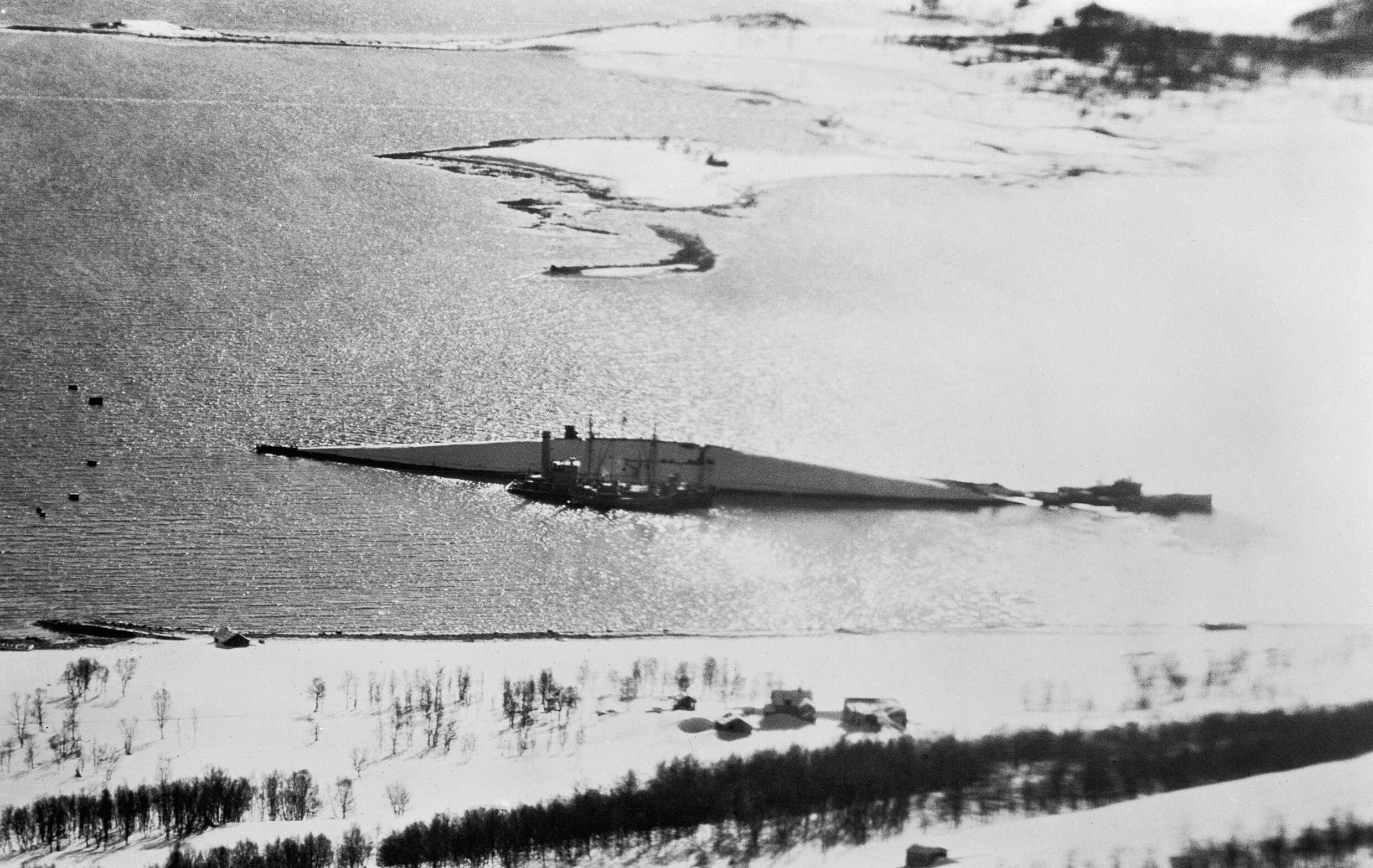
The site today
The wreck site lies at approximately 69.648 N, 18.803 E, and it was surveyed from the air on 28 March 2023 using a DJI Phantom 4 Multispectral flown at 60 to 70 metres. The survey gathered 976 images and achieved an accuracy of about 10 centimetres. The results were published in the journal Remote Sensing on 23 December 2025.
What the survey found is not a ship. The visible structures lie in shallow water at a nominal depth of around 5 metres, with features down to about 5 to 10 metres, and they consist of piles of salvage debris and the wharf that was built to break her up, a structure approximately 52 metres by 10 metres, divided into four longitudinal sections with lateral reinforcements at 1 to 2 metre spacing. The debris was estimated at about 350 cubic metres of solid material, roughly 2,400 tonnes if it is predominantly steel.
The site is described as representative of the main category of submerged cultural heritage in northern Norway. It is not protected. An attempt to protect it formally under the Norwegian Cultural Heritage Act was abandoned in 2016, and nothing has replaced it.
Work of a different kind has been done there since. The Interreg North Sea REMARCO project sampled the site in late May and early June 2025, collecting water, sediment and benthic fauna to assess the chemical and ecological footprint of the wreck, with SeaTerra deploying a crawler system and VLIZ handling the diving. The concern is corrosion releasing hazardous substances, and the possibility of munitions. German and Norwegian film crews recorded the work for television.
On the shore facing the site, at Håkøyvegen, Kvaløysletta, at 69.648211 N, 18.80269 E, stands a memorial erected by Tromsø municipality in 1984. It is 0.19 km from the recorded wreck position, which is to say it looks directly out at the water where she went over.
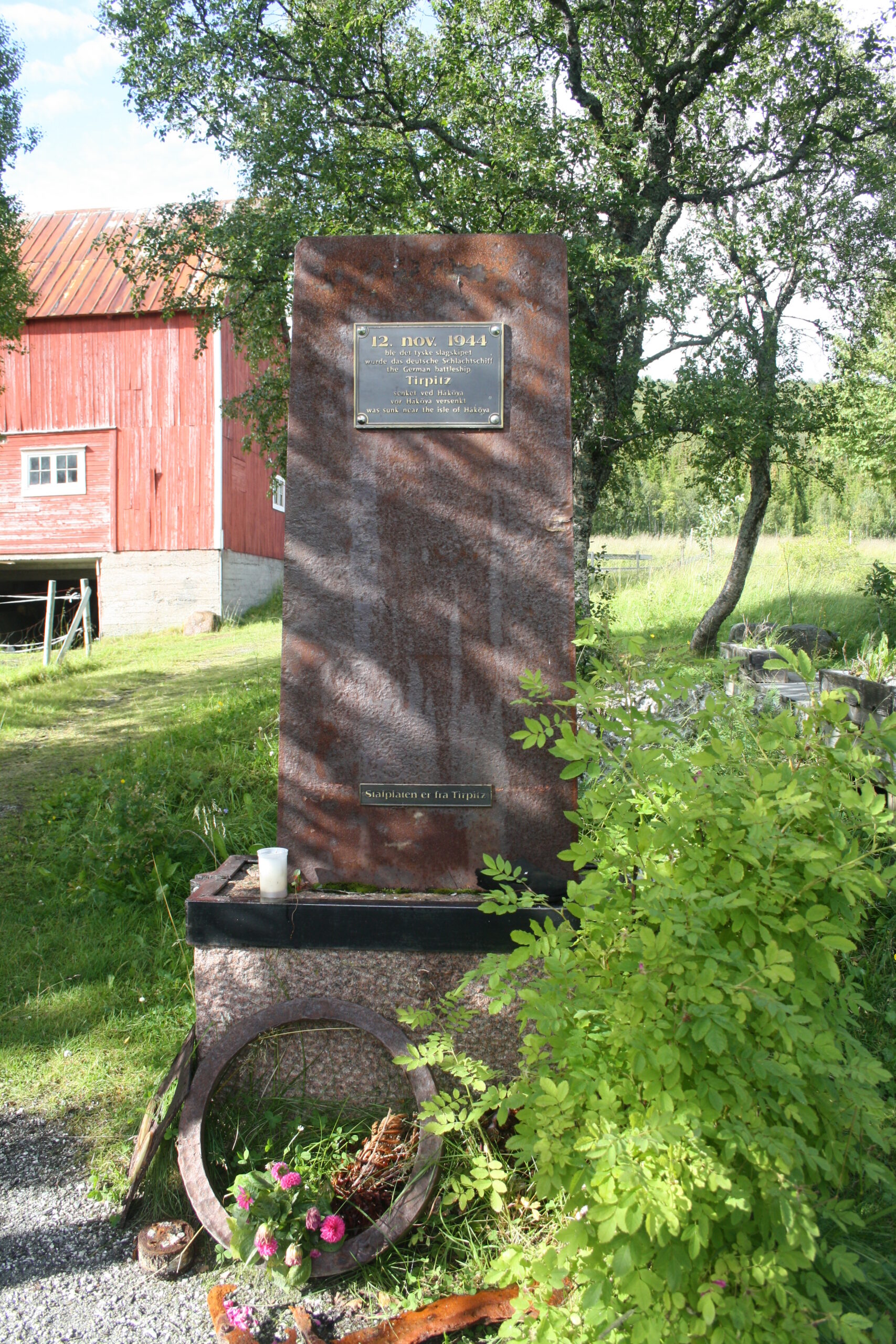
The Tirpitz Museum stands at Kåfjord in Alta Municipality, Finnmark, at 69.93063 N, 23.01634 E, in a former German barracks building on the anchorage itself, at Kaafjord, 9541 Alta. It opens daily from 1000 to 1700 between June and August, and its hours outside that season are worth checking before travelling. A visit for the November anniversary of the sinking falls outside the published season and needs arranging in advance. The same applies at the Tromsø Forsvarsmuseum, the Tromsø Defence Museum, at Solstrandvegen 370 at Kaldslett in Tromsdalen, about 4.5 km south of the Tromsø Bridge, which holds a separate Tirpitz exhibit inside a Second World War bunker and opens on Sundays from 1200 to 1600 in May, September and October, and at weekends in June, July and August, closing from November through April except for groups by appointment.
The weapon and the aircraft
A Tallboy is on public display at Brooklands Museum in Weybridge, Surrey, the site where Barnes Wallis did the design work, and his earlier weapon is the subject of our account of the Dambusters raid for Vickers Armstrong, and another at the Lincolnshire Aviation Heritage Centre at East Kirkby. Its marker gives 21 feet and 6.6 metres, and 12,000 lb and 5,443 kilograms, and records the provenance: previously displayed in a park at Heathfield in East Sussex, then privately owned, then donated to Brooklands in 1999.
The type itself is covered in our history of the Avro Lancaster. Two Lancasters survive as airworthy airframes: PA474 of the Battle of Britain Memorial Flight, and FM213 of the Canadian Warplane Heritage Museum at Hamilton, Ontario. Only FM213 is flying. PA474 will not fly in 2026. It went to Duxford in late October 2025 for a major overhaul with the Aircraft Restoration Company, expected to last at least eighteen months, and it will miss the 2026 display season entirely; the Flight’s Douglas C-47 Dakota is covering its display commitments. Anyone hoping to see a Lancaster in the air on the anniversary in Britain should plan on the basis that there will not be one.
Halifax W1048, described earlier in this account, remains on display at the RAF Museum at Hendon in London, and it is still the only substantial airframe from the Tirpitz campaign on public display in Britain. The Fleet Air Arm Museum at Yeovilton is running a project to reconstruct a Fairey Barracuda, the type that flew Tungsten, Mascot and Goodwood, assisted by a £50,000 Archives Revealed grant for access to the Fairey Aviation archive, working from an airframe recovered from a bog in Northern Ireland with further components from wreck sites.
In Britain the commemoration that has run longest is the 617 Squadron Association’s annual November reunion at Woodhall Spa, known as the Tirpitz reunion and held jointly by the 617 Squadron Association and the IX(B) Squadron Association. It falls traditionally on the Saturday before Remembrance Sunday, with a committee meeting and dinner on the Saturday and a memorial church service on the Sunday, followed by the Village Memorial and the 617 Squadron Memorials. The 2026 dates are yet to be confirmed.
A note on the photographic record, and on licensing it
The visual record of this campaign is thinner than its fame suggests, and the reasons are the reasons the campaign took four years. A great many of the attacks were flown at night, and the 1942 raids in particular produced almost nothing usable. The Kaafjord strikes of 1944 were flown into a fjord filling with chlorosulfuric fog, which is an efficient defeat of a camera as well as of a bombsight. Reconnaissance of the anchorages was flown at long range against a target that could be hidden on seven minutes’ notice.
What does exist is concentrated at the end. A Royal Air Force Film Unit Lancaster went to Russia with the Paravane force. A No. 463 Squadron RAAF aircraft flew as the film aeroplane on both Obviate and Catechism, and on 12 November 1944 Bruce Buckham’s crew carried cinecamera operators over the ship while she went over. The Imperial War Museum holds Buckham’s own spoken account, recorded on 14 November 1944, together with photographic material of the wreck taken in June 1945 and of the Fleet Air Arm preparing for the attack of April 1944; the Australian War Memorial holds Catechism film and related records. The most famous images of the whole affair come from a single aeroplane on a single morning, which is why the same handful of frames appears in every account, including this one.
High resolution scans from the Piemags collection covering the aircraft, the weapons and the ship are available to license for editorial and commercial use.
For photography of the types that flew the raid in their later and preserved forms, and for licensing terms, see the Piemags aviation archive and its licences page.
Frequently asked questions
What was a Tallboy bomb?
Tallboy was nominally a 12,000 lb bomb and actually weighed 11,855 lb. The marker beside the surviving example at Brooklands gives the nominal weight and its conversion, 12,000 lb and 5,443 kilograms. The bomb was about twenty one feet long, with a cast steel body and a metal alloy tail, and it carried 5,200 lb of Torpex D1. More than seven hundred were dropped during the war.
How did Tallboy compare with other bombs of the war?
At 12,000 lb, Tallboy was the heaviest bomb in operational use by any air force in November 1944. The 22,000 lb Grand Slam, its successor, was not used until the following spring. Tallboy was also the first of Barnes Wallis’s earthquake bombs to be used in action, first dropped on the Saumur railway tunnel on the night of 8 and 9 June 1944.
Why was a near miss more destructive than a direct hit?
A conventional bomb detonating on or above a target dissipates most of its energy into the atmosphere, and air is compressible and a poor transmitter of shock. A bomb that buries itself first couples nearly all of its energy into the medium around it, and rock and water are not compressible. A Tallboy that missed by a short distance and detonated on the seabed inside the torpedo net produced a shock and a cavity into which the hull was driven, and around which the ship’s structure was bent and sprung.
Why did Tallboy have to be dropped from such a height?
Its penetration depended entirely on how fast it was travelling on arrival, and that depended on how far it had fallen. The Brooklands Museum marker gives a release altitude of 18,000 feet and a terminal velocity of 750 miles per hour, which is about 1,100 feet per second. Dropped lower, the bomb arrives slower, penetrates less and detonates shallower, which converts an earthquake weapon into an expensive ordinary bomb.
Why did the Lancasters fly to Russia in September 1944?
Because Kaafjord lies 1,846.6 km from Lossiemouth, which is 1,147.5 statute miles, and from Yagodnik near Archangel it is only 980.0 km, 608.9 statute miles, barely more than half the distance. Thirty eight Lancasters of Nos. 9 and 617 Squadrons flew from Lossiemouth to Yagodnik on 11 September 1944 for that reason alone.
What did Operation Paravane achieve?
On 15 September 1944 one Tallboy hit the starboard bow, passed through the foredeck and hull and detonated in the water; the RAF Museum says two Tallboys hit, but most accounts say one. She took in between 850 and 1,500 tons of water, her draught increased by eight feet and the hole in the bow was 32 feet by 48 feet. The repair estimate was nine months and she was never again fit for sea.
Why did the move to Håkøya in October 1944 matter?
Håkøya lies 164.8 km west south west of Kaafjord, and because Lossiemouth is to the south west of both, moving her west moved her towards the bombers. Lossiemouth to Kaafjord is 1,846.6 km, 1,147.5 statute miles one way; Lossiemouth to Håkøya is 1,698.6 km, 1,055.4 statute miles one way. The saving of 148.1 km, 92.0 statute miles each way, and 296.2 km, 184.0 statute miles on the round trip, about 8 per cent, brought her inside the practical radius of Lancasters operating from Scotland.
What happened on Operation Obviate?
On 29 October 1944 a force given as thirty eight Lancasters, though the RAF Museum says thirty seven and the Scarborough Maritime Heritage Centre says thirty two, flew from Kinloss, Lossiemouth and Milltown with one Tallboy each. Cloud closed over the target as the bombing run began and most crews bombed on an estimated position rather than on a sighted ship. There were no direct hits; one near miss damaged the port propeller shaft and the rudder and caused flooding, three Germans were wounded, and one No. 617 Squadron Lancaster crash landed in a Swedish bog near Porjus with its crew surviving.
How long did Tirpitz take to capsize on 12 November 1944?
Bombing began at 0938 hours, the list reached approximately 35 degrees between 0938 and 0945 hours, turret Caesar exploded at 0945, and she capsized about seven minutes after the first bombs, settling at 135 degrees. Twenty nine Tallboys were dropped. One certainly hit and two probably hit, all on the port side, and about seven more detonated in the water inside the torpedo net.
Which bomb actually sank her?
The decisive weapon was the one the United States Naval Technical Mission report numbers Bomb No. 2, which penetrated all decks and all armour and detonated in a filled wing tank immediately next to the torpedo bulkhead. Her torpedo defence system was designed to resist 660 lb of explosive detonating outside it, and what detonated was 5,200 lb of Torpex D1 on the inboard side. Shell plating between frames 98 and 132 was torn away, roughly a hundred and ten feet of her port side.
Did a Tallboy blow up turret Caesar?
No source supports that. The technical report says the cause of the explosion at 0945 hours is undetermined and lists three candidates: bomb damage, ignition of the powder magazine, and an electrical short circuit. What is certain is that the turret’s rotating structure, roughly 1,000 tons of it, was thrown out of its barbette and landed about 25 yards clear of the ship.
How many men died, and how many were cut out of the hull?
About 971 men died, out of roughly 1,700 aboard. Eighty seven men were cut out of the capsized hull over about twenty four hours, while 596 were rescued from the water or reached the shore within two hours and 200 trapped men died when the air ran out.
