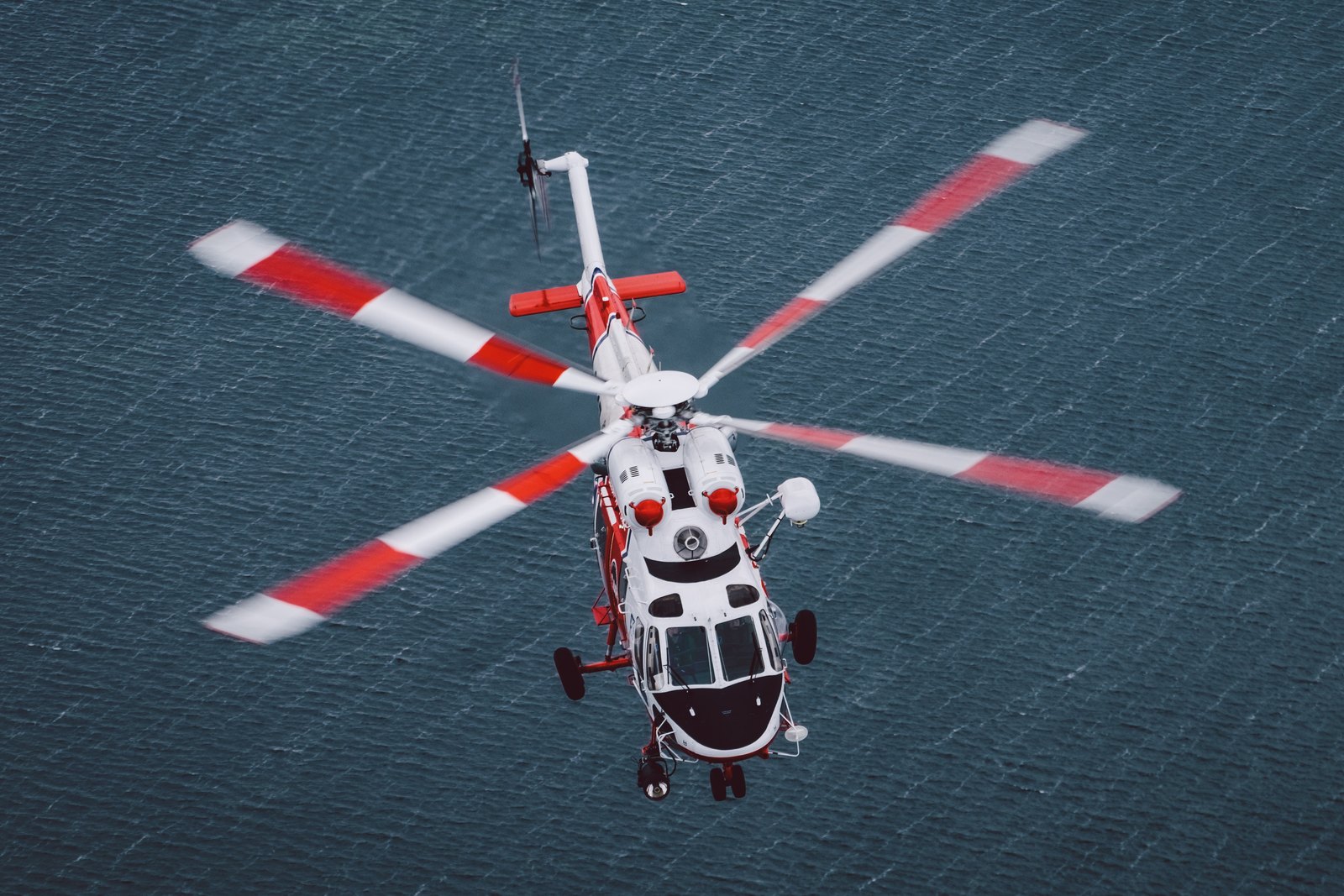
The single fact that shapes seafront airshow photography is a regulatory one: away from an aerodrome, the CAA’s guidance for display pilots sets the minimum display height at 200 feet above ground level over land, but 100 feet over water. Halve the floor and you halve the height at which the whole display can sit, and from a promenade that puts much of the flying on the horizon line or below it rather than safely up in clear sky. Everything else follows: the reach you need, the way you meter, the backgrounds you are handed, and which shoulder the sun sits over. With Eastbourne Airbourne running from 13 to 16 August 2026, it is worth working through properly.
On this page
- Why seafront airshow photography is a different problem
- The geometry of a promenade: crowd line, display line, reach
- What focal length you actually need
- Light on a seafront: which way the promenade faces, and when
- Sea haze is not heat haze
- Exposure against water and sky
- Backgrounds: the sea, the horizon, the pier, the empty frame
- Tide, and why low water costs you reach at Eastbourne
- Salt, spray, wind and kit
- The Red Arrows in 2026, and why the shapes have changed
- The UK seafront calendar as it now stands
- Planning a seafront day
- Frequently asked questions
Why seafront airshow photography is a different problem
The rulebook is CAP 403, Flying Displays and Special Events: Safety and Administrative Requirements and Guidance, currently Edition 23. Away from an aerodrome the minimum display height is at least 200 feet above ground level over land and at least 100 feet above sea level over water, and the Flying Display Director may impose more. Jets carry a separate aerobatic floor: no aerobatic manoeuvre by a jet may be flown below 500 feet, over land or water alike. That is a limit on all jets rather than a display floor for ex-military types. Swept-wing ex-military jets carry a further restriction of their own: a Civil Aviation Authority safety directive, current at the time of writing, prohibits them from flying aerobatic displays over land and limits them to flypasts and manoeuvring turns there. Over water they are not so restricted, which is a large part of why the classic jets turn up at seafront shows. Away from an aerodrome the floor is the higher of the imposed minimum and the pilot’s own Display Authorisation minimum, so a hundred feet over water is a floor rather than a promise, and at an aerodrome the Display Authorisation minimum governs on its own. That is why the same aircraft in the same programme can look so different at the two kinds of show.
Halving the floor does three things to your photographs, and they compound. The first is compositional. From a promenade at roughly sea level, an aircraft holding 100 feet is on or below the horizon for much of its pass, so the background behind it is sea rather than sky for far more of the display than you would ever get inland. The second is tonal, and it is why the exposure section below is the longest one here: the subject crosses between two backgrounds of wildly different brightness within a single pass. The third is kinetic, and the driver is distance rather than height. Angular rate is speed divided by distance, so on a line 230 metres out the drop from 200 feet to 100 feet shortens the slant range by only about two and a half per cent. What makes the pan feel fast is the reach the distance forces on you. At 400 mm and beyond the frame is narrow, and the same angular rate crosses it far quicker. Panning that felt comfortable at an airfield feels rushed on a seafront.

A second family of rules explains what you will and will not be offered overhead. Civilian display aircraft should not overfly the spectator area except in an emergency. The one routine exception is an aircraft carrying parachutists while positioning to drop, which may cross the spectator area or the car parks but not below 1,500 feet above sea level. The principle then splits in two: no aerobatic manoeuvres above structures occupied by non-essential personnel or known secondary spectator crowds within the display area, and no non-aerobatic overflight of those structures or crowds below 500 feet above the surface.
That separates the arrival or transit flypast, which can come over your head at or above 500 feet and non-aerobatically, from the display proper, which stays out over the water. Anything overhead is a flypast. Anything out to sea is the display, and photographers who wait for the display to come to them go home with a card full of belly shots. Parachute items run to their own minima, with the main canopy open by 1,500 feet above ground level for British Skydiving ‘C’ Licence holders or equivalent, so a drop hands you a long descending subject rather than a fast pass.
The geometry of a promenade: crowd line, display line, reach
Height is only half of it. The other half is lateral separation, and that is where a seafront show stops flattering you. The minimum separation from the crowd line is 230 metres for all aircraft, including rotary-wing aerobatics. That is the default and the number to hold in your head. Where speed exceeds 300 KIAS with the velocity vector pointed at the crowd, it rises to 450 metres. A reduced 150 metre line exists, but for fixed-wing aircraft it is set by CAP 403’s speed and mass limitations graph, a line of constant kinetic energy equivalent to a 1,200 kg aircraft at 150 knots, and anything above that line must use 230 metres. It also covers rotary-wing non-aerobatic flight and under-slung loads. An aerodrome show, by contrast, need only hold spectator enclosures 75 metres from a runway centreline, which is why taxi and static shots at an airfield feel close in a way nothing at a seafront ever will.
Aircraft are not permitted to display above any point on the surface closer to spectators or their vehicles than that distance. The crowd line itself is the closest edge of any area accessible to spectators, car parks included.
Does a beach count as a crowd area?
The test is accessibility, not surface type. A beach that spectators can walk onto is an area accessible to spectators, so the crowd line sits at the seaward edge of wherever people can get to, not at the sea wall. Where a tide moves that edge through the afternoon, the show’s Flying Display Director settles it.
Eastbourne is the venue that lets you plan properly, because the organiser publishes the answer. Airbourne uses two display lines, at 230 metres and 400 metres from the water mark, between the Western Lawns and the Pier, along a flying display line two miles long. Read that carefully: those distances are measured from the water mark, not from the crowd line. At high water they approximate your true distance to the aircraft. At low water, with beach exposed, the aircraft are further off than they suggest.

So the floor for planning is roughly 230 metres at best, 400 metres for the faster items, and more than either at low water. No seafront show puts a fast jet closer than 230 metres, whatever the brochure photography implies. Do not assume Eastbourne’s geometry travels. Most organisers publish nothing at all about their display lines, and at least one over-water event is not a line show: at the North East Lincolnshire Armed Forces Weekend the air displays are centred off Ross Castle at the north end of Cleethorpes rather than along the open sea.
What focal length you actually need
Separation distances turn directly into millimetres. An aircraft of length L at distance D subtends an angle of roughly L divided by D radians, while a full-frame sensor is 36 mm wide, so its horizontal half-angle is arctan of 18 divided by the focal length. Set the two equal and you can ask what focal length makes an airframe of a given size fill a given fraction of the frame at a given distance. The figures below are full frame; multiply by roughly 0.66 for APS-C and 0.5 for Micro Four Thirds for the equivalent field of view.
| Airframe | At the 230 m line | At the 400 m line |
|---|---|---|
| Typhoon-sized, about 16 m | approx 260 mm | approx 450 mm |
| Hawk-sized, about 12 m | approx 350 mm | approx 600 mm |
| 16 m airframe, filling the frame completely | approx 520 mm | around 900 mm |
Those numbers explain what published seafront images look like. Filling the frame completely with a 16 m airframe at 400 metres takes around 900 mm, which is why side-on single-ship shots are hard at a seafront show, and why most of the seafront images you admire are formations or crops. Set that against the general airshow advice of at least 300 mm and preferably 400 mm, and 400 mm is the working minimum here rather than the comfortable maximum. A 100-400 or a 200-600 zoom is the right tool. A 70-200 will get you formations and very little else.
The exception is the Red Arrows in formation. A seven-ship shape is far wider than any single aircraft and sits comfortably in 200 to 300 mm at these distances. That creates the one real kit problem of the day, because the switch from the formation to the Synchro Pair is a switch from around 200 mm to around 600 mm, and it arrives without warning. Two bodies, or one fast zoom hand and a lot of practice, are the answer. On a single body with a single long zoom, decide before the item starts whether you are shooting the formation or the pair, and accept that you will lose the other.
Crop sensors are quietly an advantage here in a way they are not at an aerodrome show, where you can often walk closer. You cannot walk closer to a line 230 metres out over water, so the reach a smaller sensor buys is reach you cannot get any other way. The trade is noise, and on a bright front-lit afternoon it is usually worth taking.
Light on a seafront: which way the promenade faces, and when
Two facts govern the day. In British Summer Time the sun is due south at about 13:00, not 12:00, with solar noon falling around 13:00 to 13:20 depending on longitude and date, so anyone planning around a midday southerly sun is an hour out all day. Through the afternoon the sun tracks from south, through south-west by mid-afternoon, to west and west-north-west by early evening. A seafront show has you facing seaward all programme, so the direction the promenade faces decides whether you spend the day in front light or fighting into it.
| Venue | Promenade faces | Display line | Sun relative to photographer, mid-afternoon | Verdict |
|---|---|---|---|---|
| Eastbourne | South-east, seaward normal about 130 degrees | Parallel to shore, 230 m and 400 m out | Abeam to the right at about three, behind the right shoulder after that | Cross-lit early, front-lit late |
| Clacton | South-south-east, seaward normal about 154 degrees | Parallel to shore, pier central | Ahead and to the right | Cross-lit, improving late |
| Paignton, Torbay | East | Parallel to shore over Tor Bay | Directly behind | Front-lit, best of the five |
| Southport | West-north-west | Parallel to shore over beach and sea | Behind early, swinging ahead through the afternoon | Well lit early, back-lit later |
| Blackpool | West | Between North Pier and Central Pier | Ahead from mid-afternoon | Back-lit from mid-slot |
Eastbourne
Eastbourne’s seafront runs broadly south-west to north-east, from the Wish Tower and Western Lawns up past the Pier, and so faces broadly south to south-east, with Beachy Head away to the west and south-west. The seaward normal is about 130 degrees, and that matters more than the broad aspect does. Around the middle of the day the sun is ahead of you and high, roughly 40 degrees to the right of the seaward view, so you are shooting into it rather than with it. Through the afternoon it swings west, comes abeam to your right at about three, and sits behind your right shoulder from then on. Aircraft over the sea are cross-lit through the early afternoon and properly front-lit only in the last part of the flying day.
That has a specific consequence for how you pick a day at Airbourne. A late morning slot, of the kind Airbourne runs at 11:40 to 12:20, puts the sun south-south-east, between 148 and 163 degrees, ahead of you and slightly to the right, so the middle of the display line is into the light. A mid-afternoon slot at 15:25 to 16:05 puts it in the south-west, about 231 to 241 degrees, roughly abeam to the right at the start and slipping behind your right shoulder by the end. That is much the better light, and if a headline item runs at both times in a week, take the afternoon. One caution about this show in particular: the Red Arrows were originally programmed for Friday to Sunday of Airbourne 2026 in exactly those slots, and withdrew on 8 August 2026 along with two other UK commitments after a prolonged spell of poor weather held the team in north-eastern Canada on its way back from North America. Check the organiser’s line-up in the last day or two before you travel rather than the one published in the spring.

Clacton
Clacton’s seaward normal is about 154 degrees, south-south-east towards the Thames Estuary approaches, which gives it Eastbourne’s problem rather than an escape from it. The sun stays in the seaward half of the sky and swings from ahead of you round to your right, clearing the shoreline behind you only at around quarter past four. The 2026 dates are Thursday and Friday, 27 and 28 August, and by late August the sun is lower and further south than at midsummer, which if anything improves the modelling on the aircraft. The pier is the differentiator, and it is worth more here than it would be at a better-lit venue. It projects south from the promenade, so from the deck you can shoot back along the display line in either direction, which is the one way to get the sun off the axis you are shooting down. Clacton is the venue where crowd position hands you a choice of light angle.
Paignton and Torbay
Paignton is a long sandy beach facing east into Torbay, the inverse of the west-facing venues. Facing east, you have the sun behind you from solar noon onwards. Morning would be into the light, but the flying is not in the morning. This is the best afternoon light of the five venues, and on the bearings it is not close. The Friday evening display, listed as starting at 18:45, is better still: by then the sun is in the west and north-west, directly behind the crowd and low, throwing strong warm side and rear light onto aircraft over the bay. For 2026, note that the event layout was altered by sea defence works along the seafront.
Southport and Blackpool
Both face broadly west, Southport a little north of west, and the sun sets over the sea at each. Southport is the difficult one. It faces west-north-west, so the first hour or two of a window running from around 12:00 to about 17:00 is well lit with the sun behind you. From about half past two the sun moves ahead of you and it worsens from there, until by five it is low and well round to your left over the sea, some 50 degrees off the seaward view. Expect flare, expect silhouettes, expect a hard time with any light-coloured airframe against a bright sky. The compensation is real: back-lit smoke and back-lit spray read beautifully, and a low sun on wet sand at low tide gives you a foreground no inland airfield can offer.
Blackpool runs the same trade on a shorter fuse. Displays begin around 14:00 and the Air Show Village runs from 12:00 to 19:00, so from 14:00 onward a west-facing crowd looks increasingly into the sun. The 2026 dates are 8 and 9 August, so the sun is still high at 14:00 and the slot is workable early and degrades through it. The compensation here is architectural rather than tidal, because the two piers give strong dark silhouette shapes to set against a bright sea.
Sea haze is not heat haze
Most airshow photography writing treats haze as one problem. It is two, with different physics and no overlap in the remedies.
Heat haze over tarmac is refractive. Air at different temperatures has different refractive indices, so the light path bends and wobbles and the detail is scrambled rather than dimmed. It is worst over hot hard surfaces in the middle of the day, worst at long focal lengths through a long air path close to the ground, and no filter fixes it. You shoot through it, change your angle, or accept the loss.
Sea haze is scattering, and sometimes it is outright fog. UK coastal fog, called haar in eastern Scotland and fret in eastern England, is advection fog: warm, moist air passes over a cool surface and cools until it saturates and condenses, classically warm air moving over the cool North Sea towards the east coast. It comes in the spring and summer months, when the land is warming but the sea, which warms more slowly, stays cold. Easterly winds push it inland quickly, warm land burns it off, cool land lets it persist. That is the season and the coastline the UK seafront airshow calendar sits on, so plan for it.

Scattering costs you contrast and saturation with distance rather than shimmer. Objects progressively further from the camera do not simply get smaller, they lose contrast, sometimes quite dramatically. On a line 400 metres out that is a flat, milky airframe your eye insisted looked crisp.
The difference to remember is what you can do about it afterwards. Heat haze is unrecoverable, because the detail was scrambled before it reached the sensor. Sea haze is partly recoverable, because contrast is compressed but the detail is still there. Shoot raw, expose so the aircraft is not sitting on the left of the histogram, and add contrast and dehaze later. Do not chase the haze in camera by underexposing to protect a sky you will darken anyway.
Exposure against water and sky
Haze acts on your meter as well as on your image. Fog and haze make the air far more reflective to light, which tricks the camera into cutting exposure much as a snow scene does. The correction is positive exposure compensation, not negative.
The seafront problem is worse, and it comes back to the 100 foot minimum. A display over water gives you two very different backgrounds inside a single pass. Above the horizon the background is bright sky. Below it the background is sea, and the sea behaves differently depending which way you face: at Eastbourne or Clacton in front light it is a dark mid-tone, while at Southport or Blackpool in back light it is a sheet of specular highlights brighter than the sky above it. An evaluative meter chases that transition, and your exposure moves between consecutive frames of the same pass.
So stop letting the camera decide. Manual exposure, set off the aircraft rather than the background and locked for the pass, is the reliable approach. If you prefer aperture priority, use a fixed exposure compensation and change it when the background changes, which means when the item crosses the horizon. For a light-coloured airframe against bright sea haze or a bright overcast sea, start at plus two thirds to plus one and a third stops and check it against the histogram on the first item of the day.
| Situation | Setting | Note |
|---|---|---|
| Jets, with a 300 mm or 400 mm lens | at least 1/500 second | the floor, not the target |
| Jets, when the light allows | 1/1000 second | the preferred figure |
| Propeller aircraft, for prop blur | 1/160 to 1/250 second | the standard working band |
| Propeller aircraft, with practised panning | as low as 1/60 second | for photographers who have put the hours in |
| Helicopters, for rotor blur | 1/125 to 1/160 second | 1/125 second is the one to come back to; slower still for hovers and big slow rotors |
| Static aircraft on the promenade | f/8 | the general recommendation for statics |
| Bright sunny conditions | ISO 100 | base for a front-lit afternoon |
| Overcast conditions | ISO 200 to 800 | raise it before you drop the shutter speed |
| Light airframe against bright sea haze or bright overcast sea | +2/3 to +1 1/3 stops | the starting point, then read the histogram off the first item |
| Focal length for aircraft in flight, general advice | at least 300 mm, preferably 400 mm | at a seafront show, treat 400 mm as the minimum |
| Polariser fitted | costs 1.5 to 2 stops | rarely affordable during flying |
Note how the shutter speed requirement interacts with everything else. You need at least 1/500 second for jets at 300 mm or 400 mm and would rather have 1/1000, on lenses that are long and therefore slow at the affordable end of the market. Under a bright front-lit sky at Eastbourne that is comfortable at ISO 100. Under flat overcast at a west-facing venue it means the 200 to 800 band and a willingness to go further. Propeller items are the awkward ones, because holding 1/160 to 1/250 second for prop blur fights the instinct to raise the shutter speed when the pan feels fast, and on a seafront the pan always feels fast.
Backgrounds: the sea, the horizon, the pier, the empty frame
Because the over-water minimum is 100 feet rather than the 200 feet over land, far more of the display sits on or below the horizon than at an inland show. The background is therefore sea: plain, low-contrast, mid-tone, and it separates an aircraft cleanly and without clutter. That is the aesthetic advantage of a seafront show, and the reason a competent seafront frame looks cleaner than a competent airfield one.
The corollary is the trap. Open water gives nothing to fix scale or place, so a shot over open sea at Eastbourne is indistinguishable from one at Clacton, and a portfolio of them is one picture repeated. The pier, the tower, the bandstand, the hotels and the crowd are what make an image a seafront image rather than an aeroplane with a blue rectangle behind it. Pick your landmark before the item starts, and decide which end of the pass will put the aircraft against it.
Two venues hand you this more readily than the rest. Blackpool concentrates its action between North Pier and Central Pier at the Tower Festival Headland, so the piers and the tower are frame furniture without hunting for an angle. Clacton puts its pier at the centre of the display line, so shooting from or beside it gives a landmark in one direction and clear water in the other. Eastbourne’s line runs between the Western Lawns and the Pier, so the Pier anchors the eastern end of a two-mile line and the Wish Tower end anchors the west.

The horizon is a compositional line as well as a nuisance. With an aircraft on or below it, it runs straight behind the airframe and any tilt is instantly visible, far more so than a sloping treeline at an airfield. Keep it level in camera, because straightening later costs resolution at exactly the moment you can least afford it. If you have an electronic level, this is the day to leave it switched on.
Tide, and why low water costs you reach at Eastbourne
The tide is the variable seafront photographers most often ignore and most often regret. One thing it does not do is move the flying, because displays run to the clock. It matters for foreground, for standing room and, at Eastbourne, for effective distance to the aircraft.
At Eastbourne the effect is direct and costly. The display lines at 230 metres and 400 metres are measured from the water mark. At high water that mark sits close to the promenade and the figures approximate the distance between you and the aircraft. At low water the mark has moved seaward and the aircraft go with it, so your true distance from a promenade position is greater than 230 metres and greater than 400 metres respectively. That is reach you cannot buy back with anything short of a longer lens. If the tide is out during a slot you care about, walk down the beach towards the water, tide safety permitting, and trade elevation for distance.
At the two west-facing venues the tide works the other way, and generously. Southport is the extreme case, with the sea over a kilometre away at low tide. It comes in quickly across that flat beach, the risk of being cut off is real, and mid-tide is the best compromise for a photographer as much as for a walker. What a low tide gives you at Southport and Blackpool is an enormous expanse of wet, flat, reflective sand under a low afternoon sun, and that is the best foreground on the UK seafront circuit. It exists precisely because those two venues have the difficult light: the back-lighting that ruins the aircraft is what makes the sand.

Check the tide before you choose your spot rather than after. Times are published per beach by the Met Office and BBC Weather. Ten minutes with a tide table the night before beats any accessory you could buy on the day, and the same is true of the wider planning of a show day.
Salt, spray, wind and kit
The failure mode at a seafront show is not water. It is the salt left behind after the water evaporates. Salt is hygroscopic, so a dried deposit keeps pulling moisture back onto whatever surface it sits on, which is why a lens that seemed fine on the day develops problems weeks later. Weather sealing helps less than people assume. It resists ingress, but it does nothing about salt deposited on external surfaces, on zoom barrels, on switch gates or on the filter thread, which is exactly where a fine airborne mist lands in an onshore breeze.
Anything used within salt spray range of breaking surf gets rinsed with fresh water on a damp cloth and dried the same day, not at the end of the weekend. Four days of Airbourne means four rinses, not one on the Sunday night. A clear protective filter is worth more here than inland, because it turns the sacrificial surface from a coated front element into an inexpensive piece of glass you can scrub without anxiety.
The polariser question
A polariser is the wrong filter for the flying and the right filter for everything else. It is strongest at about 90 degrees from the sun, and the finger trick finds it: make an L with thumb and index finger, point the index finger at the sun, and the thumb points to where sky polarisation is strongest. It costs 1.5 to 2 stops. On water it can nearly eliminate a reflection, but only near the Brewster angle of about 53 degrees from the surface normal, which from a promenade means the water in front of you rather than the far distance. It cuts the polarised part of atmospheric scatter too, which is why people reach for one on a hazy coast, but it helps less over the sea than inland, because the large droplets and salt aerosol that make sea haze scatter light that is only weakly polarised.
Two things kill it for display work. The first is the light loss, because you cannot spare 1.5 to 2 stops while holding 1/500 or 1/1000 second at 400 mm or longer. The second is geometry. At the front-lit venues you shoot with the sun behind you, which puts your subject near 180 degrees from the sun, and at the back-lit venues near 0 degrees, and both are exactly where a polariser does least. Use it for static aircraft, for the pier and for the sea itself, and take it off before the flying starts. On full frame the sky also polarises unevenly below about 28 mm, and below about 24 mm a standard filter ring can vignette at small apertures unless a thin model is used. Never use one for a stitched panorama.
Wind, piers and support
Piers are the best elevated positions at Clacton, Blackpool and Southport, and they move. A pier deck carrying a large crowd flexes and transmits footfall, which makes a tripod or monopod worse than shooting handheld, because rigid support couples you to a vibrating structure instead of letting your body damp the movement. Brace against the rail with your body, not with a leg.
Onshore wind at a seafront show is constant and unobstructed in a way it never is at an inland aerodrome, where hangars, trees and terrain break it up. It affects long lens stability, it affects how much spray and airborne salt reaches your gear, and it affects how long you can stand in one place without getting cold, even in August.
The Red Arrows in 2026, and why the shapes have changed
If you have shot the Red Arrows before, the fact to know about 2026 is that they are displaying as a seven-ship, Reds 1 to 7, expanding to nine jets with Reds 8 and 9 for special occasions such as national events. The driver is fleet management, with the Hawk T1 approaching retirement and the team rotating its remaining engines, and the seven-ship format is expected to run until the Hawk T1 leaves Red Arrows service at the end of the 2029 display season, with retirement following in 2030.
The photographic consequence is that the shapes are different. Nine-ship signature formations do not appear in 2026 displays, so date any archive image you caption alongside new work, and do not describe a 2026 display using nine-ship formation names. The guide to photographing the Red Arrows covers the current shapes. The formation names are worth knowing for the commentary, though two of them describe a nine aircraft team: Enid is Reds 1 to 5, Hanna is Reds 6 to 9, the Synchro Pair is Reds 6 and 7, and Red 10 is the Supervisor and commentator. In a seven aircraft display Hanna is Reds 6 and 7 only.
The other thing to know before you pick a lens is which display you are about to get, because the team flies three versions according to cloud base. That matters more on a seafront than at an airfield. A flat display keeps everything low and close to the horizon, good for clean sea backgrounds and hard on your panning, while a full display puts vertical work into a sky that a hazy coastal afternoon may render as a flat white sheet.
| Cloud base | Display flown | What it means on a seafront |
|---|---|---|
| Above 5,500 ft | Full display | Vertical work against sky; watch for a blown-out hazy background |
| 2,500 to 5,500 ft | Rolling display | Mixed backgrounds; expect the meter to move across the horizon line |
| Below 2,500 ft | Flat display | Everything low and close to the horizon; clean sea backgrounds, fast pans |
The UK seafront calendar as it now stands
Most of these shows are free. Eastbourne, Clacton, Blackpool, Ayr, Swansea, Bray, Scarborough, Sidmouth, Paignton, Withernsea, Guernsey and Jersey all are, while Southport is ticketed at 13 pounds plus a booking fee for an adult, 12 pounds a head for groups of ten or more, and children under 16 free. Attendance figures for the free shows are estimates rather than counts.
| Show | 2026 dates | Admission | Location note |
|---|---|---|---|
| English Riviera Airshow, Paignton | 29 to 31 May 2026 | Completely free to attend | Paignton seafront; 2026 layout altered by sea defence works; Friday evening displays from 18:45; 10th anniversary, first held 2016 |
| Scarborough Armed Forces Day | 27 June 2026, 11:00 to 17:00 | Free admission | Scarborough seafront, North Bay focus; six air displays including a Typhoon at 16:05 |
| North East Lincolnshire Armed Forces Weekend, Cleethorpes | Late June 2026 | Free, with one 2 pound ticketed evening show | Air displays centred off Ross Castle at the north end of the resort, not over the open sea |
| Wales Airshow, Swansea Bay | 25 to 26 July 2026 | Free entry | Swansea Promenade, display over Swansea Bay; over 200,000 annual attendance on the organiser’s figure |
| Bray Air Display, Co. Wicklow | 1 August 2026 | A free family festival on Bray seafront | 19th edition; main air display from 15:00 |
| Withernsea Blue Light Weekend | 8 to 9 August 2026 | Free to attend | East Yorkshire promenade |
| Blackpool Air Show | 8 to 9 August 2026 | Free to attend | Promenade between North Pier and Central Pier, Tower Festival Headland; displays from approximately 14:00, Air Show Village 12:00 to 19:00 |
| Eastbourne Airbourne | 13 to 16 August 2026 | Free for spectators; programme 10 pounds | Western Lawns to the Pier; display lines at 230 m and 400 m from the water mark; first held 1993 |
| Clacton Airshow | 27 to 28 August 2026, Thursday and Friday | Free | 33rd edition; Clacton seafront and pier; council has committed to run it through to at least 2027 |
| Sidmouth Regatta Airshow | 28 August 2026 | Free | The Ham, Sidmouth, alongside sea-based regatta events |
| Southport Air Show | 29 to 30 August 2026 | Ticketed: 13 pounds plus booking fee, 12 pounds for groups of ten or more, under-16s free | Marine Drive and the promenade; gates 10:00, flying approximately 12:00 to 17:00; first held 1991 |
| International Ayr Show, Festival of Flight | 4 to 5 September 2026 | Free entry | Ayr shorefront, Low Green; 4th consecutive edition |
| Guernsey Air Display | 9 September 2026 | Free to attend | A twilight display over St Peter Port Harbour, 18:30 to 20:00 |
| Jersey International Air Display | 10 September 2026 | Free to attend | Flying over St Aubin’s Bay, 13:00 to 17:00, one of the most fully over-water displays in the British Isles |
| Bradwell Waterside Air Display | 19 September 2026 | Not stated | Bradwell-on-Sea, Essex; confirm the date before travelling |
The International Ayr Show draws over 260,000 across its two days, the highest published two-day figure of any UK seafront show. Clacton drew an estimated 200,000 visitors in 2025, worth an estimated 12 million pounds a year to the local economy. Airbourne is the UK’s largest free airshow and one of Europe’s biggest free seafront shows. Southport, which began in 1991, is the oldest of the mainland UK seafront shows still running, ahead of Clacton in 1992 and Eastbourne in 1993.
What has been lost, and why
The calendar above is shorter than it was five years ago, and the reasons are not what people assume. The largest single loss is Sunderland International Airshow, which ran from 1989 at Roker and Seaburn. It went in 2020 and 2021 for Covid, in 2022 for ongoing uncertainty, and then permanently, the council citing the global climate emergency and a rethink of its events programme. It had drawn around a million spectators.
Bournemouth Air Festival last ran in 2024, announced as the last edition organised by the council. The council then sought a new operator from 2026, and negotiations with one potential operator failed over finances and over that operator’s demand to close public beach access. The 2024 event cost 264,000 pounds to produce, with costs expected to rise on new counter-terrorism requirements. A council report recommended ceasing efforts to bring it back for 2026 and beyond, with a Cabinet decision set for 18 June 2025: unless an operator funds the festival entirely itself and without restricting public access to Bournemouth’s coastline, it is unlikely to return any time soon. It is not returning in 2026, and there is nothing yet for 2027.
Weston Air Festival last ran in 2022, after North Somerset Council said it could no longer afford a 135,000 pound annual subsidy. Rhyl Air Show is not going ahead in summer 2026 and is absent from the Red Arrows’ published line-up. Air Waves Portrush is a different case. Last held in September 2024, it has been postponed rather than cancelled, because of clashes with the North West 200, the Lammas Fair, Armed Forces Day and 2026 commemorations, and it is next scheduled for 2028. Further back, Llandudno Airshow last ran in 2015, its 2016 edition cancelled because organisers had insufficient time to implement the new CAA safety regulations that followed Shoreham, and Dawlish Air Show’s 2017 edition was cancelled with no sign of any return.
The pattern is clear enough to state. The causes are local authority budgets and rising compliance and security costs, not aviation safety. Llandudno is the clearest case of a show ended by regulation, and Dartmouth’s regatta display went the same way, while Portrush is a scheduling pause with a date at the end of it. The rest is money. Herne Bay, Margate, Folkestone and Lowestoft also appear on the industry’s list of shows no longer held.
Planning a seafront day
Start with the tide table and the sun, in that order, because both are known in advance and neither can be fixed on the day. Work out when high and low water fall relative to the flying window. At Eastbourne a high water during the slots you care about means the aircraft are as close as the geometry allows, while a low water means planning to be down the beach rather than up on the promenade. At Southport or Blackpool you want a low water during the flying, because the wet sand is the picture, and mid-tide is the compromise if you also want to be able to move.
Then work out where the sun will be at the times on the programme that matter, remembering that solar noon in British Summer Time falls around 13:00 to 13:20 and not at midday. For Airbourne that produces the recommendation made above: an afternoon slot over a late morning one.
The published Airbourne line-up gives you the rest of the planning. Across all four days the programme lists the Battle of Britain Memorial Flight with Dakota, Spitfire and Hurricane, Rich Goodwin’s Jet Pitts, the P-51 Mustang “Marinell” and the Royal Navy Black Cats helicopter solo. Friday to Sunday adds the RAF Typhoon, the RAF Tutor Display Team, the “Spirit of Kent” Spitfire and the B-17 “Sally B”. Saturday and Sunday bring the Red Devils, The Starlings Aerobatic Team and the Conair Turbo Firecat. Thursday and Friday have the Wasp, the Stampe Formation Team and The Firebirds, and the MiG-17 appears Thursday to Saturday. The AeroSuperBatics Wingwalkers fly solo on Thursday and Friday and as a duo at the weekend, and the Red Arrows, originally listed for Friday to Sunday, withdrew on 8 August 2026. All of it is subject to RAF operational commitments, weather and serviceability, and this show is a demonstration of exactly that.

Use that mix to plan your lenses rather than your position. A day with the Battle of Britain Memorial Flight, a Spitfire, a Mustang and a B-17 in it is a day of propellers, and propellers want 1/160 to 1/250 second for blur, a different discipline from the 1/500 to 1/1000 second you will hold for the Typhoon and the MiG-17. Set the propeller speed and leave it for the whole of a piston item rather than drifting up when the pan feels quick. Wingwalkers reward tighter framing than you think, because the point of the picture is the person rather than the biplane.
On the ground, arrive early enough to walk the length of the display line before the first item. At a two mile line you are choosing an end as well as a spot, and that determines whether your landmark sits at the far edge of the frame or fills it. Look for where the crowd thins, because a rail you can lean on is worth more than a marginally better angle from a position where you cannot stand still. If a pier is open, remember that it gives elevation and a choice of shooting direction but takes away rigid support.
Plan the end of the day as carefully as the start. Rinse and dry the gear the same day if you have been near breaking surf, and back up before you sleep. If you are shooting more than one day of a four-day show like Airbourne, review the first day’s frames that evening, because everything you learn about the light, the haze and the distance on Thursday is still true on Sunday.
Pictures made at seafront shows are licensed through the Piemags aviation archive, and the terms are set out on the licences page.
Frequently asked questions
Why can display aircraft fly lower over water than over land?
Away from an aerodrome, the CAA’s guidance for display pilots sets the minimum display height at 200 feet above ground level over land and 100 feet over water. No aerobatic manoeuvre by a jet aeroplane may be flown below 500 feet, over land or water alike, which is an aerobatic limit on all jets rather than a display floor for ex-military types. At an aerodrome the governing figure is instead the individual pilot’s Display Authorisation minimum.
How close will the aircraft actually get at a seafront show?
The default minimum lateral separation from the crowd line is 230 metres for all aircraft, including rotary-wing aerobatics, rising to 450 metres where speed exceeds 300 KIAS with the velocity vector towards the crowd. A reduced 150 metre line exists, but for fixed-wing aircraft it is governed by a speed and mass graph rather than a simple threshold, drawn as a line of constant kinetic energy equivalent to a 1,200 kg aircraft at 150 knots. It also covers rotary-wing non-aerobatic flight and under-slung load work. At Eastbourne the organiser publishes display lines at 230 metres and 400 metres from the water mark.
What focal length do I need at Eastbourne Airbourne?
By calculation, a Typhoon-sized airframe of about 16 metres needs approximately 260 mm to fill half the frame width at the 230 metre line and approximately 450 mm at the 400 metre line, on full frame. A Hawk-sized airframe of about 12 metres needs approximately 350 mm at 230 metres and approximately 600 mm at 400 metres. Filling the frame completely at 400 metres with a 16 metre airframe takes around 900 mm. Multiply by roughly 0.66 for APS-C and 0.5 for Micro Four Thirds to get the equivalent field of view.
Is 400 mm enough?
General airshow advice is at least 300 mm and preferably 400 mm, but at a seafront show 400 mm is the working minimum rather than the comfortable maximum, because you cannot walk closer to a line 230 metres out over water. A 100-400 or a 200-600 zoom is the right tool. A 70-200 will get you formations and very little else.
What shutter speeds should I use?
For jets with a 300 mm or 400 mm lens, use at least 1/500 second, and 1/1000 second when the light allows. For propeller aircraft, 1/160 to 1/250 second gives prop blur, and photographers with practised panning can work as low as 1/60 second. Use ISO 100 in bright sunny conditions and ISO 200 to 800 under overcast, and f/8 for static aircraft.
Which UK seafront venue has the best light?
Facing east into Torbay, Paignton has the sun behind the photographer all afternoon, which makes it the best afternoon light of the five venues covered here. Eastbourne faces south-east and Clacton south-south-east, so the sun sits in the seaward half of the sky for much of the flying window and only moves behind the right shoulder late in the afternoon. Southport faces west-north-west and Blackpool west, so both start well lit and turn back-lit from mid-afternoon, which is difficult for the aircraft and excellent for spray, smoke and wet sand.
When is the sun due south at a UK summer show?
In British Summer Time the sun is due south at about 13:00, not 12:00; solar noon falls around 13:00 to 13:20 depending on longitude and date. Through the afternoon it tracks from south, through south-west by mid-afternoon, to west and west-north-west by early evening. Planning around a midday southerly sun will put you an hour out for the whole day.
Which Airbourne slot has the better light, late morning or afternoon?
The afternoon. A slot at 15:25 to 16:05 puts the sun in the south-west, behind the photographer’s right shoulder, which is the better light. A late morning slot at 11:40 to 12:20 puts it south-south-east, between 148 and 163 degrees, ahead of the photographer and slightly to the right, so the middle of the display line is into the light. Note that the Red Arrows, originally programmed for those Airbourne slots in 2026, withdrew on 8 August 2026. All flying is subject to RAF operational commitments, weather and serviceability.
How is sea haze different from heat haze?
Heat haze over tarmac is refractive: air of different temperatures bends the light path and scrambles detail, no filter fixes it, and the loss is unrecoverable. Sea haze is scattering, and sometimes advection fog, which the Met Office describes as forming when warm, moist air passes over a cool surface; it compresses contrast with distance rather than destroying detail. That makes sea haze partly recoverable, so shoot raw, keep the aircraft off the left of the histogram and add contrast and dehaze afterwards.
Should I use a polariser at a seafront airshow?
Not for the flying. A polariser costs 1.5 to 2 stops, which you cannot spare when holding 1/500 or 1/1000 second at 400 mm or longer, and its effect is strongest at about 90 degrees from the sun, whereas front light puts you near 180 degrees from the sun and back light near 0 degrees. Use it for static aircraft, the pier and the sea itself, and note that on full frame the sky polarises unevenly below about 28 mm and the filter ring can vignette below about 24 mm at small apertures.
Does the tide change when the display flies?
No. No organiser publishes a tide-linked flying schedule and displays are scheduled to the clock. The tide affects your foreground, your standing room and, at Eastbourne, your effective distance to the aircraft, because the 230 metre and 400 metre display lines are measured from the water mark rather than from the crowd line. At Southport the sea can be over a kilometre away at low tide, which is what creates the wet sand foreground there.
Which UK seafront shows are still running, and which are free?
Most, but not all, are free: Eastbourne, Clacton, Blackpool, Ayr, Swansea, Bray, Scarborough, Sidmouth, Paignton, Withernsea, Guernsey and Jersey are free, while Southport is ticketed at 13 pounds plus booking fee, with 12 pounds for groups of ten or more and under-16s free. Still to come in 2026, after Blackpool on 8 and 9 August, are Eastbourne Airbourne on 13 to 16 August, Clacton on 27 and 28 August, Sidmouth on 28 August, Southport on 29 and 30 August, Ayr on 4 and 5 September, Guernsey on 9 September, Jersey on 10 September and Bradwell on 19 September. Bournemouth last ran in 2024, Weston last ran in 2022, Sunderland has ended permanently, Rhyl is not running in 2026, and Air Waves Portrush is postponed rather than cancelled, next scheduled for 2028.
