
In September 2019, a forty-year-old Short Skyvan flew out of Athens with its rear ramp removed and a row of photographers strapped in where the cargo should be. Over four days, the aircraft of Athens Flying Week formated on its open back one after another: Mirage 2000s out of the clouds, a P-3 Orion over the islands, the Patrouille de France trailing the tricolore over the city, and, twice, the aeroplane every photographer on board had crossed Europe for, the McDonnell Douglas F-4E Phantom II of the Hellenic Air Force. One of those encounters lasted forty-two minutes. This is the story of that expedition, every photograph in it made from the ramp, and every one of them licensable today.
Air-to-air photography is aviation’s most demanding discipline and its least understood. The public sees the results, clean images of aircraft in their element, and assumes a long lens and luck. The reality is a flying photo studio: a camera ship, a planning table, formation briefs, radio discipline, weather calls, and subject aircraft flown by pilots willing to hold position metres from an open ramp. This piece walks through one real expedition from beginning to end, because the best way to understand what makes these photographs different is to ride along.
- The photoship: a Skyvan with the back missing
- Planning an expedition: the unglamorous fortnight
- The photoship’s own story
- Athens Flying Week: why Greece
- First surprise: the last Buckeyes
- Kalamata: two Phantoms and a photobomb
- Andravida and the last squadron
- The Phantom in Greek service
- Forty-two minutes with the Phantom
- Anatomy of a sortie morning
- Equipment notes from the ramp
- The Mirages: deltas in the cloud canyons
- The Orion over the islands
- Daedalus, the Extra and the working sky
- The Patrouille de France over Athens
- A Corsair over the Aegean
- The rotary wing: Hueys and Aegean Hawks
- The week in the gallery
- A photographer’s geography of Greek light
- Three worked briefs from this one expedition
- The craft: how ramp photography actually works
- How subjects fly the box
- What can go wrong
- From the ramp to the archive
- What these photographs are for
- Reading the frames: six images, closely
- Photographing a legend without clichés
- Using this story
- Aftermath: why 2019 matters more every year
- Frequently asked questions
- Sources and further reading
The photoship: a Skyvan with the back missing
Every air-to-air expedition begins with the camera ship, and Aviation Photo Crew’s is a Short SC.7 Skyvan, the boxy Northern Irish freighter that photographers have quietly turned into the best camera platform in Europe. The Skyvan’s virtues are exactly its lack of glamour: a big square fuselage, a rear ramp that opens in flight, docile handling across a wide speed range, and the ability to carry a row of photographers, harnessed and facing backwards, with nothing between their lenses and the subject but air.
That open ramp changes everything about what is possible. Shooting through an airliner window or a fighter’s canopy puts curved, scratched, tinted material in front of every frame. From the ramp there is no glass at all: the light arrives unfiltered, the horizon is real, and a subject aircraft can fill the frame from metres away. The cost is that everything else gets harder. The photographers work in the propwash and the cold, communication is by intercom and hand signal, and every movement is planned, because the floor ends where the sky begins.
The operation around the aeroplane is what makes it professional. Every subject sortie is briefed on the ground first: join-up procedures, formation positions, minimum separations, light angles, radio calls, and the break-away that ends each set. The photo pilot flies the lead, the subject formates on the Skyvan, and the photographers direct fine positioning through the intercom, a wing lower here, a few metres closer there, while both aircraft ride the same air. Nothing about it is casual, which is precisely why fast jets, national display teams and air forces agree to take part.
Athens Flying Week: why Greece
Athens Flying Week has grown into one of Europe’s most photogenic airshows for a simple reason: Greece still flies aircraft nobody else flies, in light nobody else has. By 2019 the Hellenic Air Force was one of the last operators on earth of two classic types, the F-4E Phantom II and the T-2 Buckeye trainer, both flying from bases with names out of classical history, and the show’s organisers had built a genuine partnership with Aviation Photo Crew: the Skyvan came to Athens, and the participating aircraft came to the Skyvan’s ramp.
The September light over the Aegean does the rest. Photographs from these sorties carry backgrounds no studio could invent: island chains in blue water, olive groves in low sun, cloud canyons over the mountains, and the white sprawl of Athens itself. For an archive whose business is imagery buyers cannot get elsewhere, the combination of rare aircraft and Greek light is close to unfair.
First surprise: the last Buckeyes
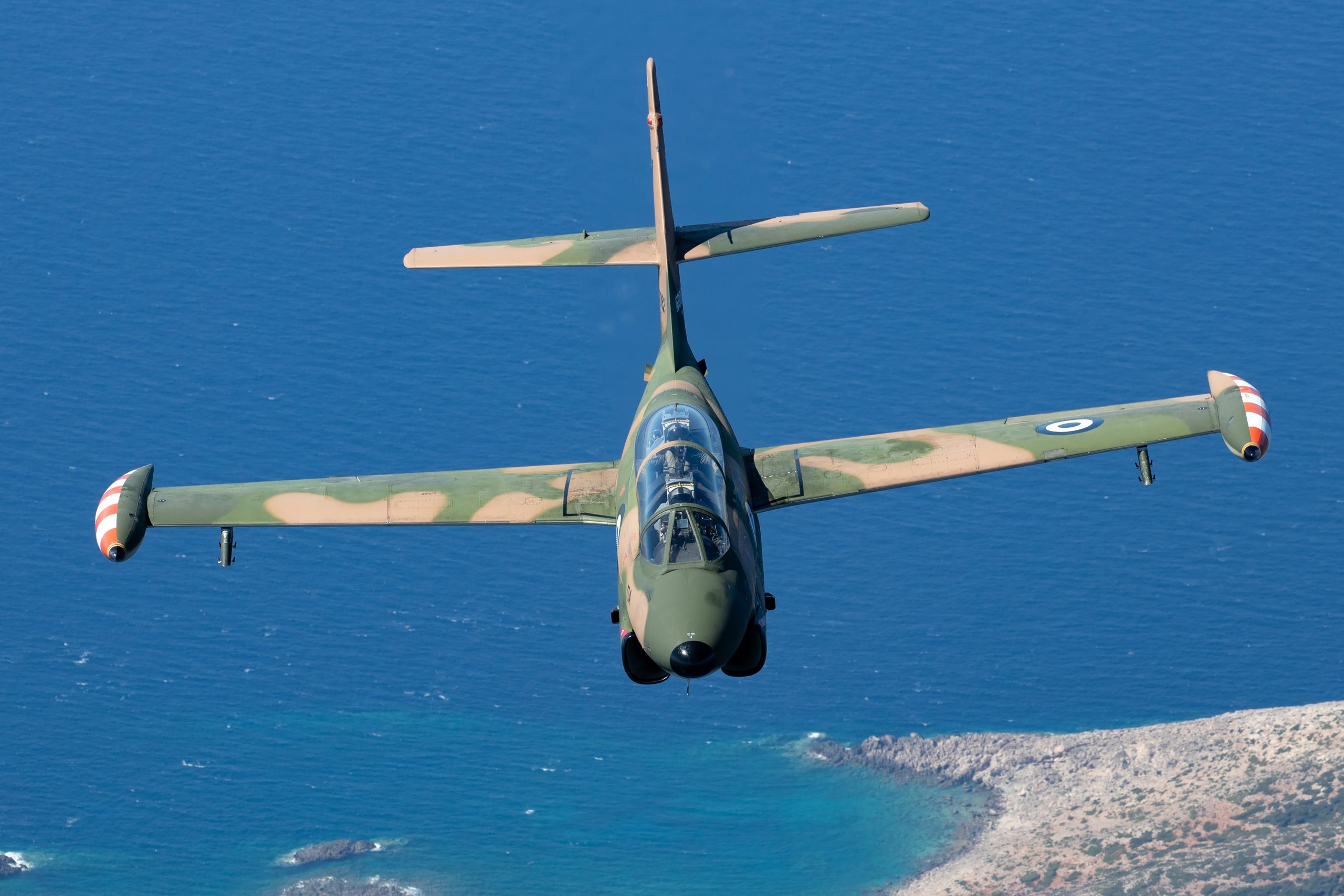
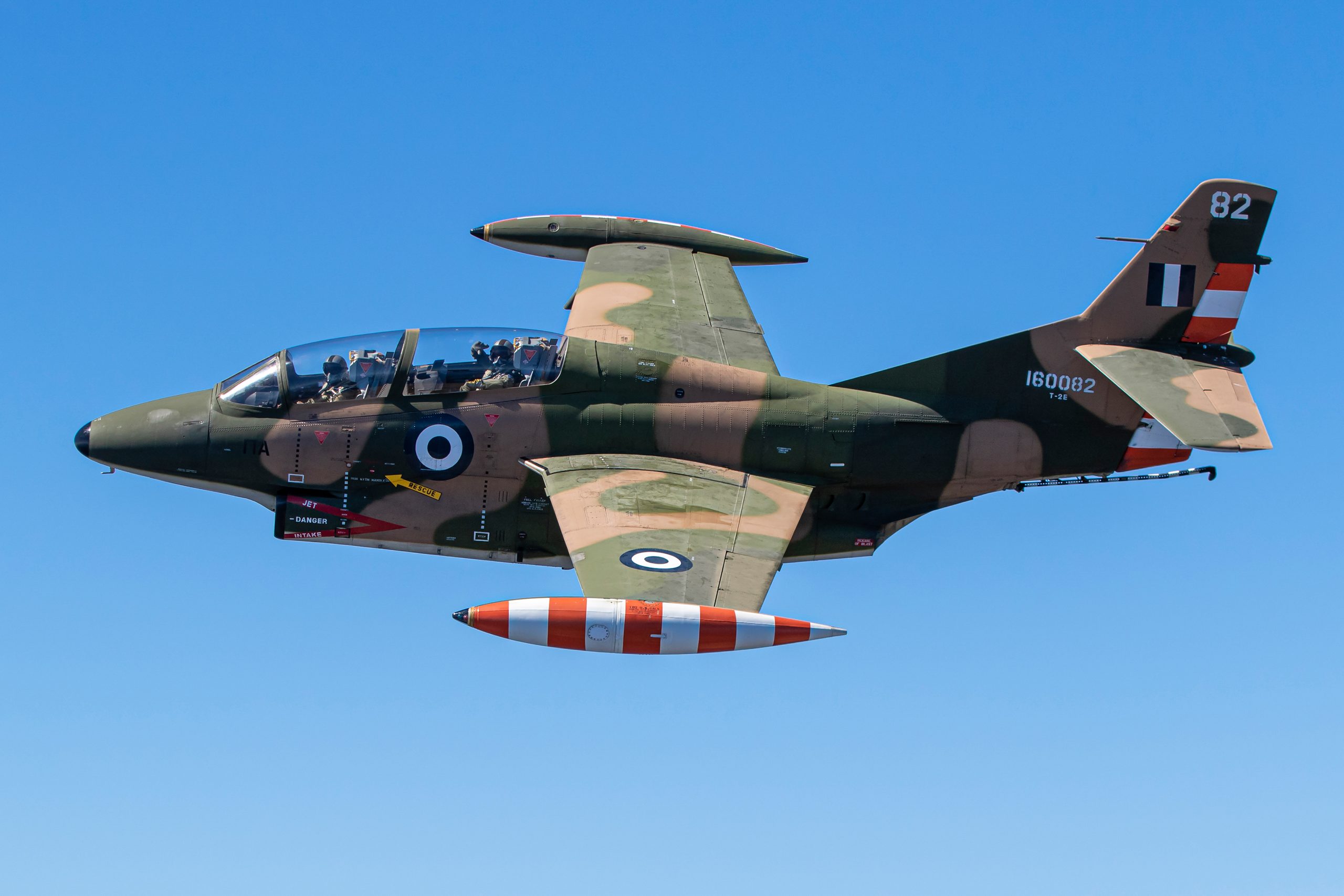
The North American T-2 Buckeye deserves a moment of respect it rarely gets. A stout American jet trainer designed in the 1950s to teach naval aviators, it retired from US service in 2008, after which exactly one air arm in the world kept flying it: the Hellenic Air Force, whose Buckeyes soldiered on at Kalamata training fighter crews. By 2019 a Buckeye in the air was, globally, a Greek phenomenon, and photographing one air-to-air was something almost no photographer alive had done.
The expedition got two. A camouflaged example, 160082, came to the ramp in close formation, practice pod under the wing, close enough to count rivets, and the coastal sortie put a Buckeye against the blue of the Aegean in the kind of frame that reads like a period photograph made with modern equipment. For publishers, these images occupy an unusual niche: a Vietnam-era American trainer, photographed in pristine condition, in service, in 2019. When the type finally retires, these will be among the last air-to-air photographs of it ever made.
Planning an expedition: the unglamorous fortnight
By the time the Skyvan’s wheels leave the runway with photographers aboard, most of the expedition’s work is already done. An air-to-air week like Athens 2019 begins weeks earlier, in correspondence: which aircraft the show and the air arms can offer, which the archive needs, what the insurance and permissions require, and what the diplomatic clearances allow, because flying a camera aircraft alongside military jets in national airspace is not a thing that happens on a handshake. Each subject then gets its own plan: speeds the Skyvan and the subject can both hold, the block of sky, the light windows, the join and the break.
Then there is the ferry. The Skyvan is a 175-knot aeroplane on a good day with the ramp on; getting it from its Belgian base to Athens is a day’s flying across half of Europe, with fuel stops planned like a small military deployment. The photographers travel with equipment for every contingency, because there is no camera shop at 5,000 feet over the Peloponnese, and the week’s schedule is built loose enough to absorb what weather and serviceability will inevitably do to it. The Kalamata diversion that turned one Phantom into two and added a Buckeye is the pleasant version of the same truth: the plan is a starting point.
What makes the whole machine work is trust accumulated over years. Air forces lend their jets to the ramp because the operation’s briefing culture, safety record and radio discipline have been proven across hundreds of sorties, and display teams sign up because the results respect the aircraft. That trust is not transferable and cannot be improvised, and it is why truly comparable air-to-air collections are so rare: the barrier to entry is not a camera, it is a decade of doing this properly. Anyone weighing that claim can read about the photographer behind this archive and the standards the journal works to before deciding what it is worth.
The photoship’s own story
The aircraft at the centre of all this deserves its own paragraph. The Short SC.7 Skyvan is a 1960s Northern Irish design, a light freighter built around a square-section fuselage and a full-width rear door, which is precisely the feature that makes it a photoship: take the door off, fit the harness rails, and the back of the aeroplane becomes a flying balcony. Its two Garrett turboprops give it the speed overlap that matters, slow enough for warbirds and helicopters, fast enough that a jet with flap can sit behind it comfortably, and its fixed undercarriage and honest handling make it a stable platform in the bumpy air where photography actually happens.
Photographers who fly on her joke that the Skyvan is the only aircraft at any airshow that appears in nobody’s photographs and makes everybody’s. It is the right joke with a serious point: the entire visible output of this archive’s air-to-air work, the Phantoms, the Mars, the F-35s, the warbirds, was made standing in that one square doorway.
Kalamata: two Phantoms and a photobomb
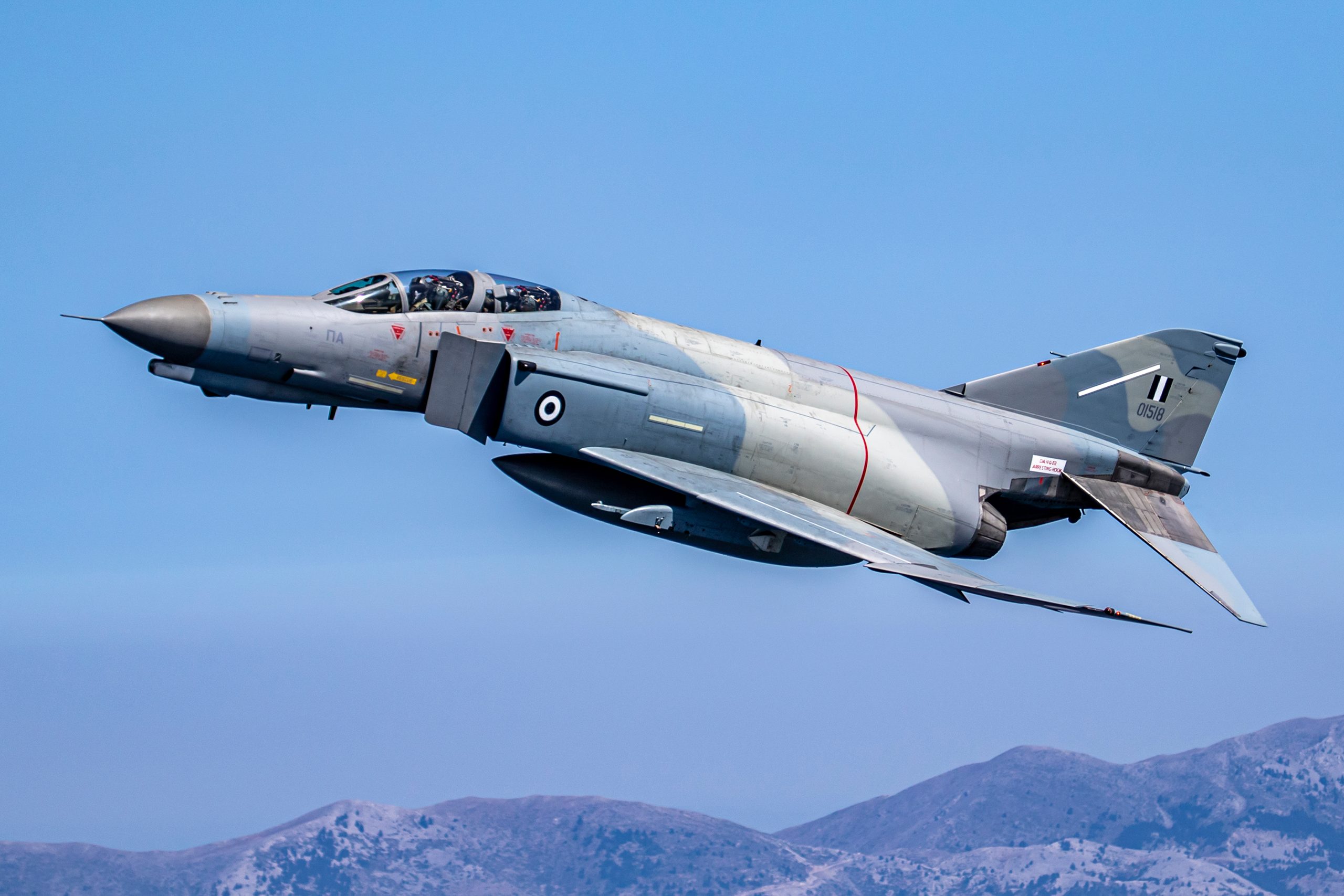
The Phantom mission was planned for the coast near Andravida, the storied fighter base in the western Peloponnese where the Hellenic Air Force’s 338 Squadron keeps the F-4E AUP alive. Like most things in aviation, it did not go quite to plan, and like the best things in aviation, the change was an upgrade. The rendezvous drifted south, towards Kalamata, and instead of one Phantom the Skyvan got two, with an escort nobody had dared hope for. The PhotoCrew’s own trip report records the moment with the punctuation it deserved: the team “flew out to the coastal region near Andravida to capture the magic F-4 Phantoms… only it turned out to be a little more South, more Kalamata region to get a very very unique encounter with 2 Phantoms ( so twice YES!!! YES!!! )… but also the super unique and ultra-rare T-2 Buckeye.”
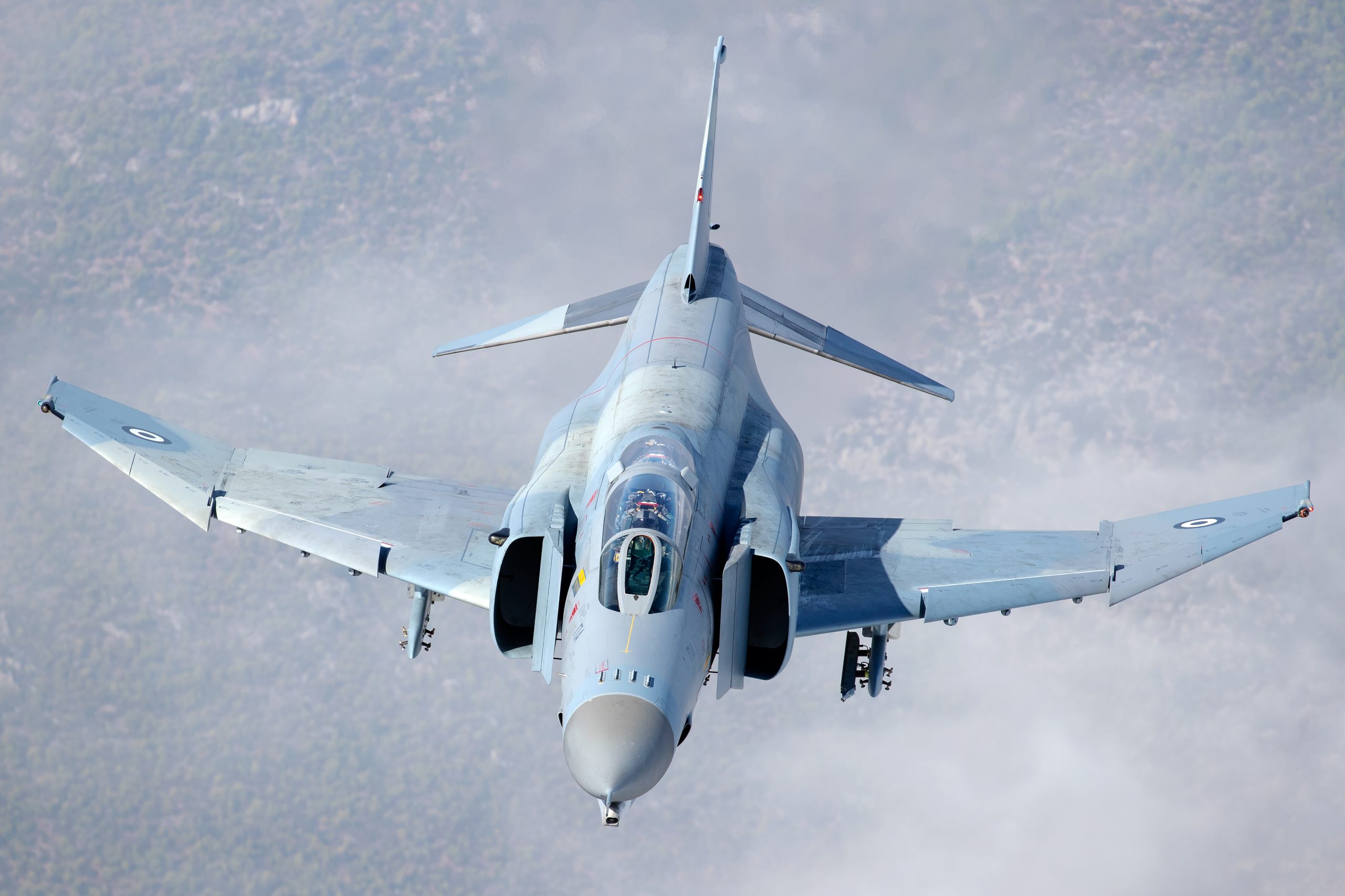
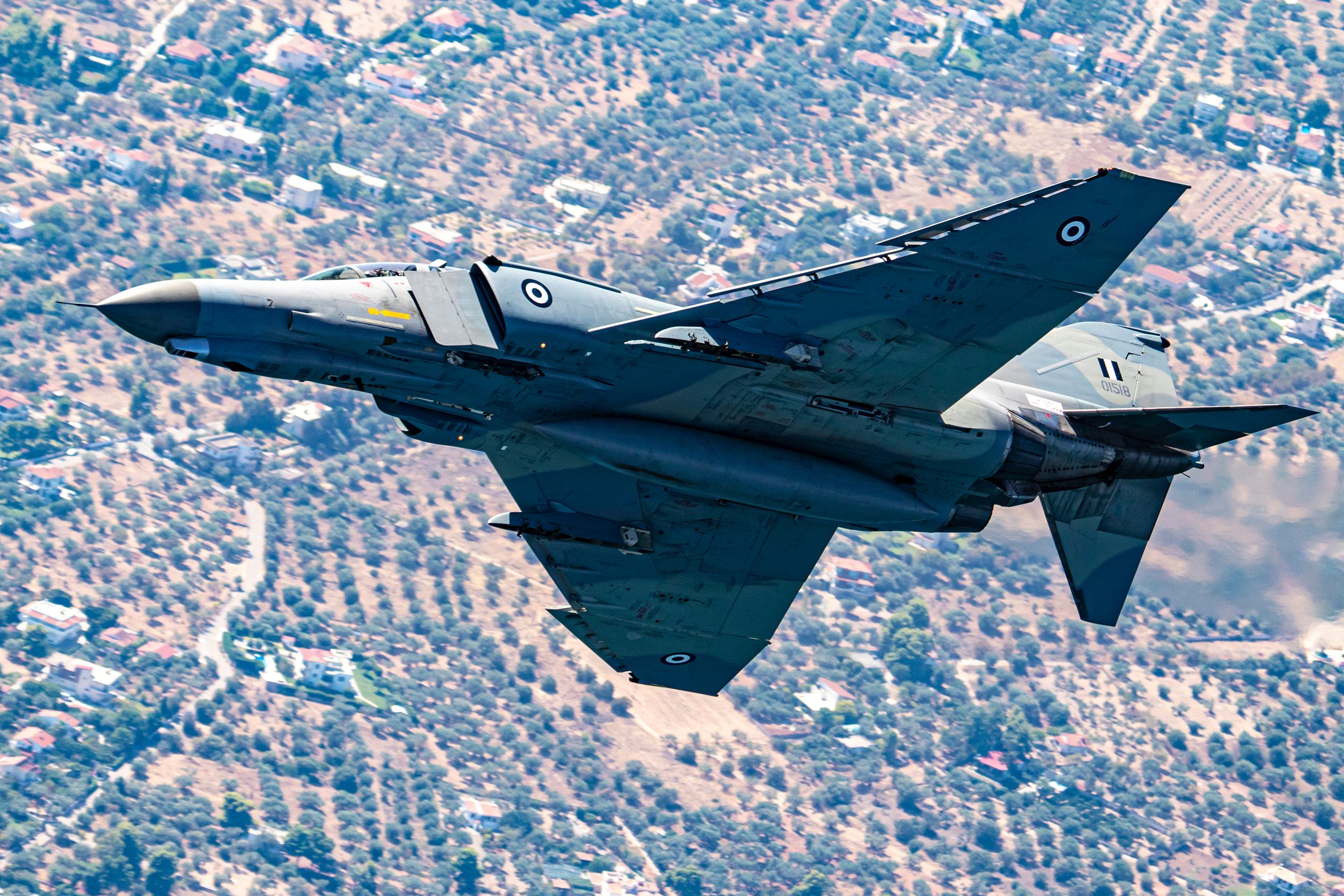
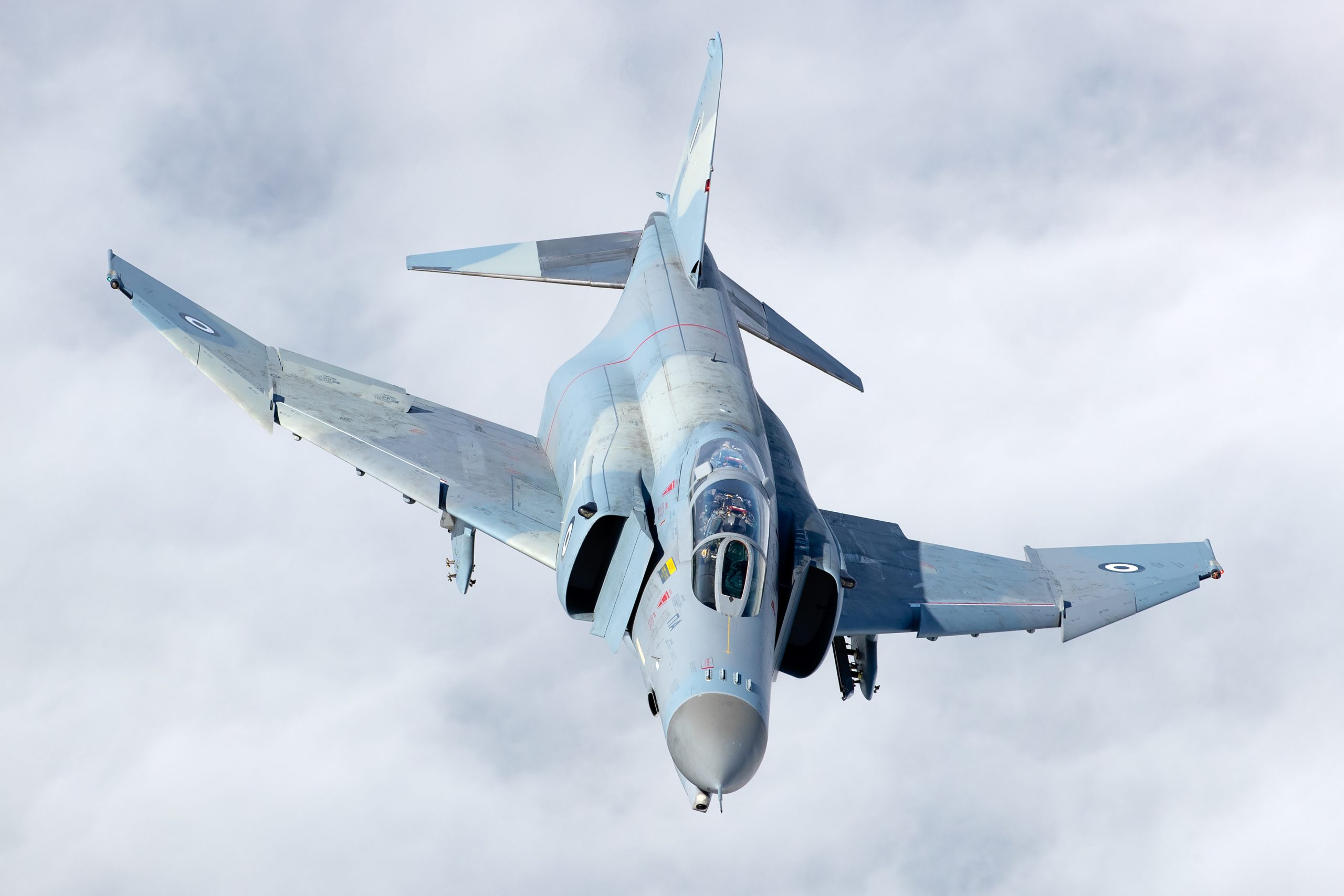
Two Phantoms and a Buckeye, formating on one elderly Skyvan over the Peloponnese: as a snapshot of why Greece matters to aviation photography, that formation is the whole argument. The frames from this first encounter run from head-on studies of 01518 boring through cloud to topside passes over the olive groves, the AUP’s two-tone greys reading beautifully against the terrain.
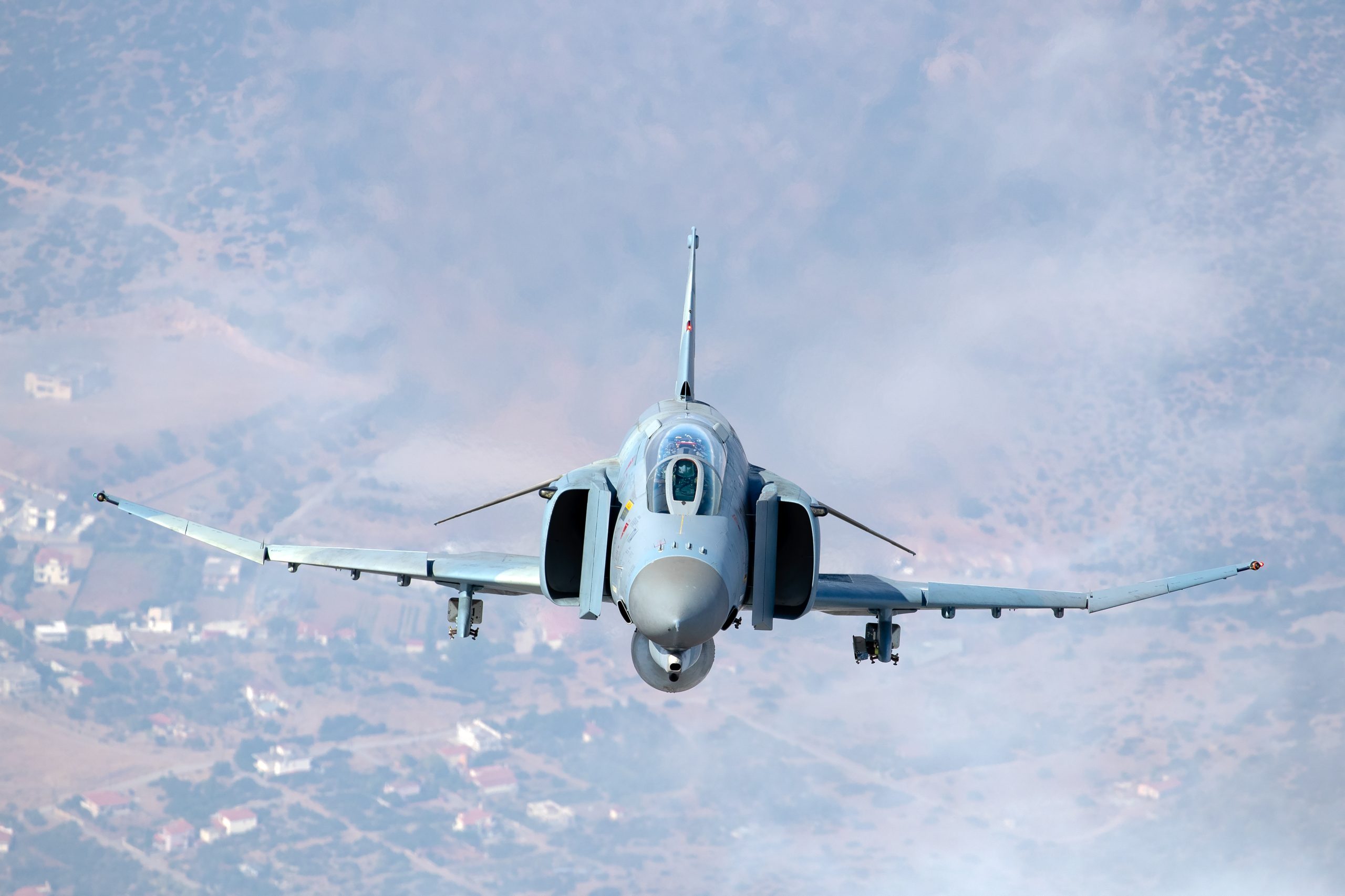
A word on the aeroplane, because its rarity is the story’s engine. The F-4E AUP, Avionics Upgrade Program, is Greece’s modernised Phantom: 1960s airframe, updated radar and avionics, flown by crews who are now among the last people on earth qualified on the type in front-line service. Japan retired its Phantoms in 2021, South Korea followed in June 2024, and with Turkey’s and Iran’s fleets the only other survivors, the Hellenic jets at Andravida are the last Phantoms in Europe, with the type’s final retirement a matter of years. Every air-to-air frame of a flying Phantom made now is a frame from the type’s last chapter.
The Phantom in Greek service: a short history
Greece and the Phantom go back half a century. The Hellenic Air Force ordered the F-4E in the early 1970s and took its first deliveries in 1974, at a moment when tensions in the Aegean made a modern two-seat, twin-engined fighter-bomber the centrepiece of the country’s air power. For the next quarter century Greek Phantoms stood alert, flew reconnaissance in the RF-4E variant, and became one of the type’s great European strongholds even as other air arms began retiring theirs.
What kept the Greek jets relevant into the 2020s was the Avionics Upgrade Program of the early 2000s, in which a portion of the fleet received modern radar, mission computers, displays and weapons integration, producing the F-4E AUP flown in these photographs. The upgrade rebuilt the aeroplane’s brain while leaving its magnificent 1960s body untouched, which is why 01518 in these frames shows both a museum-piece silhouette and a working squadron’s finish. As Greece’s Phantom squadrons consolidated over the years, Andravida’s 338 Squadron became the type’s final European home, and the crews who flew for the Skyvan’s cameras in 2019 belonged to it.
None of this history is incidental to a picture buyer. It is why the caption under a Greek Phantom photograph can carry real weight: not a generic jet, but a specific, documented survivor at the end of a fifty-year national story, photographed air-to-air in its own sky.
Forty-two minutes with the Phantom
The second Phantom encounter came on departure day, and it is the one the team still talks about. Photo sessions with fast jets are usually measured in single-digit minutes: fuel is expensive, slots are tight, and a fighter loitering behind a 160-knot freighter is working hard to stay there. What the Hellenic crews gave the Skyvan instead was, in the trip report’s own words, “42 like in fourty two actionful adrenaline minutes” with the jet, pass after pass, the crew signalling they were coming back for another, and another, and another.
Forty-two minutes is an eternity of position changes: head-on approaches with the gear travelling, banked topsides showing the full planform against the ground, close formation tight enough to see both crew’s helmets, and, as the light went long, the silhouette passes that produced some of the collection’s most atmospheric frames. The images in this story’s golden-haze section come from those minutes, the Phantom’s unmistakable outline black against the evening over the mountains.
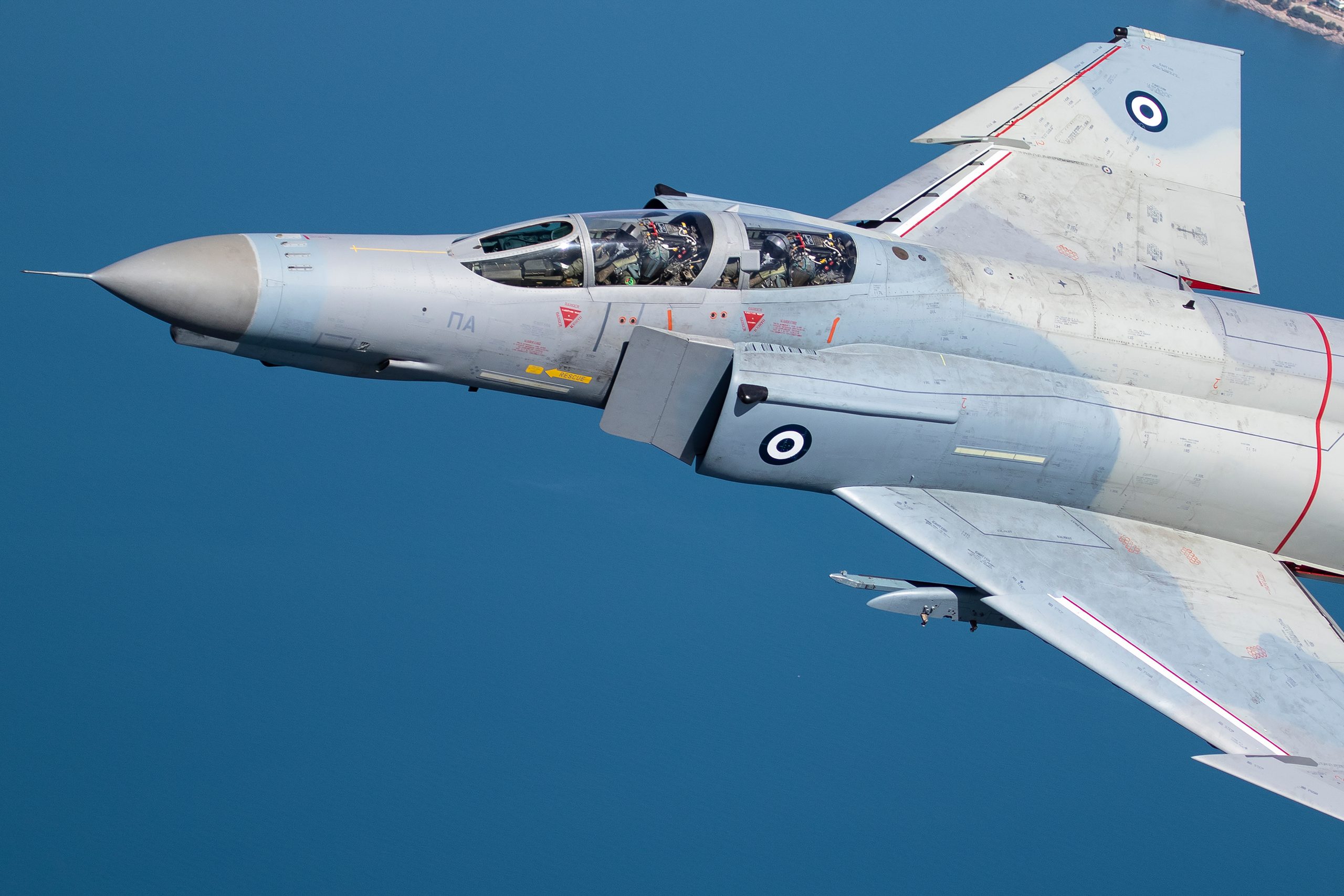
For a picture buyer, the practical meaning of those forty-two minutes is coverage depth. The archive does not hold one good Phantom frame; it holds the type photographed from every useful angle in one session, by multiple photographers, in changing light: the head-ons that make covers, the topsides that carry spreads, the crew close-ups that humanise features, and the silhouettes that open chapters. When a brief arrives, whatever its angle, the answer already exists.
The photographers’ day: anatomy of a sortie morning
A photo sortie day at an expedition like Athens runs to a rhythm that would be familiar to any military crew room. It starts with weather and light: where the cloud will be, where the sun will be at the sortie window, and therefore which block of sky gives backgrounds instead of murk. Then the brief, all crews together: the join, who calls what on which frequency, the position sequence, the minimum distances, the break, and the alternates if the subject goes unserviceable or the weather lies. The photographers brief their own choreography too, who shoots which side, when positions swap, because six lenses on one ramp without a plan is chaos.
Then the Skyvan launches first and becomes the anchor of a moving studio. The subject finds it visually or by radar vector, stabilises in the pre-briefed perch, and closes step by step on the photo pilot’s calls. From the ramp, the photographers talk positions through the intercom to the pilot, who relays; small aircraft adjustments, a wing dropped two degrees, a metre closer, transform a frame, and the discipline of asking for them properly is half the craft. Position sets run a few minutes each, then change, then the break, flown as briefed, photographed as it happens, because break shots with wing vapour are often the best of the day.
Back on the ground the day is only half done: cards are ingested and backed up twice before anyone eats, selects are flagged, and captions begin while memories are fresh, which aircraft, which crew, which position, which minute. The forty-two-minute Phantom session alone produced thousands of frames across the photographers aboard; the discipline that turns that into an archive is as unglamorous and as essential as the flying.
Equipment notes from the ramp
The ramp imposes its own equipment doctrine. Photographers fly with two camera bodies each, one wearing a mid-range zoom for close formation, one a longer zoom for perch positions and breaks, because changing lenses over an open ramp is how lenses learn to fly solo. Everything is tethered: bodies, spares, even lens caps, and loose objects are banned outright since anything that leaves the cabin meets the subject aircraft at closing speed. Eye protection, hearing protection and the harness complete the outfit; glamour is not part of it.
Settings live in the tension between shake and blur described earlier: slow shutters for props, faster for jets, manual exposure locked for the light rather than the meter’s panic, and burst discipline rather than burst faith, because ten thousand frames of the wrong position is a storage problem, not a portfolio. The Athens frames in this story were made with exactly this doctrine, and the consistency across the collection, horizon level, subject sharp, prop discs alive, is the doctrine made visible.
The Mirages: deltas in the cloud canyons
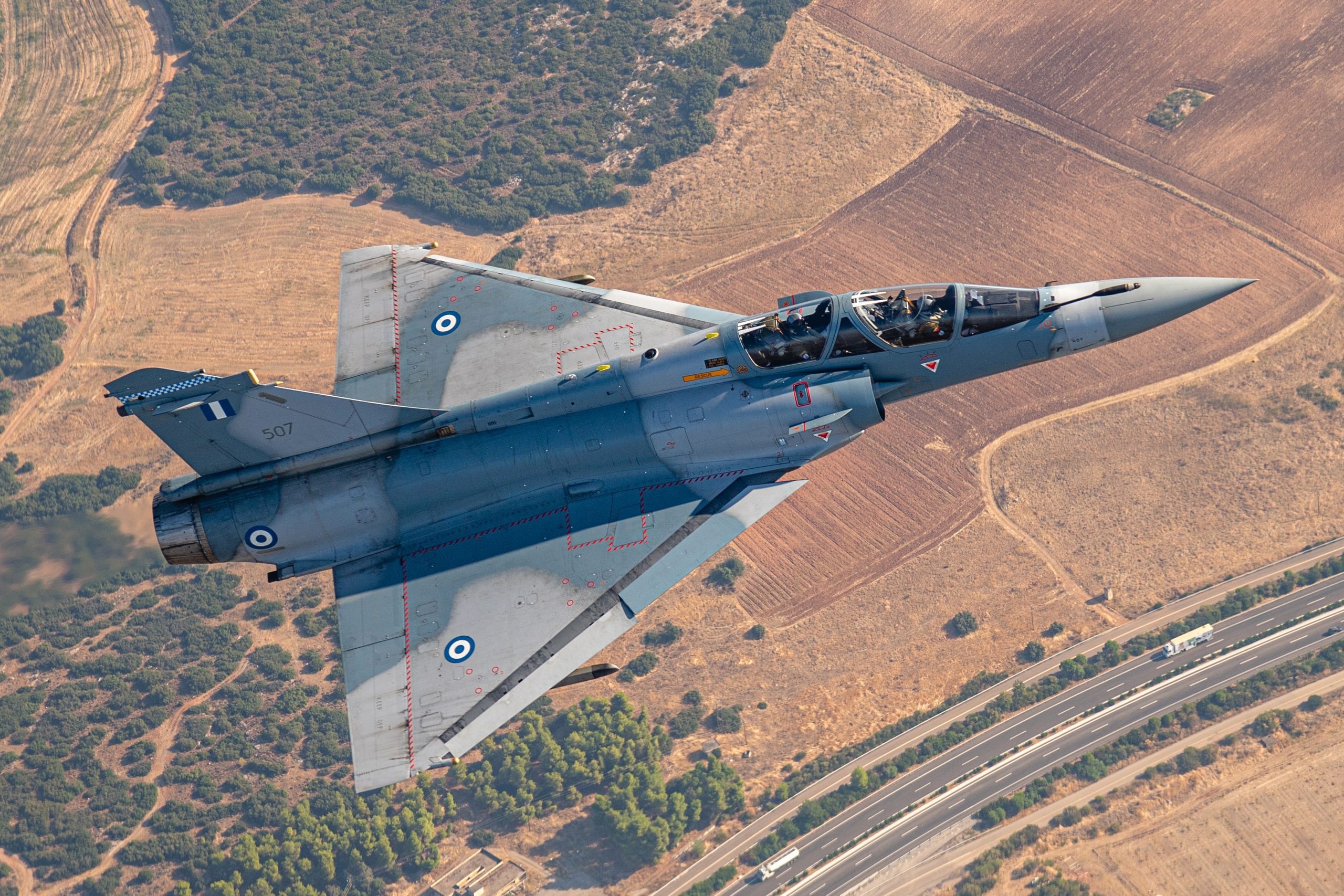
Greece’s other classic French thread ran through the week too: the Dassault Mirage 2000-5, the pure delta that still gives the Hellenic Air Force its knife-edged interceptor silhouette. The Mirage sorties worked the big cumulus over the mainland, and the frames show why photographers pray for cloud rather than empty blue: a pair of deltas threading the canyons between towers of white, and a single jet rolled onto its back to show the full triangle of its planform against the fields far below.
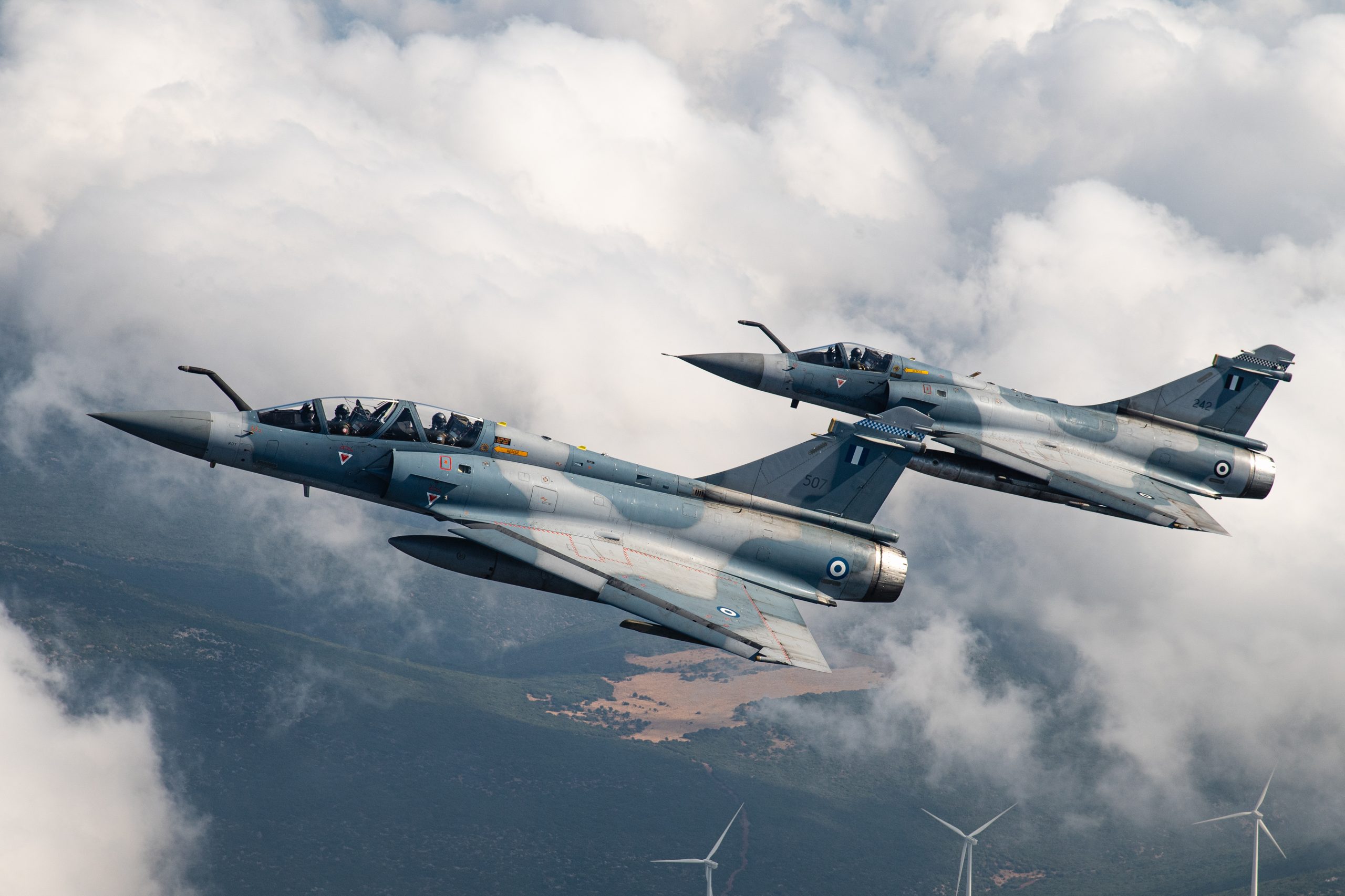
The Mirage matters commercially for the same reason as the Phantom, a step behind on the clock: the type’s operators are dwindling, France’s fleet is giving way to Rafales, and clean air-to-air coverage of the 2000 in European service gets rarer every season. Defence media covering the eastern Mediterranean reach for exactly these frames, and the pair-in-cloud images have the painterly quality that picture editors keep for openers.
The Orion over the islands
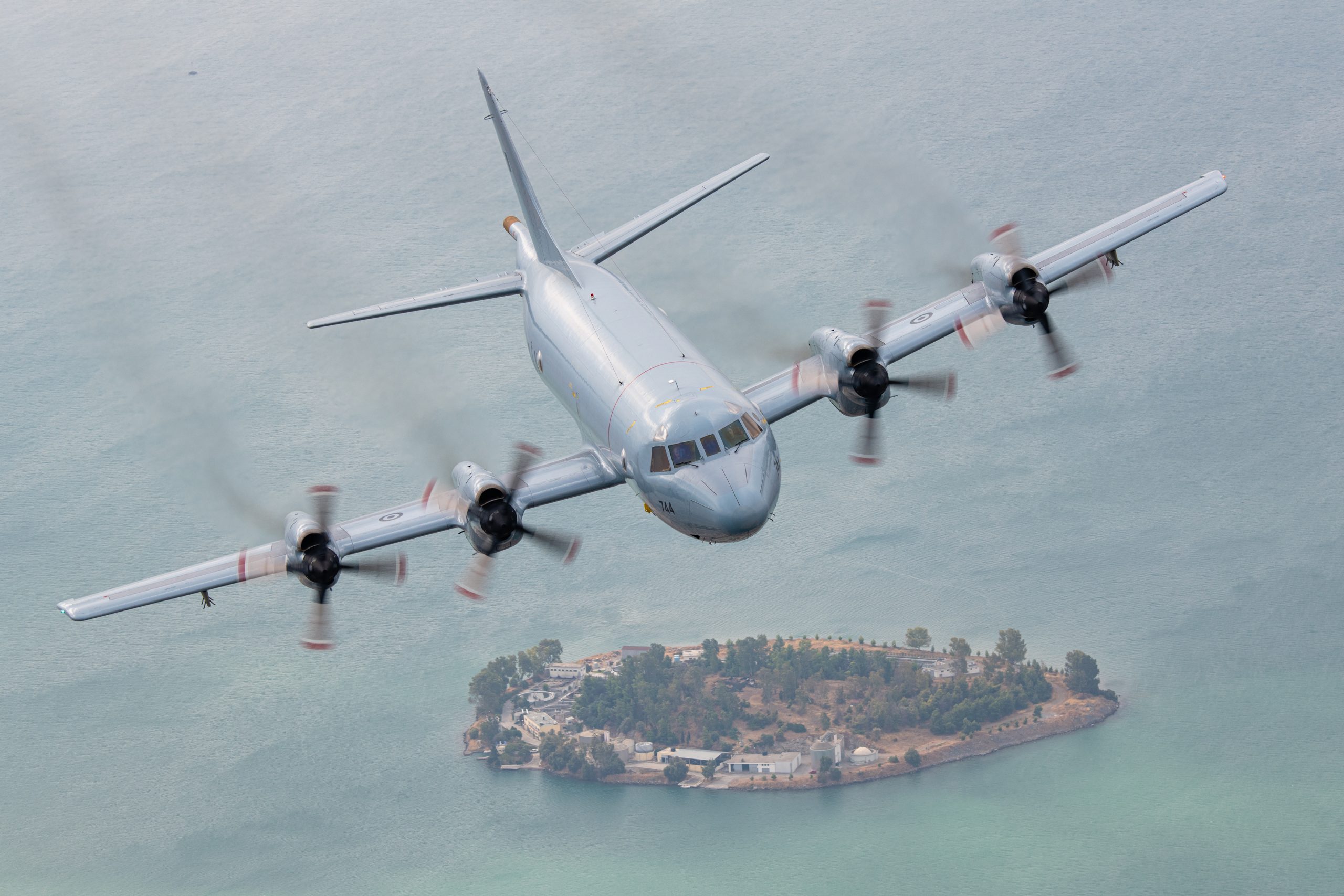
Not everything that came to the ramp was fast. One of the week’s most quietly valuable sorties brought a Lockheed P-3B Orion of the Hellenic Navy, the four-turboprop maritime patroller, out over the islands, where it did what Orions have done for sixty years: flew low, steady and purposeful over blue water. The frame of 152744 crossing a small island, four props turning, sea in every direction, is the definition of an aircraft photographed in its element, and Greece’s upgraded Orions are themselves a story, the type having been returned to service after a long lay-up as maritime surveillance moved back up Europe’s agenda.
Daedalus, the Extra and the working sky
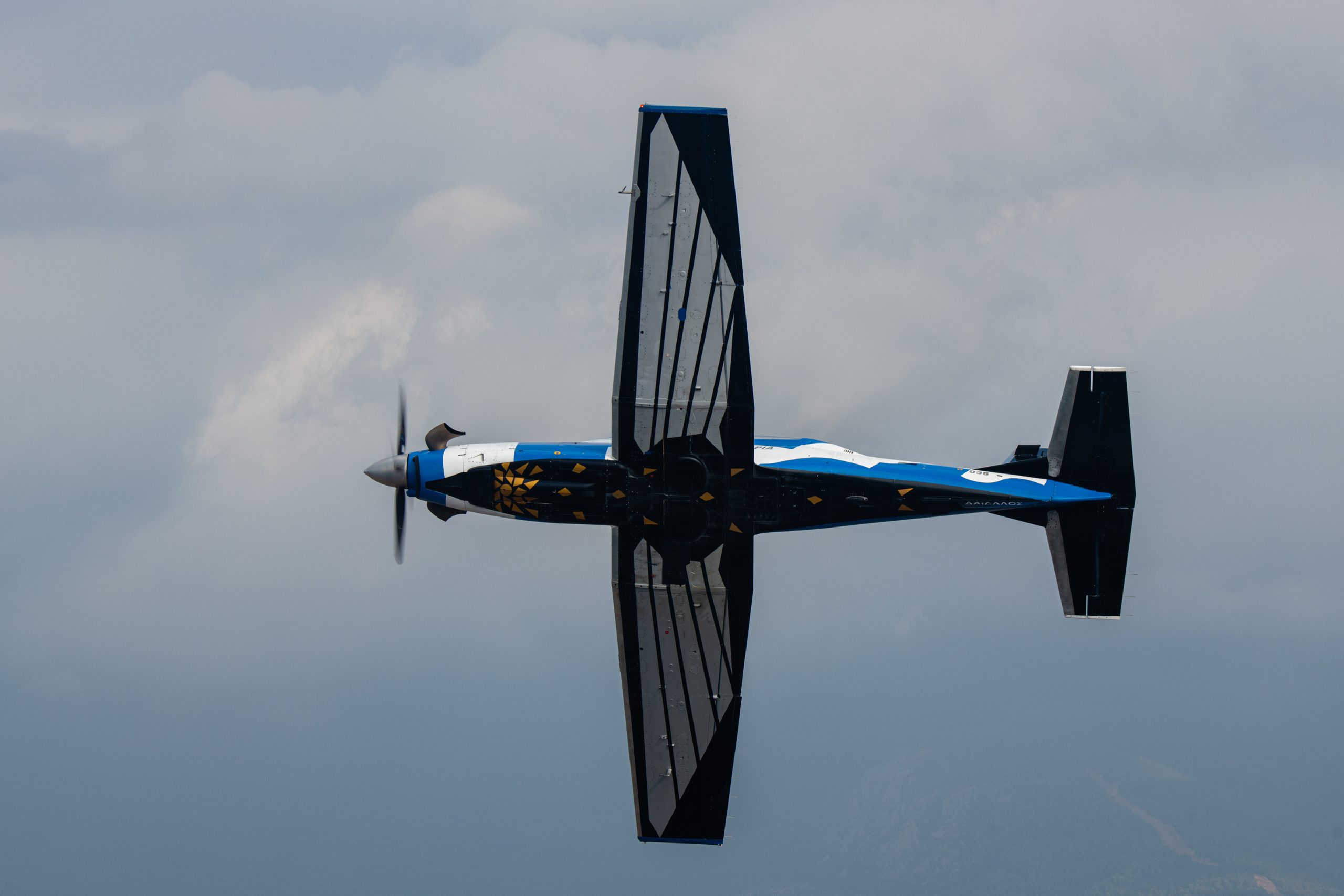
Between the marquee sorties, the week’s rhythm was kept by the trainers and the aerobatic machines, and they produced some of its most striking frames. The Hellenic Air Force’s Daedalus Demo Team brought its dark-schemed T-6A Texan II to the ramp head-on, smoke on, propeller a full disc, an image with the graphic punch of a poster. The Extra 300S came in the same way, white against the haze with smoke trailing, the shape every airshow crowd knows reduced to its cleanest geometry.
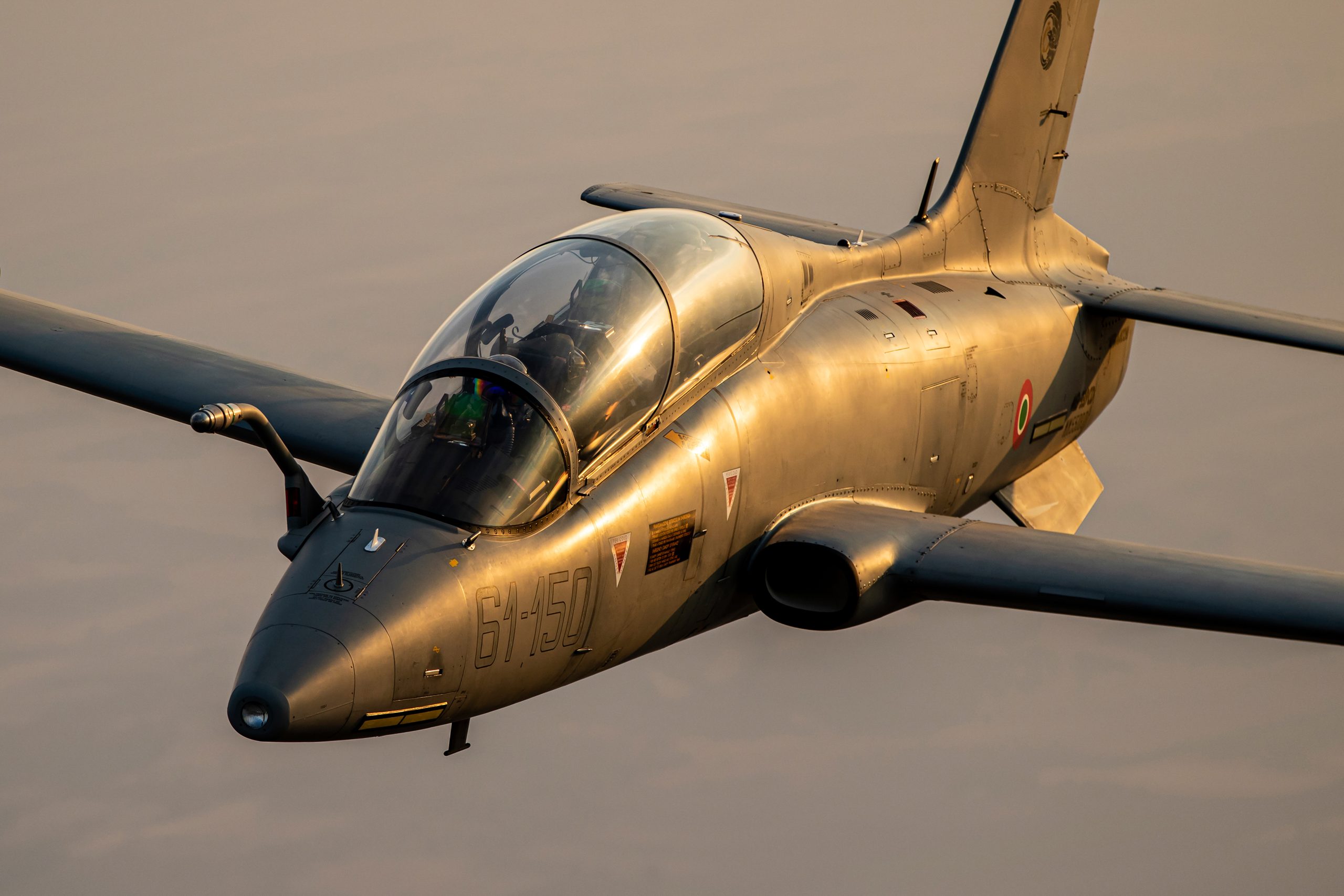
Athens Flying Week’s international flavour showed in the Italian Air Force’s contribution: an Aermacchi MB-339 in a striking gold scheme, photographed so close that the frame is as much portrait as aviation photograph. These trainer and aerobatic images earn their keep in a different market from the fighters, flight training features, airshow previews, and the packaging and poster work that wants strong shapes and clean colour, and they show the expedition’s range beyond the headline jets.
The Patrouille de France over Athens
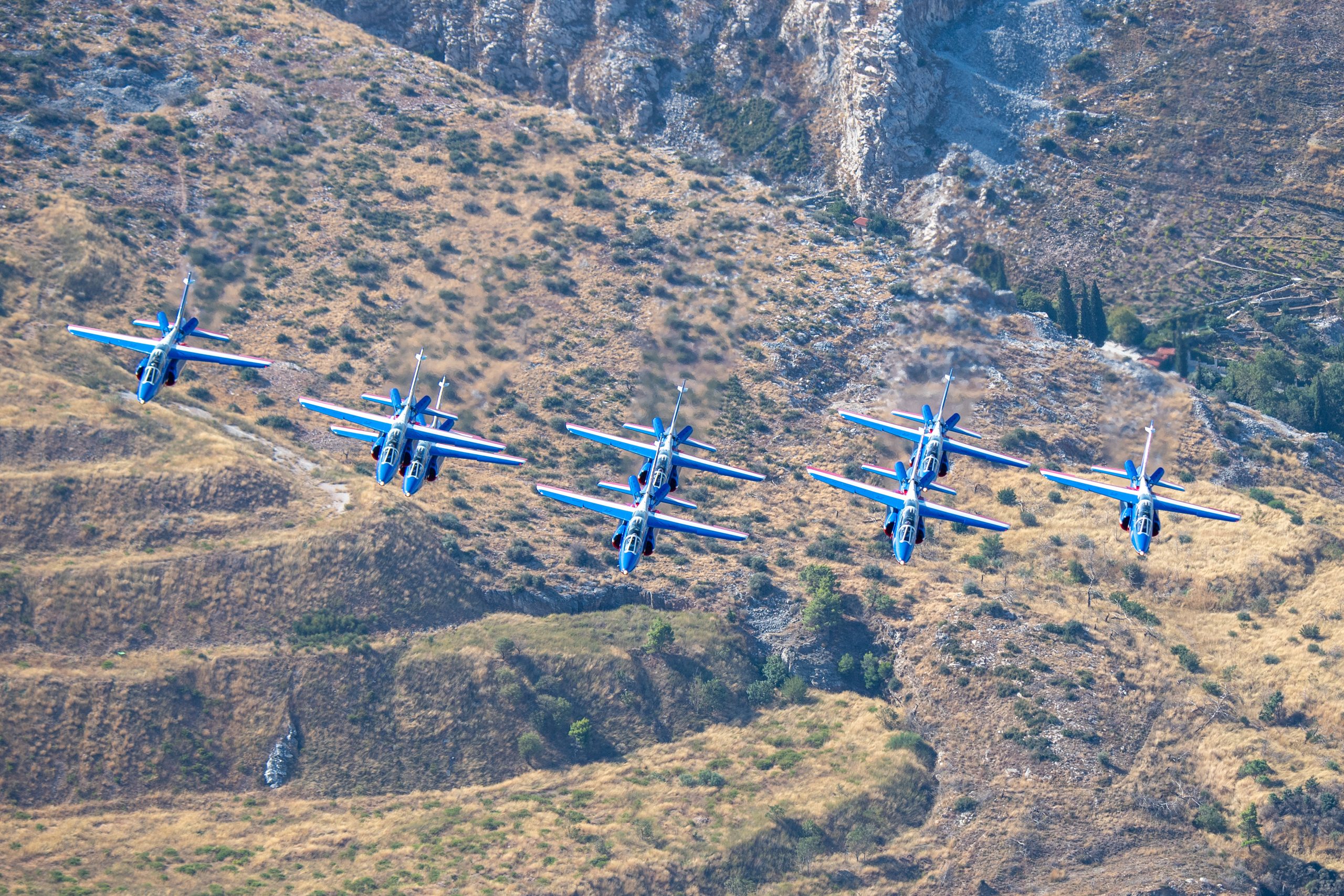
Then there were the French. The Patrouille de France, eight Alpha Jets and the oldest jet display team tradition in Europe, flew with the Skyvan over Athens itself, and the resulting frames are among the expedition’s most valuable: the full team pulling the tricolore across the white city, the Acropolis somewhere under the smoke, and line-abreast passes over the mountains inland. National display teams photograph well from the ground; from the air, over a capital city, they become something else, a one-off documentary record of a specific team, in a specific place, on a specific day.
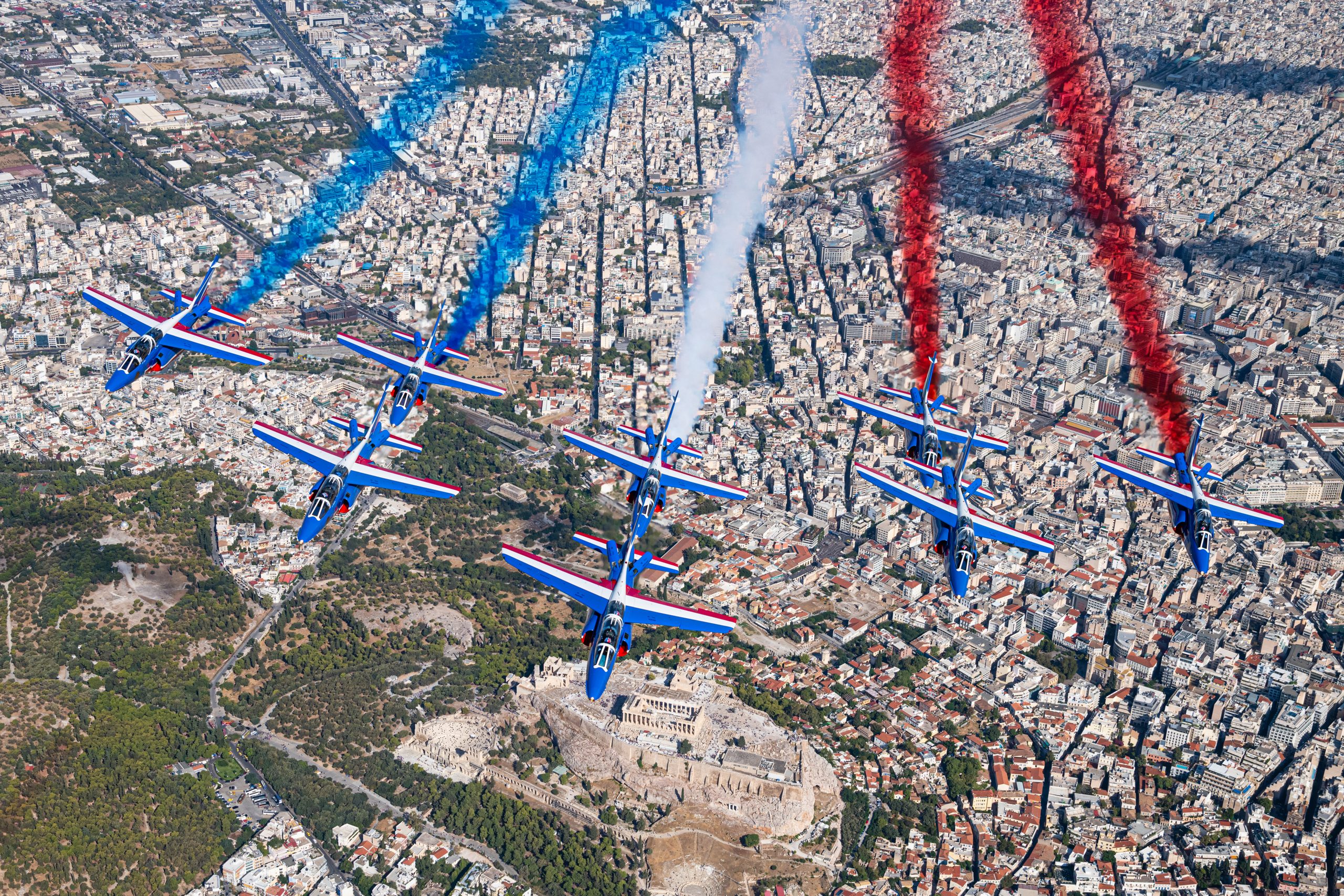
Images like these have a double market. Aviation media wants them for the obvious reasons; but city-over-shoulder team photography also sells into travel, tourism and national-pride contexts that ordinary airshow coverage never reaches. A French publisher marking a Patrouille anniversary, a Greek tourism campaign, a display-aviation history: the same frame serves all three.
A Corsair over the Aegean
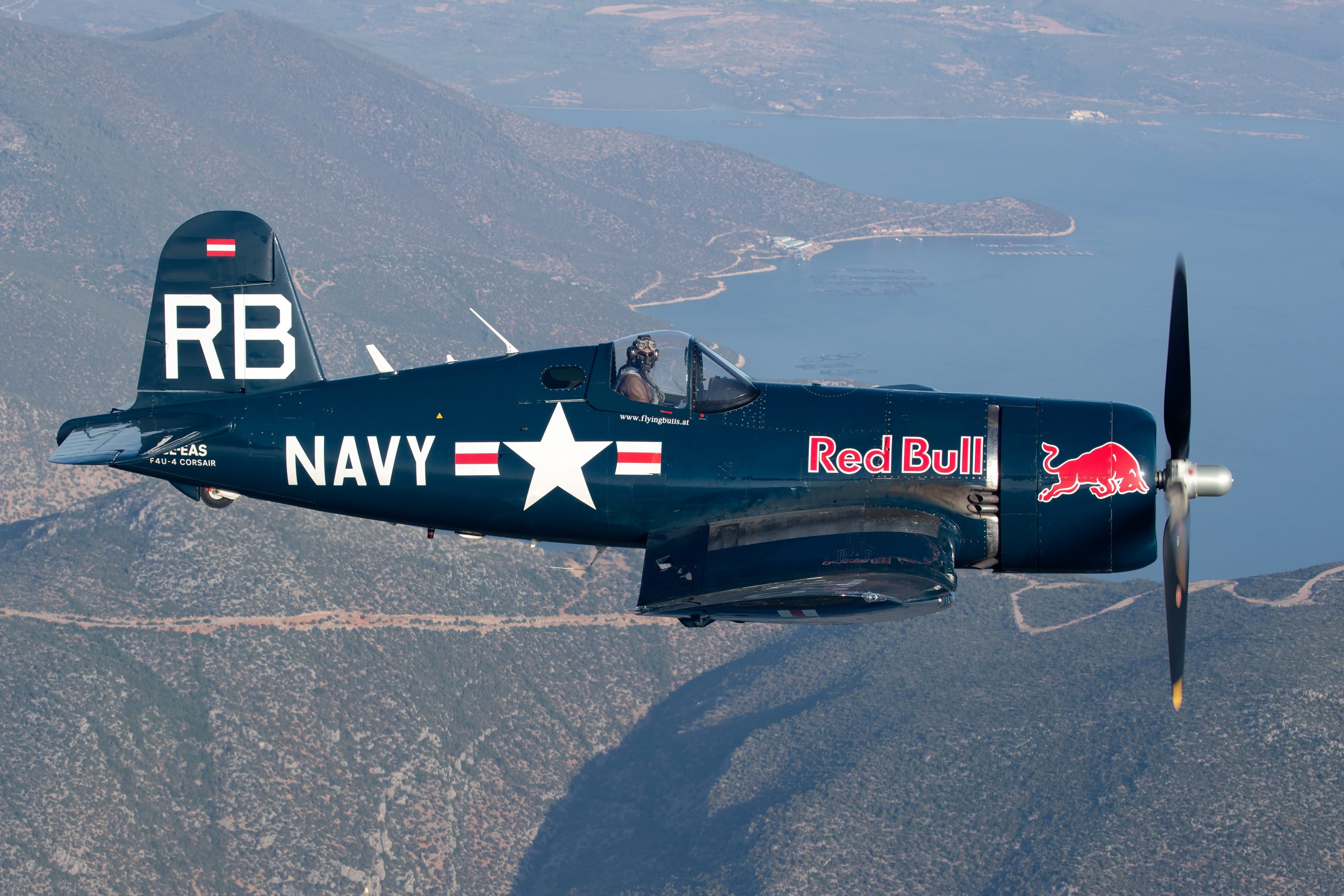
The warbird thread of the week belonged to a machine with its own following: the Flying Bulls’ Vought F4U-4 Corsair, OE-EAS, the Austrian-based veteran that tours Europe’s show circuit. Photographed side-on over the Greek coast, dark blue against pale water, gull wings level, the Corsair frame connects this expedition to the warbird collections elsewhere in the archive, and for editors it offers something rare: a Pacific-war fighter photographed over Mediterranean water, immaculate and working.
The rotary wing: Hueys and Aegean Hawks
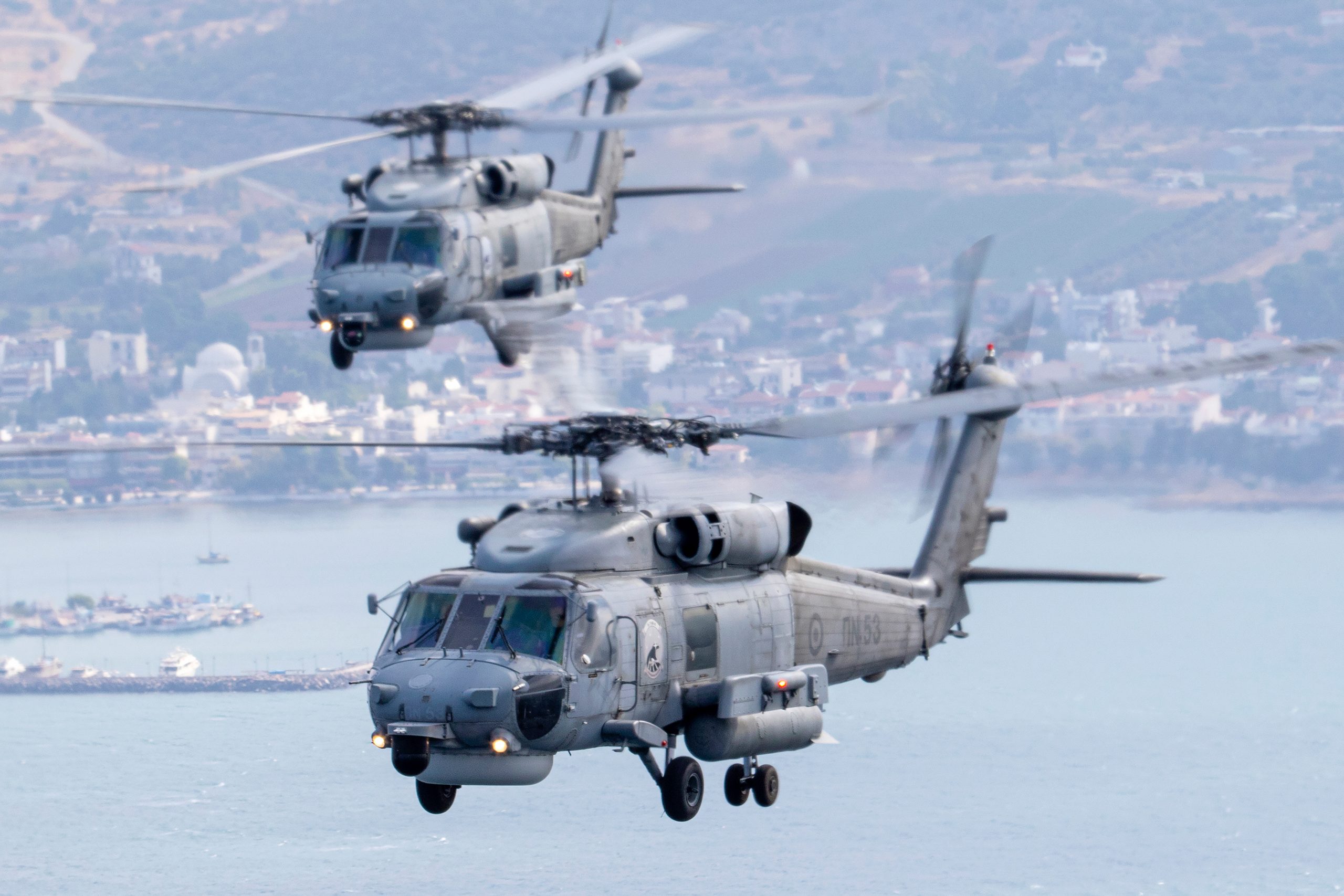
The expedition’s rotary sorties rounded out the coverage. A Hellenic Army UH-1H, the eternal Huey, came up the coastline in the clear morning light, its silhouette carrying fifty years of associations in a single glance. And the Hellenic Navy sent a pair of S-70B-6 Aegean Hawks, the naval Seahawk variant, which formated over the Athens coast in a two-ship that shows the type’s working environment better than any deck shot could. Helicopter air-to-air is its own niche, slower, closer, more intimate than jet work, and these frames serve the defence and rotary media that fixed-wing collections usually leave unserved.
The craft: how ramp photography actually works
A word on how frames like these are made, because the craft is the guarantee behind the collection. The photographers work harnessed at the open ramp, shooting into the Skyvan’s wake with the subject held in a briefed position. Propeller subjects demand slow shutters, 1/160 to 1/250, to keep the disc alive, which means panning from a vibrating platform while both aircraft ride turbulence; jets allow faster shutters but close faster and stay for less time. Exposure runs manual, because autoexposure cannot be trusted with a grey jet against bright cloud, and focus discipline matters more than focus technology when the subject is metres away and closing.
The positions are the vocabulary: head-on for covers, echelon for detail, topside banks for planform, silhouette passes when the light goes long. A good session works through them like a shot list, which is exactly what it is, agreed at the briefing table hours earlier. And underneath all of it sits the safety framework, minimum distances, escape directions, one voice on the radio, that makes the whole enterprise repeatable, insurable and welcome at military bases. The beauty is planned.
Andravida and the last squadron
The Phantoms in these photographs fly with 338 Squadron of the Hellenic Air Force from Andravida in the western Peloponnese, and the base has become something unique in Europe: the last station on the continent where the Phantom is a working front-line aeroplane rather than a museum piece. The AUP upgrade that keeps the jets credible, modern radar and avionics inside the 1960s airframe, was completed in the early 2000s, and the crews who fly them are conscious custodians of the type’s final European chapter, a fact that showed in how generously they flew for the camera.
For the photographers on the ramp, that context changed the temperature of the week. Photographing an F-35 is documenting the beginning of a story whose archive will grow for fifty years. Photographing an Andravida Phantom in 2019 was the opposite: every frame subtracted from a finite number that nobody knows, and everybody aboard knew it. The trip report’s giddy punctuation, the doubled YES, the counted minutes, is what that knowledge sounds like when it is being enjoyed rather than mourned.
The week in the gallery: what else is there
This story shows a curated sixteen frames; the full Athens Flying Week 2019 gallery holds close to a thousand, and the depth is the commercial point. The Phantom coverage alone runs past 160 frames across both encounters, every position and light. Around it sit the full Mirage, Buckeye, Orion and Patrouille sets, the Corsair, the trainers and the rotary work, plus the connective tissue an editor needs and never gets from single-image sources: the same aircraft in sequence, approach to break, wide to detail.
Gallery depth also means the frames in this story are not the only answer to any brief. A layout that needs the Phantom head-on but lighter, the Mirage pair but wider, the Patrouille over the city but with the smoke just starting, will find its exact frame among the neighbours of the ones shown here. Browse the gallery, or describe the brief and let us pull the selection.
A photographer’s geography of Greek light
It is worth being concrete about why Greece flatters this work, because the light in these frames is a licensable asset in its own right. September in the Aegean gives high, clean sun with humidity haze that softens the horizon rather than the subject, so aircraft separate from their backgrounds without the crunchy clarity that makes some air-to-air feel clinical. The terrain palette, olive green, limestone, white towns, wine-dark sea, sits naturally behind grey jets and dark warbirds alike. And the evening light goes long and gold early enough to use, which is where the silhouette Phantoms in this story came from. Photographers plan around light like sailors around tide; Greece simply has more usable tide than northern Europe.
Three worked briefs from this one expedition
The defence feature. An editor covering the Phantom’s final years needs a lead image, three inside frames and a crew detail. The forty-two-minute session supplies all five in consistent light, with registrations and unit confirmable from the frames themselves, and licensing is agreed in one email with high-res files down the same hour.
The documentary sequence. A production marking the end of the Phantom era needs stills that cut together as a visual narrative: approach, formation, crew, break, silhouette. Because the archive holds the session in sequence rather than as scattered singles, the stills behave like storyboarded coverage, and broadcast terms are on the licence from the start.
The display-team retrospective. A French publisher marking a Patrouille de France milestone wants something beyond the standard ground-based fare. The over-Athens tricolore frames, team, city and smoke in one image, give the cover and the poster, and the line-abreast mountain passes carry the interior spreads.
How subjects fly the box: positions explained
Air-to-air photography has a vocabulary of positions, and knowing it explains the variety in this story’s frames. Echelon, the subject sitting off the ramp’s left or right rear quarter, is the bread-and-butter close position: it gives the three-quarter views, crew details and formation intimacy. Line astern, directly behind and slightly below, produces the head-on frames as the subject closes or the Skyvan’s cameras shoot straight down the approach. The perch, wider and higher or lower, sets up topside and underside passes as the subject banks across the frame, which is where planform images like the Mirage over the fields come from. And the break, the crisp pull away that ends a set, gives the dynamic departing frames, vapour on the wings if the air is kind.
Each position is flown for minutes, not seconds, and the sequence is agreed before engine start. What made the Phantom’s forty-two minutes so extraordinary is that the session ran the entire vocabulary, twice, in changing light, which is why the archive’s coverage of 01518 reads like a type study rather than a lucky encounter.
What can go wrong, and what it costs when it does not
Honesty requires saying that expeditions fail in parts, always. Weather eats sortie windows; subjects go unserviceable an hour before start; a slot moves and the light that was planned is gone. The 2019 week had its share of shuffling, the Kalamata relocation among it, and the measure of an experienced operation is not that nothing changes but that changes produce photographs anyway. A team that has flown hundreds of these sorties holds alternates the way a navigator holds diversion airfields.
This is also, plainly, why professional air-to-air imagery costs more than an airshow snapshot: behind each frame sits a ferry flight across Europe, fuel for two aircraft, crew, insurance, permissions and days of planning, spent against weather risk with no refunds. When a picture editor licenses a frame from this collection, they are buying the output of that entire machine, and the match-or-beat pricing promise below is made in that context: fair value for imagery whose true production cost no stock library ever carried.
From the ramp to the archive
The last leg of the expedition happens at a desk. Every selected frame is captioned with aircraft, unit, place and date while the information is certain, keyworded for search, and embedded with identification metadata that travels inside the file to any buyer’s system. It is slow, dull and the reason a researcher can find “F-4E AUP 01518 head-on” in seconds four years later. Archives are built twice, once in the air and once at the keyboard, and both builds are part of what a licence buys.
What these photographs are for
Every image in this story, and the hundreds more from the same expedition in the Athens Flying Week 2019 gallery, is licensable directly. The collection serves the full range of buyers this blog’s guides are written for: defence and aviation media covering the eastern Mediterranean and the Phantom’s last years; book publishers needing the definitive air-to-air record of types that are leaving the sky; documentary producers, for whom the Kalamata and forty-two-minute sessions amount to a ready-made visual narrative; museums and exhibitions marking the end of the Phantom era; and the creator economy, whose appetite for properly licensed imagery of rare jets keeps growing.
Licensing is one conversation with the copyright holder’s sole representative: no agency chain, embedded identification in every file, instant high-resolution downloads on a buyer account, and clear editorial and commercial terms on the licences page, with agency-style supply through piemags.com where preferred. And the pricing position is worth stating as plainly here as anywhere: pricing is negotiable, and we will match or beat what you pay other aviation agencies. Early partners get founding-customer rates set on their account and honoured after; tell us what you currently pay and we will beat it, with instant downloads from day one.
For picture researchers building briefs around these subjects, the companion guides go deeper: aviation picture research for the sourcing landscape, and the type guides for the Spitfire, B-17, Martin Mars and F-35. That guide is now published: see our buyer’s guide to F-4 Phantom photographs, built from this very sortie.
Reading the frames: six images, closely
Photographs argue better than prose, so take six from this story and read them as an editor would. The gear-down head-on of 01518 climbing through cloud is the cover frame: symmetry, menace, and the landing gear’s awkward grace dating it instantly as an approach or departure, with clean space above the fin for a masthead. The crew close-up is the humanising frame, two helmets, two people, sixty years of type history between them, and it is the picture a feature editor runs beside the interview. The dark topside over the olive groves is the geometry frame: the Phantom’s bent wings and drooped tail drawn in one line, the terrain reading as texture, a natural double-page spread.
The golden silhouette, this story’s featured image, is the mood frame, the one that opens chapters and closes documentaries, because it is about endings and everyone who looks at it knows it. The Mirage pair in cloud is the painterly frame, French deltas in Greek weather, and it sells on beauty to publications that never cover defence. And the Patrouille over Athens is the record frame: a specific team, a specific city, one day’s light, unrepeatable. Six frames, six different jobs, one expedition; that spread of function, more than any single image, is what a picture desk is really licensing when it opens an account.
Photographing a legend without clichés
Every famous aircraft accumulates a visual cliché, and the Phantom’s is smoke, reheat and menace at an airshow fence. The ramp offers a different grammar. Up close, in formation, the Phantom is revealed as a working machine with a crew, streaked, stencilled, patched and alive, and the Athens frames trade the fence-line drama for something rarer: intimacy. That is a deliberate editorial choice as much as a technical one, and it is why this coverage sits comfortably in serious publishing, where the cliché frame has been used up for decades. The aircraft’s legend does the shouting; the photography’s job is to show the aeroplane.
Using this story
A closing word on what this piece itself is for. If you are a picture researcher, it is a briefing document: every image shown links to its gallery page, and the collection behind it is described plainly enough to judge before you enquire. If you are a producer, it is a treatment in disguise, the 2019 expedition is a self-contained narrative with characters, stakes and an ending the calendar keeps sharpening. If you are a fellow photographer, it is a straight account of how this work is actually done, with nothing airbrushed except nothing. And if you simply love the Phantom, it is forty-two minutes you would have wanted to be there for. Licensing enquiries reach the photographers directly through the links below; everyone else is welcome to stay for the pictures.
Aftermath: why 2019 matters more every year
The trip report ended with a promise: “For sure we will be back in the 2020 season, and the first aircraft confirmed for the photographers is… the F-4 Phantom!” The partnership between Athens Flying Week and the PhotoCrew has indeed continued, season after season, and the archive’s Greek coverage keeps growing. But the 2019 expedition has aged into something more than a good trip: it is becoming a historical document while we watch.
Run the clock forward from that September. Japan’s Phantoms went in 2021. South Korea’s went in June 2024. Greece’s Buckeyes and Phantoms fly on borrowed time, and when Andravida finally falls silent the Phantom will be gone from Europe after more than sixty years. The Mirage 2000’s European operators are counting down behind them. Which means the photographs made from that Skyvan ramp in 2019, the two-Phantom join near Kalamata, the forty-two minutes, the Buckeye over the blue, are moving year by year from news to history, and their value moves with them. The full story of the aeroplane at the centre of it all is in our F-4 Phantom history, illustrated from these same sorties.
Aviation photography has always been a race against retirement dates. The Skyvan’s ramp is where that race is run well: with planning, with partners who trust the operation, and with enough time in the air, forty-two minutes, once, gloriously, to bring the whole aeroplane home. This is what the archive is built from, one expedition at a time.
Requesting images. Email sales@piemags.com with the subject you need, the medium, the territory, the print run or audience, and your deadline. That is enough to quote against. Licensing terms are set out on the Piemags licences page.
Frequently asked questions
What was special about Athens Flying Week 2019 for aviation photography?
The 2019 expedition put Aviation Photo Crew’s Skyvan photoship alongside aircraft that can be photographed air-to-air almost nowhere else: the Hellenic Air Force’s F-4E AUP Phantoms, the world’s last flying T-2 Buckeyes, Mirage 2000-5s, a Hellenic Navy P-3 Orion and the Patrouille de France over Athens itself, in September Aegean light.
How long did the Phantom photo session actually last?
The second encounter, on departure day, ran for 42 minutes, an extraordinary allowance for a fast-jet photo session, with the Phantom returning for pass after pass. The first encounter, near Kalamata, produced two Phantoms in formation joined by a T-2 Buckeye.
What is a Skyvan photoship and why is it used?
The Short SC.7 Skyvan is a 1960s light freighter whose full-width rear ramp opens in flight. With the door removed and photographers harnessed at the opening, it becomes a glass-free camera platform with a speed range that suits everything from helicopters and warbirds to fast jets flying with flap.
Are the Hellenic Phantoms really the last in Europe?
Yes. Japan retired its Phantoms in 2021 and South Korea in June 2024, leaving Greece as Europe’s only front-line operator, flying the modernised F-4E AUP with 338 Squadron from Andravida, with Turkey and Iran the type’s other remaining operators worldwide.
Can I license the photographs from this expedition?
Yes, every image in the story and the wider gallery of nearly a thousand frames is licensable directly through professionalaviationphotography.com, with editorial and commercial terms on the licences page, instant high-resolution downloads on a buyer account, and agency-style supply through piemags.com if preferred.
What does licensing cost?
Pricing follows use and is negotiable: we will match or beat what you pay other aviation agencies, with founding-customer rates for early partners set on their account and honoured afterwards. Tell us your current rates and intended use and a quote comes back the same day.
How close do the aircraft get to the camera ship?
Close formation positions are briefed in metres, near enough to count rivets and read crew names, with minimum separations, join procedures and break directions agreed on the ground before either aircraft starts an engine. Every sortie runs inside a rehearsed safety framework.
What camera settings does ramp photography use?
Propeller and rotor subjects are shot at slow shutter speeds, typically 1/160 to 1/250, to keep the disc alive, panned from the moving platform. Jets allow faster shutters. Exposure is manual, because grey aircraft against bright cloud defeat automatic metering.
Was the T-2 Buckeye really that rare in 2019?
Yes. After the US Navy retired the type in 2008, Greece became the world’s only Buckeye operator, using it to train fighter crews at Kalamata. Air-to-air photography of a flying Buckeye is among the rarest modern jet coverage there is.
What other aircraft are in the Athens 2019 collection?
Beyond the Phantoms and Buckeyes: Mirage 2000-5 singles and pairs, the Hellenic Navy P-3B Orion over the islands, the Patrouille de France over Athens and the mountains, the Flying Bulls’ F4U-4 Corsair, the Daedalus T-6A demo, an Italian MB-339 in gold, an Extra 300S, Hellenic Army UH-1H Hueys and Hellenic Navy Aegean Hawk pairs.
Did Aviation Photo Crew return to Athens after 2019?
Yes. The trip report closed by confirming the F-4 Phantom as the first aircraft booked for 2020, and the partnership with Athens Flying Week has continued season by season, with later Greek coverage joining the same archive.
Where can I read more about the aircraft in this story?
The blog’s F-4 Phantom history is illustrated from these same sorties, and companion buyer guides cover the Spitfire, B-17 Flying Fortress, Martin Mars and F-35, with the aviation picture research guide mapping the wider sourcing landscape.
