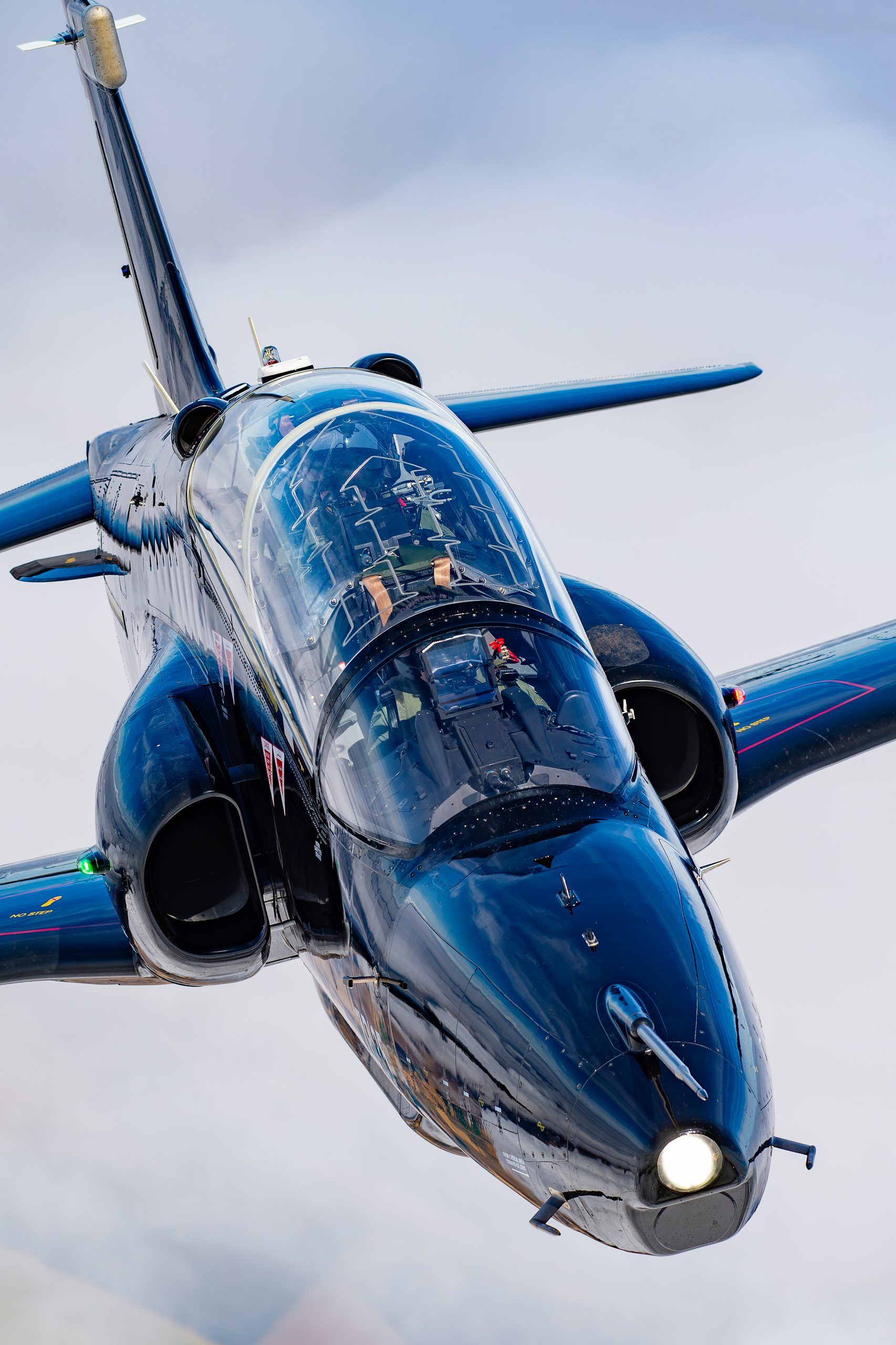
The BAE Systems Hawk is a British single-engine, tandem two-seat jet trainer that first flew on 21 August 1974, entered Royal Air Force service in 1976, and has since been built in greater numbers than any other Western jet trainer, with more than a thousand sold to eighteen operators. It is best known to the public as the aircraft of the Red Arrows, who have flown it since 1979, but its real story is one of a training design so sound that it grew into a light combat aircraft, a carrier trainer for the United States Navy, and a front-line fast-jet trainer still in service half a century after its maiden flight.
Few aircraft manage to be both ubiquitous and underrated. The Hawk has trained generations of fast-jet pilots, defended British skies in a wartime role, dropped bombs in anger in Southeast Asia, and painted the sky red, white and blue over a hundred airshows a year. This is the complete history of how it came to be, how it works, the many marks it spawned, and where you can see it today.
What this guide covers
- Origins and development
- Design: how the Hawk works
- Into RAF service
- Flying and handling the Hawk
- The jet behind the Red Arrows
- Variants: from T1 to the Hawk 200
- Export success and combat service
- Hawk operators around the world
- Why the Hawk beat its rivals
- The T-45 Goshawk
- Specifications
- Photographing the Hawk today
- Where to see a Hawk
- Retirement and the future
- Legacy
- Frequently asked questions
Origins and development
The Hawk began not as a government order but as a private study inside Hawker Siddeley Aviation. From 1968 the Kingston design team, led by Ralph Hooper, worked on a project known internally as SP.117, aimed at a modern replacement for the ageing Folland Gnat and Hawker Hunter in the RAF training role. The requirement was formalised when the Air Staff issued Air Staff Target 397 in 1970, calling for a purpose-built trainer rather than another adapted fighter.
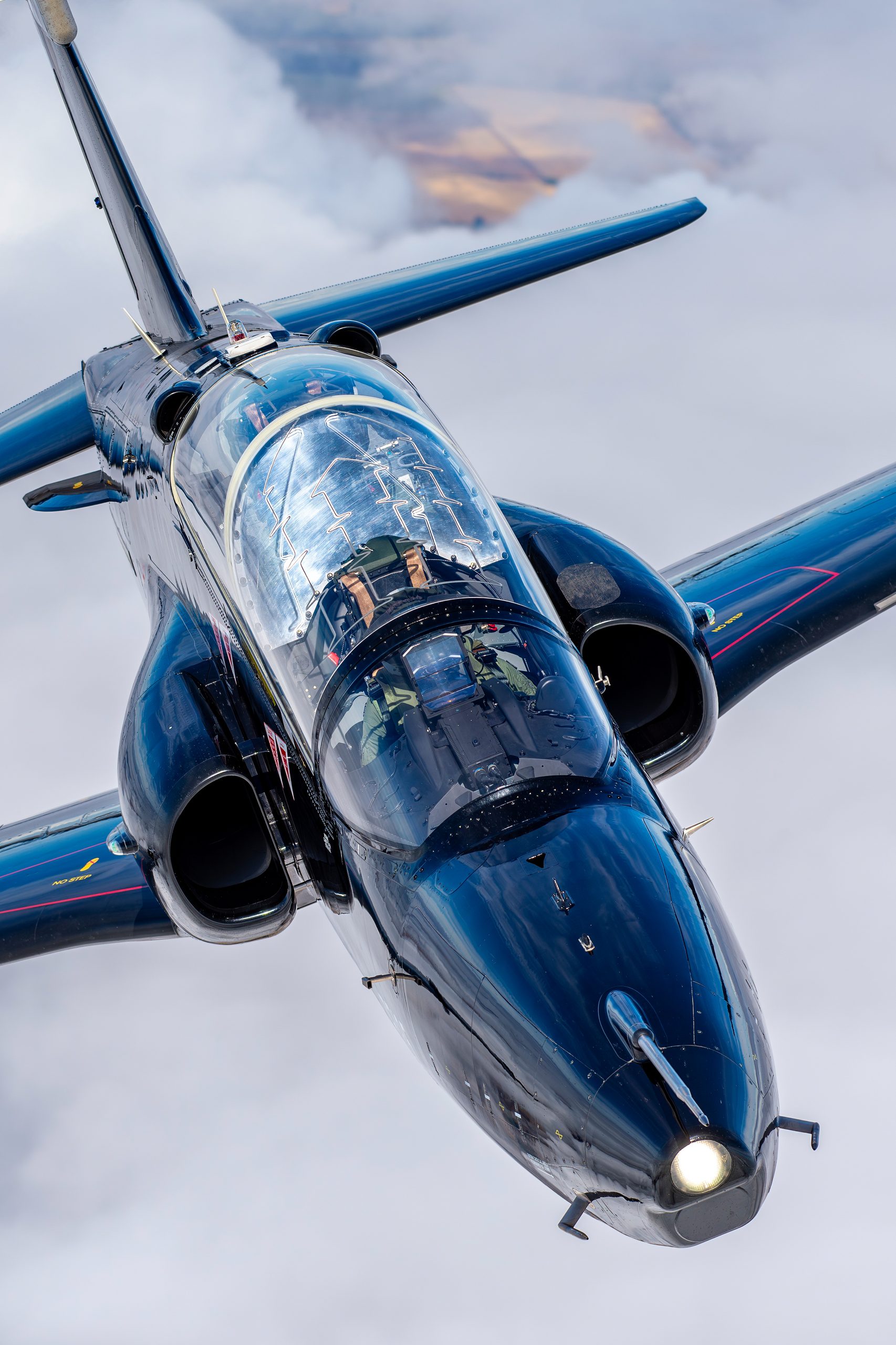
Hawker Siddeley won the competition when the RAF selected the HS.1182 on 1 October 1971, and a contract for 175 aircraft was signed in March 1972. The decision to design a trainer from a clean sheet, rather than modify an existing combat type, was the key to everything that followed. It gave the RAF an aircraft that was cheap to run, forgiving to fly, and easy to maintain, while still being fast enough to prepare pilots for the transonic world of the Jaguar, Phantom and later the Tornado.
The prototype, serial XX154, made its first flight from Dunsfold on 21 August 1974 in the hands of chief test pilot Duncan Simpson, climbing to 20,000 feet in a fifty-three-minute sortie. The name Hawk continued the Hawker tradition of aircraft names beginning with the letter H, following the Hurricane, Hunter and Harrier. Corporate change came quickly: Hawker Siddeley was absorbed into the nationalised British Aerospace in 1977, which in turn became BAE Systems in 1999, and the type has been marketed under all three names.
Design: how the Hawk works
The Hawk is deliberately conventional, and that is its genius. It has a low-mounted cantilever wing, a tandem cockpit with the instructor raised behind the student for a clear view forward, and a single non-afterburning turbofan fed by intakes in the wing roots. There is nothing exotic about it, and that was the point: an aircraft that student pilots could not easily break, that engineers could turn round quickly, and that flew plainly enough to teach the fundamentals before a pilot moved to a supersonic type.
Power comes from the Rolls-Royce Turbomeca Adour, an Anglo-French turbofan shared in a different form with the Jaguar. The original RAF Hawk T1 uses the Adour Mk 151, while the modern Hawk T2 and the current export trainers use the more powerful, FADEC-equipped Adour Mk 951. Without an afterburner the Hawk cannot go supersonic in level flight, reaching about Mach 0.84 straight and level, but it can nudge past the sound barrier in a dive, letting students feel transonic handling in a controlled way.
The airframe is stressed for high g, comfortably beyond the loads a training syllabus demands, and the aircraft carries Martin-Baker ejection seats. From the outset the design included underwing hardpoints and provision for a centreline gun pod, because Hawker Siddeley understood that an armed trainer with a light attack capability would sell far more widely than a pure trainer. That single decision, to build in weapons capability from the start, is what turned a British training aircraft into a global export success and eventually into a dedicated combat aircraft.
Into RAF service
The Hawk T1 entered Royal Air Force service in 1976, with RAF Valley on Anglesey as its first and enduring home. It replaced two very different aircraft in one stroke: the tiny, nimble Folland Gnat that the Red Arrows had made famous, and the larger Hawker Hunter used for weapons and tactical training. Consolidating both roles into a single, cheaper type was exactly the efficiency the RAF had been looking for.
In service the Hawk quickly proved popular. Instructors valued its honesty and its willingness to be thrown around, and its serviceability meant more sorties flown per aircraft than the types it replaced. A significant number of T1s were later modified to T1A standard, around eighty-eight aircraft, gaining the ability to carry two AIM-9L Sidewinder missiles alongside the centreline ADEN cannon pod. This gave the RAF a useful reserve of point-defence fighters that, in wartime, would have been vectored onto incoming raiders by Tornado F3 interceptors, a really clever use of an aircraft that was nominally just a trainer.
Advanced fast-jet training at Valley today is flown on the Hawk T2 by No. 4 Flying Training School, whose squadrons include IV(R) Squadron and No. XXV(F) Squadron. The T2 is a very different machine from the T1 under the skin, with a glass cockpit designed to simulate the sensor-rich environment of the Typhoon and F-35, but the basic Hawk shape and philosophy carry straight through from the 1970s original.
Flying and handling the Hawk
Ask any pilot who has flown the Hawk and the same words come back: honest, forgiving, a delight. That reputation is not an accident. Because it was designed as a trainer rather than adapted from a fighter, every part of its handling was tuned to teach rather than to catch out. The controls are crisp and well harmonised, the aircraft rolls quickly and turns tightly, and it gives clear warning before it stalls, which is exactly what a student needs when learning to fly at the edge of the envelope.
The tandem cockpit is central to the training job. The instructor sits behind and above the student, high enough to see forward past them, so a demonstration can be flown from the back seat and a developing mistake spotted before it becomes dangerous. Visibility from both seats is excellent under the one-piece canopy, which matters as much for the aerobatics the Red Arrows fly as for the circuit work a first-tourist practises. The airframe is stressed well beyond the demands of a training syllabus, so the aircraft can be flown hard, day after day, without complaint.
What the Hawk cannot do is as important as what it can. It is not supersonic in level flight, it carries no radar in its basic trainer form, and it was never meant to dogfight a front-line fighter. That restraint is the point. A pilot learns airmanship, formation, low flying, weapons delivery and instrument flying on a machine that is cheap to run and hard to break, then moves to the Typhoon or the F-35 having already mastered the fundamentals. The Hawk teaches the flying so the expensive front-line jet can teach the fighting.
The jet behind the Red Arrows
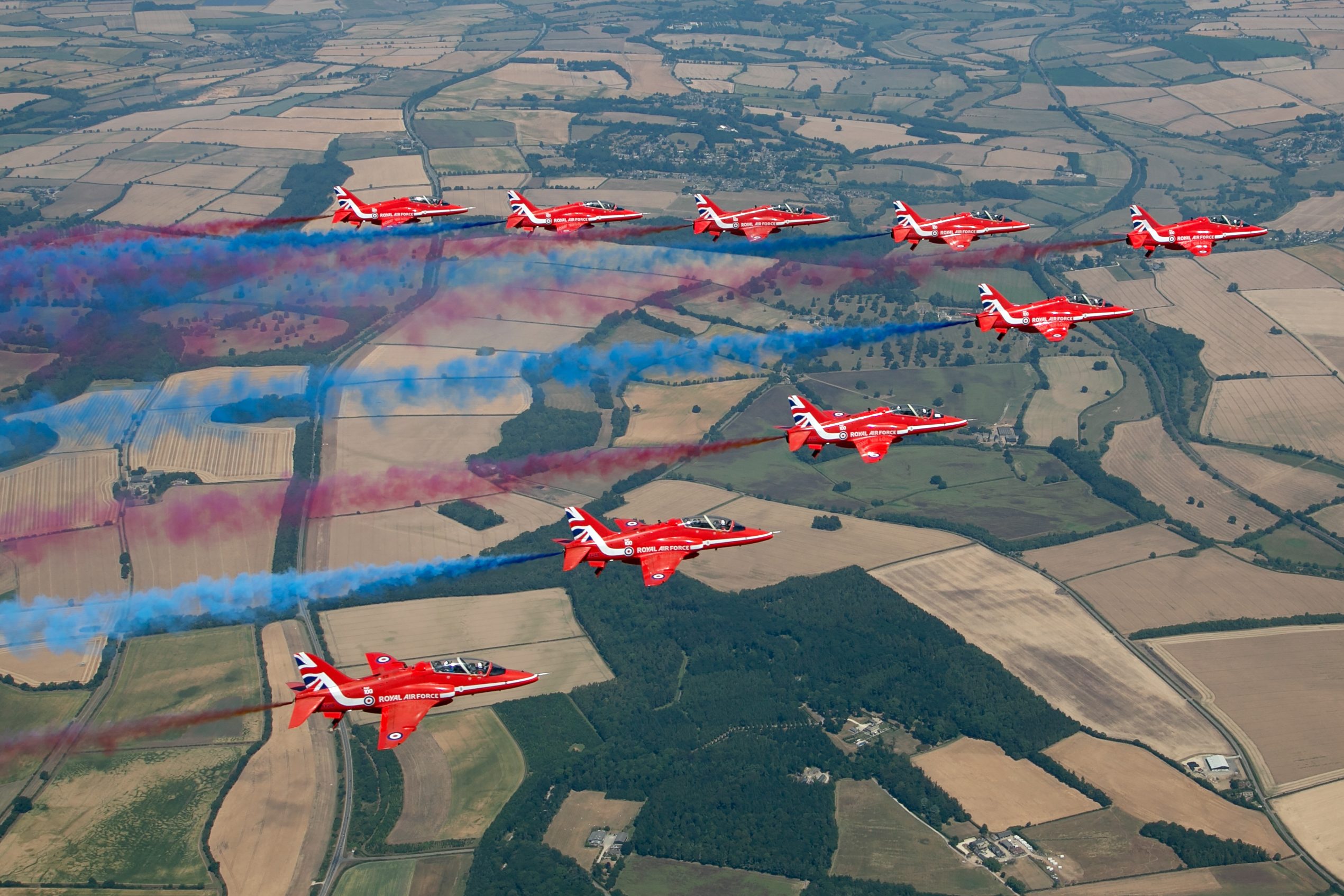
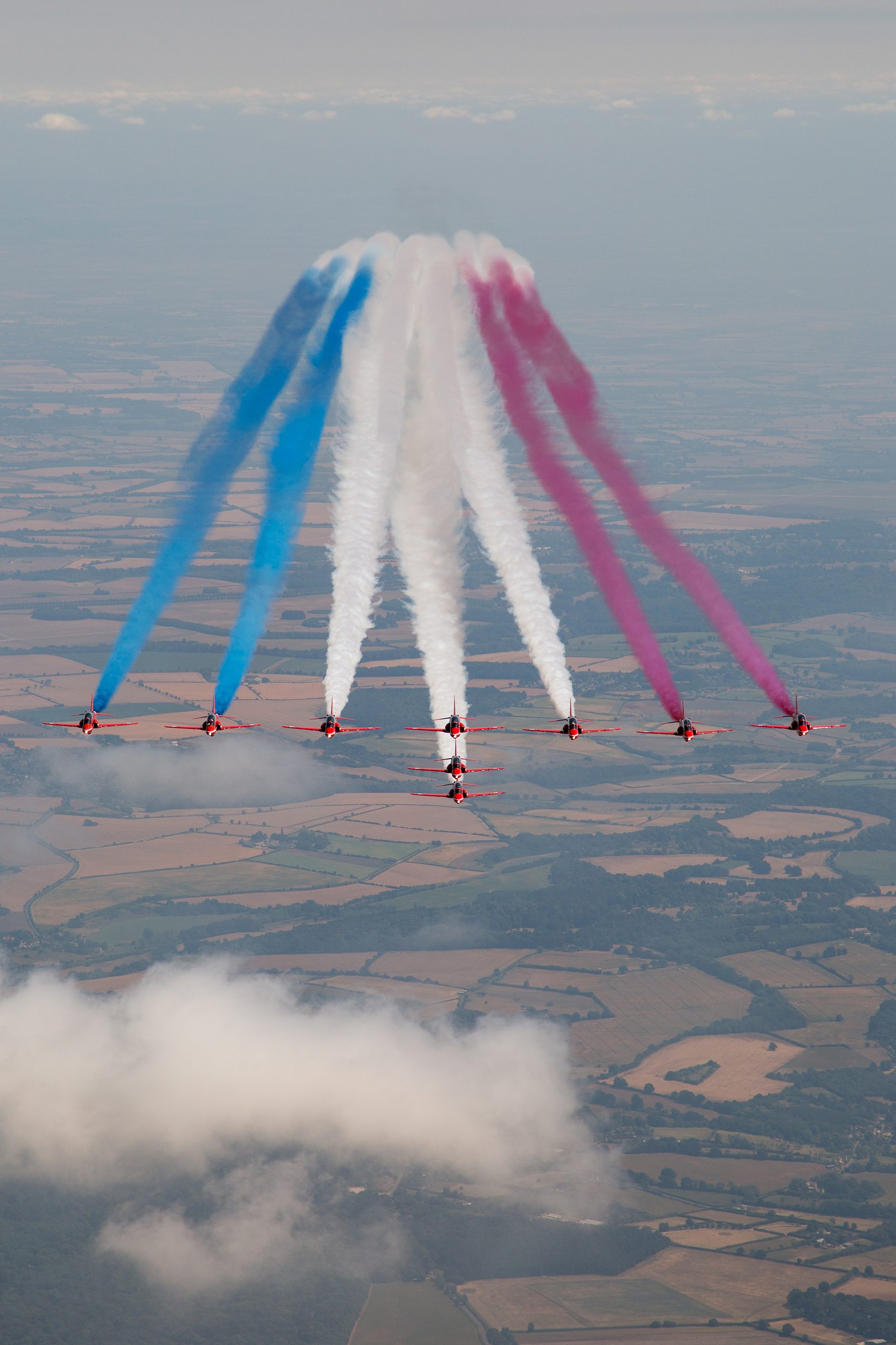
For most people the Hawk is the Red Arrows, and the association is now more than four decades old. The Royal Air Force Aerobatic Team re-equipped with the Hawk T1 in 1979 and 1980, retiring the Folland Gnats on which they had built their early reputation. The Hawk gave the team a bigger, more powerful and more reliable aircraft, and the red display scheme it has worn ever since has become one of the most recognisable images in British aviation.
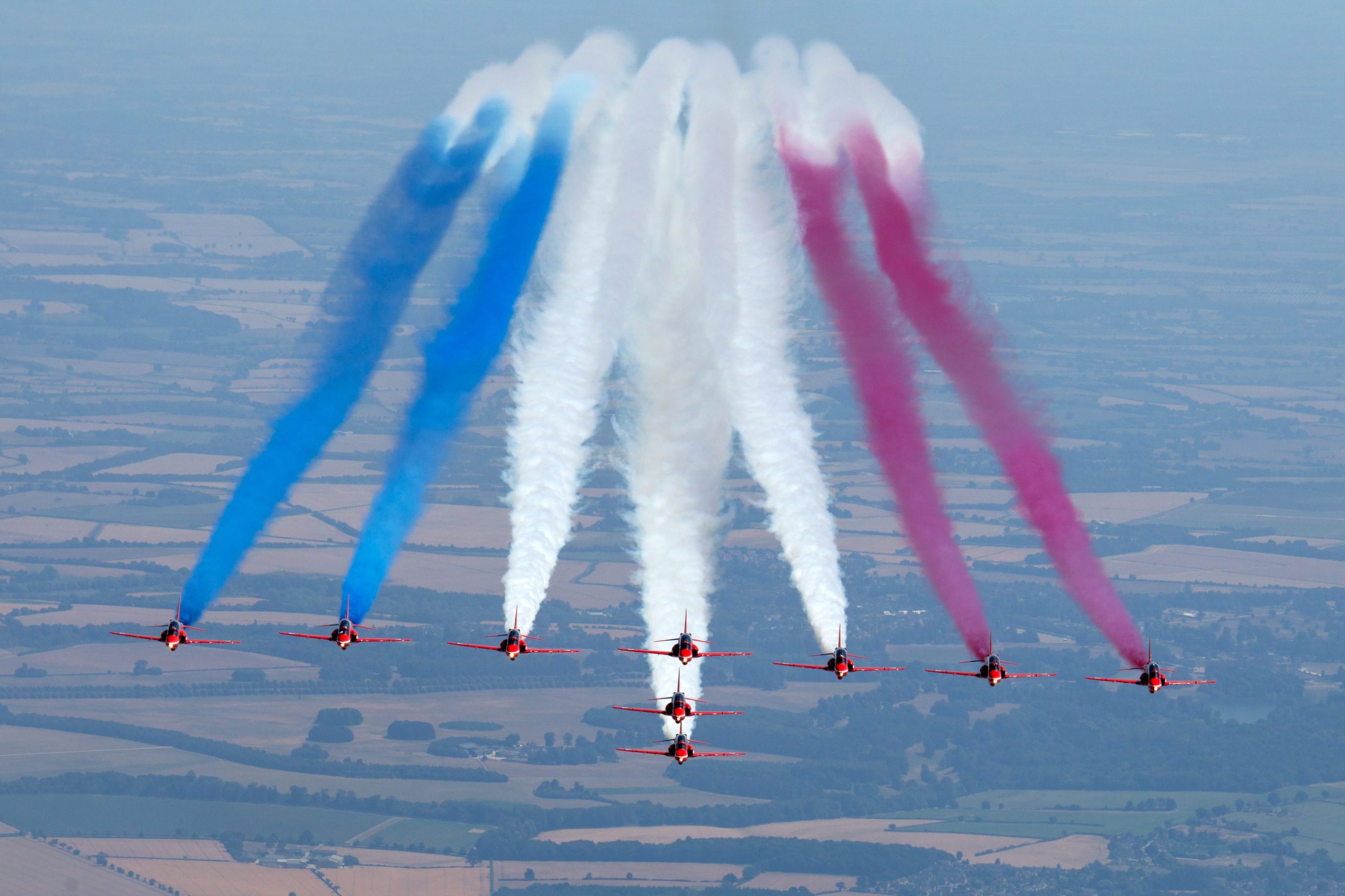
The team flies nine aircraft in its display, the famous Diamond Nine, backed by a small number of spare airframes. The display jets are standard Hawk T1s with one modification that matters for the crowd: the centreline gun pod is replaced by a tank that mixes diesel with coloured dye to produce the red, white and blue smoke. Everything else is a service trainer, which is part of the appeal. The aircraft the public watches looping over a seafront is fundamentally the same one that teaches students to fly fast jets at Valley.
The team was based at RAF Scampton in Lincolnshire from 1983, a station synonymous with the Dambusters, until the Ministry of Defence announced Scampton would close. In October 2022 the Red Arrows moved the short distance to RAF Waddington, taking with them tonnes of equipment, shipping containers and two static Hawks by road. The team remains at Waddington today, and with the retirement of the RAF training T1s it is now the last operator of the Hawk T1 anywhere.
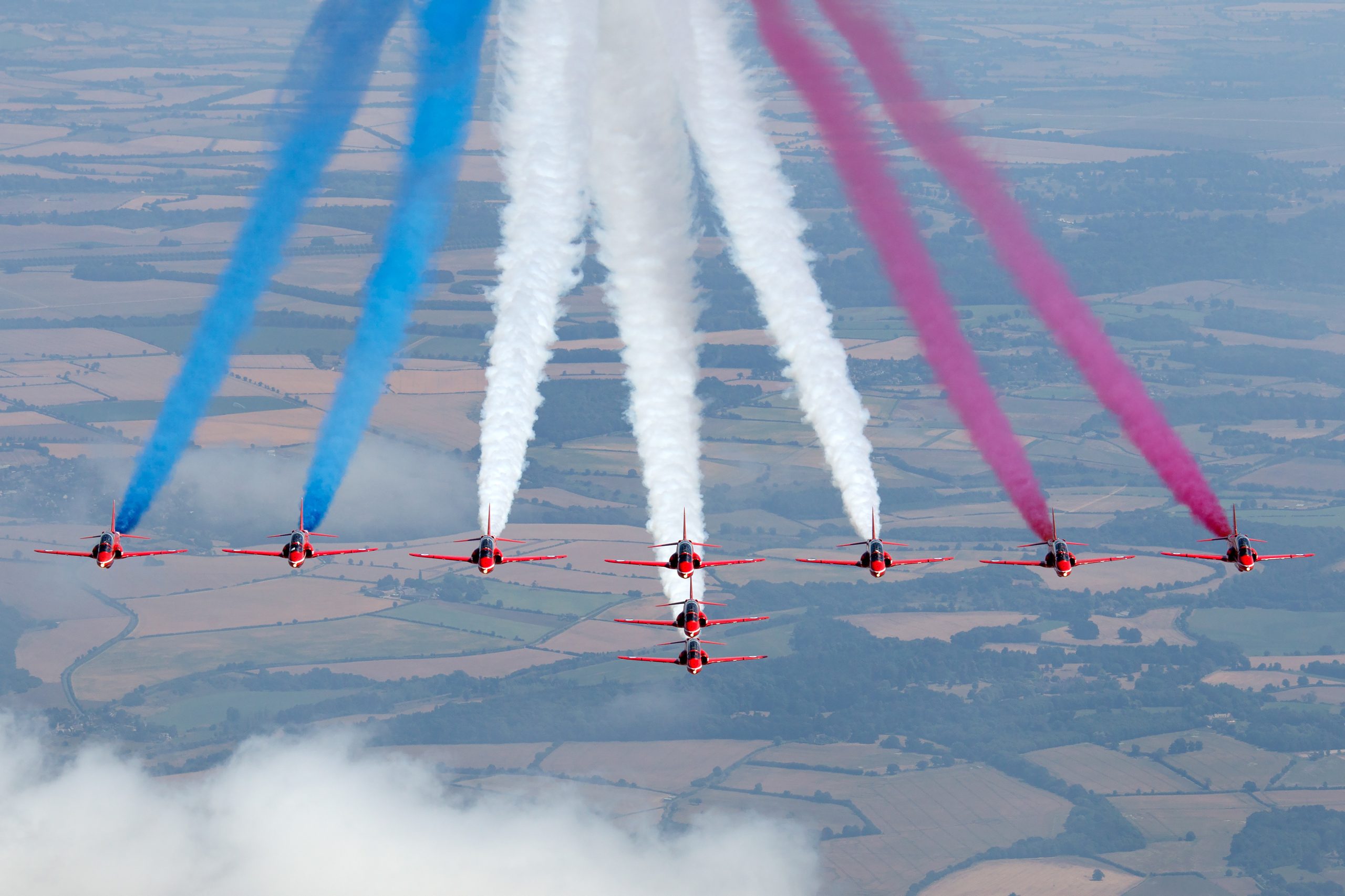
The team has known tragedy in its Hawks. In 2011 the team lost two members: Flight Lieutenant Jon Egging died following a display at Bournemouth, and Flight Lieutenant Sean Cunningham was killed when his ejection seat fired on the ground. In March 2018 an engineer, Corporal Jonathan Bayliss, was killed when a Hawk crashed at RAF Valley; the pilot, Flight Lieutenant David Stark, ejected and survived. These losses are part of the aircraft’s story and a reminder that even a training jet in display service operates at the edge. In 2019 the team took twelve Hawks on a landmark tour of North America, Exercise Western Hawk 19, displaying across the United States and Canada in support of British trade and the wider national effort.
Variants: from T1 to the Hawk 200
The Hawk family tree is large, because the basic design proved endlessly adaptable. Understanding the main branches is the key to making sense of the many marks that have served around the world.
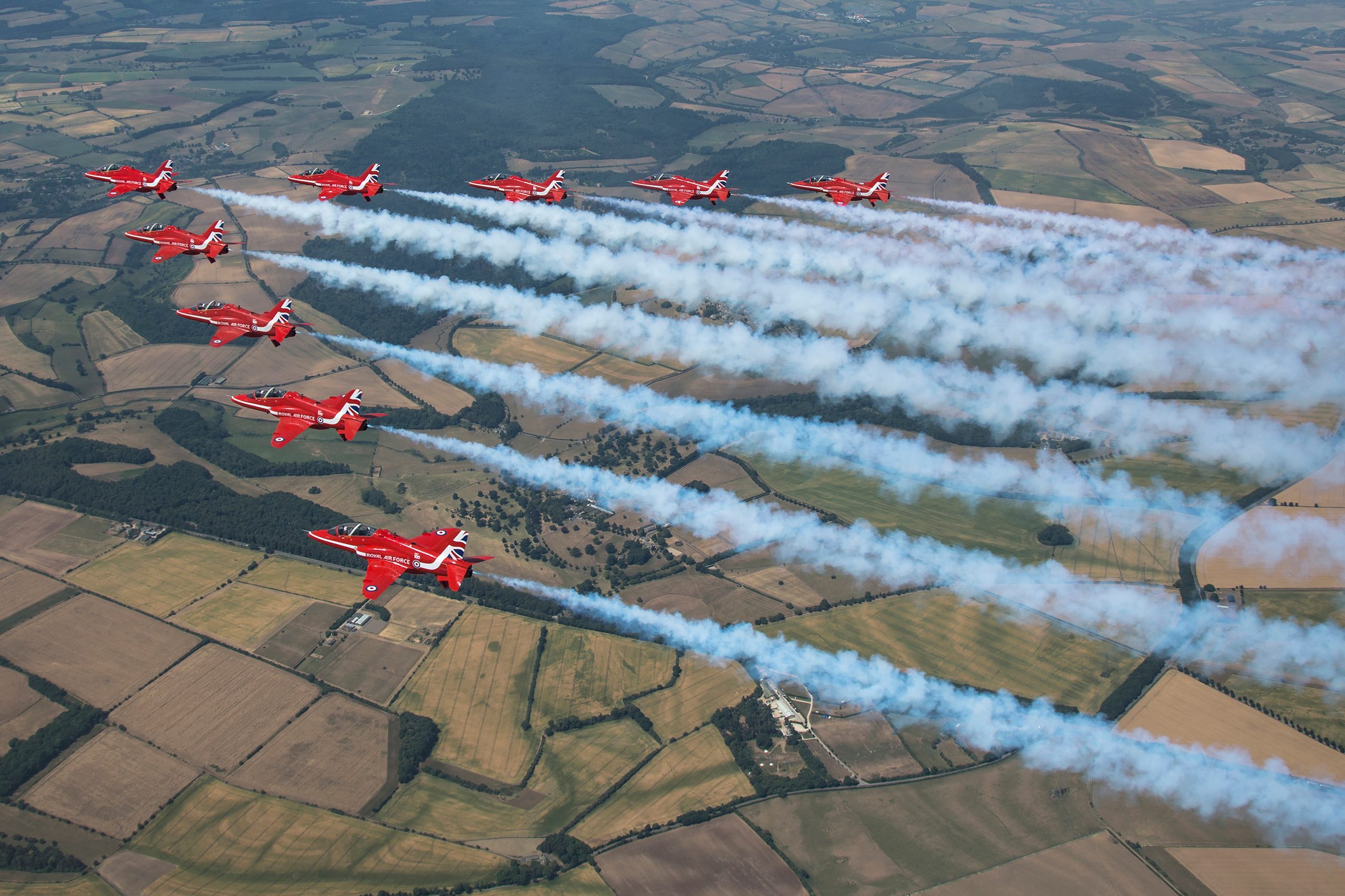
The Hawk T1 is the original RAF version, of which 175 were built. Around eighty-eight were later upgraded to T1A standard with Sidewinder capability for the wartime point-defence role. The first export version was the Hawk 50 series, an armed trainer that first flew in May 1976 and sold to Finland, Indonesia and Kenya. The improved Hawk 60 series followed with a more powerful Adour and a greater weapons load, and it was from this series that the United States Navy carrier trainer was later developed.
The Hawk 100 series is a two-seat advanced weapons trainer with a redesigned wing, modern avionics and optional forward-looking infrared, sold to countries including Australia, Canada, India, Oman and Malaysia. The RAF’s own Hawk T2, also known as the Hawk 128, is a member of this family; it made its maiden flight at Warton on 27 July 2005, and an order for 28 aircraft followed in 2006. The most radical departure is the Hawk 200, a single-seat lightweight multi-role combat aircraft in which the front cockpit is replaced by an avionics bay housing a multi-mode radar. Sixty-two Hawk 200s were built for Oman, Malaysia and Indonesia.
| Variant | Role | Notes |
|---|---|---|
| Hawk T1 / T1A | RAF advanced trainer | 175 built; 89 upgraded to T1A with Sidewinder capability |
| Hawk 50 series | Export armed trainer | First flew May 1976; Finland, Indonesia, Kenya |
| Hawk 60 series | Improved export trainer | Uprated Adour; basis for the T-45 Goshawk |
| Hawk 100 series | Advanced weapons trainer | Includes RAF Hawk T2 / Hawk 128; many export users |
| Hawk 200 | Single-seat light combat | 62 built; radar-equipped; Oman, Malaysia, Indonesia |
| T-45 Goshawk | US Navy carrier trainer | 221 built; strengthened for carrier operations |
Export success and combat service
The Hawk is one of the most successful British aircraft exports of the jet age. More than a thousand have been sold to eighteen operators, a figure that excludes the separate production run of 221 T-45 Goshawks for the United States Navy. Licence assembly took place in Finland, and later in India, where Hindustan Aeronautics has built large numbers of the Hawk 132 for the Indian Air Force and Navy.
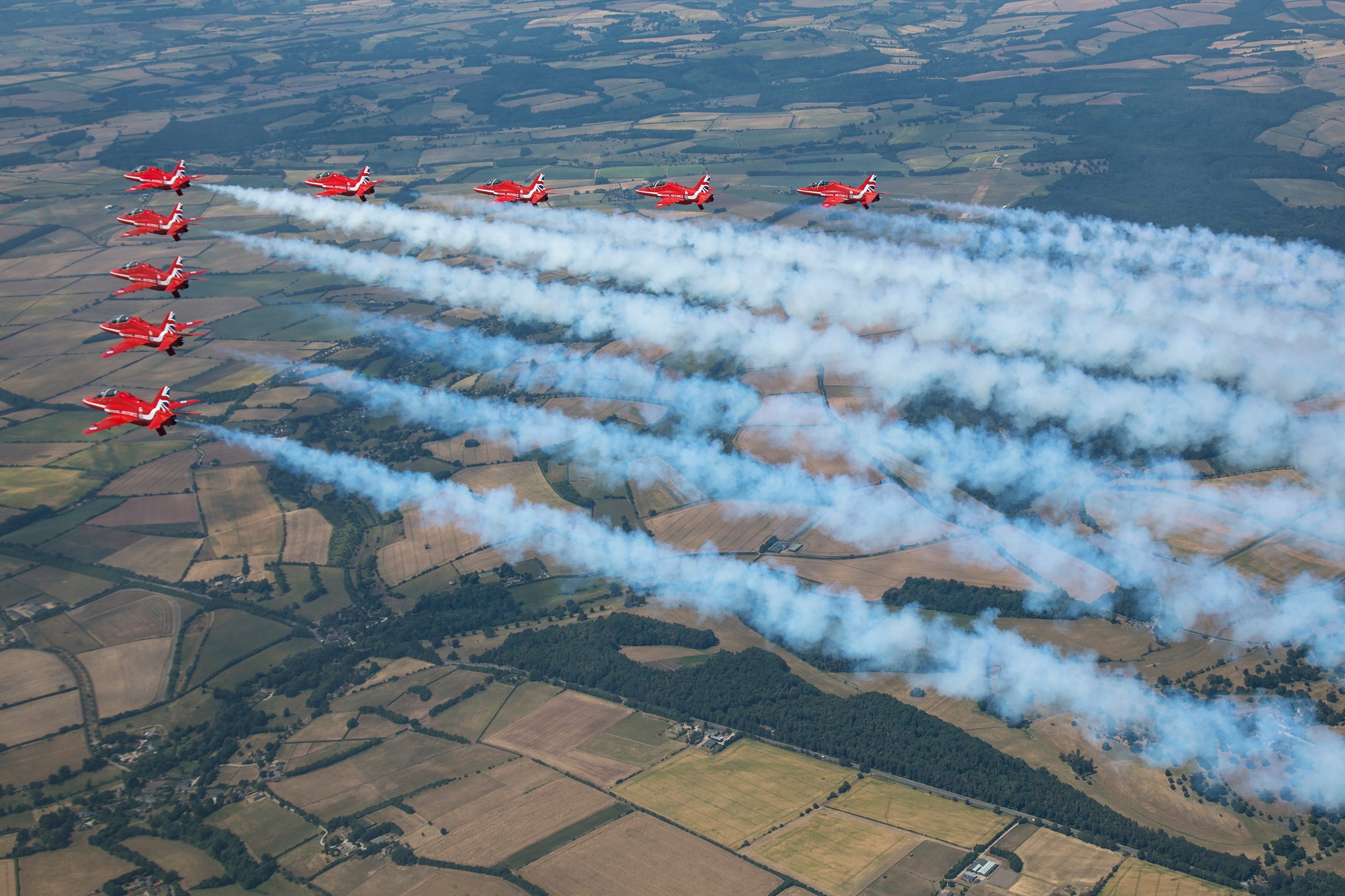
Because so many Hawks were sold in armed versions, the type has seen genuine combat. Indonesian single-seat Hawks were used in ground-attack operations during the Aceh conflict in 2003 and 2004. Malaysian Hawk 208s flew airstrikes with bombs and rockets during the Lahad Datu standoff in Sabah in 2013. Zimbabwean Hawk 60s saw action in the Second Congo War around the turn of the century. None of this was ever the primary purpose of a training aircraft, but the built-in weapons capability that made the Hawk such an easy export sale also made it a real, if modest, combat aircraft in several air forces.
Hawk operators around the world
The map of Hawk operators reads like a survey of air forces that wanted a capable trainer without the cost of a supersonic one. Beyond the Royal Air Force, some of the largest fleets are in India, where Hindustan Aeronautics has built well over a hundred Hawk 132s under licence for the Indian Air Force and the Indian Navy, making India one of the biggest Hawk operators anywhere and giving the country its own advanced training and aerobatic capability.
In Europe, Finland was an early and important customer, ordering the Hawk 50 in 1977 and assembling most of its aircraft domestically, later supplementing them with ex-Swiss airframes; the Finnish Air Force has flown the Hawk for decades and uses it for its Midnight Hawks display team. Australia operates the Hawk 127 as its lead-in fighter trainer, and Canada flew the CT-155 in the NATO Flying Training in Canada programme until its retirement. Saudi Arabia has been a long-standing and substantial customer through successive defence agreements, and further operators include Oman, Qatar, Bahrain, Kuwait, the United Arab Emirates, Malaysia, Indonesia and South Africa, whose Hawk 120s serve with the South African Air Force.
Not every operator still flies the type. Switzerland, Kenya, Zimbabwe and South Korea have retired their Hawks, and the roll call changes as air forces re-equip. Even so, the spread is remarkable for any aircraft, let alone a trainer: a single British design, in trainer, advanced-trainer, carrier and light-combat forms, has equipped the air arms of some two dozen nations across five continents. Few post-war British aircraft have travelled so far or served so many flags, and fewer still have done it for half a century and counting.
Why the Hawk beat its rivals
The Hawk arrived in a crowded market. The Franco-German Alpha Jet, the American Northrop T-38 Talon and later designs such as the Aermacchi MB-339 all competed for the same training and light-attack sales, yet the Hawk outsold them all in the West. Understanding why explains a great deal about the aircraft.
The first reason is cost. A single non-afterburning engine, a simple structure and high serviceability meant a low price to buy and a low price to fly, which is decisive when an air force is counting the cost of every training hour. The second is versatility. By building in a gun pod and underwing hardpoints from the start, Hawker Siddeley turned a trainer into an armed trainer and, in the Hawk 200, a genuine light fighter, so a customer could buy one airframe family for training and light strike. The third is credibility. When the United States Navy chose a version of the Hawk to teach its own pilots the hardest skill in aviation, carrier landing, it gave the design a stamp of approval no marketing could buy.
There is a fourth, less tangible reason: the Hawk simply kept getting better without losing what made it good. The glass-cockpit T2 flies the same honest airframe as the 1974 prototype, now able to mimic the sensors of a fifth-generation fighter. Fifty years of continuous development on a sound original is why the Hawk, almost alone among its generation of trainers, is still being flown, still being photographed, and still setting the standard others are measured against.
The T-45 Goshawk
The most demanding job any Hawk does is landing on aircraft carriers, and for that the United States Navy adopted a heavily modified version called the T-45 Goshawk. Developed from the Hawk 60 series and strengthened throughout for the violence of carrier operations, the Goshawk gained a stronger undercarriage, an arrestor hook, catapult attachment and numerous airframe changes to survive repeated deck landings.
The prime contractor was McDonnell Douglas, later Boeing, working with British Aerospace, and the aircraft first flew on 16 April 1988. In all, 221 were built. The Goshawk is the only aircraft the US Navy uses specifically to train its pilots for carrier landings, a role it took over fully in the 1990s, and it remains in service in its digital-cockpit T-45C form. That a British training design was chosen, adapted and trusted to teach American naval aviators the hardest skill in flying is perhaps the clearest possible measure of how good the basic Hawk was.
Specifications
The figures below are for the RAF Hawk T1, the original and most numerous version and the mark the Red Arrows fly. Later variants such as the Hawk T2 are slightly longer and more powerful, with the FADEC-controlled Adour Mk 951, so specifications vary by mark and should not be blended. Where sources differ on the early T1, the commonly cited reference figures are given.
| Attribute | Figure |
|---|---|
| Crew | Two, in tandem |
| Length | About 11.96 m (39 ft 2 in) |
| Wingspan | About 9.4 m (30 ft 10 in) |
| Height | 3.98 m (13 ft 1 in) |
| Engine | One Rolls-Royce Turbomeca Adour Mk 151 turbofan |
| Thrust | About 5,200 lbf (23 kN) |
| Maximum speed | About Mach 0.84, roughly 555 knots; transonic in a dive |
| Service ceiling | About 44,500 ft (13,565 m) |
| Range | About 2,520 km (1,360 nm) ferry |
| First flight | 21 August 1974 |
| Number built (T1) | 175 for the RAF |
Photographing the Hawk today
The Hawk is one of the most photographed aircraft in Britain, largely thanks to the Red Arrows, and it rewards the same techniques as any other fast jet. It is quick but not supersonic in the display, so a shutter speed in the region of 1/640 to 1/1000 of a second freezes the airframe cleanly while keeping enough control for a smart pan, and continuous autofocus with a moving focus point tracks it well against a bright sky.
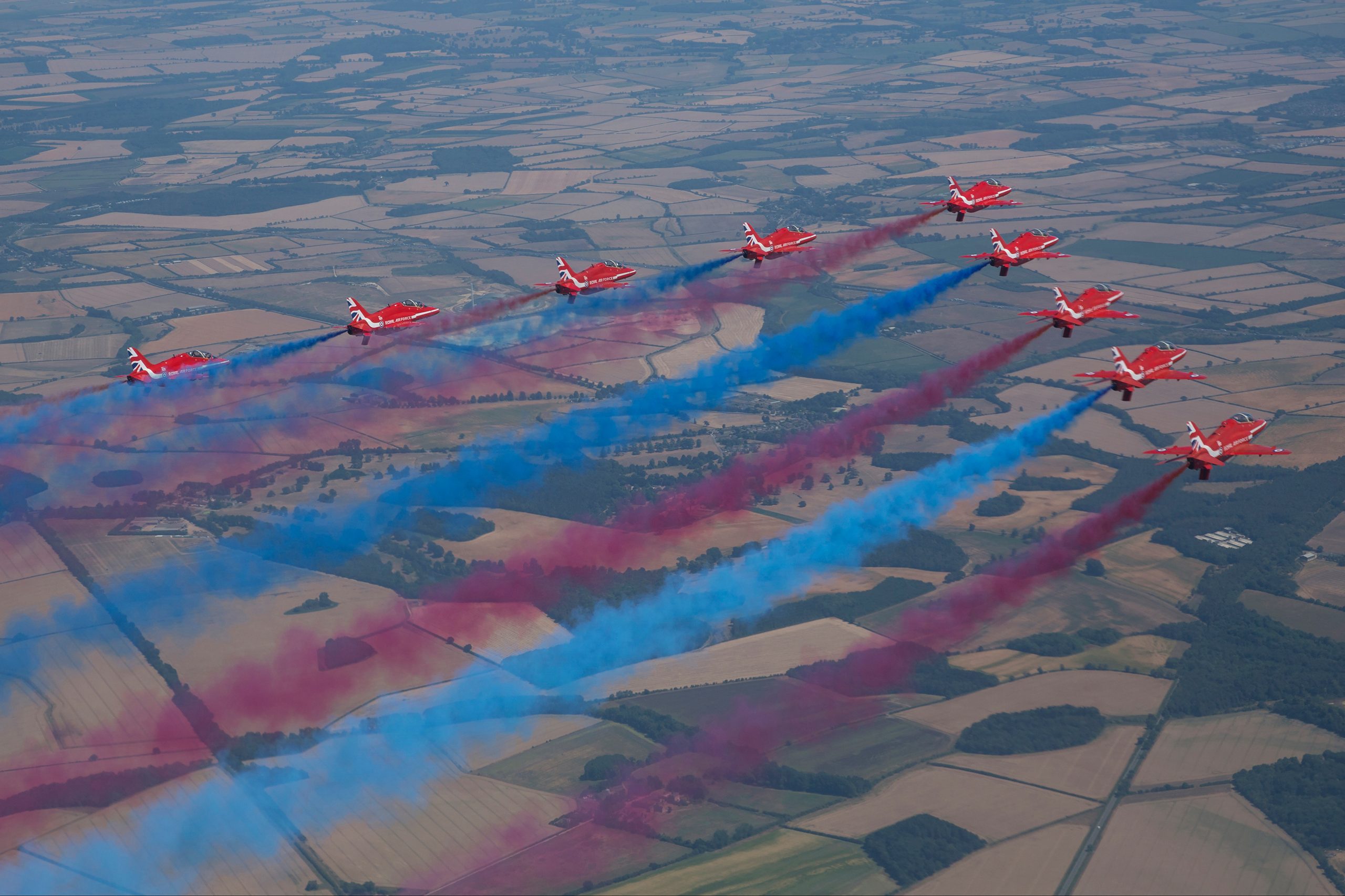
For the Red Arrows specifically, the challenge is formation and smoke rather than a single airframe, so timing the break and keeping the whole diamond in frame matters more than filling it with one jet. Our guide to photographing formation flying and the dedicated piece on photographing the Red Arrows cover the specifics, while the broader method for tracking jets is set out in our guide to how to photograph fast jets. You can see finished results in the Professional Aviation Photography galleries, and the terms for using them are on the licences page.
Where to see a Hawk
The best place to see a Hawk is in the air, and for most people that means a Red Arrows display or a visit to the vicinity of RAF Valley on Anglesey, where Hawk T2s fly advanced training sorties. Preserved examples are harder to find than for older RAF types, simply because the Hawk is still in service and few have yet reached museums.
The prototype, XX154, survives. After a long career that ended with the Empire Test Pilots’ School in December 2018, it was airlifted by Chinook in August 2019, on the forty-fifth anniversary of its first flight, to the Boscombe Down Aviation Collection at Old Sarum airfield in Wiltshire, where it is preserved. The RAF Museum has acquired a Hawk T1A for its collection at Cosford, and National Museums Scotland holds a Red Arrows Hawk. Because the type is still flying in numbers, the museum picture will grow steadily over the coming years as airframes are retired.
Retirement and the future
The Hawk is entering its final chapter with the RAF, though it is a long one. The RAF withdrew the Hawk T1 from its training role in March 2022, leaving the Red Arrows as the sole T1 operator, and the ageing fleet is being managed carefully to make its remaining flying hours last.
Looking further ahead, in 2025 the Ministry of Defence launched a competition to replace both the Hawk T1 and the Hawk T2, and has committed funding to a new British jet trainer system that explicitly includes new aircraft for the Red Arrows. As of August 2026 no specific replacement type has been named. The Hawk airframes are expected to leave service around 2030, with the T2 continuing for some years beyond that. After more than half a century, the aircraft that replaced the Gnat is finally preparing to hand over, though as of 2026 it still flies, still trains and still displays.
Legacy
The Hawk’s legacy is written in the logbooks of thousands of pilots. Almost every RAF fast-jet pilot of the last five decades learned their trade on it, as did aviators in dozens of other air forces and, in the Goshawk, the carrier pilots of the United States Navy. It is the yardstick against which other jet trainers are measured, and its combination of low cost, honest handling and built-in weapons capability has never been bettered by a Western competitor in commercial terms.
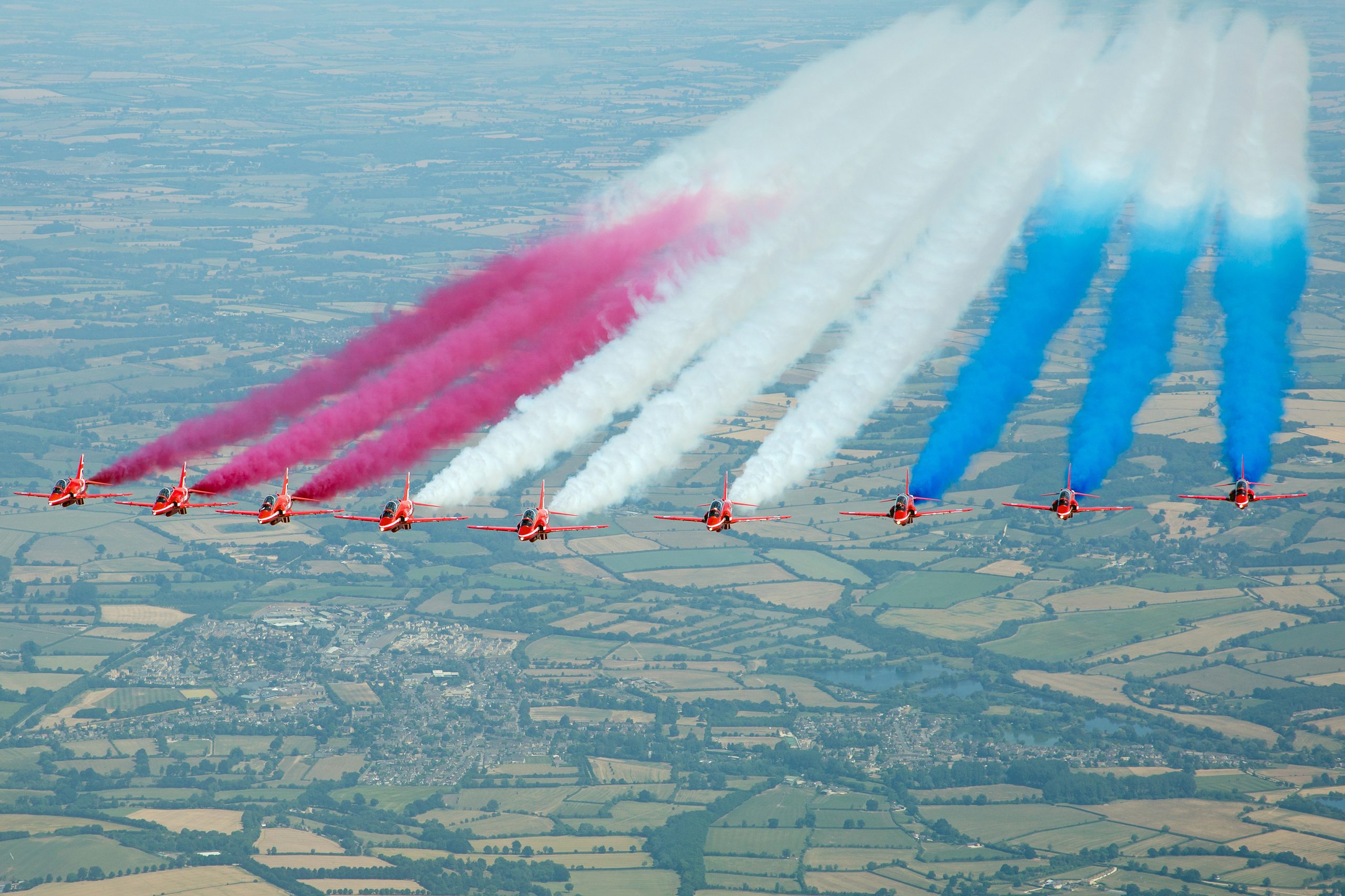
There is a neat symmetry to the story. The Hawk was designed to replace the Gnat that the Red Arrows once flew, and it then became the Red Arrows’ own aircraft for over forty years, carrying the team’s reputation around the world. When it finally retires it will do so as one of the most successful and longest-serving jet trainers ever built, a really great aircraft that spent its whole life being quietly, brilliantly useful.
Most Hawk photographs in circulation show Red Arrows aircraft, which is not always what a picture desk actually needs. Our guide to aviation picture research covers sourcing the less obvious operators and marks.
The Hawk in Red Arrows markings is a licensing subject in its own right, and our guide to licensing Red Arrows photographs sets out what exists, what the markings date a picture to, and what the type’s retirement means for the archive.
Frequently asked questions
When did the BAE Hawk first fly?
The prototype, serial XX154, made its first flight from Dunsfold on 21 August 1974, piloted by Hawker Siddeley chief test pilot Duncan Simpson. It entered Royal Air Force service in 1976, with RAF Valley on Anglesey as its first base, replacing the Folland Gnat and the Hawker Hunter in the training role.
Why is the Hawk associated with the Red Arrows?
The Royal Air Force Aerobatic Team re-equipped with the Hawk T1 in 1979 and 1980, replacing the Folland Gnat, and has flown it ever since. The team uses nine aircraft in its Diamond Nine formation, and the display jets are standard Hawk T1s with the centreline gun pod replaced by a tank that produces the red, white and blue smoke from diesel and dye.
How many BAE Hawks have been built?
More than a thousand Hawks have been sold to eighteen operators worldwide, making it the most successful Western jet trainer of the jet age. That figure excludes the separate production run of 221 T-45 Goshawks built for the United States Navy, so the wider Hawk family exceeds twelve hundred aircraft.
What engine does the Hawk use?
The Hawk is powered by a single Rolls-Royce Turbomeca Adour turbofan, an Anglo-French engine. The original RAF Hawk T1 uses the Adour Mk 151, while the modern Hawk T2 and current export trainers use the more powerful, FADEC-equipped Adour Mk 951. The engine has no afterburner, so the Hawk is subsonic in level flight but can exceed the speed of sound in a dive.
Is the BAE Hawk supersonic?
No, not in level flight. Because it has no afterburner, the Hawk reaches about Mach 0.84 straight and level, which is deliberately fast enough to teach transonic handling without the cost and complexity of a supersonic engine. It can, however, nudge past Mach 1 in a dive, allowing student pilots to experience supersonic flight in a controlled way.
What is the difference between the Hawk T1 and Hawk T2?
The T1 is the original 1970s RAF trainer with an analogue cockpit and the Adour Mk 151 engine, and it is the mark the Red Arrows fly. The T2, also called the Hawk 128, is a modern member of the Hawk 100 family with a glass cockpit designed to simulate the Typhoon and F-35, a more powerful Adour Mk 951, and a slightly longer airframe. It first flew in 2005 and 28 were delivered to the RAF.
Has the BAE Hawk seen combat?
Yes. Because many Hawks were sold in armed versions, several operators have used them in action. Indonesian Hawks flew ground-attack missions during the Aceh conflict in 2003 and 2004, Malaysian Hawk 208s carried out airstrikes during the Lahad Datu standoff in 2013, and Zimbabwean Hawks saw combat in the Second Congo War. The single-seat Hawk 200 was designed specifically as a light combat aircraft.
What is the T-45 Goshawk?
The T-45 Goshawk is a carrier-capable version of the Hawk developed for the United States Navy from the Hawk 60 series. Strengthened for deck operations with an arrestor hook, catapult attachment and a stronger undercarriage, it first flew on 16 April 1988. In total 221 were built, and it remains the only aircraft the US Navy uses to train pilots specifically for carrier landings.
Are the Red Arrows still flying the Hawk in 2026?
Yes. As of 2026 the Red Arrows still fly the Hawk T1 from RAF Waddington, and they are now the last operator of that mark. Because of airframe fatigue and out-of-production engines, the team is flying seven aircraft for most of the 2026 season rather than the traditional nine, keeping the full Diamond Nine for major occasions. The Ministry of Defence says the fleet has enough life to serve to around 2030.
When will the RAF retire the Hawk?
The RAF withdrew the Hawk T1 from training duties in March 2022, leaving only the Red Arrows flying it. In 2025 the Ministry of Defence launched a competition to replace both the T1 and the T2, and has funded a new British jet trainer system that includes new aircraft for the Red Arrows. The Hawk airframes are expected to leave service around 2030, with the T2 continuing for some years after that.
Where can I see a BAE Hawk?
The easiest way is to watch a Red Arrows display or visit near RAF Valley on Anglesey, where Hawk T2s train. Preserved examples are still uncommon because the type is in service, but the prototype XX154 is at the Boscombe Down Aviation Collection at Old Sarum, the RAF Museum has acquired a Hawk T1A for Cosford, and National Museums Scotland holds a Red Arrows Hawk.
Who designed and built the Hawk?
The Hawk was designed by Hawker Siddeley Aviation at Kingston, with a team led by Ralph Hooper, from a private study begun in 1968. Hawker Siddeley became part of British Aerospace in 1977 and then BAE Systems in 1999, so the aircraft has been marketed under all three names. It has also been built under licence, in Finland and later in India by Hindustan Aeronautics.
