The Berlin Airlift was the Western Allied operation that supplied more than two million people in the western sectors of Berlin entirely by air for fifteen months, from June 1948 to September 1949, after the Soviet Union cut every road, rail and canal route into the city. It delivered over 2.3 million tons of food, coal and fuel, and it was the moment the Cold War turned from a diplomatic argument into a contest of will.
Nobody thought it would work. Not the Soviets, who calculated that a city of that size simply could not be fed through the eye of a needle. Not, at the beginning, many of the Allied commanders, who looked at the arithmetic and reached the same conclusion. The airlift was launched as a stopgap, a way of buying a few weeks while the politicians found a real answer. The real answer never arrived. Instead, a fleet of war-surplus transports and the men who flew and loaded them turned an improvisation into the largest logistical air operation ever attempted, and beat a blockade that was supposed to be unbeatable.
What follows is the story of how it was done, what flew, what it cost, and where you can still stand in front of the aircraft that did it.
What this guide covers
- A city cut in four
- The currency reform and the blockade
- The decision to fly
- Three corridors, twenty miles wide
- The aircraft of the Berlin Airlift
- Black Friday and the Tunner system
- Tempelhof, Gatow and an airfield built from nothing
- Coal, flour and salt: what actually flew
- The winter of 1948 to 1949
- The Easter Parade
- Operation Little Vittles and the Candy Bomber
- The cost
- 12 May 1949: the blockade lifted
- Why the airlift mattered
- Legacy: what the airlift taught aviation
- Where to see the Berlin Airlift today
- Frequently asked questions
A city cut in four
When Germany surrendered in May 1945, the victorious powers divided the country into four occupation zones: American, British, French and Soviet. Berlin, the capital, sat deep inside the Soviet zone, roughly a hundred miles from the nearest western territory. Berlin was nonetheless divided into four sectors of its own, on the same lines.
That arrangement created something with no precedent: a Western enclave, home to well over two million people, entirely surrounded by Soviet-controlled territory, and reachable only by roads, railways and canals that ran across land the Soviets policed. It was an obvious pressure point and everybody knew it. The wartime agreements had been carefully specific about air access and casually vague about surface access. That drafting detail, which looked trivial in 1945, decided everything three years later.
The relationship curdles
By 1947 the wartime alliance had gone. The Marshall Plan offered American money to rebuild Europe, and the Soviet Union rejected it and forbade its satellites from accepting it. The Western powers began, cautiously, to merge their zones and to talk about a West German state. From Moscow’s point of view, that meant a rebuilt, industrialised, American-aligned Germany on the doorstep, and a Western garrison sitting in the middle of the Soviet zone acting as a shop window for it. Berlin was the leverage.
The squeeze came in stages. Traffic on the roads and railways was harassed, stopped, inspected, delayed. Soviet fighters buzzed Allied aircraft in the corridors; in April 1948 a Yak fighter collided with a British European Airways Viking near Gatow and both aircraft were destroyed, killing everyone aboard. The message was clear enough.
The currency reform and the blockade
The trigger was money. The western zones were still using the worthless Reichsmark, and the black market had replaced the economy. On 20 June 1948, the Western Allies introduced a new currency, the Deutsche Mark, in their zones, and days later extended it into the western sectors of Berlin.
The Soviets responded by cutting the city off. Surface traffic into the western sectors was progressively strangled and, on 24 June 1948, the last land and water routes were closed. Electricity supplied from generating plants in the Soviet zone to the western sectors was cut as well. The stated reasons were technical: repairs, maintenance, unfortunate difficulties. Nobody was fooled.
West Berlin at that point held food stocks measured in weeks and coal stocks measured in about six. After that, the calculation went, the city would either starve or accept Soviet supply, and a city that accepted Soviet supply would shortly become a Soviet city. Stalin did not need to fire a shot. He simply had to wait.
The decision to fly
The alternatives were all bad. An armed convoy pushed up the autobahn risked a shooting war with the Red Army, which vastly outnumbered Allied ground forces in Germany. Withdrawal from Berlin meant abandoning two million people and announcing to every wavering government in Europe that American guarantees were worthless.
Flying was the third option, and it had one enormous advantage: the air corridors were guaranteed in writing. To stop the aircraft, the Soviets would have to shoot them down, and that would be an act of war committed by them, not by the West. The moral and legal burden was inverted. It was a brilliant piece of strategic judo, and it worked because the paperwork from 1945 happened to be watertight where it mattered.
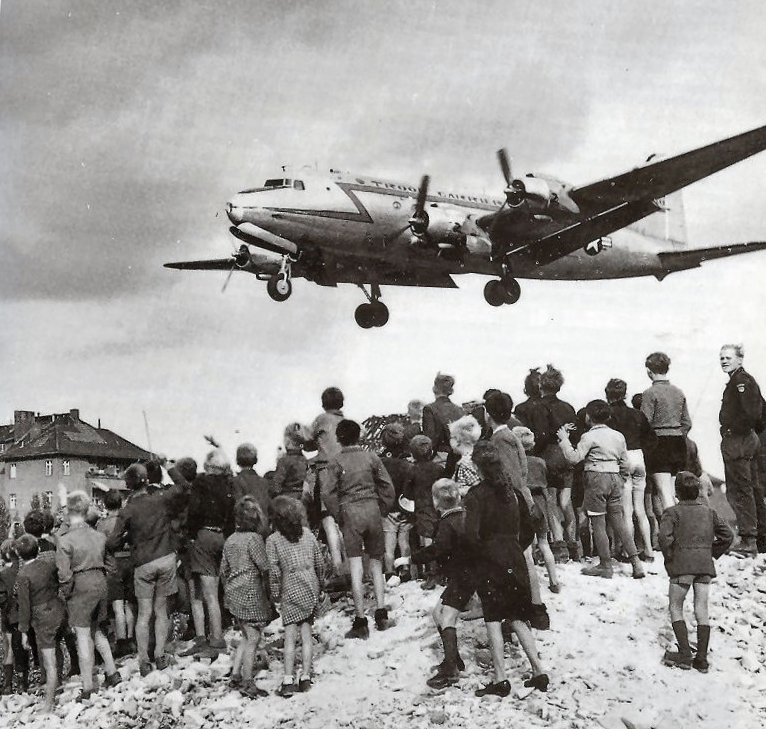
The Americans called their effort Operation Vittles. Flying began on 26 June 1948, when USAF C-47 Skytrains carried about eighty tons of food into Tempelhof. Eighty tons against a requirement of thousands. It was, on that first day, close to a gesture.
The British name their operation three times
The RAF started on 28 June under the codename Operation Knicker, which was initially about supplying the British garrison rather than the city. It was renamed Carter Paterson on 29 June. That turned out to be a mistake: Carter Paterson was the name of a well-known British removals firm, and Soviet propaganda gleefully broadcast that the British had chosen a moving company’s name because they were packing up and leaving Berlin. The operation was promptly renamed again, to Plainfare, and Plainfare it stayed.
Three corridors, twenty miles wide
Everything flew through three air corridors across the Soviet zone, each twenty miles wide. They ran from Hamburg, from Bueckeburg and from Frankfurt. The shortest was about 110 miles long. Aircraft flew inbound on two of them and outbound on the third, which turned the whole system into a one-way conveyor rather than a two-way road.
Inside those corridors the aircraft were stacked in altitude blocks, separated vertically, flying at fixed speeds and fixed intervals. Deviation was not a matter of airmanship preference; it was a diplomatic incident. Soviet fighters flew alongside the corridors throughout, and there were repeated incidents of harassment, of aircraft being buzzed, of searchlights and flak fired near but not at the transports. Not one Allied transport was shot down.
The aircraft of the Berlin Airlift
The airlift was flown almost entirely on wartime designs, most of them built for war and repurposed for a very different job.
Douglas C-47 Skytrain
The military Dakota, the aeroplane that had done everything in the Second World War. It opened the airlift and it was, quite quickly, the wrong aircraft for it. A C-47 could carry roughly three tons. In a system where every landing slot in Berlin was a scarce and precious resource, an aircraft that used up a slot to deliver three tons was throwing that slot away. The C-47 was phased out of the American effort during the autumn of 1948 in favour of something much bigger.

Douglas C-54 Skymaster
The aircraft that won the airlift. A four-engined transport carrying roughly ten tons, more than three times a C-47, on the same single landing slot. The USAF concentrated C-54s in Germany from every corner of the American air transport world, and the fleet built up to more than three hundred aircraft. Contemporary accounts put the American commitment at some 319 USAF C-54s, supported by 24 R5Ds, the US Navy designation for the same aeroplane, flown by two Navy transport squadrons of twelve aircraft each.
The Skymaster’s virtues were unromantic and decisive: it was reliable, it had a strong floor, it could be loaded quickly, and there were enough of them. Standardising the fleet on a single type also meant every ground crew, every loading team and every spare part in the system worked on the same aeroplane. That standardisation was worth as much as the extra tonnage.
Avro York
The backbone of the British effort. The York was a transport built on Lancaster foundations: it used the wings, the engines, the undercarriage and the tail of the bomber, married to a new square-section fuselage that could actually hold cargo. If you have read our history of the Avro Lancaster, the York is the Lancaster’s civil afterlife, and the Merlins sounded exactly the same over Berlin as they had over the Ruhr.
Only 258 Yorks were built in total, and not all of them flew on the airlift, but the type carried a very large share of the British tonnage. The RAF also flew Dakotas, and from late 1948 the new Handley Page Hastings began to arrive, a purpose-built postwar transport that could carry a heavier load than the York.

Short Sunderland
The most unlikely aircraft in the operation, and the one with the best reason to be there. Salt was essential and salt was a nightmare: spilled in the hold of an aluminium landplane it would attack the structure and the control cables underfloor, with consequences nobody wanted to discover at 3,000 feet over the Soviet zone.
The Sunderland was a flying boat. Its airframe was already protected against sea water, and its control runs were routed through the roof rather than under the floor. It was, in other words, the one aircraft in the inventory that could carry salt without eating itself. Sunderlands and their civil Hythe cousins flew from Finkenwerder on the Elbe near Hamburg and landed on the Havel lake beside Gatow, delivering thousands of tons of salt through the summer and autumn of 1948. The operation stopped in mid-December when the risk of ice on the Havel became unacceptable, and the salt task passed to converted Handley Page Halifaxes carrying it in panniers slung under the fuselage, well away from the structure.

The civil fleet
Britain also chartered a small army of civil operators, and their contribution is routinely forgotten. Charter companies flew Lancastrians, Halifaxes, Dakotas, Yorks and Vikings. Converted Lancastrian tankers hauled liquid fuel, which was the cargo nobody in uniform wanted. These were small firms flying tired aeroplanes on thin margins into a blockaded city in winter, and several of them lost aircraft and crews doing it.
| Aircraft | Operator | Approximate payload | Role in the airlift |
|---|---|---|---|
| Douglas C-47 Skytrain / Dakota | USAF, RAF, civil charter | About 3 tons | Opened the airlift; withdrawn from the US effort as too small |
| Douglas C-54 Skymaster / R5D | USAF, US Navy | About 10 tons | The workhorse; the fleet built to over 300 aircraft |
| Avro York | RAF, civil charter | About 9 tons | Backbone of the British contribution |
| Handley Page Hastings | RAF | About 9 tons | Entered service on the airlift from late 1948 |
| Short Sunderland / Hythe | RAF, civil charter | About 5 tons | Salt, landing on the Havel until the ice came |
| Handley Page Halifax | Civil charter | About 6 tons | Freight and, in pannier form, salt after the Sunderlands stopped |
| Avro Lancastrian | Civil charter | Liquid fuel | Tanker conversions hauling petrol and diesel |
Payload figures for individual sorties varied enormously with fuel load, route and configuration, so the numbers above are indicative rather than exact.
Black Friday and the Tunner system
In the first weeks the airlift was enthusiastic and inefficient. Aircraft arrived when they arrived, stacked over Berlin waiting for a slot, went around when they missed an approach, and cluttered the sky. Tonnage crept up but the system was near its ceiling, and the ceiling was well below what the city needed.
In late July 1948 Major General William H. Tunner was given command of the airlift task force. Tunner had run the wartime supply route over the Himalayas, the Hump, and he understood something that had escaped almost everyone else: an airlift is not a flying problem, it is a production line problem. The aeroplane is a machine tool. What matters is cycle time.
13 August 1948
The day that changed it is known as Black Friday. Tunner was flying into Tempelhof to present an award to a pilot. The weather closed in, cloud dropped onto the approach, an aircraft overran the runway and caught fire, another blew its tyres, a third landed on a runway under construction. Aircraft began stacking up over Berlin in worsening weather, layer upon layer of them, and the whole system seized. Tunner, circling in the middle of it, ordered every aircraft over Berlin to be sent home.
By the time he landed back at Wiesbaden he had decided the airlift needed rebuilding from the ground up. The rules he then imposed are what actually delivered the tonnage:
- Instrument flight rules at all times, regardless of how good the weather was. No aircraft ever operated visually, so the system behaved identically in sunshine and in fog.
- One approach only. If you missed it, you did not go round. You flew back to your base in western Germany with your load still aboard and were slotted back into the stream. Brutal, and it worked: the stack disappeared, and with it the delays that fed it.
- Fixed intervals, fixed speeds, fixed altitudes. Aircraft became beads on a string.
- Crews stay with the aircraft. No wandering off to the mess. Snack bars and weather briefings were brought to the aircraft on the ramp while it was unloaded.
- Unloading against the clock. German ground crews, many of them former Luftwaffe personnel, were organised into teams and timed. Turnarounds fell to a matter of minutes.
- Maintenance industrialised. Aircraft came out of the line at fixed hours for fixed inspections, whether they felt like it or not.
The result was an aircraft landing in Berlin, at the peak, roughly every ninety seconds and at times more frequently still. Tunner is supposed to have said that the mark of a successful airlift is that it is boring, and that is exactly what he built: a monotonous, relentless, unglamorous conveyor belt.
Tempelhof, Gatow and an airfield built from nothing
Everything landed at three places, and at the start there were only two.
Tempelhof
In the American sector, and one of the strangest airports ever built: an enormous curved terminal, a legacy of Nazi monumental architecture, with apartment blocks pressed right up against the approach. Pilots came in over six-storey buildings and put a fully loaded C-54 down on a short strip with no room for error at either end. The Americans laid a new 6,000 foot runway between July and September 1948 and then another shortly after, working while the aircraft kept landing.
Gatow
The RAF base in the British sector, and the destination for the York and Dakota traffic. Gatow was rebuilt and extended during the airlift too, and the adjacent Havel lake became the flying-boat base. It survived as an RAF station until 1994 and is now a museum, which is why a good deal of the airlift’s surviving hardware is still there.
Tegel
Two airfields were not enough, so the French sector built a third. Tegel was constructed in about ninety days, largely by hand, by a workforce reported at some 19,000 Berliners, a great many of them women, working with rubble from the bombed city as hardcore. The rubble of the Second World War was literally used to build the runway that saved Berlin from the peace.
Tegel had one problem: a radio mast belonging to a Soviet-controlled station stood in the approach path. The French commandant asked for it to be removed, was refused, and then blew it up. Asked by his Soviet counterpart how he could do such a thing, he is reported to have replied, with dynamite. The story is repeated in almost every account of the airlift, and its exact wording varies from telling to telling, in the way of all good anecdotes. The mast, however, definitely came down.

Coal, flour and salt: what actually flew
The popular image of the airlift is food. The reality was coal. Berlin in 1948 heated its homes, ran its power stations and fired its industry on coal, and coal made up the large majority of the tonnage flown in. It was filthy work: coal dust got into everything, into the airframes, into the electrics, into the lungs of the loaders. Aircraft that flew coal were noticeably harder on their crews and their maintenance teams than aircraft that flew flour.
After coal came food: flour, dehydrated potato, dried milk, dried egg, cereals, sugar, tinned meat. Everything was chosen for calories per ton. Fresh food was a luxury the arithmetic did not allow, and the diet in West Berlin during the blockade was monotonous and thin, but it was survivable. Then came liquid fuel, hauled by tanker conversions, and salt, which had its own aeroplane, and then the unglamorous rest: medical supplies, newsprint so the newspapers could keep publishing, and machinery.
Aircraft did not fly out empty. West Berlin’s factories kept working, and manufactured goods were flown out on the return legs, along with passengers. Somewhere in the region of 200,000 people were carried out of the city over the course of the operation, a detail that rarely makes the histories.
The winter of 1948 to 1949
Everyone knew the winter would decide it. Coal demand would rise exactly when the weather made flying hardest, and Berlin fog is a serious business.
It was grim. Berliners lived in cold flats with an electricity supply available for a few hours a day, often in the middle of the night, so people got up at two in the morning to cook and to iron. Trees in the Tiergarten were cut for fuel. The ration was calculated to keep a person alive and did not do much more.
And the airlift held. It held because of the Tunner system, which was indifferent to weather because it treated every day as an instrument day, and because ground-controlled approach radar was pushed to its limits by controllers talking aircraft down into visibility that would have grounded any peacetime operation. Tonnage did not collapse. By the spring, the Soviets could see that the winter, their strongest card, had been played and lost.
The Easter Parade
By April 1949 the airlift was not merely surviving, it was winning, and Tunner decided to say so out loud. He planned a maximum effort over twenty-four hours, a demonstration aimed squarely at Moscow. Every serviceable aircraft, every available crew, no other cargo but coal, no interruptions.
Beginning on 15 April and running through Easter Sunday, 16 April 1949, the airlift flew roughly 1,400 sorties and delivered close to 13,000 tons in a single day. The most commonly quoted figures are 12,941 tons in 1,398 flights, although sources differ slightly and you will see 12,849 tons and 1,383 flights in equally respectable accounts. The precise number matters less than what it demonstrated: that the airlift could now deliver, in one day, roughly three times what the planners had originally believed was the bare minimum for survival.
The Easter Parade also lifted the average. Crews had discovered how much more they could do, and daily tonnage after Easter settled at a permanently higher level. The blockade, as a strategy, was finished.
Operation Little Vittles and the Candy Bomber
The best-remembered story of the airlift began with a packet of chewing gum. First Lieutenant Gail Halvorsen, a C-54 pilot, got talking through the fence at Tempelhof to a group of Berlin children who, he noticed, asked him for nothing. He had two sticks of gum in his pocket. He handed them through the wire, watched the children divide them into scraps and pass the wrappers round to be smelled, and told them that the next time he flew in he would drop them sweets from the aircraft. Asked how they would know which aeroplane was his, he said he would wiggle his wings.
He made his first drop on 18 July 1948, using handkerchiefs tied at the corners as parachutes. It was, strictly, unauthorised. When his commanders found out, they had the sense to see what they had, and Operation Little Vittles became official. Confectionery manufacturers in the United States sent tons of sweets; American schoolchildren tied the parachutes. By January 1949 something like a quarter of a million little parachutes had gone down over Berlin. The Berliners called the aircraft Rosinenbomber, raisin bombers, and they call them that still.
It is easy to be cynical about the story, and it would be a mistake. Three years earlier those aircraft had been dropping something else on that city. The propaganda value was enormous precisely because it was not, at the start, propaganda at all: it was one pilot with two sticks of gum. Halvorsen went on flying, and in later life flew again with the Berlin Airlift Historical Foundation’s preserved C-54 Spirit of Freedom. He died in 2022.

The cost
Flying heavily loaded, war-weary transports into short runways in bad weather, at ninety-second intervals, month after month, killed people. Aircraft hit high ground, hit buildings, iced up, ran off runways and caught fire.
The usual figure given for lives lost during the airlift is around 101, made up of British, American and German dead. Different sources apportion it differently: you will see 39 or 40 British, 31 or 33 Americans, and a number of German ground personnel, and the totals do not always reconcile because different accounts count non-flying deaths, ground accidents and civil charter crews in different ways. The honest position is that around a hundred people died to keep Berlin alive, and that the roll of honour on the memorial at Platz der Luftbruecke names them.
It is worth naming what those men were doing when they died. They were not in combat. They were flying freight. It was one of the most dangerous non-combat flying operations ever mounted, and the danger came from the sheer, grinding relentlessness of it.
12 May 1949: the blockade lifted
The Soviets had counted on the West being unable to supply Berlin and unwilling to fight. They were wrong about the first and never got to test the second. Meanwhile the blockade had produced the exact opposite of what it was designed to achieve. Western Europe, watching Berlin, drew a straight line to its own security: the North Atlantic Treaty was signed on 4 April 1949, while the airlift was still running. A Western counter-blockade denied the Soviet zone the industrial goods it needed from the west. And Berliners, who three years earlier had been an enemy population, became the symbol of a free city.
At one minute past midnight on 12 May 1949, the barriers went up and the first convoy drove into Berlin. Crowds waited on the autobahn to cheer lorries.
The airlift did not stop. The Allies kept flying until 30 September 1949, building a stockpile inside the city sufficient to see it through another blockade, because nobody trusted the reopening to last. That decision tells you exactly how much confidence there was in Soviet good faith.
| Item | Figure |
|---|---|
| Blockade of surface routes | 24 June 1948 to 12 May 1949 |
| Airlift flying | 26 June 1948 to 30 September 1949 |
| American operation name | Operation Vittles |
| British operation name | Operation Plainfare (after Knicker and Carter Paterson) |
| Total flights | Around 278,000 |
| Total cargo delivered | More than 2.3 million tons |
| Largest component of the cargo | Coal |
| Peak day, 16 April 1949 | Close to 13,000 tons in roughly 1,400 flights |
| Air corridors | Three, each 20 miles wide |
| Berlin airfields used | Tempelhof, Gatow, Tegel, plus the Havel lake |
| Lives lost | Around 101; figures vary by source |
Why the airlift mattered
It set the pattern for the whole Cold War
Berlin established the rules of the next forty years: enormous pressure applied everywhere short of open war, met by enormous resolve applied everywhere short of open war. Both sides discovered they could push very hard indeed without shooting, and both sides discovered where the line was. Every subsequent crisis, up to and including the Wall in 1961, was played from the script written in 1948.
It changed what Germany was to the West
In 1945 Germany was a defeated enemy. In 1949 West Germany was a partner, and the Federal Republic was founded that May. Nothing accelerated that transformation more than the sight of American and British aircrew risking their lives to feed German civilians, and of German workers building runways for them. The airlift did in fifteen months what a decade of policy might not have managed.
It proved that airlift is a strategic instrument
Before Berlin, air transport was a supporting arm. After Berlin, it was a strategic capability that could hold a political position on its own. Every large humanitarian air operation since has been run on Tunner’s principles, and the aircraft that do it, from the C-130 Hercules onwards, exist in the shape they do because of what was learned over Berlin.
Legacy: what the airlift taught aviation
- Standardise the fleet. A mixed fleet is a maintenance and loading nightmare. One type, in numbers, beats five types of equal total capacity.
- The bottleneck is the ramp, not the runway. Cycle time, unloading time and maintenance downtime decide the tonnage. Flying is the easy part.
- Treat every day as an instrument day. A system that only works in good weather is a system that fails when it is needed.
- Never let the stack form. One approach, then go home. Counter-intuitive, and mathematically correct.
- Ground-controlled approach works. The airlift proved radar-talkdown at a scale nobody had attempted, and civil aviation inherited the result.
- Boring is the objective. An airlift that produces exciting stories is an airlift that is going wrong.
Where to see the Berlin Airlift today
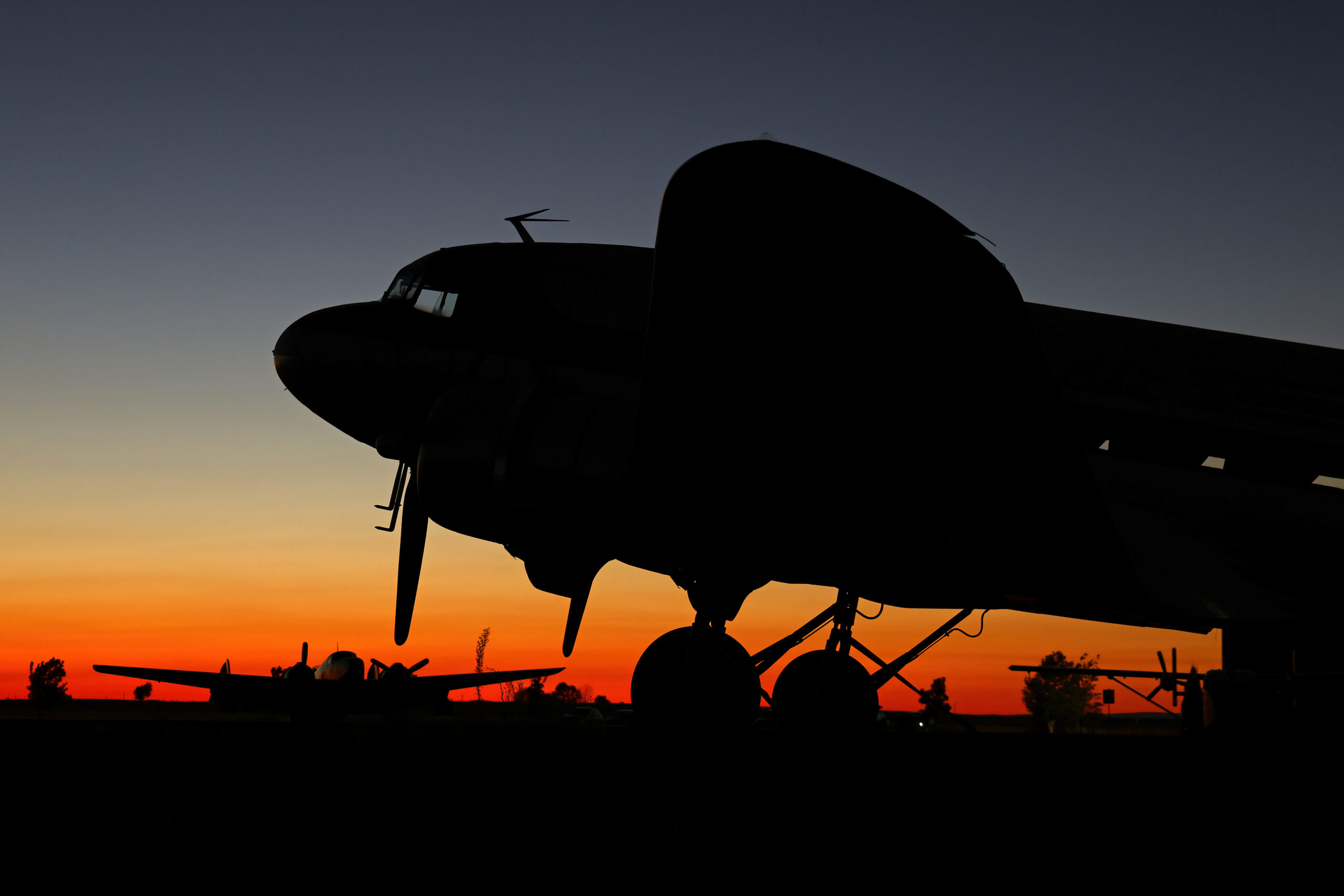
More of it survives than you might expect, and it is worth photographing properly rather than snapping.
In Berlin
The Luftbrueckendenkmal, the airlift memorial, stands at Platz der Luftbruecke outside the old Tempelhof terminal. It was unveiled in 1951 and its three upward prongs represent the three air corridors. Berliners call it the Hunger Rake. There are companion monuments in Frankfurt am Main and at Celle. Tempelhof itself no longer handles flights and the airfield is now an enormous public park, which means you can walk on the runway that the C-54s used.

The former RAF Gatow is now the Militaerhistorisches Museum Flugplatz Berlin-Gatow, with a substantial airlift collection on the airfield where the Yorks and Dakotas landed. The AlliiertenMuseum in Berlin-Dahlem has a Handley Page Hastings, TG503, in its open-air display, along with a great deal of airlift material.
In Britain
Two complete Avro Yorks survive, and both are in the UK. G-ANTK is at the Imperial War Museum at Duxford, and it has a genuine airlift history: it is credited with having carried the 100,000th ton of supplies into Berlin. The other, G-AGNV, formerly the RAF’s TS798, is at the RAF Museum at Cosford. No York remains airworthy. If you are planning a visit with a camera, the same principles that apply to any hangar subject apply here, and our guide to photographing warbirds covers the techniques for museum and airfield work.
Still flying
The Berlin Airlift Historical Foundation operates a preserved Douglas C-54 named Spirit of Freedom as a flying museum in the United States, and Gail Halvorsen himself flew with it in later life. Seeing and hearing a C-54 in the air is the closest anyone now gets to the sound that Berliners waited for.
If you photograph any of these aircraft, keep the record straight: type, variant, serial or registration, museum and date. An unlabelled frame of a preserved Hastings is worth very little; a properly captioned one is a piece of the archive. You can see how a working aviation archive handles that in the Piemags galleries and the archive collections, and the licensing terms set out how images are made available for editorial and commercial use. For a wider view of the era that produced these aircraft, our history of the aircraft of the Battle of Britain covers the RAF that, eight years before Berlin, had been fighting the city it would later feed.
Frequently asked questions
What was the Berlin Airlift?
It was the Western Allied operation to supply the western sectors of Berlin entirely by air after the Soviet Union blockaded all road, rail and canal routes into the city on 24 June 1948. Aircraft flew in food, coal, fuel and everything else the city needed through three twenty-mile-wide air corridors. It ran until 30 September 1949 and delivered more than 2.3 million tons.
How long did the Berlin Airlift last?
The airlift began on 26 June 1948 and the flying continued until 30 September 1949, about fifteen months. The blockade itself was lifted earlier, on 12 May 1949, but the Allies kept flying for a further four and a half months in order to build up stockpiles inside Berlin in case the Soviets closed the routes again.
What aircraft were used in the Berlin Airlift?
The Douglas C-54 Skymaster was the workhorse, with over three hundred committed by the USAF and US Navy, each carrying around ten tons. The Douglas C-47 opened the airlift but was withdrawn from the American effort as too small. The British flew Avro Yorks, Dakotas, Handley Page Hastings and Short Sunderland flying boats, supported by a large fleet of chartered civil aircraft including Halifaxes and Lancastrian tankers.
Why were flying boats used in the Berlin Airlift?
Because of salt. Salt spilled in the hold of an aluminium landplane would corrode the structure and the control cables that ran under the floor. The Short Sunderland already had a hull protected against sea water and control runs routed through the roof, so it could carry salt safely. Sunderlands flew from the Elbe near Hamburg and landed on the Havel lake beside Gatow until the threat of ice stopped the operation in December 1948.
How much did the Berlin Airlift deliver?
More than 2.3 million tons of supplies in the region of 278,000 flights. Coal, not food, made up the largest share of the tonnage. On the single busiest day, 16 April 1949, the airlift delivered close to 13,000 tons in roughly 1,400 flights, an effort known as the Easter Parade.
Who was the Candy Bomber?
First Lieutenant Gail Halvorsen, a C-54 pilot who began dropping sweets to Berlin children on handkerchief parachutes from 18 July 1948, waggling his wings so they would know which aircraft was his. The idea grew into Operation Little Vittles, and by January 1949 around a quarter of a million small parachutes had been dropped. Berliners nicknamed the transports Rosinenbomber, or raisin bombers.
How many people died in the Berlin Airlift?
Around 101 lives were lost, although the exact total and its breakdown vary between sources. British, American and German dead are all counted, and different accounts include or exclude ground accidents and civil charter crews. The names are recorded on the airlift memorial at Platz der Luftbruecke in Berlin.
Where can I see Berlin Airlift aircraft today?
Two complete Avro Yorks survive, both in Britain: G-ANTK at the Imperial War Museum Duxford, which carried the 100,000th ton into Berlin, and G-AGNV at the RAF Museum Cosford. In Berlin, the former RAF Gatow is now the Militaerhistorisches Museum Flugplatz Berlin-Gatow, and the AlliiertenMuseum in Dahlem displays a Handley Page Hastings, TG503. A preserved C-54 named Spirit of Freedom still flies with the Berlin Airlift Historical Foundation.
Why did the Soviet Union blockade Berlin?
The immediate trigger was the introduction of the new Deutsche Mark in the western zones from 20 June 1948 and its extension into the western sectors of Berlin. The underlying aim was to force the Western Allies out of a city that sat a hundred miles inside the Soviet zone, and to stop the emergence of a Western-aligned German state. The blockade failed on both counts and helped bring about the very things it was meant to prevent.
Did the Soviets ever shoot at the airlift aircraft?
Soviet fighters harassed the corridors throughout, buzzing transports, shining searchlights and firing anti-aircraft guns near the routes, but no Allied transport was shot down during the airlift. Shooting one down would have been an act of war committed against aircraft flying in corridors the Soviet Union had itself agreed to, which is precisely why the Allies chose to fly rather than to force the roads.
