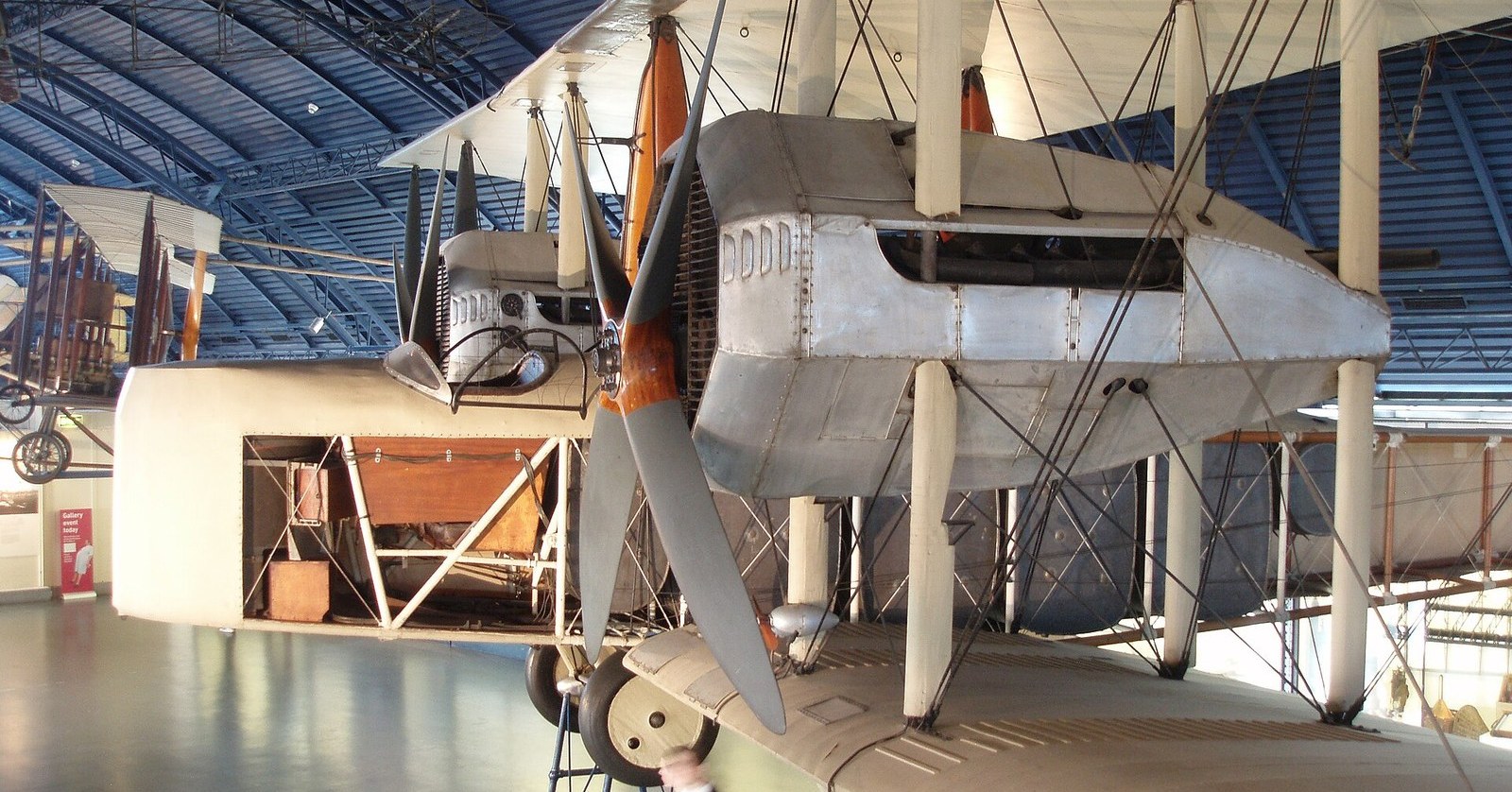
At about ten past three in the morning on 15 June 1919, somewhere over the middle of the Atlantic, a Vickers Vimy stalled in cloud and fell. The altimeter unwound past three thousand feet, past two thousand, past one thousand. The navigator loosened his safety belt and got ready to save his notebook. When the aeroplane came out of the bottom of the cloud the sea was less than a hundred feet below and standing on its edge, because the machine was almost on its side; the pilot got it level with fifty feet to spare, and the compass swung round and settled pointing west. Alcock and Brown had come out of it flying back towards America.
John Alcock and Arthur Whitten Brown took off from a hillside outside St John’s, Newfoundland, at 4.13 on the afternoon of 14 June 1919 and stopped, nose down in a bog in Connemara, sixteen hours and twenty-seven minutes later. It was the first non-stop flight across the Atlantic. It won the Daily Mail’s ten thousand pounds and made both men knights inside a week. Six months later Alcock was dead.
Both of them told the story afterwards, and they told it differently. Alcock talked to reporters within a day of landing. Brown wrote a book a year later. One of the things neither of them described has grown, in the century since, into the best known scene of the flight.
What is on this page
- Four aeroplanes in Newfoundland, and nobody watching
- The first hour: the radio, the exhaust and a wire Brown hid
- Navigating on three glimpses of the sky
- Ten past three: fifty feet above the Atlantic
- The ice, and the story that grew out of it
- Derrygimlagh: the one bog in Ireland with a telegraph office on it
- Who was first, and what the prize actually asked for
- Alcock and Brown both said it was the wrong aeroplane
- Six months: the death of John Alcock
- Brown afterwards
- What survives, and where to see it
- Frequently asked questions
- Sources and further reading
The first non-stop Atlantic flight: key facts
- Date: 14 to 15 June 1919.
- Crew: Captain John Alcock, pilot, and Lieutenant Arthur Whitten Brown, navigator.
- Aircraft: Vickers Vimy, the thirteenth Vimy built, two Rolls-Royce Eagle VIII engines of 360 horsepower, 865 imperial gallons of fuel.
- Route: Lester’s Field, St John’s, Newfoundland, to Derrygimlagh bog near Clifden, County Galway.
- Times: off at 4.13 p.m. Greenwich, down at 8.40 a.m. Greenwich the next morning.
- Duration: sixteen hours and twenty-seven minutes in the air; fifteen hours and fifty-seven minutes over water.
- Distance: 1,680 nautical miles coast to coast by Brown’s reckoning, at 105 to 106 knots.
- Prize: the Daily Mail’s ten thousand pounds, presented by Winston Churchill on 20 June 1919.
- Honours: both men made Knights Commander of the Order of the British Empire at Windsor on 21 June 1919.
- The aeroplane today: Science Museum, London, object 1919-476.
Four aeroplanes in Newfoundland, and nobody watching
Four aeroplanes were sitting in Newfoundland that spring and three of their crews were after the same ten thousand pounds. There were no aerodromes. Finding ground long enough and flat enough to get a loaded aeroplane off was the hard part of the whole business, and two teams had already found out what happened when you could not.
On the evening of 18 May, Harry Hawker and Kenneth Mackenzie-Grieve left Mount Pearl in a single-engined Sopwith, lost their cooling water somewhere over the ocean, turned south to look for the shipping lanes and put down alongside a small Danish steamer called the Mary. As the Sopwith went, Frederick Raynham and C. W. F. Morgan took the Martinsyde down a strip by Quidi Vidi Lake with the wind across them, got it off the ground at the third attempt, caught a gust and crashed. The Mary had no wireless. Britain gave Hawker and Grieve up for the best part of a week, until the ship signalled the Lloyd’s station at the Butt of Lewis on 25 May. A Handley Page four-engined bomber was working up at Harbour Grace under Admiral Mark Kerr, though Kerr’s people had said from the start that they were going whether there was a prize in it or not.
Alcock and Brown put their Vickers Vimy together on Raynham’s ground at Quidi Vidi, because Raynham lent it to them after his own crash and offered them his spare petrol into the bargain. Brown, in his own account of the flight, called him “as much of a sportsman as ever”. For the take-off they used a meadow on a hillside outside town, offered by a local man named Lester who had been doing their carting. It had a swamp at the bottom and about three hundred yards of level run. The use of four more fields on the hilltop was paid for after what Brown called “much haggling”, and thirty labourers levelled the lot with picks and shovels and blasted out the boulders.
The aeroplane was the thirteenth Vimy built, from the Weybridge works of the firm that would later build the Wellington. The bomb gear had come out and extra tanks had gone in, one of them shaped like a boat and made to come loose so it could be used as a raft, and plumbed so it emptied first. The two men sat side by side in what is normally the pilot’s cockpit, with the front cockpit faired over and a tank inside it. It held 865 imperial gallons, which is the figure that went out on the wire at the time and the one the Science Museum carries; Brown, writing a year later, remembered 870.
They flew it on 9 June from Quidi Vidi across to the new field, and again on 12 June. They wanted to go on Friday the thirteenth, thirteen being the number they had decided was lucky. Brown: “with all the hurry and bustle we found that everything could not be ready by Friday the thirteenth.”
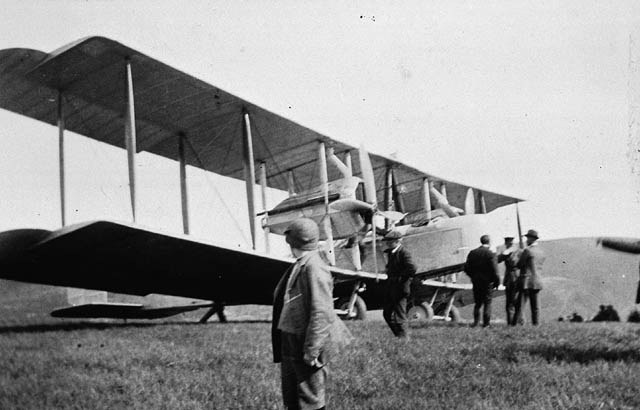
Saturday came in windy. Gusts touched forty-five knots and there was not enough room to run into them. Hardly anybody turned up, because the people who had been coming out daily to watch took one look at the weather and assumed it would be another postponement.
Brown:
Owing to its heavy load, the machine did not leave the ground until it had lurched and lumbered, at an ever-increasing speed, over 300 yards. We were then almost at the end of the ground-tether allowed us.
And six lines further down, about the man beside him:
I am convinced that only Alcock’s clever piloting saved us from such an early disaster. When, after a period that seemed far longer than it actually was, we were well above the buildings and trees, I noticed that the perspiration of acute anxiety was running down his face.
Alcock told it at the Savoy five days afterwards, and he tells it the way a pilot does:
Our aerodrome was rather narrow, and the wind was blowing slightly across. Anyway, we had the help of a good strong breeze, but after getting off we had to fly through a valley, where we got some very nasty bumps from the gusts of the wind, which made it very alarming – to the spectator.
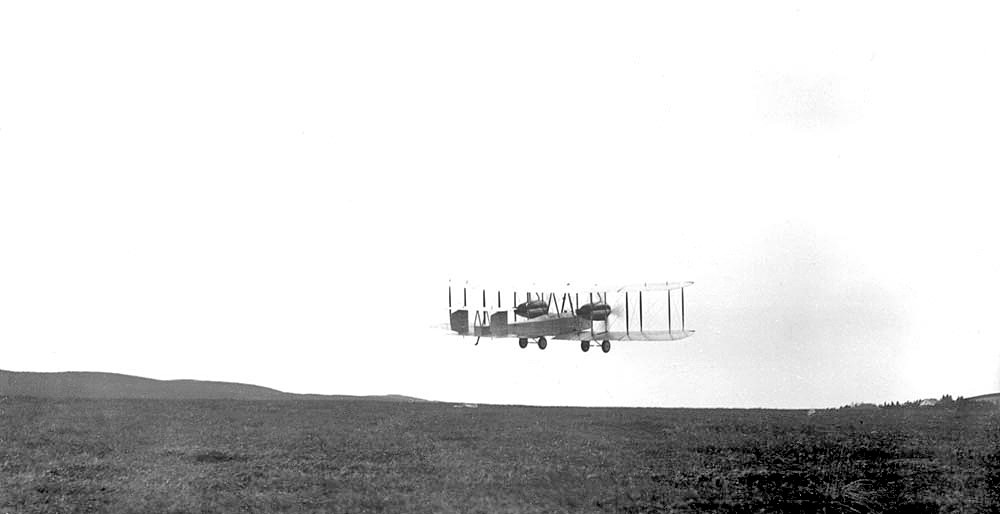
They crossed the Newfoundland coast twelve hundred feet up with thirty-five knots of wind behind them, doing close to a hundred and forty over the ground.
The first hour: the radio, the exhaust and a wire Brown hid
An hour out, Brown leaned across to the wireless set and the little propeller driving its generator snapped off. He looked at it then and looked at it again after they landed and never could account for it. The note he passed to Alcock read: Wireless generator smashed. The propeller has gone. That was the transmitter finished for the rest of the crossing. The receiver went on working, and he listened at it when he had nothing more urgent on. In sixteen hours the only thing he heard was somebody calling B. M. K. at twenty to eight, which he said cheered him mightily. No message ever came for them. “The complete absence of such contact made it seem that nobody cared a darn about us.”
Speaking at the Savoy five days after the landing, he said the failure was partly his own fault: he had been advised against that method of installing the generator, and in the rush they had never fitted the gear that would have let him stop it in flight, so he took the risk of letting it run the whole way and his faith was not justified. A year later, in print, he simply could not explain it.
Just after six the starboard engine began making a noise he compared to machine-gun fire close by. A length of exhaust pipe had split away and was vibrating in the slipstream like a reed. It went red, then white, then softened, crumpled and blew off, leaving three cylinders exhausting into the open air with a flame licking out at a bracing wire and making it glow. Throttling back to stop it meant losing height they did not have. It ran like that for the rest of the way and left them both very deaf.
There was a third failure and Brown kept it to himself. The Associated Press had it out of him the day after they landed, and it is in neither man’s later account:
At the same time, Lieutenant Brown said, a stay wire had broken, but of this he did not speak to his companion until they landed. Captain Alcock said he would have turned back had he known this.
Navigating on three glimpses of the sky
Brown had a marine sextant clipped to the dashboard, an Abney spirit level with a bubble where the horizon should be, a Baker navigating machine on his knees with the charts inside it, a course and distance calculator clipped to the fuselage, a drift-bearing plate under his seat, traverse tables, and a Mercator chart with transparent overlays carrying Sumner circles for all times of day and for six chosen stars at night. He had met Lieutenant Commander Byrd of the US Navy and tried through him to get a bubble sextant. The American naval authorities promised to send one from Washington and it arrived after they had gone.
He decided against directional wireless, not being sure in 1919 that it was reliable enough. The question stopped mattering an hour out.
All that apparatus does one job. It turns a sight of the sun, a star or the sea into a position. Without a sight of one of the three there is nothing to do but dead reckoning, and dead reckoning wants a wind. The forecast at St John’s said the westerly would drop inside a hundred miles and the rest of the ocean would be largely clear. Both halves were wrong.
Most of my “dead reckoning” calculations were short of our actual position because, influenced by meteorological predictions based on the weather reports at St. John’s, I had allowed for a falling off in the strength of the wind, and this had not occurred.
Three usable fixes came out of the whole crossing. A sun sight through a gap at half past eight in the evening. A fix at twenty-five past midnight on Vega and the Pole Star, taken against a cloud horizon lit by the moon, which put them at 50 degrees 7 minutes north, 31 degrees west, 850 nautical miles out at an average of 106 knots. And a sun line taken with the Abney level that he finished working out at twenty past seven the next morning, which is why they came ashore roughly where he meant them to.
Ten past three: fifty feet above the Atlantic
Brown:
At about sunrise – 3:10 A. M. to be exact – when we were between thirty-five hundred and four thousand feet, we ran into a thick bank that projected above the lower layer of cloud.
He describes what that does to a man, and he gets it right. The word his book puts on it is not a word, in 1920 or since; he means the semicircular canals of the inner ear.
Unless there be outside guidance, the effect on the Augean canal in one’s ears of the centrifugal force developed by a turn in a cloud causes a complete loss of dimensional equilibrium, so that one is inclined to think that an aeroplane is level even when it is at a big angle with the horizontal. The horizontal, in fact, seems to be inside the machine.
The airspeed indicator seemed to jam. The aeroplane stalled, hung for a second and fell away into something Brown would not put a name to:
it heeled over and fell into what was either a spinning nosedive, or a very steep spiral.
The engines, which normally turned at sixteen hundred and fifty to seventeen hundred, went to about twenty-two hundred. The altimeter unwound: three thousand, two thousand, one thousand, five hundred. Brown loosened his safety belt and got ready to save his notes.
We were now less than a hundred feet from the ocean. The sea-surface did not appear below the machine, but, owing to the wide angle at which we were tilted against the horizontal, seemed to stand up level, sideways to us.
When at last the machine swung back to the level and flew parallel with the Atlantic, our height was fifty feet.
The compass needle, which had been swinging, steadied and pointed west. They had come out of it flying back towards Newfoundland.
Flight’s reporters heard it that week with the clock an hour or more later, between four and five in the morning, and with one thing added: the machine ended up “practically on its back about 50 ft. from the water”. Alcock, asked about it within a day of landing, gave a version of his own. “We looped the loop, I do believe, and did a very steep spiral. We did some very comic ‘stunts,’ for I have had no sense of horizon.” The Associated Press called it a flat spin. Neither man who was in it would ever say what it had actually been doing.
The ice, and the story that grew out of it
Here is the version in circulation. Ice forms on the engine air intakes. Brown climbs out of the cockpit and crawls along the wing, five or six times depending on who is telling it, and chips the ice away with a pocket knife while the slipstream tries to take him off the aeroplane. It is on aviation sites and in magazine features and it was still being published this year.
Here is Brown, the only time in the book he leaves the cockpit.
When we had reached a height of eight thousand eight hundred feet, I discovered that the glass face of the gasoline overflow gauge, which showed whether or not the supply of fuel for the motors was correct, had become obscured by clotted snow. To guard against carburetor trouble, it was essential that the pilot should be able to read the gauge at any moment. It was up to me, therefore, to clear away the snow from the glass.
The gauge was fixed on one of the center section struts. The only way to reach it was by climbing out of the cockpit and kneeling on top of the fuselage, while holding on to a strut for balance. This I did; and the unpleasant change from the comparative warmth of the cockpit to the biting, icy cold outside was very unpleasant. The violent rush of displaced air, which tended to sweep me backward, was another discomfort.
I had no difficulty, however, in reaching upward and rubbing the snow from the face of the gauge. Until the storm ended, a repetition of this performance at fairly frequent intervals continued to be necessary. There was, however, scarcely any danger in kneeling on the fuselage as long as Alcock kept the machine level.
The fuselage, not the wing. Snow rubbed off with a hand, not ice chipped with a blade. The slipstream did try to sweep him off the back of the aeroplane and he says so, and then a man with every reason to make it sound worse says there was scarcely any danger in it.
Alcock gave his own account to the Associated Press on 16 June, within a day of landing, and his is harder:
My radiator shutter and water temperature indicator were covered with ice four or five hours. Lieutenant Brown continually had to climb up in the fuselage to chip off the ice with a knife.
So the knife is real and it is Alcock’s, from 1919, a year before Brown’s book. The engine cooling gear is in there too. What is in neither account, and never has been, is the wing. Somewhere in the century since, the story moved the man out onto it and put a number on how often he went. Two men who were both there disagreed about how bad it had been. The rest is embroidery.
The ice did its real damage without anybody climbing anywhere. Brown, at nine thousand four hundred feet:
Snow was still falling, and the top sides of the plane were covered completely by a crusting of frozen sleet. The sleet imbedded itself in the hinges of the ailerons and jammed them, so that for about an hour the machine had scarcely any lateral control.
An hour with no roll control, in cloud, over the Atlantic, at night.
Derrygimlagh: the one bog in Ireland with a telegraph office on it
They saw two small islands off the Galway coast at a quarter past eight, crossed the coast at two hundred and fifty feet, and then Brown recognised something.
A few minutes later, however, the wireless masts at Clifden gave the key to our position.
Marconi had put a transatlantic wireless station on the blanket bog at Derrygimlagh, working to Glace Bay in Nova Scotia from 17 October 1907, the world’s first commercial transatlantic wireless telegraphy service. Eight wooden masts, two hundred and ten feet each, in the middle of Connemara. It was working that morning and it had a British military detachment posted on it. The War of Independence had begun at Soloheadbeg on 21 January, about five months earlier. Republican forces stormed the station in July 1922, during the Civil War, three years after all this, and it never really recovered.
The masts told Brown where he was, and with the Vimy’s own transmitter dead since the first hour they are how London heard about it within minutes.
The landing was a crash and Brown says so in as many words.
Alcock flattened out at exactly the right moment. The machine sank gently, the wheels touched earth and began to run smoothly over the surface. Already I was indulging in the comforting reflection that the anxious flight had ended with a perfect landing. Then, so softly as not to be noticed at first, the front of the Vickers-Vimy tilted inexplicably, while the tail rose. Suddenly the craft stopped with an unpleasant squelch, tipped forward, shook itself, and remained poised on a slant, with its fore-end buried in the ground, as if trying to stand on its head.
Alcock braced against the rudder bar hard enough to bend it, a hollow steel tube, almost into a horseshoe. Brown, in his own words, “only stopped a jarring collision with the help of my nose”. Petrol from snapped connections started running into the cockpit while they were still in it, and did not catch, because Alcock had switched the magnetos off as he saw what was coming. Four propeller blades were buried in the peat and none of them broke. They got out and salvaged the mailbag and their instruments, though the petrol had the chart and the Baker machine before Brown could reach them.
Deceived by its smooth appearance, we had landed on top of a bog; which misfortune made the first non-stop transatlantic flight finish in a crash.
Alcock, to the Daily Mail: “From above, the bog looked like a lovely field, but the machine sank into it up to the axle and fell over on to her nose.”
The official starter at St John’s had timed them off at 4.13 in the afternoon, Greenwich. The official observer in Ireland timed them across the coast at 8.25 the next morning, Greenwich, and they stopped in the bog a quarter of an hour after that. Sixteen hours and twenty-seven minutes in the air.
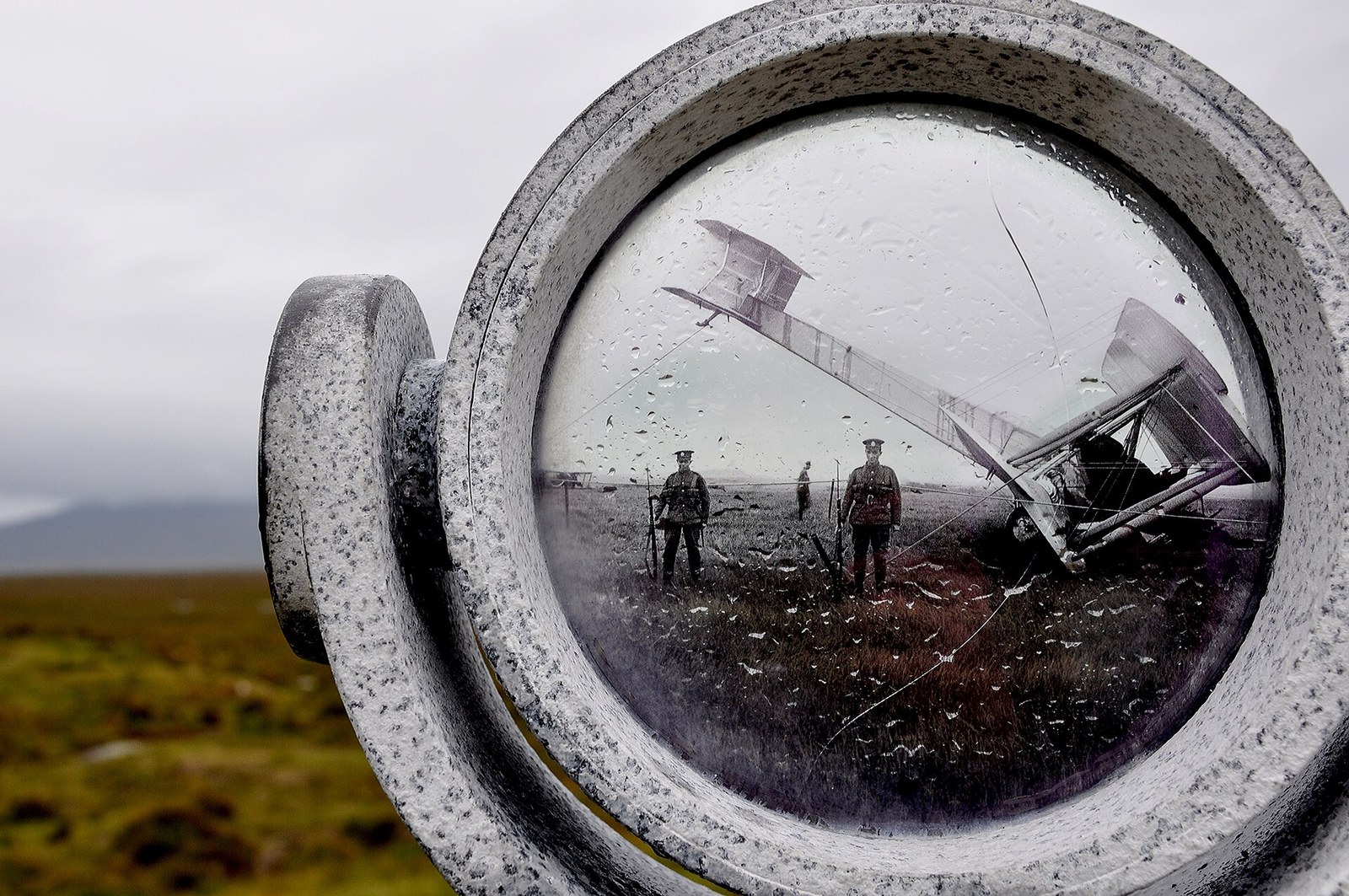
Men from the Marconi station came over. Brown’s account of what they said is the funniest thing in the book:
“Anybody hurt?” – the usual inquiry when an aeroplane is crashed – was the first remark when they arrived within shouting distance. “No.” “Where you from?” – this when they had helped us to clear the cockpit. “America.” Somebody laughed politely, as if in answer to an attempt at facetiousness that did not amount to much… Quite evidently nobody received the statement seriously at first. Even a mention of our names meant nothing to them, and they remained unconvinced until Alcock showed them the mail-bag from St. John’s.
The Irish sources have a different set of first words. In Kathleen Villiers-Tuthill’s account for History Ireland, Alcock says “I’m Alcock – just come from Newfoundland”, Brown says “That is the way to fly the Atlantic”, and Alcock, a little later and entirely in character, says “Now, if we had a shave and bath, we should be all right.”
She has two things the British accounts never carry. T. J. W. Kenny, editor of the Connacht Tribune, got out to Derrygimlagh ahead of the Daily Mail’s own man and scooped the newspaper that was paying for the story, finding Alcock “looking as spruce, attired in a navy lounge suit, and cheerfully smoking a cigarette”. And by that evening there were souvenir pieces of the wings on sale in Clifden.
Who was first, and what the prize actually asked for
They were not the first people to cross the Atlantic by air and nobody at the time pretended otherwise.
The US Navy’s NC-4, a Curtiss flying boat commanded by Lieutenant Commander Albert Read, had left Rockaway on Long Island on 8 May and reached Plymouth on 31 May, by way of Chatham in Massachusetts, Halifax, Trepassey, Horta, Ponta Delgada, Lisbon, Mondego Bay and Ferrol in Spain. Fifty-four hours of flying spread over twenty-three days. Two sister aircraft set out with her and neither got across; the crew of one taxied theirs two hundred miles to the Azores on the surface.
The British press worked through it inside a day. The Associated Press ran a survey of the London papers on 16 June. The Daily Chronicle: “The honor of the first crossings belongs to the gallant Americans, but Alcock and Brown were the first to cross in less time than would be taken by a sea voyage. The Atlantic honors are now fairly divided between the United States and Great Britain.” The Daily Telegraph: “It does not eclipse the glory of the American achievement, but that is because there is no question of an eclipse in these matters, as there is no question of jealousy.”
Flight gave both halves of it in one paragraph:
nothing can alter the fact that to America belongs the glory of having been first to throw an aerial bridge across the Atlantic… Still, it is the names of Alcock and Brown which will be for ever associated with the first direct crossing, and we scarcely think it is claiming too much to ask that they should be credited with the first real Atlantic flight.
King George V was careful about it as well. Receiving both men at Windsor on 21 June to make them Knights Commander of the Order of the British Empire, he expressed his pleasure, in Flight’s report of it, that British officers were the first to cross the Atlantic in direct flight. Not the first to cross the Atlantic. The first to do it in one go.
The Daily Mail prize was not for a non-stop flight either. The rules were reprinted in full when the competition reopened after the Armistice, and they say the opposite:
Stoppages. – Any intermediate stoppages may only be made on the water.
Towing. – Towing is not prohibited.
The aircraft could be repaired on the way. You could stop, so long as you stopped on the sea. You could be towed. The binding conditions were the endpoints, one aircraft per attempt, and seventy-two consecutive hours. Every one of the NC-4’s stops was on water and would have been allowed. She was out on the clock, by three weeks, and she had never been entered anyway.
Non-stop was not what the Daily Mail asked for. It is what Alcock and Brown happened to do.
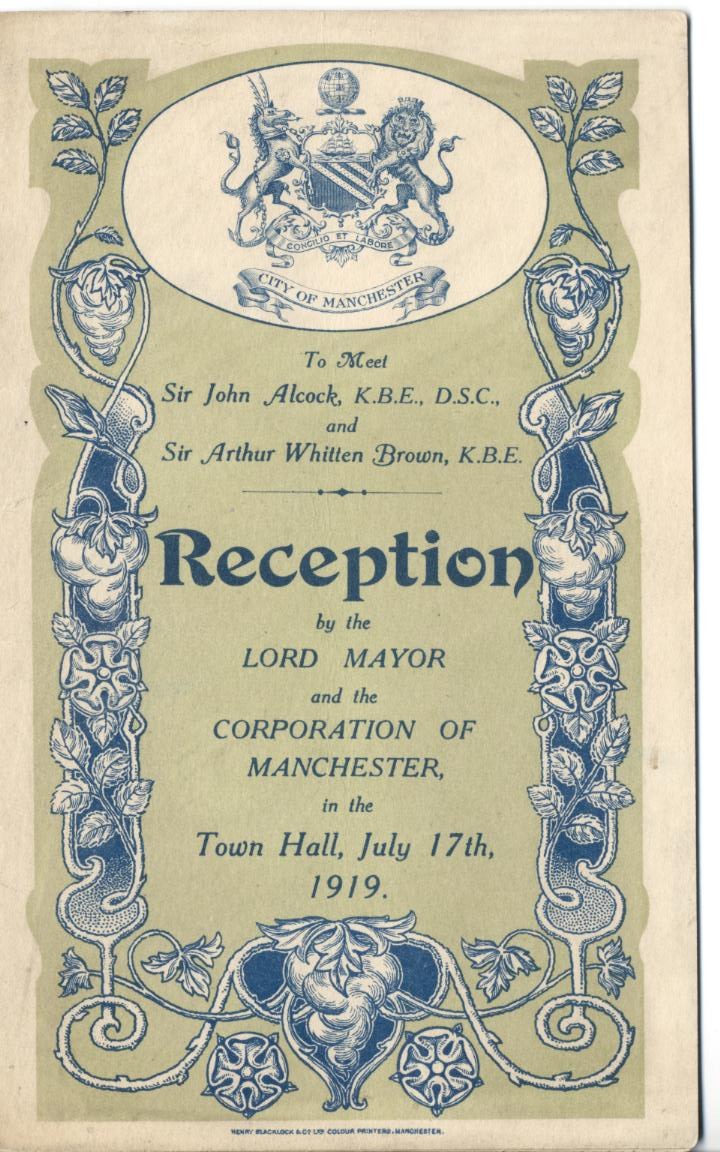
Winston Churchill handed over the cheques at the Savoy on 20 June. He was Secretary of State for War and Air at the same time, which is why sources cannot agree on his title. There were three cheques: ten thousand pounds from the Daily Mail, a thousand added by Laurence Philipps for the first Briton to fly the Atlantic, and two thousand one hundred from the proprietors of State Express Cigarettes for the winner of the flight. Churchill handed all three to Alcock, who was the entrant and who was the Briton in question, Brown having been born an American. The two extra ones were his to keep.
The chairman dealt with that at the lunch with the delicacy of the period: “Capt. Alcock was an Englishman, and England was proud of him. Lieut. Brown was, he thought, of English domicile.” The American Ambassador replied: “I rejoice in the paternity of one at least of those distinguished gentlemen.”
Churchill, in the same speech: “No one has ever flown the Atlantic in a single bound before, and no one will ever fly the Atlantic for the first time in a single bound again.”
And then the two of them gave a fifth of the money away. Alcock, in the Evening News: “We have decided to divide £8,000 between us, and the remaining £2,000 we are giving to the workmen employed on the building of the machine.”
Seventeen days later the airship R34 left East Fortune in East Lothian, reached Mineola on Long Island in a hundred and eight hours and flew home to Pulham in Norfolk. That was the first east to west crossing by air, and the first return. There is a coincidence in her log that Brown thought worth repeating: Brigadier-General Maitland, who kept it, noted that the airship’s first sight of land on the way home was the same two small islands off Galway that Alcock had pointed at on 15 June.
Charles Lindbergh was eight years off, and when he came he was flying alone and flying New York to Paris. Something like eighty people had crossed the Atlantic by air before him, and nearly all of them went by airship.
Alcock and Brown both said it was the wrong aeroplane
Alcock, to the Daily Mail, within a day of landing:
The flight has shown that the Atlantic flight is practicable, but I think it should be done not with an aeroplane or seaplane, but with a flying-boat.
Brown, closing his account of the flight a year later:
Although I am supremely glad to have had the opportunity of flying the Atlantic by aeroplane, afterthoughts on the risks and chances taken have convinced me that, while our own effort may have been useful as a pioneer demonstration, single or twin engine aircraft are altogether unsuitable for trans-ocean voyages. We were successful – yes. But a temporary failure of either of our motors… would have meant certain disaster and likely death.
Flight, in its first issue after the landing, ran a paragraph headed “Beware of Undue Optimism”:
We are still of the opinion that the immediate future of Transatlantic aerial services lies with the airship rather than with the heavier-than-air machine.
The pilot wanted flying boats. The navigator wanted more than two engines. The trade paper wanted airships. All three were right for the best part of thirty years, and the ocean was crossed commercially by flying boat and by airship long before it was crossed by a landplane. Then the war built long runways and four-engined aeroplanes everywhere and all three of them were wrong. That is the sort of thing that goes missing once a story hardens into a legend.
Brown had a view about prize money as well, which reads oddly from a man who had just come into four thousand pounds:
I do not believe the system of money prizes for spectacular flights to be altogether an economically sound proposition. It is not generally realized that as a rule the amount spent by each of the firms that enter a machine for such a contest as the transatlantic flight vastly exceeds the amount of the prize… Would it not be more practical to pay directly for research work?
Six months: the death of John Alcock
On the afternoon of 18 December 1919 Alcock was taking a new Vickers Viking amphibian to the Paris air show. Near Rouen he ran into fog and a strong wind. A farmer at a place the papers called Côte d’Evrard, about twenty-five miles north of the city, saw the aeroplane come out of the fog flying unsteadily and then hit the ground. It was about one o’clock.
The farmhouse was out of the way and there was a delay getting word out. Doctors came from No. 6 British General Hospital at Rouen. Flight’s report a week later: “but they were too late.” He had a fractured skull and he died the same day without regaining consciousness. He was twenty-seven and had been Sir John Alcock for six months. He is buried in Southern Cemetery, in the city he was born in.
Three days before he died, Alcock had stood on the platform at South Kensington while the Vimy was handed over to the nation and the Science Museum’s new aeronautics section was opened.
Vickers had taken a stand at the Paris Salon and the Viking was to have been the exhibit on it. Flight, reporting from the show in the same issue that carried his death, noted that the Vickers stand held a Vimy-Commercial cabin, some magnetos and a series of scale models.
The King’s message to his parents, sent through Lieutenant-Colonel Clive Wigram:
The King desires me to express his deep sympathy with you in the untimely and tragic death of your distinguished son, whose name will ever occupy an honoured place in the roll of British airmen who never spared themselves in order to uphold the honour of their country.
The Dictionary of National Biography put it this way: “Alcock, who was unmarried, was a modest and generous man, and won the affection of all who came into contact with him.”
Brown afterwards
Arthur Whitten Brown was born in Glasgow on 23 July 1886 to American parents, and was an American citizen by birth. He took British nationality in 1914 so that he could enlist, having, as he put it, “not the patience to wait for the entry into the war of the United States”. He was commissioned into the Manchester Regiment and went to the Royal Flying Corps as an observer with 2 Squadron. He was shot down twice, the second time in November 1915, when he came down in occupied territory and was taken prisoner. One of the two crashes left him with a leg injury that stayed with him for life and a walking stick to go with it.
He was a prisoner in Germany for fourteen months and then interned in Switzerland for nine, and he spent the time studying aerial navigation.
His own book never mentions the leg once.
He married Marguerite Kathleen Kennedy at the Savoy Chapel on 29 July 1919, six weeks after the flight. The engagement is in the book, at the end of the chapter about the London reception, in the best sentence in it: “In the evening we separated, Alcock to see a big prize fight, I to visit my fiancée.”
He did not go back to aviation as a career. He went back to engineering with Metropolitan-Vickers, the firm he had apprenticed with under its old name, and from 1923 ran their Swansea operation. No source says why he gave it up, and the obvious guesses are only guesses.
In the Second World War he served in the Home Guard and then rejoined the RAF, working on navigation in Training Command until his health gave out in 1943.
His only child, Flight Lieutenant Arthur Whitten-Brown, known as Buster, flew Mosquitos with 605 Squadron. He was killed on the night of 5 to 6 June 1944, the night of the Normandy landings, and is buried at Hoorn in the Netherlands. He was twenty-two.
Brown died at Swansea on 4 October 1948, aged sixty-two. The inquest recorded a verdict of death from asphyxia due to an overdose of Veronal, accidentally self-administered.
What survives, and where to see it
The aeroplane does. Vickers took it back to Weybridge, got the bog out of it and rebuilt it, and it was presented to the nation on 15 December 1919. It hangs in the Flight Gallery at the Science Museum in London as object 1919-476.
So do the cats. There were two of them aboard and they were stuffed toys, not live animals. Brown, listing what they carried, described a real black cat that walked past the aeroplane that morning and then introduced the passengers: “Two other black cats – more intimate if less alive – waited in the Vickers-Vimy. They were Lucky Jim and Twinkletoe, our mascots.” They had white heather as well, and Alcock had a horseshoe under his seat. Lucky Jim went on display at the Science Museum in London in August 2024, next to the aeroplane he crossed in, the pair of them together for the first time since 1919. Twinkletoe, whom the RAF Museum spells Twinkletoes, is at RAF Museum Midlands at Cosford. The museum also holds Brown’s navigation logs, his chart and a vacuum flask that went across with them.
The mailbag carried the first mail flown across the Atlantic and delivered. Accounts of how much of it there was differ: Brown remembered three hundred private letters, and the philatelic record gives a hundred and ninety-six letters and one parcel. The Newfoundland post office surcharged ten thousand stamps for the occasion, and Brown noted a year later that eight hundred and seventy-five dollars had been offered and refused for one of them on the Manchester Exchange within two days of delivery.
At Derrygimlagh there is a cairn near the landing place, unveiled on the fiftieth anniversary in 1969, and on the hill about two kilometres north a sculpture in the shape of an aircraft tail fin, dedicated on the fortieth in 1959. The Marconi ruins are on the same bog. It is a Wild Atlantic Way signature discovery point now, free to walk, about four kilometres south of Clifden.
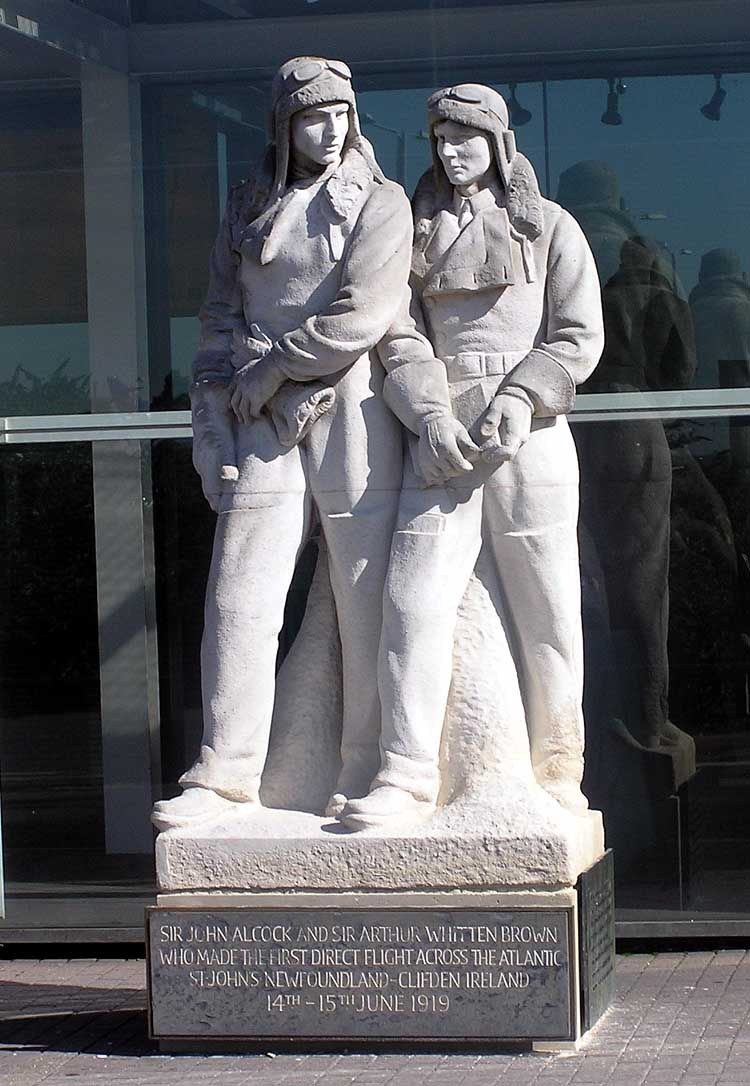
William McMillan’s limestone statue of the two men stood at Heathrow from 1954, with a plinth that reads, in part, “who made the first direct flight across the Atlantic”. Whoever chose that wording had been paying attention. It went to Ireland on loan for the centenary in 2019 and never came back to the airport. Prince Michael of Kent unveiled it at Brooklands Museum, where the Vimy was built, on 11 February 2020, and a bronze cast of it was unveiled in Clifden town square on 6 March.
Photographs from this period survive in greater numbers than most people expect, and our guide to early aviation photographs covers where they are and what they show. The Wright brothers had got off the ground at Kitty Hawk sixteen years earlier. Concorde was crossing in under three hours within sixty. If you want to see what the archive holds from the first thirty years of flight, the Piemags aviation archive is searchable by subject, and the terms are set out in our licences.
Frequently asked questions
Did Alcock and Brown make the first Atlantic crossing by air?
No. Alcock and Brown made the first non-stop crossing, not the first crossing of any kind. The US Navy’s NC-4, a Curtiss flying boat commanded by Lieutenant Commander Albert Read, had left Rockaway on Long Island on 8 May 1919 and reached Plymouth on 31 May by way of Chatham in Massachusetts, Halifax, Trepassey, Horta, Ponta Delgada, Lisbon, Mondego Bay and Ferrol in Spain. The British press said as much within a day of the Vimy landing, and King George V, receiving both men at Windsor, was careful to say British officers were the first to cross the Atlantic in direct flight.
How long did Alcock and Brown’s flight take?
Alcock and Brown were in the air for sixteen hours and twenty-seven minutes, of which fifteen hours and fifty-seven minutes was over water. Their own telegram to the Royal Aero Club made it sixteen hours and twelve minutes, timed from the Newfoundland coast to the landing.
What time did Alcock and Brown take off and land?
Alcock and Brown took off at 4.13 in the afternoon Greenwich time on 14 June 1919, which was 1.42 in the afternoon in St John’s, and stopped in the bog at 8.40 the next morning Greenwich, which was twenty to ten on the clocks in Connemara. Newfoundland clocks were about two and a half hours behind Greenwich that summer, and Ireland was an hour ahead.
Where did Alcock and Brown take off from?
Alcock and Brown took off from Lester’s Field, a meadow on a hillside outside St John’s, Newfoundland. It had a swamp at the bottom and about three hundred yards of level run until the use of four more fields was paid for and thirty labourers levelled them with picks and shovels.
Did Brown climb out onto the wings to clear ice?
No. Brown never climbed onto the wings and no contemporary account says he did. He described climbing out of the cockpit and kneeling on top of the fuselage, holding a centre-section strut, to rub clotted snow off the glass of the petrol overflow gauge, and wrote that there was scarcely any danger in it as long as Alcock kept the machine level. Alcock, speaking within a day of landing, gave a harder version: Brown “continually had to climb up in the fuselage to chip off the ice with a knife”. The knife is Alcock’s, from 1919. Neither man ever mentioned the wings.
What aircraft did Alcock and Brown fly?
Alcock and Brown flew a Vickers Vimy, the thirteenth of its class, built at Weybridge, powered by two Rolls-Royce Eagle VIII engines of 360 horsepower. The bomb gear had been taken out and extra fuel tanks put in, one of them boat-shaped and detachable so it could be used as a raft. It carried 865 imperial gallons by the figure the Science Museum holds, though Brown remembered 870.
How far did Alcock and Brown fly, and how fast?
Alcock and Brown flew about 1,890 miles across the Atlantic, which is the great-circle distance; Brown’s own coast to coast figure was 1,680 nautical miles at an average of 105 to 106 knots, or a little over 120 miles an hour. Published distances run as high as 1,960 miles, which is the figure the Dictionary of National Biography used.
How high did Alcock and Brown fly?
Alcock and Brown flew between about fifty feet and eleven thousand feet. They crossed the Newfoundland coast at twelve hundred, lost control at between three and a half and four thousand and recovered at fifty, climbed to eight thousand eight hundred in the snow, and were at eleven thousand for the last sun sight before Ireland.
What did Alcock and Brown eat and drink?
Alcock and Brown carried sandwiches, chocolate, malted milk and two thermos flasks of coffee, with emergency rations in a cupboard in the tail. Alcock told reporters they had drunk coffee and ale, which does not appear in Brown’s list. Brown passed everything across one item at a time, because Alcock never took his right hand off the control lever or his feet off the rudder bar.
Why did Alcock and Brown crash on landing?
Alcock and Brown crashed because they put the Vimy down on Derrygimlagh bog, which from the air looked like a firm green field. Brown wrote that they had been “deceived by its smooth appearance”. Alcock put it more simply: “From above, the bog looked like a lovely field, but the machine sank into it up to the axle and fell over on to her nose.” Neither man was seriously hurt.
What went wrong during the flight?
Four things went wrong. The wireless generator’s propeller snapped off in the first hour and nothing could be sent for the rest of the crossing. Just after six a length of exhaust pipe on the starboard engine went white hot, crumpled and blew off, leaving three cylinders exhausting into the open air for the rest of the way. Ice jammed the aileron hinges so that for about an hour the aircraft had scarcely any lateral control. And at about ten past three in the morning it went into a cloud between three and a half and four thousand feet, stalled, fell, and came out fifty feet above the sea pointing back towards America.
What was the Daily Mail prize, and was it for a non-stop flight?
The Daily Mail Atlantic prize was ten thousand pounds, first offered in April 1913 and reopened after the Armistice, and it was never a prize for a non-stop flight. The published rules allowed intermediate stoppages on water, permitted repair on the way and did not prohibit towing. The binding conditions were the endpoints, one aircraft per attempt and seventy-two consecutive hours. Alcock and Brown kept eight thousand pounds between them and gave the other two thousand to the men who had built the aeroplane.
Were Alcock and Brown knighted?
Yes. King George V made both men Knights Commander of the Order of the British Empire at Windsor on 21 June 1919, six days after the flight.
When did Alcock die?
Sir John Alcock died on 18 December 1919, six months after the Atlantic flight, aged 27. He was taking a new Vickers Viking amphibian to the Paris air show, ran into fog near Rouen and crashed at a place the papers called Côte d’Evrard. Doctors came from No. 6 British General Hospital at Rouen and, in the words of Flight’s report, “they were too late”. He is buried in Southern Cemetery, Manchester.
Where is Alcock and Brown’s Vickers Vimy now?
Alcock and Brown’s Vickers Vimy is in the Flight Gallery at the Science Museum in London, catalogued as object 1919-476. Vickers took it back to Weybridge after the crash, cleaned the bog out of it and rebuilt it, and it was presented to the nation on 15 December 1919.
Can you visit the landing site at Derrygimlagh?
Yes. The Derrygimlagh landing site is free to walk and lies about four kilometres south of Clifden in County Galway. There is a cairn near the landing place, unveiled on the fiftieth anniversary in 1969, and a sculpture in the shape of an aircraft tail fin on the hill about two kilometres north, dedicated on the fortieth in 1959. The Marconi station ruins are on the same bog, and the whole of it is a Wild Atlantic Way signature discovery point.
Sources and further reading
- Arthur Whitten Brown, Flying the Atlantic in Sixteen Hours, 1920, the full text. The title page records that it was written with the assistance of Captain Alan Bott, a professional writer, so the log entries are Brown’s and the literary passages are not necessarily his voice alone.
- Flight, 21 November 1918, which reprinted the Daily Mail rules in full when the Royal Aero Club reopened the competition after the Armistice.
- Flight, 19 June 1919, carrying the Royal Aero Club’s official telegrams, Alcock’s statement to the Daily Mail, and the editorial on who crossed the Atlantic first.
- Flight, 26 June 1919, the investiture at Windsor and the Savoy luncheon, with Churchill’s speech and the division of the prize money.
- Flight, 25 December 1919, the report of the crash near Rouen that killed Alcock.
- Philadelphia Evening Public Ledger, 16 June 1919, the Associated Press report carrying Alcock on the knife, Brown on the broken stay wire, and the survey of the London papers.
- London Gazette, 27 June 1919, the citation making both men Knights Commander of the Civil Division of the Order of the British Empire.
- Science Museum Group, the Vickers Vimy, object 1919-476.
- Science Museum, August 2024, on Lucky Jim going on display beside the aeroplane he crossed in.
- Science and Industry Museum, Alcock and Brown.
- RAF Museum, a transatlantic tale, which holds Brown’s navigation logs and chart.
- Kathleen Villiers-Tuthill, “Ditched in Derrygimla”, History Ireland, far and away the best account of the Irish end.
- Naval History and Heritage Command, the NC-4.
- National Museums Scotland, the R34.
- Dictionary of National Biography, 1927 supplement, John William Alcock.
- Brooklands Museum, the McMillan statue.

Leave a Reply