Four Japanese fleet carriers were mortally damaged in one morning at Midway, and every one of them was finished off by a Japanese torpedo fired from a Japanese destroyer. No American torpedo hit a Japanese carrier all day, and not one bomb dropped by a B-17 hit a ship. What decided the battle was a two-man dive bomber with holes drilled in its flaps so that it could hold a seventy-degree dive steady enough to hit a manoeuvring flight deck.
What is on this page
- What Nimitz knew, and what he did not
- Three carriers and a repair
- The aircraft on both sides
- The Devastator, and a torpedo that could not be dropped
- The Wildcat, and what folding wings cost
- Midway as an air base
- The strike on Midway
- The strikes from the island
- Nagumo’s dilemma
- The three torpedo squadrons
- 1022
- Hiryū’s answer
- The five minutes that never were
- What it cost
- What it changed
- What survives
- Questions people ask
What Nimitz knew, and what he did not
The Japanese Navy’s general-purpose code was a book of about 45,000 five-digit numbers, each standing for a word or a phrase, with an additive table laid over the top to disguise the result. Before Pearl Harbor the Americans could read 10 to 15 per cent of it. The operative break came on 13 March 1942, and even after it the picture stayed partial. Nimitz put his own coverage to Admiral King on 26 May 1942 at 40 per cent of the messages copied, decoded, out of only 60 per cent of the possible messages copied at all. That is what the advantage at Midway was made of: part of the enemy’s mail, read late.
What it pointed at was the First Air Fleet, the Kidō Butai, under Vice Admiral Nagumo Chūichi: four fleet carriers, Akagi, Kaga, Sōryū and Hiryū, four of the six that had attacked Pearl Harbor. The other two had been roughed up in the Coral Sea in May and took no part. Where the four were going came down to two letters. Japanese signals gave the objective the designator AF; Corregidor had correlated AF with Midway on 7 March 1942 and Melbourne reaffirmed it after that centre opened on 20 March. Washington did not accept it, and between 15 and 21 May opinion there ran to Samoa, to the American west coast and to Hawaii itself, with John Redman holding out for Johnston Island.
Midway has no fresh water. Everything drinkable there came out of distillation plants, and that physical fact is the hinge of the story everyone knows about the battle. The Japanese half of it is documented. On 22 May 1942 Melbourne published a translation of a Japanese intelligence signal reporting that the AF air unit had radioed the 14th Naval District to say it had only two weeks’ water left and to ask for an immediate supply. That intercept ended the argument over AF. The American half is different. The NSA’s own history of the campaign states that no direct evidence exists that the episode happened, that a message was reportedly sent to Midway on 18 or 19 May directing the station to broadcast a water shortage in clear, and that some attribute the idea to Rochefort. Other institutional accounts give it to Lieutenant Jasper Holmes, or to nobody at all, and what Midway transmitted has never been published.
On 25 May the Hawaii unit broke the Japanese Date Cipher and got two dates out of it: the Aleutians on 3 June and Midway on 4 June. Nimitz built his timetable on them over the objections of his own staff, and both were right.
Now the half most accounts skip. Yamamoto’s Main Body eluded analysis altogether. On 21 May Melbourne concluded that the Commander-in-Chief of the Combined Fleet would not move to any area to take direct command of operations. That was wrong, and the NSA history offers it as part of the reason the First Fleet’s move to a position some 700 miles west of Midway went undetected before the battle was joined. The estimated Japanese order of battle in Nimitz’s own report of 28 June 1942 runs in three columns, Striking Force, Support Force and Occupation Force. There is no Main Body in it and no Yamato.
The reading stopped as well. On 27 May the Japanese brought in a new cipher and almost nothing sent after that date could be read. On 28 May Rochefort reported no radio traffic heard from the carriers of the First Air Fleet, and on 29 May none of them could be located at all. On 2 June the Office of Naval Intelligence in Washington reported a fifth carrier, Zuikaku, and put two battleship divisions and a carrier division in home waters when they were approaching Midway from the west. Nimitz neither acted on that nor passed it on, because his own people had found on 31 May that Zuikaku‘s fighter pilots had been transferred to a northern unit that left Ominato on 26 May. That is the finding that let him plan against four carriers rather than five.
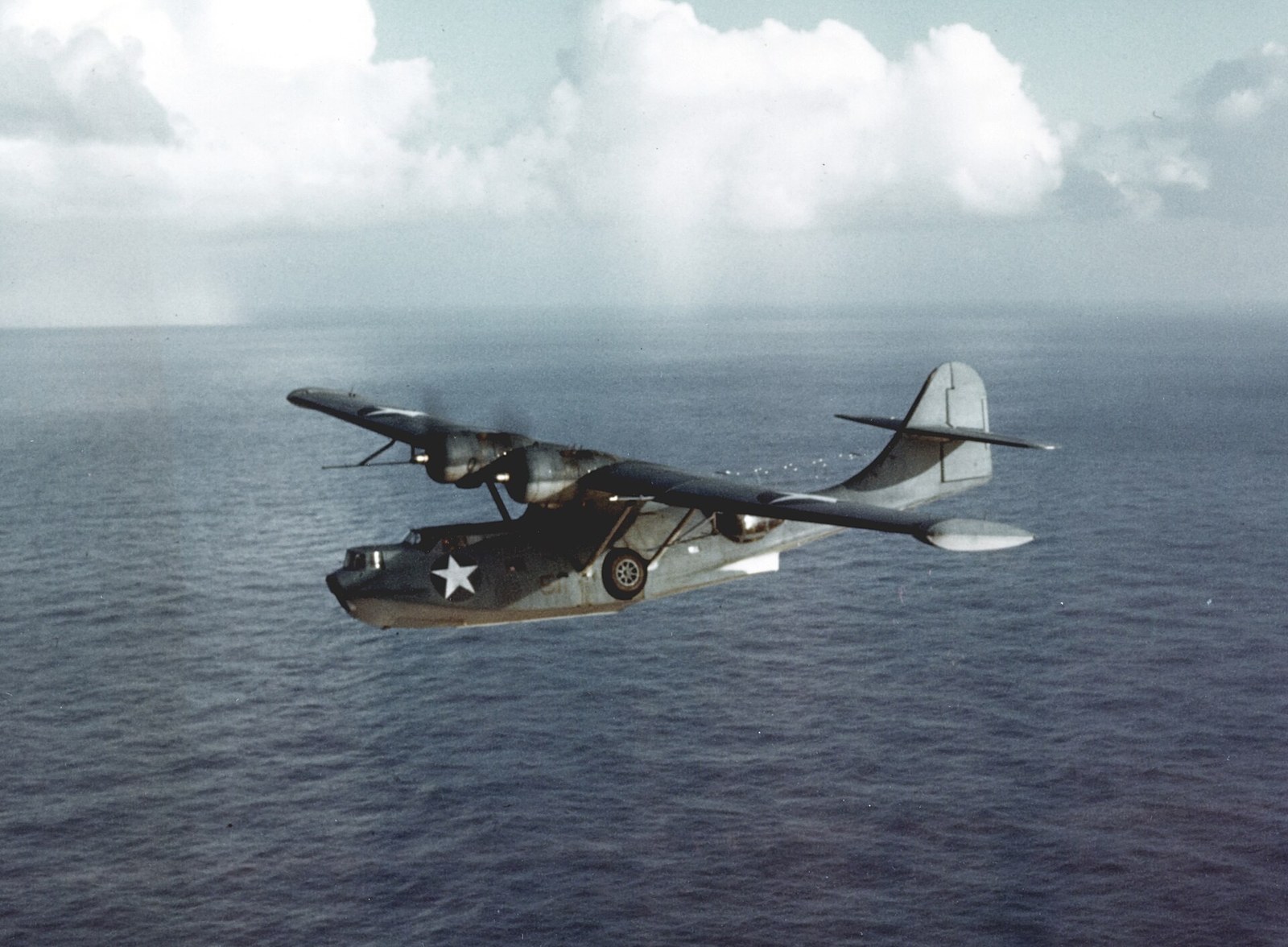
So he sailed knowing the objective, the timetable and the approximate order of battle, and not knowing where the enemy carriers were. They were found on the morning of 4 June 1942 by a Catalina. At 0545 Midway time a PBY reported many planes heading for Midway, 150 miles distant on bearing 320, and seven minutes later another PBY sighted two of the enemy carriers, 180 miles out.
Three carriers and a repair
USS Yorktown had been bombed in the Coral Sea on 8 May 1942. One bomb went through to below the third deck and burst at frame 108; a second glanced off the starboard gallery walkway and burst abreast the bow; a third was a near miss to port. Sixty-six of her crew were killed or seriously injured. The Bureau of Ships summary calls the first bomb’s effects extensive but not vital, and the estimate of what putting her right would take was about three months.
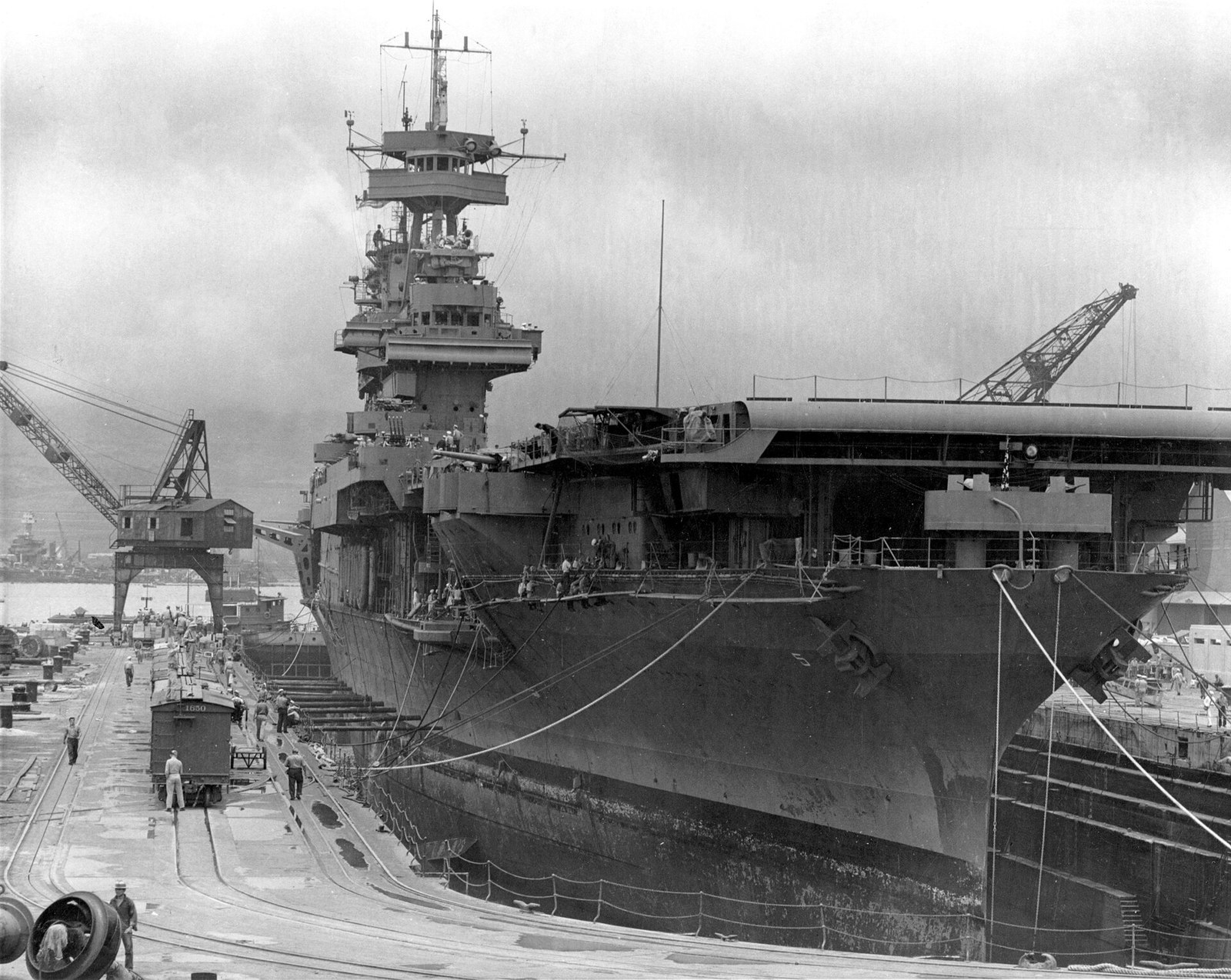
She reached Pearl Harbor on 27 May 1942 and sailed on 30 May. Nimitz’s report is precise about what that meant: it was found, most fortunately, that the Yorktown and her aircraft could be placed in reasonable fighting condition in three days. Three days is the elapsed time from arrival to sailing, and the dry-docking was one part of it. She was photographed in Dry Dock No. 1 on 29 May, and the shipyard’s own account puts about 1,400 shipfitters, machinists, welders and electricians on her around the clock. The Bureau of Ships had a term for the result and used it in the war damage report written after the battle: temporary repairs.
One piece of that work has since become an argument. The Coral Sea near miss had pushed in her outer plating and badly damaged a 24-foot section of shell, shearing or blowing out the rivets along a lap joint, and the structure supporting the shell from inside could not be restored in the time available. The damaged plating was forced together and welded rather than riveted. A case made in the pages of the Naval Institute’s journal is that this hurried seam probably reopened when the two Japanese torpedoes struck on 4 June. That is a modern author’s inference rather than a finding in the record, and it is worth having as an argument.
The air group she carried was not the one she had fought the Coral Sea with. Her squadrons were augmented by aircraft and flyers from Saratoga, not replaced by them, and elements of her own previous squadrons stayed aboard: Fighting Three, under Lieutenant Commander John S. Thach, went aboard with sixteen of Yorktown‘s own VF-42 pilots on its roster. She sailed with 27 Wildcats on the books in VF-3, 25 of them serviceable, 18 Dauntlesses in VB-3, 19 more in VS-5 and 15 Devastators in VT-3 under Lieutenant Commander Lance Massey, twelve of which flew on 4 June, and Enterprise and Hornet carried groups of the same shape. Across the three ships that came to 234 aircraft assigned and roughly 225 operational, with the squadron counts in the published orders of battle varying by a couple either way.
Which makes the arithmetic of the battle very different from the way it is usually told. The NSA’s history counts, at the point of contact, four Japanese carriers, 17 escorts, 229 aircraft and 17 seaplanes, against three American carriers and 22 escorts at sea, 234 aircraft afloat and 110 on Midway. The Naval History and Heritage Command counts four Japanese carriers with 248 aircraft and 20 escorts against three American carriers with 233 aircraft, 25 escorts and an island airfield with 127, for 360 American aircraft in all. The two tallies rest on different definitions and neither should be split with the other.
At the point of contact on the morning of 4 June 1942 the Americans had more aircraft than the Japanese. That is not a revisionist reading; it is what both institutional counts show.
The aircraft on both sides
Four Japanese carriers went to Midway with three types between them, which is the thing to understand about the Kidō Butai: it was a standardised instrument. The Mitsubishi A6M2 was the fighter, the Aichi D3A1 the dive bomber, the Nakajima B5N2 the level and torpedo bomber. The operational air groups came to 72 A6M2, 70 D3A1 and 81 B5N2, 223 aircraft in all, and the strike sent against Midway at 0430 on 4 June 1942 was made of all three in equal parts: 36 level bombers, 36 dive bombers and 36 fighters, nine from each of the four ships.
| Carrier | A6M2 | D3A1 | B5N2 |
|---|---|---|---|
| Akagi | 18 | 18 | 18 |
| Kaga | 18 | 18 | 27 |
| Sōryū | 18 | 16 | 18 |
| Hiryū | 18 | 18 | 18 |
Kaga had the largest air group in the force and carried 27 torpedo bombers rather than 18; Sōryū was two dive bombers short, which is why Kaga carried two spares for her, and she also had Yokosuka D4Y1 reconnaissance aircraft aboard, one or two of them and probably two, on the type’s combat debut. Twenty-one A6M2s of the 6th Air Group were riding as deck cargo, intended to garrison Midway once it had been taken, and they were destroyed aboard the carriers without ever being a fighting reserve. Counting the ferry Zeros, the spares and the D4Y1s, the four ships had 248 aircraft aboard.
The Mitsubishi A6M2 Model 21 was designed by Horikoshi Jiro at Mitsubishi to a Japanese Navy specification of 1937, and about 11,283 Zeros of all marks were built. It carried two 20 mm cannon and two 7.7 mm guns, all firing forward, and had a range of 1,930 miles. It had no armour and no self-sealing fuel tanks, which made it vulnerable to being hit. Against the Grumman F4F-4 it was slightly faster, 331 mph against about 318, climbed far better, turned incomparably better at low speed and had roughly two and a half times the reach. Against a Devastator at 206 mph there was no contest of any kind.
The American carriers flew three types as well, but they were not comparable machines. The F4F-4 Wildcat was the fighter, and it was aboard in that form because of the folding wing, which allowed roughly a 50 per cent increase in the number of Wildcats a fleet carrier could embark and is why the squadrons carry 27 aircraft rather than 18. What that gain cost is the subject of its own section.
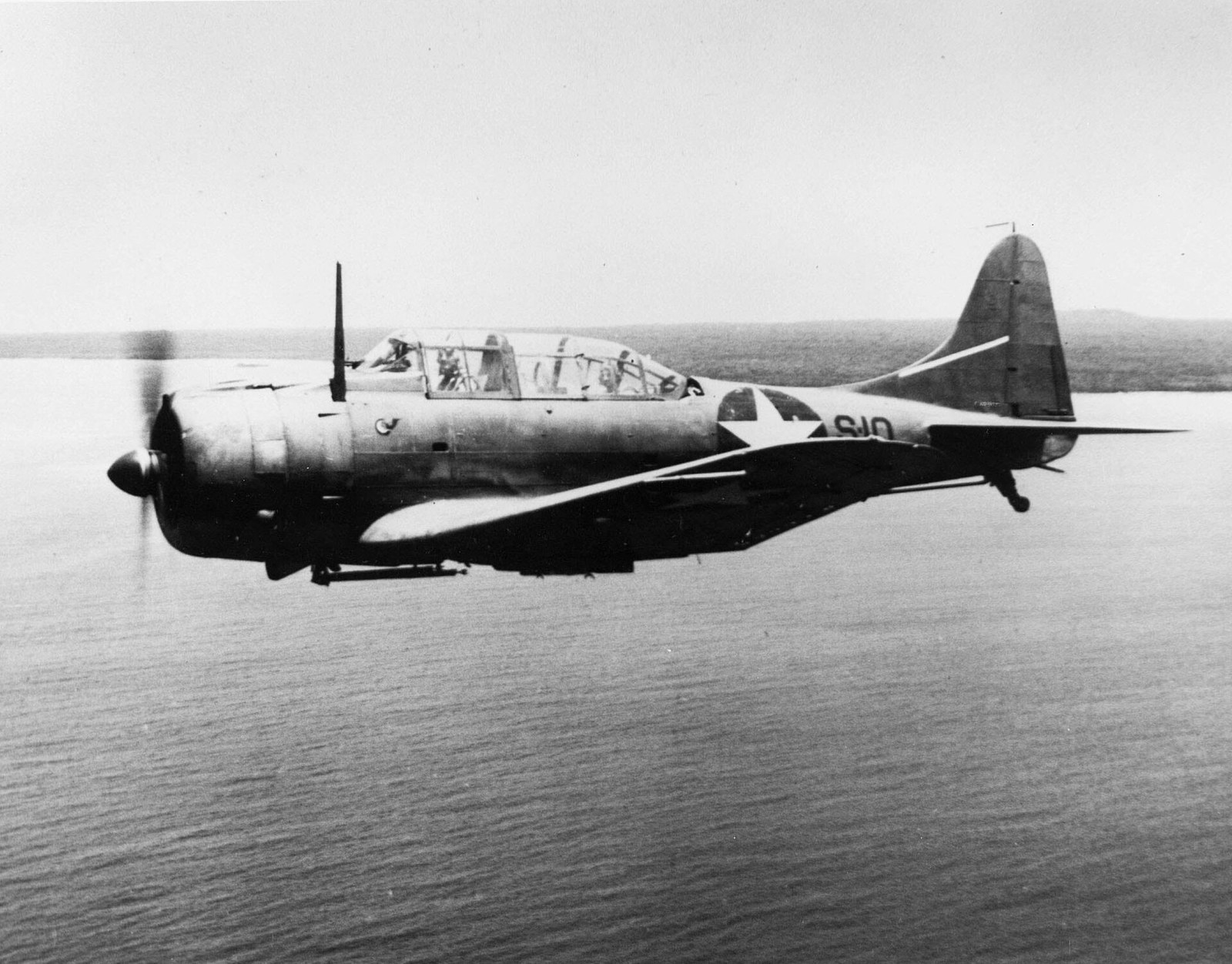
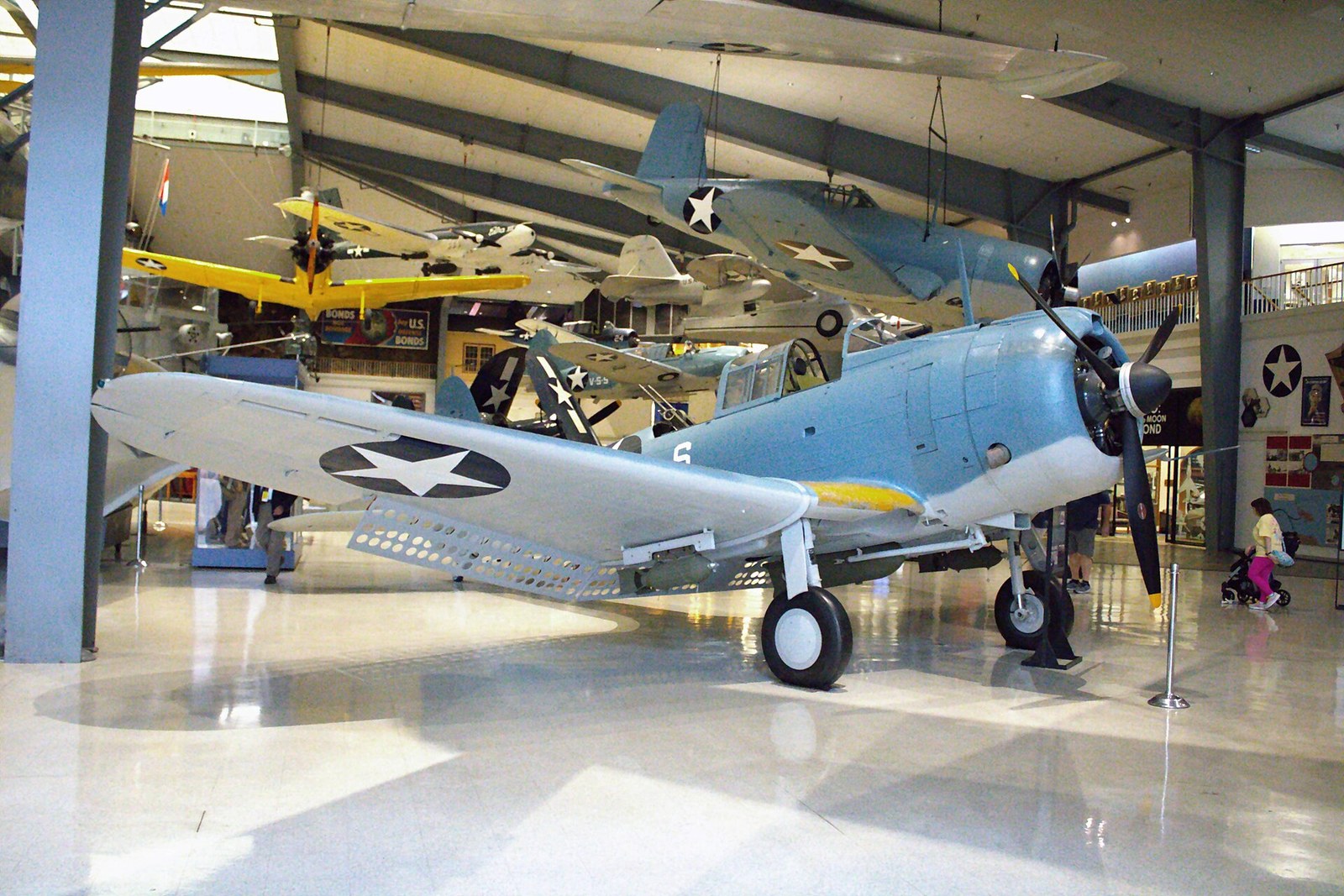
The Douglas SBD Dauntless was the striking weapon. Its business was to arrive over a manoeuvring ship at 15,000 to 20,000 feet, roll into a 70-degree dive, hold that dive steady all the way down and release at about 2,000 feet, with the aiming error small enough to put a bomb on a moving flight deck. The engineering that made the dive holdable was the perforated split dive flap: Ed Heinemann’s team at Douglas El Segundo drilled the flaps full of holes because solid ones set up tail buffeting bad enough to threaten the airframe, and the perforations bled the turbulence away. The Dauntless had a Wright R-1820 of about a thousand horsepower, a maximum around 250 mph, a crew of two, two fixed .50 calibre guns forward and a pair of flexible .30 calibre guns in the back seat, and usually carried one 1,000 lb or 500 lb bomb. The third type was the Douglas TBD-1 Devastator.
The Devastator, and a torpedo that could not be dropped
The TBD-1 was ordered in 1934 and made its maiden flight in 1935: an all-metal carrier monoplane with a fully enclosed cockpit and hydraulically folding wings, at a moment when that combination was as advanced as carrier aviation got. A hundred and twenty-nine were built, 114 ordered in February 1936 and fifteen more in August 1938. By 1942 every one of those advantages had been overtaken by somebody else’s aeroplane and the airframe had not changed. It had a Pratt and Whitney R-1830-64 Twin Wasp of 900 hp, a service ceiling of 19,700 feet, a range of 700 miles and a maximum of 206 mph that was a laboratory figure rather than an operational one. It spanned 50 feet, carried a crew of three, and its defensive armament was one gun in the cowling and one flexible rifle-calibre gun facing aft.
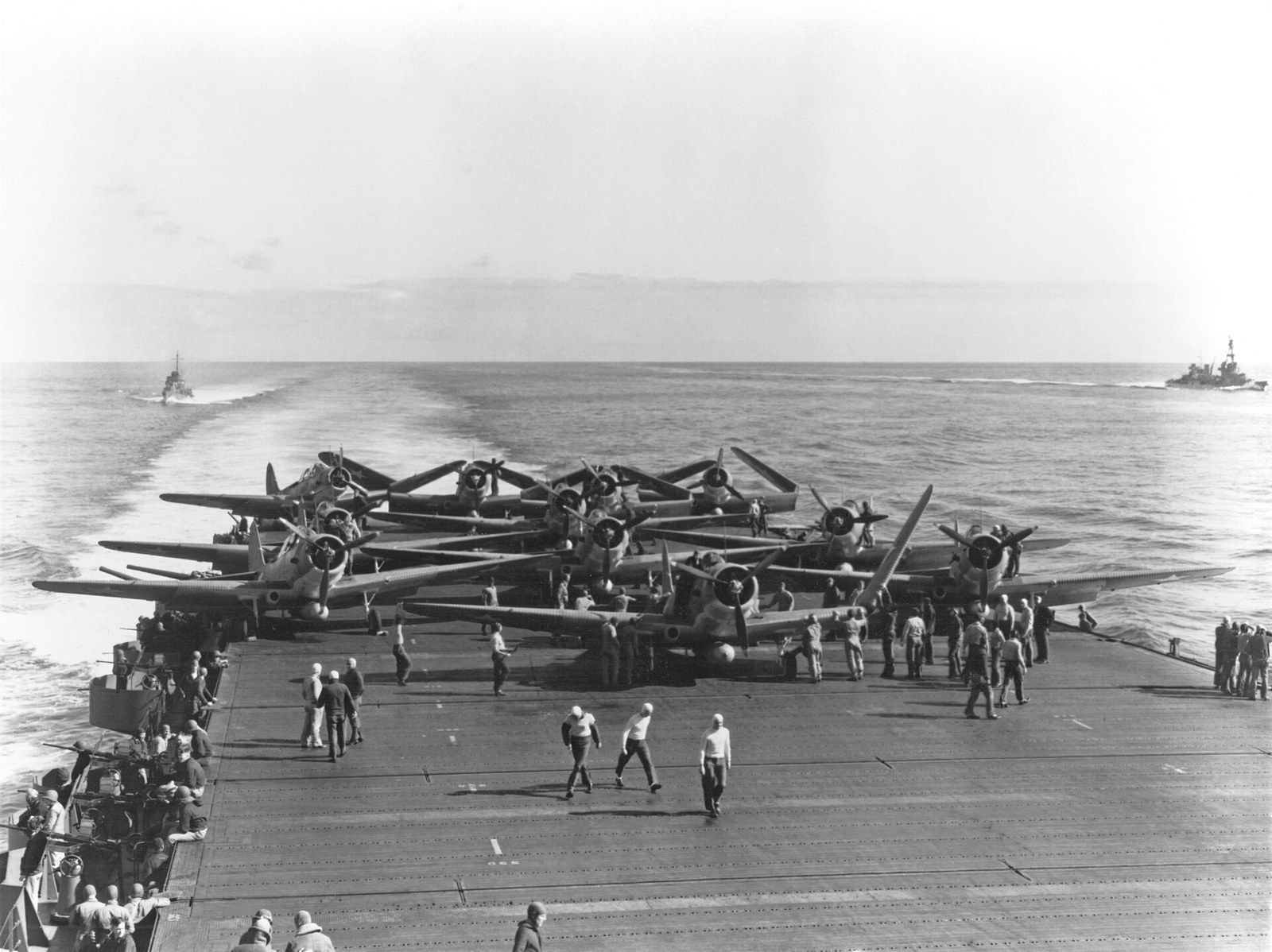
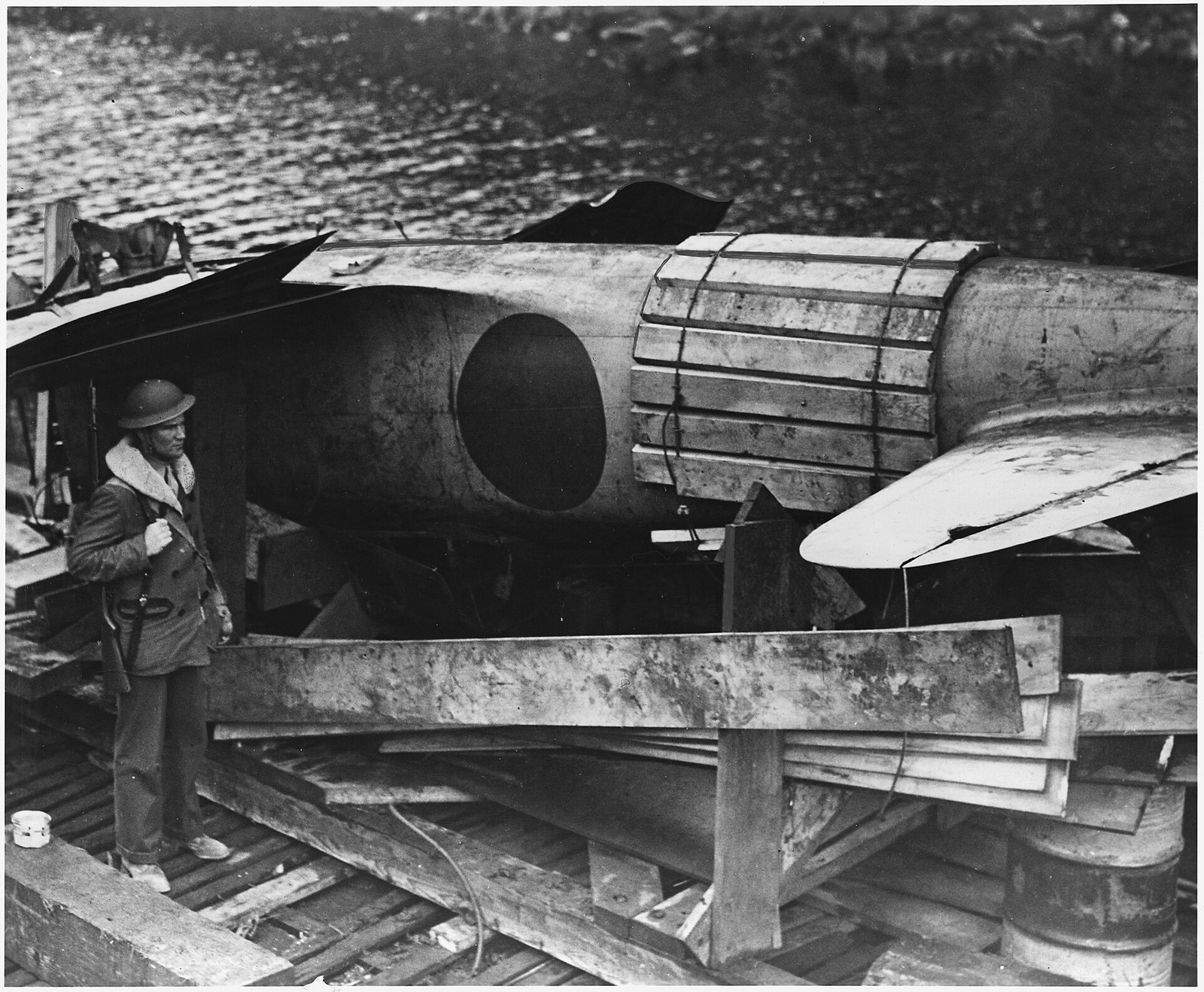
The aeroplane was only half the problem. The other half was the weapon it existed to carry. The Mark XIII aerial torpedo was 13 feet long and 22.4 inches in diameter. In the water it made 33.5 knots and would run 6,300 yards. Those are respectable figures. The one that mattered is different: dropped from above 50 feet, or at more than 110 knots, the early Mark XIII tended to break up.
Read that as an instruction to a pilot and the shape of the morning of 4 June 1942 falls out of it. To deliver the weapon at all, a Devastator had to come down to 50 feet above the sea, slow to under 110 knots, point at a carrier that was turning hard, and hold that height and speed and heading, straight and level, for the last minutes of the run. There was no evasive manoeuvre available inside those limits, because the obvious ones broke the torpedo. Loaded, the aeroplane’s practical attack speed was little better than the drop limit anyway, so the limits cost it almost nothing it still had to give. A Zero closing on it was flying at more than three times that speed, and the only thing pointing back at the Zero was a single rifle-calibre gun in the hands of a man sitting behind the pilot.
The constraint was not peculiar to the Devastator, which is the evidence that the trouble lay in the torpedo and not only in the aeroplane. The Army B-26 crews sent against the same ships from Midway were instructed to release at 150 knots, and the Marauder would stall before it got that slow, so they improvised. Nobody had solved the delivery problem for anybody. What made it lethal in the Devastator’s case was that the aeroplane had no margin of speed and no armour worth the name.
That arithmetic was worked out on paper years earlier by ordnance engineers who never met the men who would fly it. On the morning of 4 June 1942 three American torpedo squadrons took off to fly it.
The Wildcat, and what folding wings cost
Every fighter the three American carriers put into the air on 4 June 1942 was a Grumman F4F-4, and the second dash in that designation is the whole of an argument about how a carrier fights. The F4F-3 had a fixed wing. The F4F-4 had a wing that folded, and Leroy Grumman had arrived at the mechanism by watching the way a bird twists its wings back against its body, then demonstrating it with a drafting eraser and two bent paper clips. What the fold bought was roughly a fifty per cent increase in the number of Wildcats an American fleet carrier could stow and therefore embark. That is why Yorktown, Enterprise and Hornet each carried twenty-seven fighters at Midway rather than eighteen.
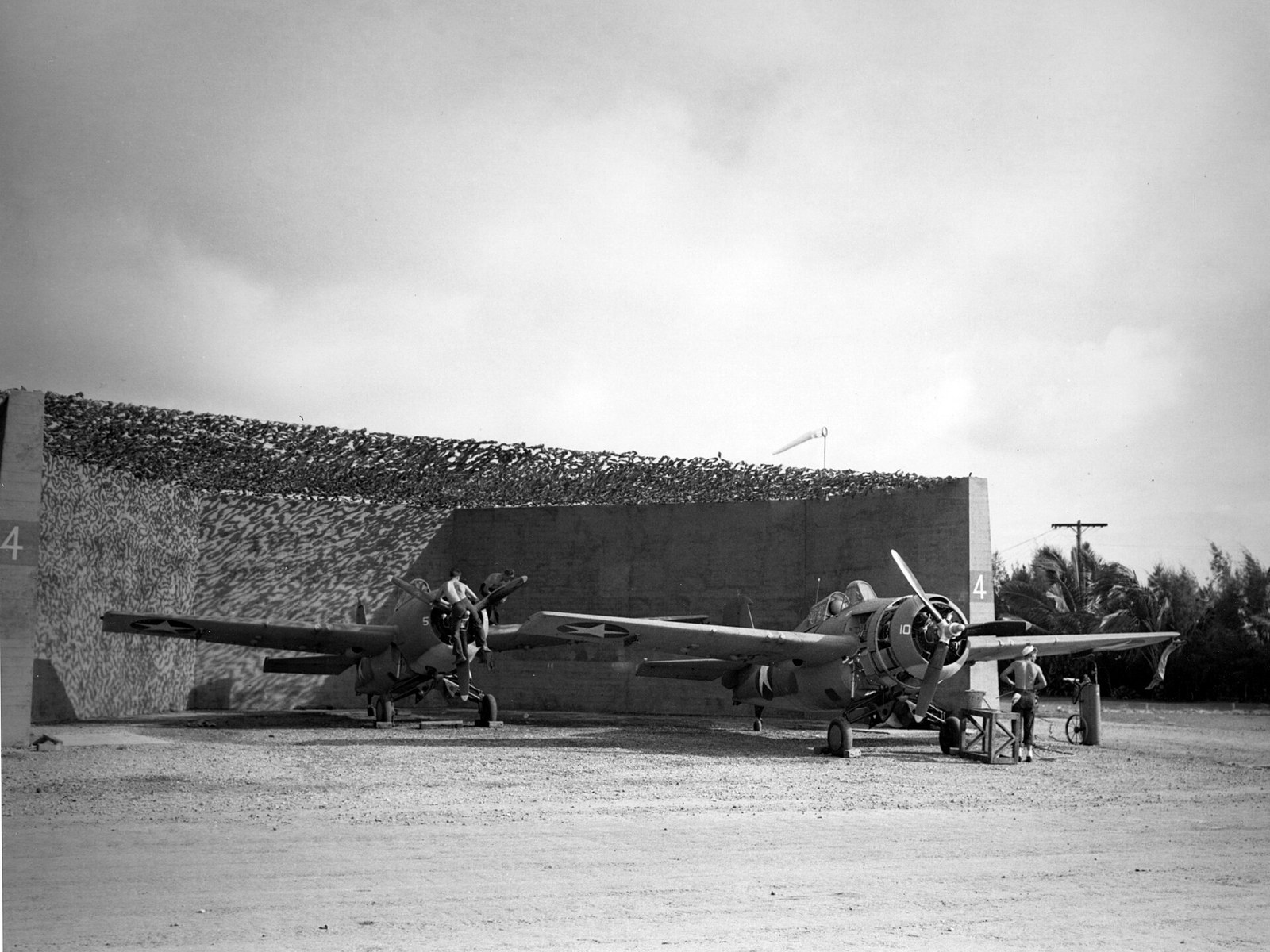
The bill came in ammunition, and it is the part almost never told alongside the folding wing.
| F4F-3 | F4F-4 | |
|---|---|---|
| Guns | 4 × .50 in Browning M2 | 6 × .50 in Browning M2 |
| Rounds per gun | 450 | 240 |
| Total rounds | 1,800 | 1,440 |
| Firing time | about 34 seconds | under 20 seconds |
| Wings | fixed | folding |
Two more guns, fewer rounds behind each of them, and a pilot who could hold the trigger down for under twenty seconds before he was a passenger. Some pilots dealt with it by using the gun selector to fire four guns and keep the other two in reserve, which is a workaround for a design decision, not a tactic. The F4F-4 made about 318 mph at 19,400 feet against the F4F-3’s 328 mph at 21,000. Grumman quoted a climb of 1,950 feet per minute; in combat conditions pilots reported five hundred to a thousand.
What they had to climb against was the Mitsubishi A6M2. The Zero was slightly the faster at 331 mph, climbed far better, turned incomparably better at low speed and had something like two and a half times the Wildcat’s range. Set against that, the F4F-4 could dive faster, roll better at speed, absorb vastly more damage, and carried a heavier and more effective battery. It also had a reliable radio, which most Zeros did not.
The radio is what turned an idea into a tactic. Lieutenant Commander John S. Thach had worked out on paper a pair of crossing turns by which two Wildcats flying abreast could each cover the other’s tail, and the manoeuvre only works if both pilots can be told when to start it. He flew it over the Japanese fleet on 4 June with six F4F-4s escorting the Yorktown torpedo squadron, was credited with three Zeros, and had a wingman claim a fourth. The Zero’s own design gave him something to shoot at: it carried neither armour nor self-sealing tanks.
The trade was argued afterwards. Rear Admiral Frank Jack Fletcher observed that folding wings were an improvement only if they actually put more fighters into the air group. Yorktown‘s own action report called the six-gun F4F-4 a mistake and said that for the opposition then being met, four guns with 450 rounds each were much superior to six with 240. The armament was left as it was. The other recommendation that came out of the battle, for drop tanks, was acted on.
Midway as an air base
Midway lies about 1,200 miles north-west of Honolulu and some 140 nautical miles east of the International Date Line, and it is an elliptical ring of coral about five miles across enclosing some 28 square miles of shallow lagoon. Two of the islands inside the ring were usable. Sand Island, about a mile and a half by a mile and capped by a hill 42 feet high, held the seaplane base, the fuel, the hospital, the barracks, the power plant and the cable company’s buildings. Eastern Island, a flat triangle a mile and a quarter long by three quarters of a mile wide, held the airfield.
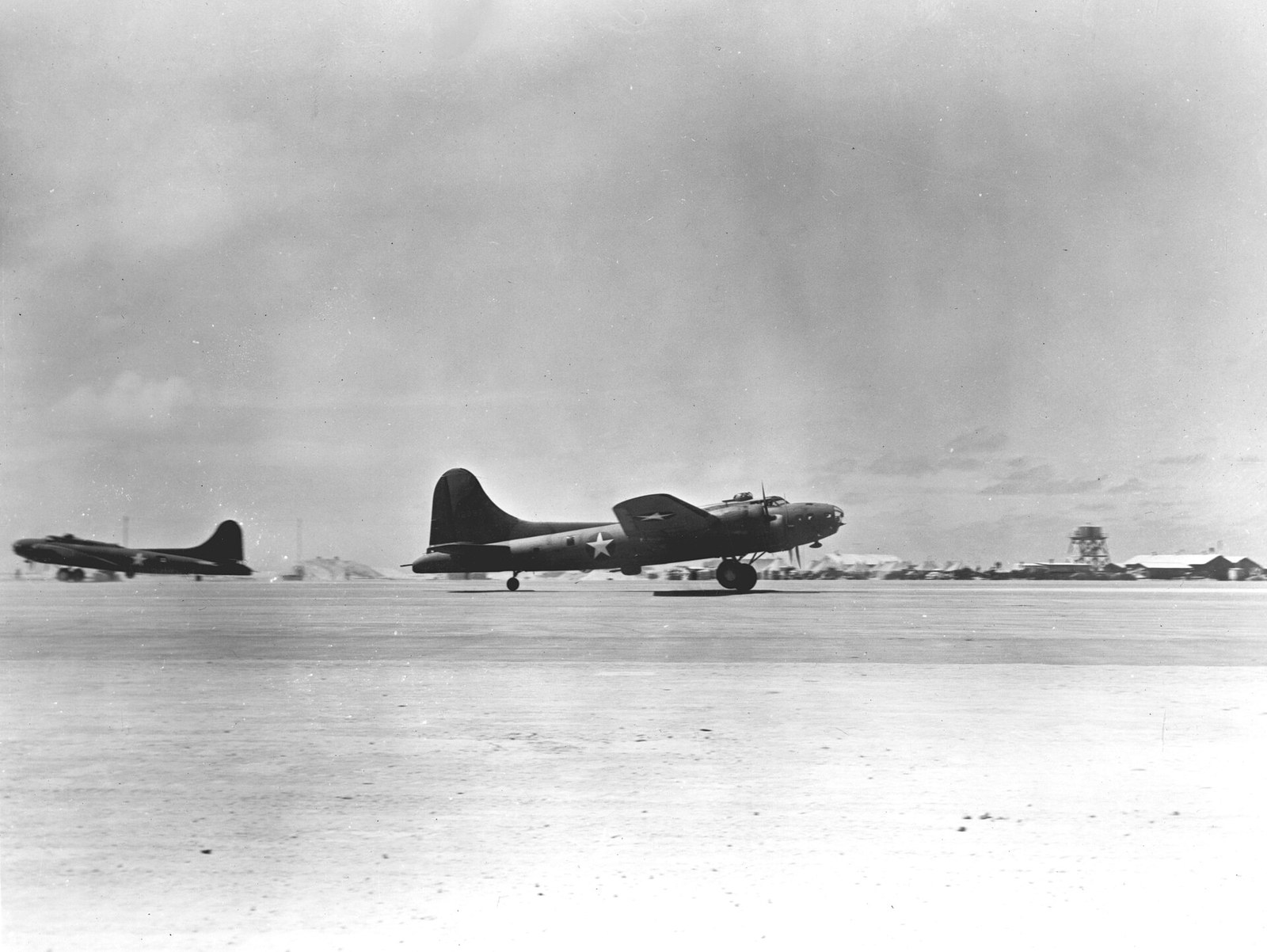
The airfield was three asphalt runways laid over dredged coral, each 300 feet wide, at 3,250, 4,500 and 5,300 feet. They were laid out to fit a triangular island rather than to suit the wind. Two hangars went up beside them with parking areas and warm-up mats, and there were ready rooms for fighter, bomber and patrol crews, much of it in Quonset huts. Five thousand three hundred feet of coral asphalt in the tropics puts a loaded Seventh Air Force B-17E, the wartime Flying Fortress whose story we have told separately, close to the edge of its book figures. Six of them were flown in on 30 May, and on 31 May six more came from the 431st Bombardment Squadron, two from the 31st and one from the 72nd.
Sand Island carried the flying boats. A large steel seaplane hangar stood on the edge of a parking mat, with four concrete ramps and an emergency ramp besides, and behind the mat an ordnance shop, a radio shop, an engine shop and a storehouse and tool room fitted out for major overhaul work. The mat sat on dredged fill held by about 2,800 feet of sheet piling. There was no natural harbour, so the channel, the seaplane basin, the submarine basin and the turning basin were all cut out of the reef between 1938 and 1941, some three million cubic yards of it. The Sand Island power plant went into a bombproof structure of reinforced concrete and steel, which tells you what the builders expected.
What they had not finished was the fuel. Underground aviation gasoline storage had been begun in twenty-two steel tanks of 2,500 gallons each, 55,000 gallons in all, and on 4 June 1942 it was still under construction. The petrol that mattered was in surface tanks, in lines running above ground, and in drums.
On to that the Navy loaded an air force. The Navy’s own tally for 3 June counted fourteen PBY-5s and sixteen PBY-5As of the Patrol Wing 2 detachment, four B-26 Marauders, seventeen B-17s and the six TBF-1 Avengers of the Torpedo Squadron 8 detachment. To those add Marine Aircraft Group 22: twenty-one Brewster F2A-3 Buffalos and seven F4F-3 Wildcats of VMF-221, the Wildcats having arrived on 26 May, and eighteen SBD-2 Dauntlesses and sixteen SB2U-3 Vindicators of VMSB-241. That is well over a hundred aircraft on three runways and one seaplane mat, on an island a mile and a quarter long, and Nimitz’s report afterwards said they were necessarily difficult to protect on the ground and on the water.
The strike on Midway
At 0430 on 4 June 1942, from a position roughly 250 miles north-west of the atoll, Vice Admiral Nagumo launched 108 aircraft under Lieutenant Tomonaga Jōichi, the air group commander of Hiryū. It was made up of thirty-six B5N2 level bombers, eighteen each from Hiryū and Sōryū; thirty-six D3A1 dive bombers, eighteen each from Akagi and Kaga; and thirty-six A6M2 fighters, nine from each of the four carriers. The targets were divided before take-off. Kaga‘s aircraft were to take the seaplane facilities on Sand Island and Akagi‘s the airfield on Eastern.
A Midway PBY sighted the formation 150 miles out at 0545. At 0555 the 6th Defense Battalion’s radar logged many planes, the sirens went, and the pilots of Marine Aircraft Group 22 ran for their aircraft. VMF-221 was off between about 0600 and 0605; VMSB-241 launched last and rendezvoused twenty miles east. Both squadrons were airborne in under ten minutes.
At 0616 the Marine fighters sighted the escorted formation about thirty miles out. Captain John F. Carey, leading a division in one of the F4F-3s, attacked from 14,000 feet and called the tally-ho. He was wounded in both legs and he got his aircraft down at Midway. Captain Kirk Armistead took a second group of thirteen fighters in from 17,000 feet, and he survived to write the squadron’s report of the action two days afterwards. They had time for a single pass at the bombers before anything from one to five Zeros fastened on to each Marine. The Marine Corps’ official history says they were hopelessly outnumbered and that the Zeros could fly rings around them, and the machines bear it out: the F2A-3 and the fixed-wing F4F-3 were holding a fighter that outclimbed and outturned the newer Wildcat.
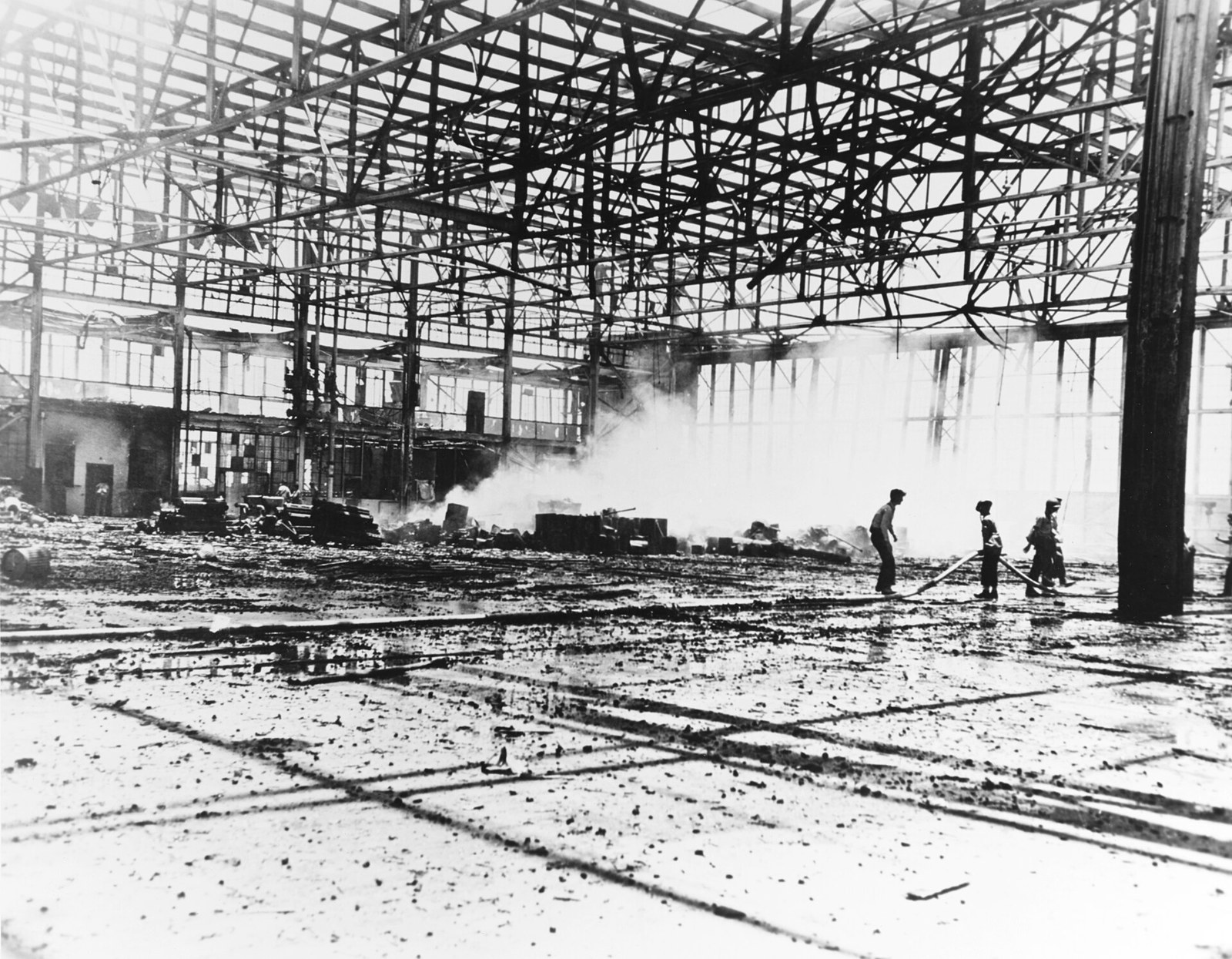
The first Japanese formation bombed from 14,000 feet at 0630. Anti-aircraft fire brought down two aircraft before they could release; twenty of them bombed, and eighteen more of the second wave followed. On Sand Island they hit the seaplane hangars with nine 242 kg bombs and the fuel oil tanks 500 yards north of them, and destroyed the dispensary. On Eastern Island two direct hits from 805 kg bombs all but destroyed the powerhouse, and the mess hall, galley and post exchange were hit, buildings the Japanese crews reported afterwards as hangars. The 6th Defense Battalion’s command post on Eastern Island took a direct hit which killed the Marine sector commander, Major William W. Benson. A bomb hit killed four of VMF-221’s ordnance men. Ruptured fuel lines left more than two thirds of Midway’s aviation petrol unusable, and petrol was hand-pumped out of drums and trucked from Sand Island. The strike was over shortly after 0700, the Zeros strafing on their way out.
VMF-221 had thirteen F2A-3s and two F4F-3s missing. Ten aircraft came back and only two of those were fit to fly again. Of the twelve pilots in the first of the two Marine formations to make contact, three survived. Their squadron claimed forty-three Japanese aircraft; six failed to return to the carriers, three level bombers, two dive bombers and one fighter, and a further sixteen that did get back either ditched or were written off. Three Japanese aircraft were shot down outright by the Marines. The gap is a fact about combat reporting rather than about the men, and it recurs on both sides all day.
At 0700 Tomonaga radioed his admiral to say that a second attack on Midway would be necessary: the airfield was still operating and the anti-aircraft fire had been intense. Nagumo had launched half his strength against an island and been told it was not enough.
The strikes from the island
Most accounts give the counter-attacks from Midway a sentence. There were four of them, they were flown by five types, and they cost most of the aircraft committed. The first went in from about 0705. Six TBF-1 Avengers of the Torpedo Squadron 8 detachment under Lieutenant Langdon K. Fieberling had taken off at 0555, five to ten minutes behind the Marine fighters, and they attacked at about 4,000 feet and 160 knots, mainly at Hiryū. Four torpedo-armed B-26 Marauders under Captain Collins went for Akagi and Hiryū. Neither unit had trained in torpedo delivery.
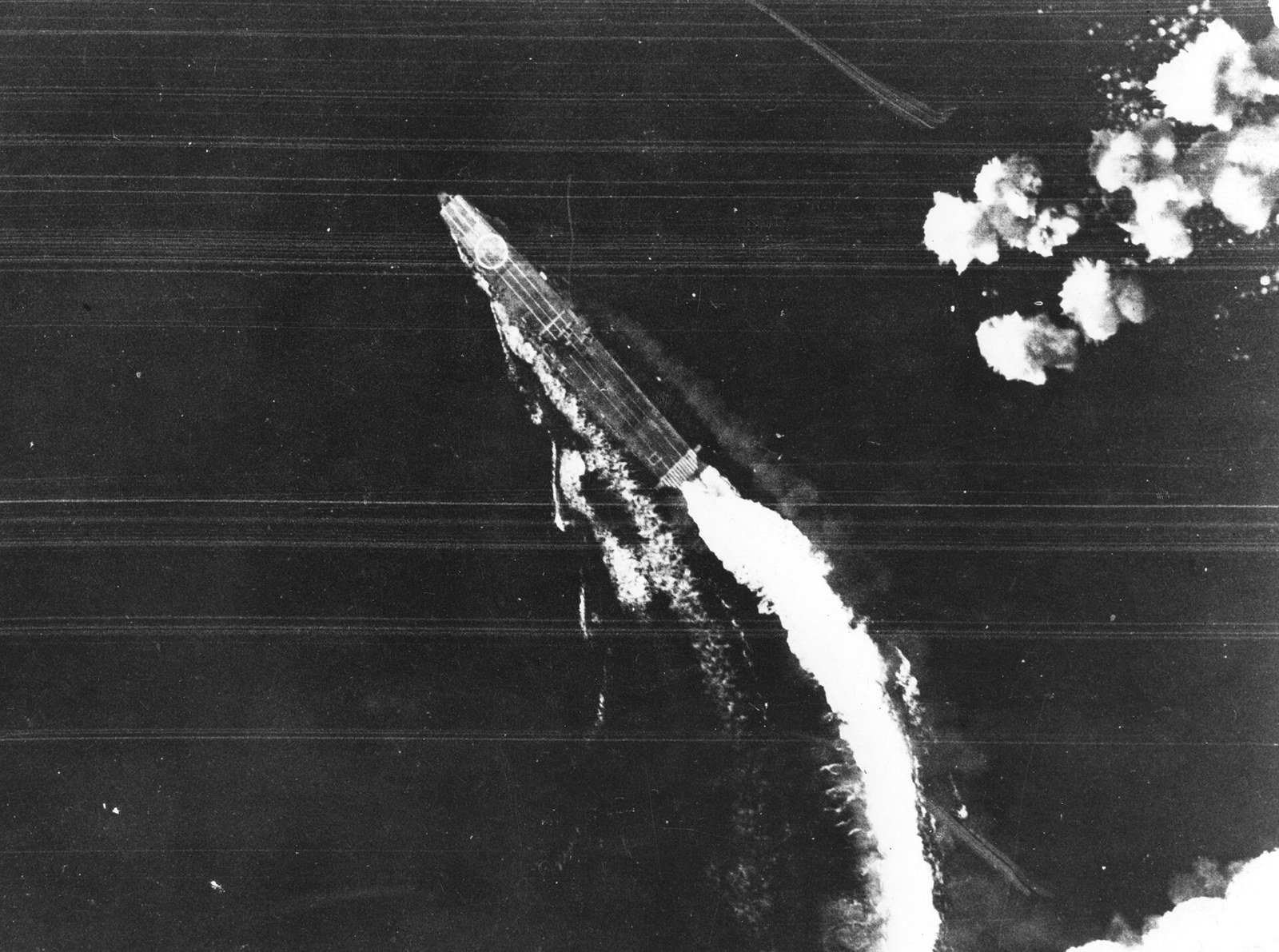
Two of the Avengers pressed close enough to drop before they crashed, and the carrier simply outran the torpedoes. Five of the six were shot down. Of the eighteen aircrew who set out, two came home alive. Lieutenant Fieberling was not among them and he has no known grave. Ensign Albert K. Earnest brought the sixth aircraft back, crash-landing at Midway at 0944 with no hydraulics, one wheel and no tail wheel, his gunner AMM3c Jay Manning dead in the turret and his radioman RM3c Harry Ferrier wounded and alive. The Marauders scored no hits. Two were shot down with their crews. Collins and Lieutenant James P. Muri crash-landed the surviving two at Midway and both were written off, one of them with 186 flak and bullet holes in it. On the way out a B-26 flew the length of Akagi‘s flight deck at very low level. The Naval History and Heritage Command holds that Fieberling’s decision to attack at once, and the ferocity of the combined attack, helped push Nagumo into his 0715 order to re-arm his reserve with bombs for a second go at the island.
Major Lofton R. Henderson brought sixteen of VMSB-241’s SBD-2s over the Japanese at 0744. His pilots had very little time on the type, most of them having converted from Vindicators only recently, so he took them in on a shallow glide rather than a dive. They had climbed to 9,000 feet and they spiralled down into Zeros already airborne and being reinforced from below. Their bombs straddled Hiryū and none of them hit. Henderson was killed. Eight of the sixteen got back to Midway and two of those never flew again. His gunners were credited with four Japanese aircraft and two probables, and Henderson Field on Guadalcanal carries his name.
At 0814 the B-17s came over at 20,000 feet, twelve of them under Lieutenant Colonel Walter C. Sweeney Jr, bombing in three groups across about twenty minutes at Sōryū, Akagi and Hiryū. The carriers were bracketed by falling water. Not one bomb dropped by a B-17 hit a ship at Midway. Japanese aircraft returning from the strike on the atoll arrived overhead in the middle of it and had to be waved off while the carriers manoeuvred. Between 3 and 5 June the heavy bombers based on Midway flew fifty-five sorties in sixteen attacks and expended 314 bombs of 500 and 600 lb without hitting a warship, and they flew again on 6 June.
The last of the morning attacks was Major Benjamin W. Norris with eleven SB2U-3 Vindicators, which had taken off with Henderson. Harried by fighters, Norris took the nearest thing he could reach and made a standard glide run on the battleship Haruna, some of his aircraft going for Kirishima. There were no hits. Three Vindicators were shot down. Norris himself came through the morning, took off again at 1900 with the squadron’s remaining six Dauntlesses and five Vindicators to look for a burning carrier reported 200 miles north-west, and did not return.
What these attacks did not do is the thing they are usually credited with. They did not strip the Japanese combat air patrol: something like thirty fighters were already airborne or launching when the Avengers and the Marauders arrived, and more were fed in as the fight developed. Jonathan Parshall’s reading is the one the timings support. What the island’s aircraft took off Nagumo was time.
Not one aircraft flown from Midway hit a Japanese ship on 4 June 1942. Their effect was measured on the clock instead: the Japanese official history records that the successive American attacks between 0705 and 1022 stopped a strike being spotted on any of the four flight decks.
Nagumo’s dilemma
At 0700 Tomonaga radioed from over the atoll that a second attack on Midway was needed. The airfield was still working and the anti-aircraft fire had been heavy. At 0705 the first of the Midway-based aircraft reached the Striking Force, six Avengers and four Marauders with torpedoes. Nagumo had never been attacked in that way before.
At 0715 he ordered the reserve rearmed for a land attack. The signal, as the Nagumo Report has it in translation, ran: “Planes in second attack wave stand by to carry out attack today. Re-equip yourselves with bombs.” The reserve was the anti-ship strike Yamamoto had verbally directed him to keep ready, between 93 and 107 aircraft: B5N2s with torpedoes aboard Akagi and Kaga, D3A1s aboard Hiryū and Sōryū. The work went on in the hangars, because Japanese carriers armed and fuelled their aircraft below rather than on the open flight deck as the Americans did.
At 0728 the No. 4 scout seaplane from the cruiser Tone reported: “Sight what appears to be ten enemy surface ships, in position 10 degrees distance 240 miles from Midway. Course 150 degrees, speed over 20 knots.” That aircraft had launched late, and the report gives no reason for it. At 0745 he ordered his aircraft prepared for attacks on enemy fleet units, and the torpedoes left on those machines that had not yet been changed over. At 0748 Sōryū signalled another attack coming in, Major Henderson’s Marine Dauntlesses. At 0809 the scout gave the composition: five cruisers and five destroyers. Cruisers and destroyers were no threat to him, and his alarm eased.
At 0814 the B-17s bombed from 20,000 feet. At 0820 the Tone scout sent the message that changed the battle: “Enemy force accompanied by what appears to be aircraft carrier bringing up the rear.” Nagumo ordered every aircraft armed for anti-ship attack. At about 0830 Rear Admiral Yamaguchi signalled from Hiryū, “Consider it advisable to launch attack force immediately.” He had 36 dive bombers in the two Carrier Division 2 hangars.
Nagumo declined. The Midway strike was overhead, short of fuel and in places shot about, and recovering it needed clear decks, as did spotting a strike of his own. He had no fighters to send with one either: his roughly 84 Zeros were flying the combat air patrol, nearly fifty airborne at the peak, or down for fuel and ammunition. He had spent the morning watching what happened to unescorted bombers and would not send his own out that way. At 0837 Akagi began taking the Midway strike aboard. At 0917 the last of it landed and the Striking Force turned 70 degrees to the north-east to regroup. At 0920 Torpedo Squadron 8 arrived, and from that moment until 1022 the flight decks were never free.
Spotting a twenty-one aircraft strike for launch took around forty minutes and the launch itself another five to ten, so Nagumo needed an unbroken three quarters of an hour of clear deck on all four ships at once, and the American attacks never left him one. At 1022 all four carriers still had their armed and fuelled strike aircraft in the hangars. The aircraft on the flight decks were fighters: patrol Zeros being landed on, refuelled, rearmed and sent up again.
Spotting a strike on a Japanese flight deck took about forty minutes, and launching it another five to ten. No such window existed on any of the four decks between 0705 and 1022, and at 1022 the strike aircraft were still below.
The three torpedo squadrons
The Douglas TBD-1 Devastator’s 206 mph maximum was a laboratory figure, and it carried one rifle-calibre gun facing aft. The weapon settled the rest. The early Mark XIII torpedo broke up if it was dropped from above 50 feet or faster than 110 knots, so a Devastator had to come at a manoeuvring carrier low, slow and straight for the last minutes of the run, in front of a fighter that could do more than three times its attack speed.
Lieutenant Commander John Waldron took VT-8 off Hornet between 0700 and 0734, fifteen Devastators with no escort. He broke away from Commander Ring’s group and flew his own course to the enemy. He found them; the rest of the Hornet air group did not. The squadron attacked between 0918 and 0920 against something like thirty Zeros. All fifteen aircraft were shot down and no torpedo hit. Of thirty aircrew, one came back: Ensign George Gay, who launched his torpedo, was shot down, floated under a seat cushion for the rest of the battle and was picked up alive. Waldron did not come back, and neither did the other twenty-eight.
VT-6 launched fourteen aircraft with the Enterprise group from 0706 under Lieutenant Commander Eugene Lindsey, who had crashed on landing aboard Enterprise on 28 May and been pulled out of the sea, and who flew this mission injured. Its escort never reached the target: VF-6 orbited far to the north at altitude, never heard the calls, and returned to Enterprise without firing a shot. The squadron attacked Kaga at about 0940 and dropped five torpedoes, all of which she avoided. Ten of the fourteen did not return. Lindsey was killed and has no known grave. One crew was picked up after seventeen days in the water.
VT-3 launched from Yorktown at 0838 with twelve aircraft under Lieutenant Commander Lance Massey, and with the escort neither of the other two had, six F4F-4s of VF-3 under Lieutenant Commander John Thach, four high and two close. Thach’s six were set upon by a large number of Zeros, and over the Japanese fleet he flew the crossing-turn manoeuvre he had worked out on paper. He was credited with three Zeros and his wingman with a fourth. Six fighters could not save a torpedo squadron. VT-3 made its runs at Hiryū from about 1010, the last between 1030 and 1035, and dropped five torpedoes, all of which she avoided. Ten of the twelve were lost and two came back. Massey was killed leading the attack and has no known grave. Ensign Wesley Osmus was shot down, was picked up alive by a Japanese destroyer, was interrogated, and was killed.
Forty-one Devastators were launched by the three squadrons. Thirty-five were shot down and not one torpedo hit. The three American torpedo squadrons suffered the heaviest proportional loss of any American squadrons in a single action in the Pacific war.
What that achieved has been argued about since, and the traditional answer is not a popular corruption of the record but the record itself. Nimitz wrote it into his report to King on 28 June 1942: “Recognizing the torpedo plane for the menace it is, the Japanese concentrated most of their fighters and antiaircraft fire on it. The result was that the VT squadrons were a sacrifice that enabled the dive bombers to make their attack almost unopposed, with disastrous results for the enemy.” In the same paragraph he added a judgement that is almost never quoted: even had they attacked later and in perfect coordination, without adequate fighter protection their losses would have been probably as great. That finding was the official American account for sixty years. The modern revision, which is better evidenced, holds that the distortion of the Japanese combat air patrol was lateral rather than vertical. VT-3’s attack from about 1010 pulled the patrol into the threat vector to the south-east and left the Kidō Butai uncovered from the bearings the dive bombers came from, Enterprise‘s out of the south-west and Yorktown‘s out of the north-east, while the earlier squadrons took time off the clock that Nagumo needed. The point remains argued. What no document supports is intent. Nobody planned it, nobody ordered it and nobody anticipated it, and Waldron broke away from his air group to find the enemy, not to draw fighters.
1022
Lieutenant Commander Wade McClusky led 33 Dauntlesses off Enterprise from 0706, VS-6 under Gallaher, VB-6 under Best and his own aircraft. He flew to the point where the Japanese should have been, found empty ocean, and with his fuel going down flew a search leg instead of turning for home. At 0955 he sighted a single ship making high speed to the north-east: the destroyer Arashi, left behind to depth-charge the submarine Nautilus and hurrying to rejoin. He reasoned she would lead him to the fleet, followed her wake, and at 1005 sighted the wakes of the carriers about 35 miles ahead.
McClusky then broke radio silence to assign targets and got it wrong. Doctrine gave the far ship to the leading squadron and the near ship to the trailing one; his assignment sent both squadrons at Kaga, the near carrier, and the Naval History and Heritage Command calls it a critical mistake. The decision that won the battle and the error that came nearest to leaving Akagi alive were made by the same man inside two minutes. Best, leading VB-6, had not heard the assignment and was setting up on Kaga by the book when McClusky’s aircraft flashed past him into the dive. He closed his dive flaps, pulled out, and took his two wingmen, Lieutenant Edwin Kroeger and Ensign Frederick Weber, across to Akagi. He went in at full throttle, too fast at the push-over to open the flaps again, horsed up to 14,000 feet to bleed off speed enough to get them out, and released at 2,000 feet in a 70 degree dive. Those three aircraft were the only ones that attacked her, and had Best stayed where he was she would have come through the morning untouched with her air group intact.
Yorktown had begun launching at 0838, deliberately late, with VS-5 held back as a reserve. Lieutenant Commander Maxwell Leslie took 17 Dauntlesses of VB-3 for the far carrier, Sōryū, expecting VS-5 to take the near one, and VS-5 was not there. A fault in a newly fitted electrical arming switch dropped the bombs of four VB-3 pilots into the sea on the way out, Leslie’s among them, and he led the dive without one. The two groups came over the target between about 1020 and 1025 from different bearings, neither knowing the other was in the sky, which the same command describes as sheer coincidence.
Kaga, attacked from 1022 by some 25 to 27 aircraft, took at least four hits and probably five. One burst by the island and killed Captain Okada Jisaku and four other senior officers where they stood; Gallaher’s hit an aircraft parked and starting its take-off run. Akagi, attacked at 1026 by Best, Kroeger and Weber, took one direct hit and two damaging near misses: Best’s bomb struck amidships and went through into the upper hangar deck, and the near miss aft jammed her rudder and left her circling. Sōryū, with thirteen of VB-3’s aircraft diving on her between 1025 and 1029, took three, the last a thousand-pounder amidships at 1029 that wrecked the engine uptakes and stopped her engines at once. She was abandoned within about twenty minutes. Hiryū, which was not found until the afternoon, took four about seven hours later.
One bomb killed Akagi because of where Japanese carriers did their arming. It went into an enclosed hangar full of fuel vapour, fuelled aircraft and live torpedoes, among the fragmentation bombs that had come off the aircraft in the rearming reversal and been left stacked about the hangars instead of struck below to the magazines. That is why three hits and four hits gutted Sōryū and Hiryū inside minutes.
Exactly one American aircraft was shot down by Japanese carrier anti-aircraft fire in the whole of 4 June. The Dauntless losses came from fighters on the way out and from fuel. Of the 33 that attacked Akagi and Kaga, two were shot down, five ditched with their crews rescued, nine ditched with their crews lost, two landed aboard Yorktown and went down with her, four came back to Enterprise unfit to fly and eleven came back intact. Ensign Frank O’Flaherty and Aviation Machinist’s Mate First Class Bruno Gaido of VS-6 were picked up alive by Japanese ships, interrogated and killed.
Hiryū’s answer
Yamaguchi began launching at 1054, about half an hour after the bombs fell on his sisters and about half an hour after Hiryū had dodged the last of VT-3’s torpedoes, and was finished at 1058. Eighteen D3A1 dive bombers went, with six Zeros, under Lieutenant Kobayashi Michio, a veteran of every operation the Nagumo force had mounted. They found their way by following Yorktown‘s aircraft home.
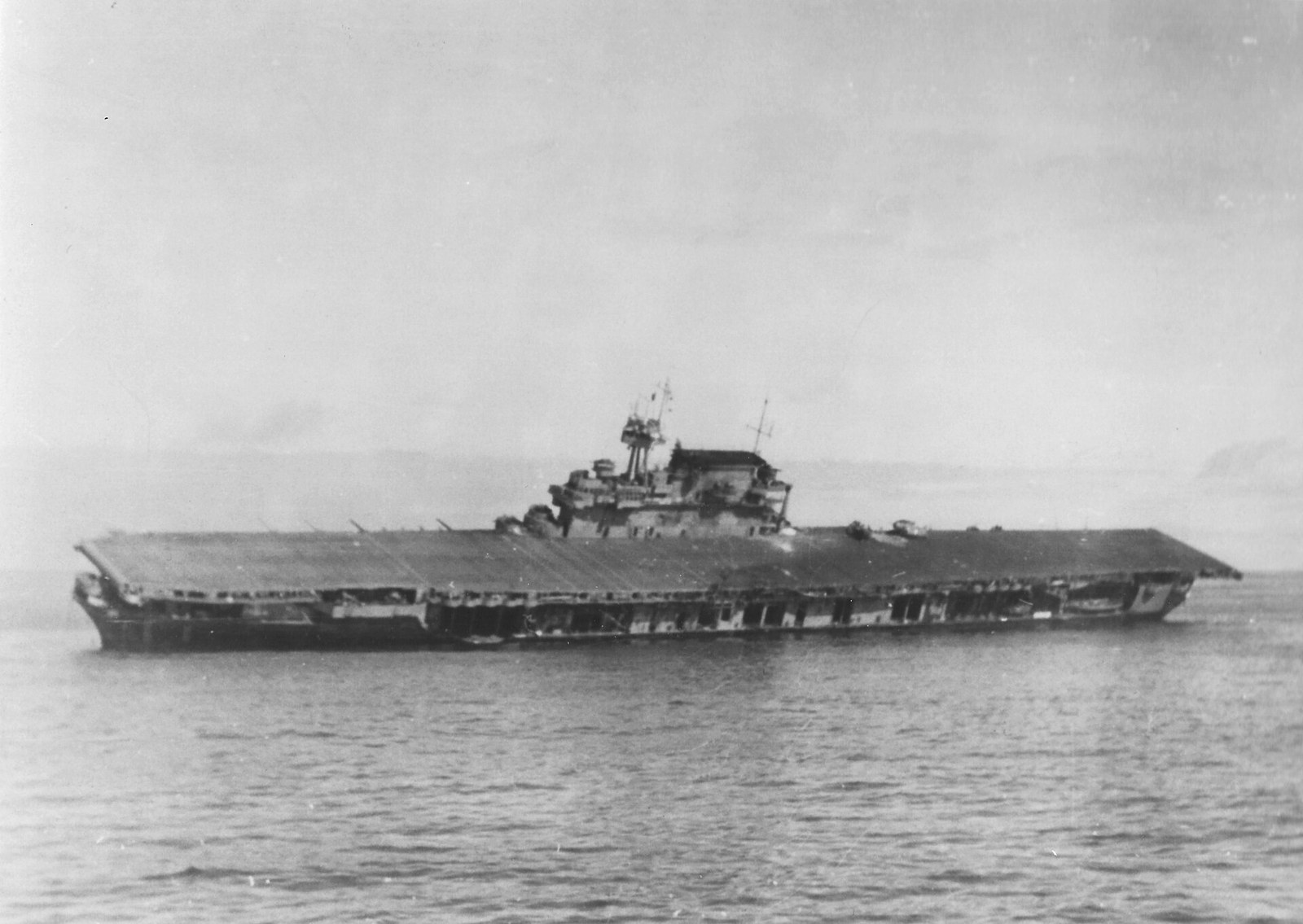
Yorktown‘s patrol shot down ten of them, anti-aircraft fire took two more, and six made their attacks between 1208 and 1214. Three bombs hit and two near misses did damage. Two opened twelve-foot holes in the flight deck, at frames 36 and 132, and one burst in the uptakes at frame 95, put boilers out of action and left her dead in the water. Five dive bombers and three Zeros got back to Hiryū. Kobayashi was among the dead.
Fletcher shifted his flag to the cruiser Astoria and passed tactical command of both task forces to Spruance. By about 1400 Yorktown was under way again at about 20 knots with her flight deck patched.
The second strike went shortly after 1245: ten B5N2 torpedo bombers where there should have been eighteen, with six Zeros, under Tomonaga, who had led the morning attack on Midway. His own aircraft had a fuel tank shot through over the atoll that had not been repaired, and he flew it knowing he could not get back. At 1426 they sighted a carrier under way with her escorts, and at 1432 Tomonaga ordered his sections to spread out and attack from different bearings. It did not occur to them that this was the same ship. Two torpedoes went into Yorktown‘s port side within about half a minute of each other and she took a list of 23 to 24 degrees. Unlike the American Mark XIII, the Japanese Type 91 detonated as designed. Seventeen minutes after the hits Captain Buckmaster ordered her abandoned. Tomonaga was seen to fly into the anti-aircraft fire, release, and explode. Five torpedo bombers and three Zeros came home, and by 1630 Hiryū‘s whole remaining air group was six Zeros, five dive bombers and five torpedo bombers.
Yamaguchi meant to send them out again at dusk and did not get the chance. One of ten VS-5 Dauntlesses Yorktown had put up on a search shortly before noon had found Hiryū. Spruance launched 25 Dauntlesses from Enterprise at about 1530 under Gallaher, eleven of her own and fourteen orphaned VB-3 aircraft with nowhere else to land. They came out of the south-west with the sun behind them, and Hiryū, which had no radar, did not see them until they were overhead. Thirteen dived on her and hit her four times at 1703, three close together on the forward flight deck and the fourth amidships by the bridge. Three Dauntlesses were shot down. Weber, who had helped to kill Akagi that morning, was shot down and killed by the Japanese patrol as the survivors re-formed.
All four carriers were then sunk by their own side. Sōryū took three torpedoes from the destroyer Isokaze at 1912 on 4 June and went down stern first; 711 of her men died, among them her captain, Yanagimoto Ryusaku, and 242 of her engineering staff. Kaga took two from Hagikaze into her starboard side at 1925; 811 died. Akagi, still circling on her jammed rudder, was torpedoed by four destroyers at 0520 on 5 June and sank tail first; 267 died. Hiryū was dead in the water by 2123 with her fires out of control. At 0230 on 5 June Yamaguchi ordered her abandoned and stayed aboard with her captain, Kaku Tomeo. The destroyer Makigumo put one torpedo into her at 0510 and she took four hours more to go: a scout from the light carrier Hōshō photographed her still afloat and burning, and she went down by the bow at 0912, 240 to 260 miles north-west of Midway. Her loss took 392 men with her.
Yorktown was still afloat on 5 June, and a salvage party under Buckmaster reboarded her on 6 June, the destroyer Hammann alongside to starboard with power, water and hoses, five destroyers screening. At 1335 the submarine I-168, under Lieutenant Commander Tanabe Yahachi, got inside the screen and fired four torpedoes at close range. One hit Hammann amidships, two ran under her into Yorktown‘s starboard side, one missed. Hammann broke in two and sank in under four minutes. Her depth charges had not been set to safe and went off as she went down, in the water where her people were swimming. Of 251 aboard, 81 were killed. Yorktown‘s list to port began to increase on 7 June, and at 0501 she turned over on her port side and sank in 3,000 fathoms.
No American torpedo hit a Japanese carrier at Midway. Every one of the four was sunk by a Japanese torpedo fired from a Japanese destroyer.
The five minutes that never were
The picture nearly everybody carries of 1022 on 4 June is of four Japanese flight decks packed with armed and fuelled aircraft, engines turning, minutes away from launching the strike that would have changed the war, at the moment the American dive bombers fell on them. It is the single largest error in the popular history of the battle, and it comes from one book: Midway: The Battle That Doomed Japan, by Fuchida Mitsuo and Okumiya Masatake, published by the United States Naval Institute Press in 1955.
The Japanese official war history says something different. Its Midway volume, published in 1971, records that the successive American attacks between 0705 and 1022 prevented the Japanese from spotting a strike on any of the four flight decks, that at 1022 the armed and fuelled aircraft of all four carriers were still in the hangars, and that spotting such a strike would have taken no less than forty minutes.
Work that forward and the window disappears. Spotting a strike of twenty-one aircraft took about forty minutes, and the launch itself another five to ten. To go after the American carriers, Nagumo needed an unbroken three quarters of an hour on all four decks at once, and between 0705 and 1022 he never had it. The decks were occupied continuously, recovering, refuelling, rearming and relaunching the combat air patrol.
The B-17s were over the Japanese fleet for thirty-five minutes that morning, and in the photographs they took there is not one aircraft on any of the four flight decks.
One thing cuts the other way and it belongs in the account. Hiryū, still unhit, began launching eighteen dive bombers and their fighter escort at 1054, roughly thirty minutes after her sisters were struck, which is faster than the forty-minute model allows. The historian who built that model says so himself and does not claim it is inviolable.
Why the fable lasted is the part worth understanding. Fuchida’s was for decades the only Japanese account of the battle available in English, and it froze the Japanese side of the story in place for about fifty years. Parshall’s verdict, published in 2022, is that the tale was intentionally fed into the historical record. It held because there was nothing to set against it, and among those who held it was the United States Navy.
What it cost
The American dead numbered 307, being 92 officers and 215 men, counted in the CINCPAC report of 28 June 1942. About 150 American aircraft were lost in action or damaged beyond repair. The carrier Yorktown and the destroyer Hammann were sunk. Hammann broke in two and went down in under four minutes with 81 of the 251 men aboard her, many of them killed in the water when her own depth charges detonated as she sank. The Marines lost 49 killed and 53 wounded. The Army Air Forces lost two B-26s with their crews, and two B-17s, one crew of which was rescued less one man.
Seventy American carrier aircraft were lost in the morning strikes alone: 37 torpedo aircraft, 21 dive bombers and 12 fighters, which was 40 per cent of the aircraft involved.
The Japanese lost 3,057 men killed and 248 aircraft, the entire embarked complement of the four carriers, spares and ferry aircraft included. Kaga took 811 men down with her, Sōryū 711, Hiryū 392 and Akagi 267, and the heavy cruiser Mikuma, sunk on 6 June, took 700. Roughly two thousand of the Japanese dead were engine room and hangar personnel who never saw the aircraft that killed them.
The aircrew figure is much smaller than the legend around it. One hundred and ten Japanese fliers were killed, 36 of them aboard the ships and 74 in the air, most of the latter from Hiryū. Over 700 aviation maintenance personnel were killed, a skill held in very limited supply in the Imperial Japanese Navy, and Rear Admiral Samuel J. Cox of the Naval History and Heritage Command argues that theirs was the harder loss to make good.
The United States Strategic Bombing Survey, reporting in 1946, found that two thirds of the pilots aboard the Japanese carriers that sank were rescued by Japanese destroyers, and that the fully trained Japanese naval air units, including those rescued at Midway, were lost later and piecemeal in the Solomons. Japan’s carrier aircrew were not destroyed at Midway. What was destroyed was four fleet carriers, 248 aircraft and 3,057 men. The American count was 307.
What it changed
Midway is routinely called the turning point of the Pacific war, and the official record does not settle the question. The United States Strategic Bombing Survey argues both sides of it in different chapters of the same report.
The case for is made by institutions. The Survey’s finding is that, deprived of its carriers, the Japanese fleet had to retire despite its preponderance in heavy ships, and that a balance of naval air power in the Pacific, and with it a balance of naval power as a whole, was achieved at Midway. Its word is balance, not superiority. The National Security Agency’s history of the codebreaking effort goes further: the victory exposed to American planners Japan’s incapability to wage effective carrier warfare in the central Pacific. And the Naval History and Heritage Command makes a political argument heard less often than it should be, that had Midway been an American defeat, Roosevelt would have had an extremely difficult time holding to his politically unpopular strategy of beating Germany first.
The counter-case is well founded, and part of it comes from the same Survey, which elsewhere dates the passing of the initiative to the end of 1942, after Guadalcanal and Buna. The Japanese Combined Fleet was not destroyed in June. Immediately after Midway Japan had four carriers fit for action with a fifth about to join, of which only one was large, and six more under repair or building; the United States in the same moment had three large carriers operational in the Pacific and thirteen further carriers and fifteen escort carriers being readied or under construction. The veteran aircrew went in the Solomons. And the Americans were not outnumbered in the air on 4 June: 234 carrier aircraft, with the atoll’s own squadrons behind them, against 229. Willmott holds that Coral Sea, Midway and Guadalcanal together shifted the strategy and that no single battle did it.
The Aleutians belong in this argument, because the operation in the north is usually explained as a feint to draw the American fleet away and it was nothing of the kind. The Navy’s official historians state flatly that Operation AL was not a diversion but a complementary operation, meant to set the conditions for occupying the islands. It opened a day before Midway, which is the wrong way round for a decoy, and it drew no American carrier away from Midway. The traditional reading is still in print in the Naval Institute’s own pages, so the point is argued rather than settled. What is not argued is what it cost Yamamoto: the two carriers of Carrier Division 4, under Rear Admiral Kakuta Kakuji, were in northern waters instead of with the Kidō Butai. From his own perspective it was indeed a diversion, but of his own resources.
Where the two cases meet is the timing. Japanese aircraft production did not peak until September 1944, at 2,572 aircraft a month, by which time a Japanese naval pilot was going into combat with just over 100 hours of flying against 600 for the American opposite him, where at the outbreak of the war the Japanese figure had been 650. The types both sides flew are still put into the air at displays, and our guide to photographing Second World War fighters in flight is written for that work. The rebuilt Japanese carrier arm was destroyed in a single day in the Philippine Sea in June 1944, flown by pilots with a fraction of the training their predecessors had.
Midway did not win the war in 1942. It set the terms on which the war would be lost in 1944.
What survives
One aeroplane that fought at Midway still exists. It is a Douglas SBD-2 Dauntless, Bureau Number 2106, at the National Naval Aviation Museum at Pensacola, and the museum records it as the only known surviving aircraft from the battle. It survived the attack on Pearl Harbor in an aircraft pool on Ford Island; it flew with Bombing Squadron 2 from Lexington on the Lae and Salamaua raids early in 1942; at Midway it was on the strength of Marine Scout Bombing Squadron 241. It does not fly; no Dauntless that flies is an SBD-2 or an SBD-3, and nothing airborne in 2026 was airborne on 4 June 1942.
The only other Midway Dauntlesses anyone has laid eyes on are inside Yorktown, where a remotely operated vehicle filmed at least three of them on the hangar deck on 19 and 20 April 2025, one still armed and lying inverted with a 500 lb bomb secured in its release cradle. They went down with the ship on 7 June 1942.
Of the other American types that flew that day the record is thinner. Not one Douglas TBD-1 Devastator survives on land anywhere in the world. Of the 129 built for service, none has been preserved in a museum or a private collection; all the known examples rest on the ocean floor. The only Devastator on display anywhere is a full-scale replica built for the 2019 film Midway.
The Naval History and Heritage Command announced a recovery project on 30 January 2026. The aircraft is TBD-1 Bureau Number 1515, which flew with Torpedo Squadron 5 from Yorktown as 5-T-6 and ditched in the lagoon at Jaluit Atoll in the Marshall Islands on 1 February 1942. She lies in 120 feet of water. Her three-man crew survived the ditching, were taken prisoner and came home after the surrender, which is why she is not a war grave. The plan is to lift her, conserve her at Texas A&M University and display her cleaned but not rebuilt at the new National Museum of the United States Navy. As of 21 August 2026 nothing has been raised.
The Vought SB2U Vindicator at Pensacola is the only Vindicator of any mark left in the world, and it is not the Midway variant. It is an SB2U-2; the Marine squadron at Midway flew SB2U-3s. Marine Second Lieutenant A. W. Lemmons put it into Lake Michigan on 21 June 1943, off the training carrier USS Wolverine, after the safety barrier tore its tailhook off, and it came out of the lake in 1990 with its fabric covering all but gone. Putting it back together took over 20,000 hours. Wherever the original parts could be treated and returned to the aircraft they were, in their original condition, the marks of corrosion still visible in the form of holes and rough areas.
No United States Navy Brewster F2A Buffalo survives. The F2A-3 that VMF-221 flew on the morning of 4 June is extinct. The only original Buffalo of any kind is BW-372, a Brewster Model 239 built for export to Finland, ditched in a Karelian lake on 25 June 1942 and recovered from it in the summer of 1998.
Seeing any of it means museum light rather than a flight line, and our guide to photographing aircraft indoors covers the angles and exposures that go with it. Our own aviation photographs are catalogued in the Piemags aviation archive, and the terms for reproducing one are set out on the licences page.
Two of the four Japanese carriers have been found. Kaga was located on 17 October 2019 and Akagi on 20 October 2019, by the research vessel Petrel, in more than 17,000 feet of water inside Papahānaumokuākea Marine National Monument. Sōryū and Hiryū have not been located. The two that have are war graves; 811 men went down in Kaga alone. They are worked under permit, by archaeologists, with Japanese academic partners, and nobody had laid eyes on Akagi until the survey of September 2023 found her intact but severely disarticulated and embedded in the sediment.
The atoll is not open. Midway Atoll National Wildlife Refuge and the Battle of Midway National Memorial are closed to public visitation and no reopening date has been published. Roughly 40 refuge staff, contractors and volunteers live there at any one time, and nearly three million birds nest on the sand. The airfield works on: Henderson Airfield on Sand Island, PMDY, is what keeps the refuge supplied. The eastern airfield, from which the Marine squadrons flew, closed in 1945.
The battle decided from the air is a claim about how the fighting was done, and it holds. The surface fleets never engaged, and Yamamoto’s main body got no opportunity to fight at all. Four fleet carriers were mortally damaged in a single morning by dive bombers and then scuttled by their own destroyers, and Mikuma was sunk by carrier aircraft two days later. No American torpedo hit a Japanese carrier. Not one bomb dropped by a B-17 hit a ship. The only successful American aerial torpedo attack of the entire battle was made by a PBY Catalina at night, against a fleet oiler.
What decided Midway was the one American weapon that worked as designed: a two-man dive bomber with holes drilled in its flaps so that it could hold a seventy-degree dive steady enough to hit a manoeuvring flight deck. Whether the battle was the turning point of the Pacific war can be argued in either direction. How it was decided cannot. Of everything that flew that morning, Japanese and American, one aeroplane is left, and it is a Dauntless.
Questions people ask
What aircraft fought at the Battle of Midway?
Four Japanese carriers went to Midway with three types between them: the Mitsubishi A6M2 fighter, the Aichi D3A1 dive bomber and the Nakajima B5N2 level and torpedo bomber. The operational air groups came to 72 A6M2, 70 D3A1 and 81 B5N2, 223 aircraft in all, and counting the ferry Zeros, the spares and the D4Y1s the four ships had 248 aircraft aboard. The American carriers flew the Grumman F4F-4 Wildcat, the Douglas SBD Dauntless and the Douglas TBD-1 Devastator. Midway itself held the Brewster F2A-3 Buffalo and F4F-3 Wildcats of VMF-221, the SBD-2s and SB2U-3 Vindicators of VMSB-241, Army B-17s and B-26s, six TBF-1 Avengers and thirty PBY Catalinas.
Why were the American torpedo bombers wiped out?
Because of the weapon, not only the aeroplane. The early Mark XIII torpedo tended to break up if it was dropped from above 50 feet or at more than 110 knots. To deliver it a Devastator had to come down to 50 feet, slow to under 110 knots, point at a carrier that was turning hard and hold that height and speed and heading for the last minutes of the run, with no evasive manoeuvre available inside those limits because the obvious ones broke the torpedo. A Zero closing on it was flying at more than three times that speed. Of 41 TBD-1s launched by VT-8, VT-6 and VT-3, 35 were shot down and not one torpedo hit.
Were the Japanese really five minutes from launching a strike?
No, and the picture comes from one book: Midway: The Battle That Doomed Japan, by Fuchida Mitsuo and Okumiya Masatake, published in 1955. The Japanese official war history records that the successive American attacks between 0705 and 1022 prevented a strike being spotted on any of the four flight decks, that at 1022 the armed and fuelled aircraft of all four carriers were still in the hangars, and that spotting such a strike would have taken no less than forty minutes. The B-17s were over the Japanese fleet for thirty-five minutes that morning and in the photographs they took there is not one aircraft on any of the four flight decks. One thing cuts the other way: Hiryu began launching eighteen dive bombers and their escort at 1054, roughly thirty minutes after her sisters were struck, which is faster than the forty-minute model allows.
Did the torpedo squadrons’ sacrifice clear the way for the dive bombers?
The traditional answer is not a popular corruption of the record but the record itself. Nimitz wrote it into his report of 28 June 1942: the VT squadrons were a sacrifice that enabled the dive bombers to make their attack almost unopposed. In the same paragraph he added that even had they attacked later and in perfect coordination, without adequate fighter protection their losses would have been probably as great. The modern revision, which is better evidenced, holds that the distortion of the Japanese combat air patrol was lateral rather than vertical, and that the earlier squadrons’ real contribution was taking time off the clock. The point remains argued. What no document supports is intent: nobody planned it, ordered it or anticipated it.
How many bombs hit each Japanese carrier?
Kaga took at least four and probably five, from some 25 to 27 aircraft attacking from 1022. Akagi took one direct hit and two damaging near misses, from Best, Kroeger and Weber at 1026; Best’s bomb struck amidships and went through into the upper hangar deck, and the near miss aft jammed her rudder. Soryu took three between 1025 and 1029, the last a thousand-pounder amidships that stopped her engines at once. Hiryu, which was not found until the afternoon, took four about seven hours later. Anyone who writes that multiple bombs hit Akagi has the count wrong.
Did the B-17s hit anything at Midway?
Not one bomb dropped by a B-17 hit a ship at Midway. Twelve of them bombed from 20,000 feet at 0814 in three groups across about twenty minutes at Soryu, Akagi and Hiryu, and the carriers were bracketed by falling water. Between 3 and 5 June the heavy bombers based on Midway flew fifty-five sorties in sixteen attacks and expended 314 bombs of 500 and 600 lb without hitting a warship, and they flew again on 6 June.
Was USS Yorktown really repaired in seventy-two hours?
She reached Pearl Harbor on 27 May 1942 and sailed on 30 May, so three days is the elapsed time from arrival to sailing, and the dry-docking was one part of it. She was photographed in Dry Dock No. 1 on 29 May, with about 1,400 shipfitters, machinists, welders and electricians on her around the clock. The Bureau of Ships had a term for the result and used it in the war damage report written after the battle: temporary repairs. The estimate of what putting her properly right would take had been about three months.
How many Japanese aircrew were killed at Midway?
One hundred and ten Japanese fliers were killed, 36 of them aboard the ships and 74 in the air. Over 700 aviation maintenance personnel were killed, and Rear Admiral Samuel J. Cox of the Naval History and Heritage Command argues that theirs was the harder loss to make good. The United States Strategic Bombing Survey found that two thirds of the pilots aboard the carriers that sank were rescued by Japanese destroyers, and that the fully trained Japanese naval air units, including those rescued at Midway, were lost later and piecemeal in the Solomons. Japanese losses in the battle were 3,057 men killed and 248 aircraft. The American dead numbered 307.
Who actually sank the four Japanese carriers?
Their own side. Soryu took three torpedoes from the destroyer Isokaze at 1912 on 4 June, Kaga two from Hagikaze at 1925, Akagi four destroyers’ torpedoes at 0520 on 5 June, and Hiryu one from Makigumo at 0510 on 5 June. No American torpedo hit a Japanese carrier at Midway. American dive bombers did the damage that made the scuttlings necessary.
Were the Aleutians a diversion to draw the American fleet north?
The Navy’s official historians state flatly that Operation AL was not a diversion but a complementary operation, meant to set the conditions for occupying the islands. It opened a day before Midway, which is the wrong way round for a decoy, and no American force went north on account of it. The traditional reading is still in print in the Naval Institute’s own pages, so the point is argued rather than settled. What is not argued is what it cost Yamamoto: the two carriers of Carrier Division 4 were in northern waters instead of with the Kido Butai.
What did the Wildcat’s folding wings cost?
Ammunition. The fold bought roughly a fifty per cent increase in the number of Wildcats a fleet carrier could embark, which is why Yorktown, Enterprise and Hornet each carried twenty-seven fighters at Midway rather than eighteen. The F4F-3 had four .50 in Brownings with 450 rounds per gun and about 34 seconds of firing time; the F4F-4 had six guns with 240 rounds per gun and under 20 seconds. Yorktown’s action report after the battle called the six-gun F4F-4 a mistake and said that for the opposition then being met, four guns with 450 rounds each were much superior to six with 240. The armament was left as it was.
Can you see any of the aircraft that fought at Midway?
One. A Douglas SBD-2 Dauntless, Bureau Number 2106, at the National Naval Aviation Museum at Pensacola, which the museum records as the only known surviving aircraft from the battle. Not one Douglas TBD-1 Devastator survives on land anywhere in the world, and the only Devastator on display anywhere is a full-scale replica built for the 2019 film Midway. The Vindicator at Pensacola is the only one of any mark left in the world and it is an SB2U-2, not the SB2U-3 the Marine squadron flew. No United States Navy Brewster F2A Buffalo survives at all. Midway Atoll National Wildlife Refuge and the Battle of Midway National Memorial are closed to public visitation.
Sources and further reading
- Commander in Chief, United States Pacific Fleet, Report to CominCh on the Battle of Midway, 28 June 1942, with the estimated Japanese order of battle and the casualty return. history.navy.mil
- Naval History and Heritage Command, H-Gram 006, Rear Admiral Samuel J. Cox, on the Japanese aircrew and maintenance losses and the fate of the four carriers. history.navy.mil
- Naval History and Heritage Command, H-016-2, on Operation AL and whether the Aleutians were a diversion. history.navy.mil
- National Security Agency, A Priceless Advantage: U.S. Navy Communications Intelligence and the Battles of Coral Sea, Midway, and the Aleutians, on the AF identification, the water ruse and what the codebreakers could not read. nsa.gov
- Jonathan Parshall, David Dickson and Anthony Tully, “Doctrine Matters: Why the Japanese Lost at Midway”, Naval War College Review, Vol. 54 No. 3, 2001, for the spotting and launch arithmetic. digital-commons.usnwc.edu
- Jonathan Parshall, “A Timeless Battle, Evolving Interpretations”, Naval History, June 2022, on the five-minute fable and the lateral distortion of the combat air patrol. usni.org
- United States Strategic Bombing Survey, Summary Report (Pacific War) and the Japanese naval air chapters, on the balance of naval air power and the rescue of the carrier pilots. anesi.com
- Lieutenant Colonel Robert D. Heinl Jr, Marines at Midway, Historical Section, US Marine Corps, 1948, for VMF-221, VMSB-241 and the atoll defences. ibiblio.org
- National Park Service, World War II Facilities at Midway, for the runways, the seaplane base, the dredging and the unfinished fuel storage. nps.gov
- National Naval Aviation Museum, collection record for Douglas SBD-2 Dauntless Bureau Number 2106. history.navy.mil
- Naval History and Heritage Command, news release announcing the project to recover Douglas TBD-1 Devastator Bureau Number 1515, 30 January 2026. history.navy.mil
- United States Fish and Wildlife Service, Midway Atoll National Wildlife Refuge, on access to the atoll and the memorial. fws.gov
- Papahanaumokuakea Marine National Monument and NOAA Ocean Exploration, on the location of Kaga and Akagi and the 2023 and 2025 surveys. oceanexplorer.noaa.gov
