The Boeing 707 was not the first jet airliner and it did not cross the Atlantic first. What it did was make the cheap seat pay, by carrying six people abreast instead of five and producing nearly three times the seat-miles a year of the piston aircraft it replaced. This is the Boeing 707 history that the barrel roll usually crowds out.
What is on this page
- The roll
- Sixteen million dollars, and no order
- The Dash 80
- Tanker or airliner
- The orders of 1955
- The aeroplane Boeing sold
- Water, then bypass
- The marks
- Flying it
- In uniform
- Idlewild to Le Bourget
- October 1958
- What else was flying
- The arithmetic
- What economy class actually was
- Share, not passengers
- The jet set
- What the accidents changed
- The long tail
- What finished it
- What the 727, the 737 and the 747 took from it
- What survives
- The judgement in the title
- Questions people ask
The roll
On Sunday 7 August 1955 the crowd at the Gold Cup hydroplane races on Lake Washington looked up and saw a four-engined jet transport come down the race course, lift its nose, and go over onto its back. It kept going, all the way round, and came out the right way up. Alvin M. “Tex” Johnston, Boeing’s chief of flight test, was flying it, with James R. Gannett in the right-hand seat and better than four hundred miles an hour on the clock. Then Johnston turned round, came back over the water, and did it again.
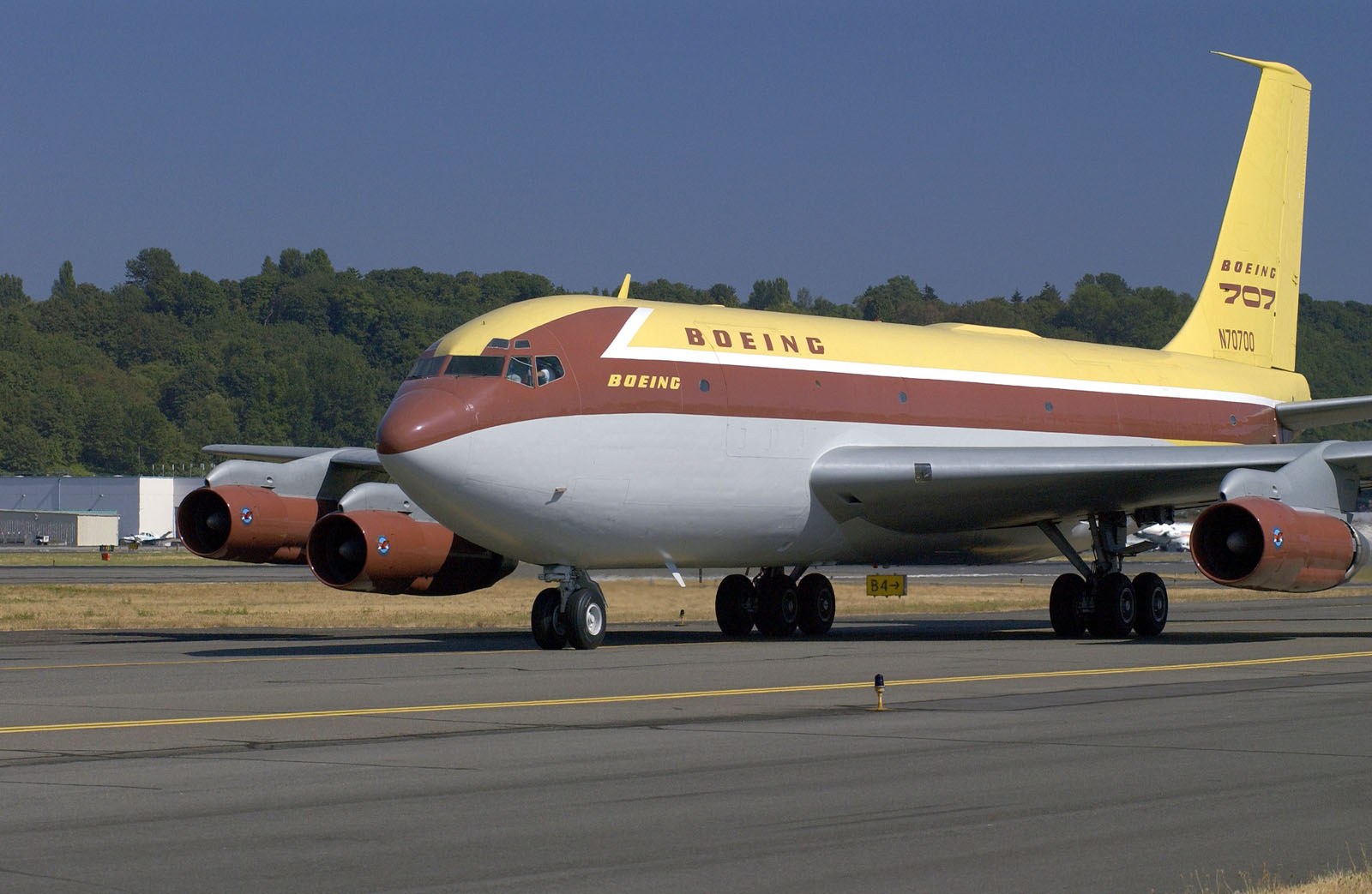
What he flew was a barrel roll, and a barrel roll is not the thing it appears to be from the ground. The aeroplane turns through a full roll while also pitching through a large arc. The climb is the point. Johnston pulled the nose up thirty-five degrees, fed in full roll control, and held a continuous back pressure the whole way round, so the wing went on lifting in the same sense for all 360 degrees. Inverted at the top of the barrel, the aeroplane was at the top of a wide loop, and the lift it needed still pointed up through the cabin floor.
A wing does not know its attitude. It knows load factor, and at one g it carries exactly the bending moment of straight and level flight, upside down or right way up. Roll about the flight path instead and the wing unloads to about minus one g inverted, which is what an airliner is not built for. Johnston, talking to the Seattle Times in 1990, said he had pulled one g throughout and that it was “almost like sitting in an easy chair”. “The barrel roll went so smoothly that a glass of water could have been placed on the instrument panel, and not a drop would have been spilled.”
None of which made it a small thing to do: it needs height, energy and a pilot who will not let the nose drop. Bill Allen, Boeing’s president, was down on the water with the airline customers. After the second roll he thought Johnston had lost his mind or the aeroplane was in trouble. He turned to Larry Bell, of Bell Aircraft, whose heart pills he knew about. “Give me one of those damned (heart) pills,” Allen said. “I need it worse than you do.” In Allen’s office the next morning, asked what he had thought he was doing, Johnston gave the answer that has outlived everyone in the story: “Selling the airplane.”
The flypast itself was no surprise. The regatta programme had advertised that Johnston would fly the aeroplane over the lake on race day, and only the roll was unannounced. Nor was the aeroplane a 707, whatever the headlines have said since, because no 707 existed in August 1955. It was the Model 367-80, one of one, and Boeing had paid for it out of its own pocket.
Sixteen million dollars, and no order
Boeing had been drawing jet transports since the end of the Second World War, on and off, through 1951. The turbojet had already flown in an aeroplane, in Germany, five days before the war began. In May 1952 the board authorised the money to build one: fifteen million dollars, later raised to sixteen. There was no customer. No airline had ordered it, and neither had the United States Air Force, though the aeroplane was aimed at both.
Sixteen million dollars was, by the American Society of Mechanical Engineers’ reckoning, about a quarter of the company’s net worth. It was not the whole of Boeing by any measure, either. The company in 1952 was building the B-47 and the B-52, and those lines were running at full stretch. The Dash 80 was funded alongside them, not instead of them.
The timing had an edge to it. De Havilland’s Comet had carried the first fare-paying jet passengers on 2 May 1952, and the American manufacturers had nothing in the air and nothing on order. Douglas was still selling piston airliners, the DC-7 among them, and was in no hurry to move. Boeing’s position was the reverse. It had no civil business worth defending, and the way to acquire one was to build the aeroplane and fly it in front of people.
The Dash 80
Construction of the Model 367-80 began at Renton in November 1953. It was rolled out in May 1954 in copper and canary, brown and yellow, with William M. Allen as master of ceremonies and the founder, William E. Boeing, watching in silence and failing health. Bertha Boeing broke champagne on the nose. “I christen thee the airplane of tomorrow,” she said, “the Boeing Jet Stratotanker Stratoliner.” There was no 707 in that name, and no pretence about what the aeroplane was for: two products at once, neither of them sold.
It made its maiden flight on 15 July 1954, with Johnston flying and Richard L. “Dix” Loesch beside him. She flew, Johnston said afterwards, like a bird, only faster.
The aeroplane was 127 ft 10 in long, spanned 129 ft 8 in, weighed 190,000 lb gross and carried four Pratt and Whitney turbojets of about ten thousand pounds of thrust each. Range was more than 3,500 miles. The Smithsonian’s record for the aeroplane says it flew 100 miles per hour faster than the de Havilland Comet.
The wing is where Boeing’s advantage lay, and it was not a secret one. George Schairer, the company’s chief aerodynamicist, was in Germany in the spring of 1945 with a technical intelligence team, found German wind-tunnel data on sweepback, and wrote home about it in May. Other American firms received the same data. Boeing turned it into aeroplanes, first the B-47 and then the B-52, and the 35 degrees of sweep at quarter chord runs unbroken from those bombers into the Dash 80. R. T. Jones had set out the physics for the National Advisory Committee for Aeronautics in 1947: what a wing feels is the component of the airflow normal to its leading edge, so sweeping it keeps that component below the critical speed while the aeroplane goes faster. The result cruises high and near Mach 0.8, and speed is productivity. Boeing had built two large swept-wing jets before the Dash 80 was begun, and nobody in the airliner business had built any.
Tanker or airliner
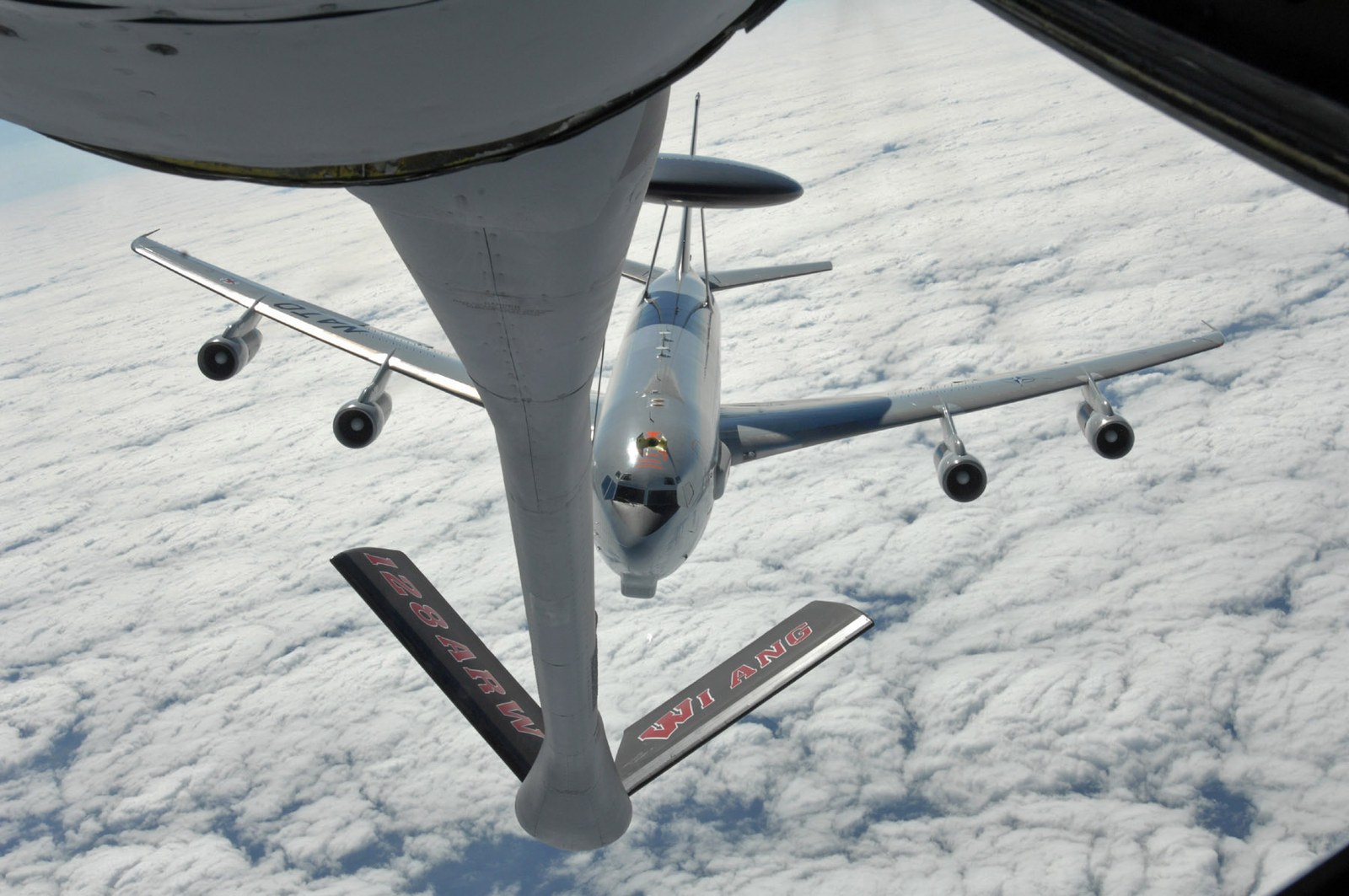
The Dash 80’s fuselage was 132 inches across at its widest, and neither of the aeroplanes that came out of it kept that figure. The Air Force wanted a jet tanker and got one: the KC-135, 144 inches wide and 168 inches high, which made its maiden flight on 31 August 1956 and reached Castle Air Force Base in California in June 1957. Boeing delivered 732 KC-135As by 1965 and 803 of all versions, and it remains the principal United States tanker.
Boeing had wanted the airliner to use that same 144-inch section, to economise on tooling, and the airlines told the company it was too narrow. Douglas was offering the DC-8 at 147 inches, which was enough for six seats abreast instead of five. Boeing went to 148. The decision to pay for the retooling was Allen’s, and the arithmetic behind it is simple and brutal: six abreast instead of five is a fifth more seats down the entire length of the cabin, for four inches of width, a few hundred pounds of structure and a very slightly draggier aeroplane. Cost per seat falls by about a sixth, on every aeroplane, for the whole of its life.
By then the tanker and the airliner had stopped being the same machine. The KC-135 flew more than fifteen months before the first 707, and it has a different cross-section, different aluminium alloys and a different pressure vessel. On the 707 the whole fuselage including the cargo holds is pressurised. On the tanker the lower lobe carries fuel cells and is not.
The KC-135 is not a military 707, and the 707 is not a widened KC-135. They are cousins. Both descend from the Dash 80, the tanker flew first, and by the time either was built they no longer shared a pressure hull.
The orders of 1955
The American jet age was bought, not launched, and the buying began in the summer of 1955. National Airlines contracted for six Douglas DC-8s on 10 August 1955, at thirty-six million dollars, for delivery in 1959 and 1960. Eastern Air Lines announced on 27 September that it would buy twenty American-built jets for a hundred and twenty-five million, without saying whether they would be Boeings or Douglases. W. A. Patterson of United said in September that his airline would order twenty-five jets, at the same price, before October was out.
Then, on 13 October 1955, Juan Trippe announced that the Pan American board had approved the purchase of two hundred and sixty-nine million dollars’ worth of jet transports. The Associated Press called it “the biggest contract by an American company for purchase of jet transport planes”, and it was, but the shape of it mattered more than the size. Trippe ordered twenty Boeing 707s and twenty-five Douglas DC-8s, from two competing manufacturers, with engines from one supplier on both.
Splitting the order was the whole trick. Neither manufacturer could dictate terms, and each had to assume the other was being told things it was not. The Douglas contract carried a confidentiality clause, and Boeing, on learning that Douglas was working on something larger, went back and renegotiated its own contract on Pan Am’s terms. Robert Daley’s summary of the mood around him is hard to improve on: “Apart from Juan Trippe, the aviation world was terrified of jets.”
What the order did was end the argument. National had committed; Eastern and United had announced intentions. Pan American put its money on both American jets at once, with Boeing deliveries to start in December 1958. After 13 October 1955 the question was no longer whether the airlines would go over to jets, but which manufacturer would be ready first, and with what.
The aeroplane Boeing sold
The first production 707 was N708PA, works number 17586, line number one, and it left Renton on 20 December 1957 with Tex Johnston flying, James Gannett in the right-hand seat and Tom Layne at the flight engineer’s panel. The weather closed in and the flight lasted seven minutes. A second flight the same day ran to an hour and eleven minutes.
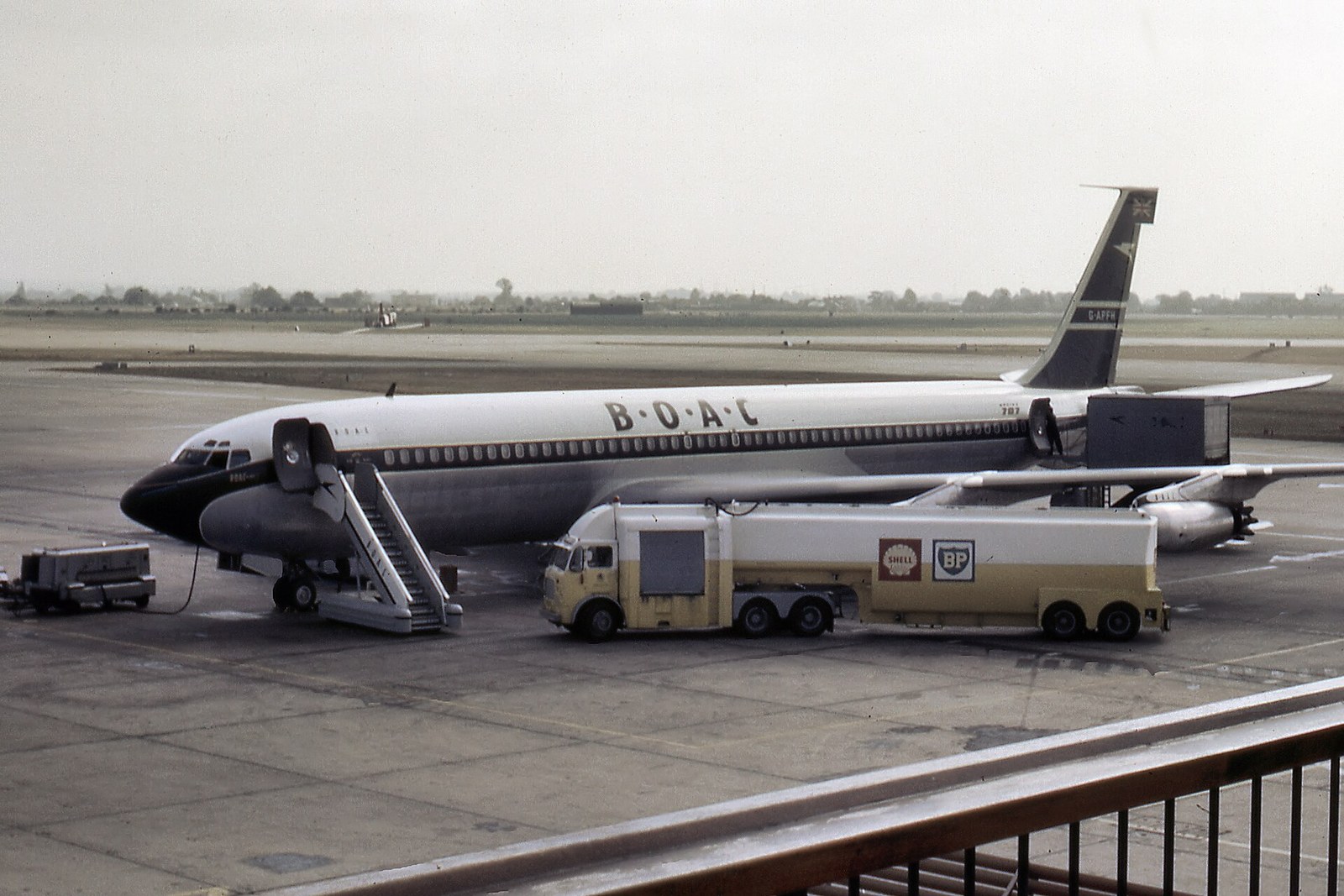
What went down the line at Renton was not the Dash 80 with a coat of airline paint. The prototype’s fuselage was 132 inches across at its widest. The 707’s upper lobe is 148 inches wide and 170.5 inches high, and the whole fuselage, cargo holds included, is a pressure vessel. The 707-120 came out 145 ft 1 in long against the prototype’s 127 ft 10 in. It spanned 130 ft 10 in, stood 42 ft 5 in to the top of the fin, and weighed 122,533 lb empty against the prototype’s 75,630 lb. The wing kept 35 degrees of sweep at quarter chord, and on the -120 it was near enough the KC-135’s wing.
The mechanical arrangement was the prototype’s: a two-spar aluminium wing with honeycomb skins on the flaps to save weight, two independent hydraulic systems at 3,000 psi, and lateral control divided between high-speed and low-speed ailerons working with spoilers on the upper surface. A swept wing is a poor lifting surface at low speed, so the 707 carried Krueger flaps along the leading edge and large flaps behind, and it still wanted a great deal of runway. The flight deck was laid out for three: captain, first officer, and a flight engineer facing sideways at a panel of his own.
| Mark | Length | Wingspan | Maximum take-off weight | Passengers, maximum |
|---|---|---|---|---|
| 707-120 | 145 ft 1 in | 130 ft 10 in | 247,000 lb | 174 |
| 707-320 | 152 ft 11 in | 142 ft 5 in | 312,000 lb | 194 |
| 707-320B | 152 ft 11 in | 145 ft 9 in | 328,000 lb | 194 |
| 707-320C | 152 ft 11 in | 145 ft 9 in | 335,000 lb | 219 |
| 720 | 136 ft 2 in | 130 ft 10 in | 229,300 lb | 131 |
The -120B shared the -120’s dimensions, the -420 the -320’s, and weights rose through the type’s life.
Water, then bypass
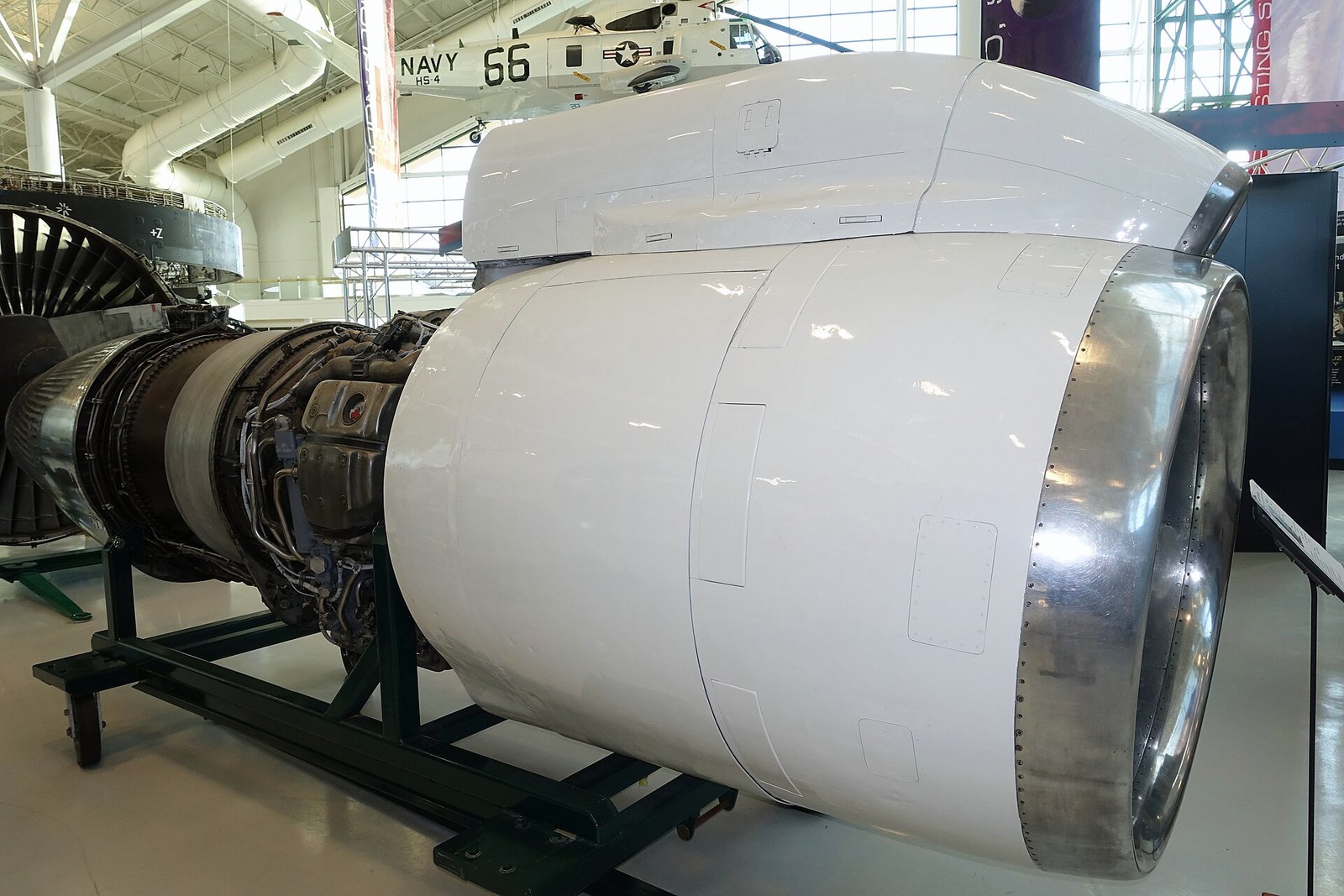
The 707-120 flew behind four Pratt and Whitney JT3C-6 turbojets rated at 11,200 lb of thrust each. Under an aeroplane of 247,000 lb that is thin, and turbojet thrust falls with air density, so it falls further on a hot afternoon and at an airport that sits high. The answer was water, which raised the take-off rating to 13,500 lb, about a fifth more. It was not cooling the engine. The National Advisory Committee for Aeronautics had set the mechanism out in 1950. The evaporating liquid takes heat out of the air, which gives “for the same compressor work input, a higher compressor pressure ratio”, and that raised ratio “increases both the mass flow of gases through the engine and the exhaust-jet velocity”. The water was demineralised, because ordinary water scales a compressor and a turbine. Crews ran the tank dry on departure and left a black plume over the airport.
| Engine | Type | Thrust, each | Fitted to |
|---|---|---|---|
| Pratt and Whitney JT3C-6 | turbojet | 11,200 lb dry, 13,500 lb wet | 707-120, -138, 720 |
| Pratt and Whitney JT4A-3 | turbojet | 15,800 lb | 707-220, 707-320 |
| Rolls-Royce Conway | bypass | 17,500 lb | 707-420 |
| Pratt and Whitney JT3D-1 | turbofan | 17,000 lb | 707-120B, 720B |
The Conway was the first production bypass (turbofan) engine. Rolls-Royce began it in 1952, ran it in 1953 and put it through government type-testing in 1955 with the lowest specific fuel consumption among tested jet engines at that time. It went into airline service on the 707-420 with Lufthansa in March 1960, ahead of the JT3D-powered 707-120B, which entered service with American in March 1961.
Pratt and Whitney’s answer was cleverer commercially than it was mechanically. The JT3D took the service-proven JT3 gas generator and put a two-stage fan on the front of it, so that a much larger mass of air moved rearwards at a much lower jet velocity for the same thrust. The Smithsonian’s record for the engine puts the result at 35 per cent more thrust, 15 to 22 per cent lower fuel consumption and 10 decibels less noise, for very little weight. Ten decibels is a factor of ten in acoustic power. Better still, the change needed only a simple modification to engines already in service, and an operator could make it with a kit from the manufacturer. Airlines converted their JT3C fleets instead of replacing them. The JT3D flew on a 707-120 on 22 June 1960.
The turbofan is what turned the 707 from a fast aeroplane that stopped at Gander into an intercontinental one. It bought thrust, fuel and quiet at once, and it could be bought as a kit.
The marks
Every 707 carried its customer in its designation. The last two digits are a customer code, so a 707-321 is a -300 series aeroplane for Pan American, a 707-331 the same series for TWA, a 707-436 a -400 for BOAC and a 707-138 a -100 for Qantas. Code 20 was reserved for Boeing’s own use and went to a single company demonstrator, which is why the generic forms read -120, -220, -320 and -420.
The 707-120 was the domestic aeroplane, 56 delivered. Qantas wanted less of it and got the 707-138, ten feet shorter with six frames taken out of the fuselage, seven built and six more as -138Bs. The 707-220 was a -120 with JT4A turbojets, five built, into service with Braniff in December 1959. The 707-320 was the intercontinental one, longer in the fuselage and much bigger in the wing, 69 delivered, into service with Pan American in August 1959. The 707-420 was that aeroplane with Conways, 37 built. Then came the turbofans: the 707-120B, 72 delivered, and the 707-320B, 174. The 707-320C, convertible between passengers and freight, took 337 deliveries, the largest single production block in the family and the reason the type earned its last twenty years as a freighter. Of the 856 707s Boeing delivered, 725 went to commercial customers between 1957 and 1978, and the rest were military.
The 720 is the odd one, nine feet shorter than the 707-120, lighter, with a glove added at the wing root, and aimed at shorter sectors and shorter runways. It flew on 23 November 1959 and entered service with United on 5 July 1960. Sixty-five were built as turbojets and 89 as 720Bs. Boeing delivered 856 707s of all versions and 154 720s, 1,010 aeroplanes in all, against 556 DC-8s.
Flying it
The flight engineer sat sideways behind the first officer and ran the aeroplane’s plumbing: electrics, pneumatics and air conditioning, pressurisation, the fuel system and fuel transfer, engine starting, and on the turbojet marks the water injection.
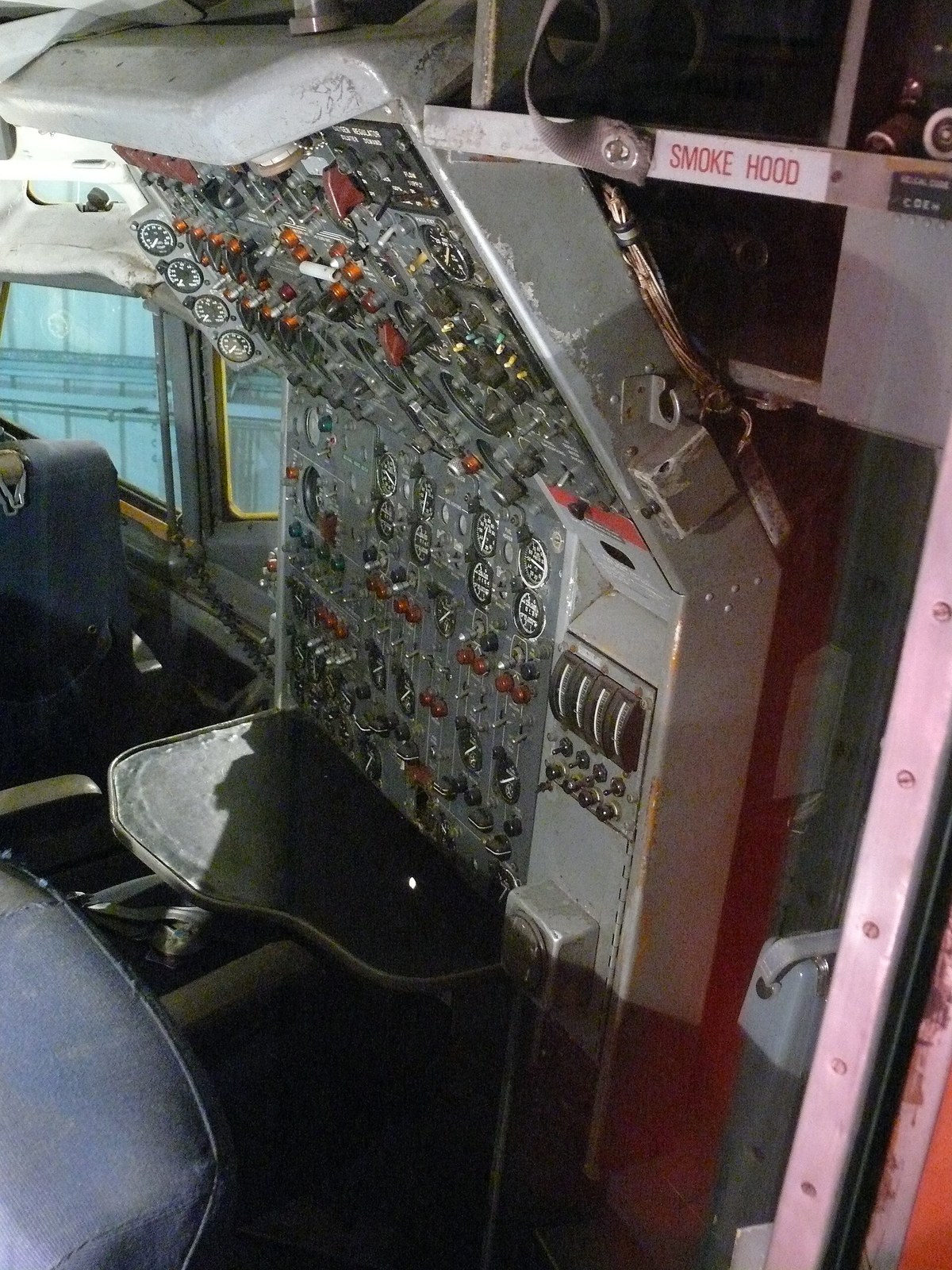
The take-off was the part of the aeroplane’s day that everybody remembers. The climb-out was flat by any modern standard, the water made the engines louder and blacker, and airports were rebuilt to suit. At Idlewild, runway 13R-31L was extended by 3,350 ft to 14,600 ft by August 1960, and runway 1-19 was restricted to propeller aircraft and then closed in 1961.
In the air the swept wing sent its own bill. Yaw and roll are strongly coupled on a swept wing, the early 707’s directional stability was weak, and it carried a yaw damper. With the damper off it would oscillate in a combined yaw and roll that a pilot could reinforce instead of damp, and Boeing was training airline crews in recovery from it in 1959. The company fitted a larger ventral fin to the 707-120 about a year after the type entered service, increased the fin area again, and issued a service bulletin on 5 February 1960 for an improved rudder with greater boost at low airspeed. The Federal Aviation Administration also found that the horizontal stabiliser had a range of nose-down trim movement in excess of what was needed to trim the aeroplane anywhere in its operating envelope. Crews had picked up the untrained habit of running the stabiliser trim with the elevator to lighten the control forces. That habit killed 43 people aboard a 720B in 1963, and the doctrine that trim is not a primary flight control was written afterwards.
The test crews were phlegmatic. James Gannett, on having to change out a hydraulic system during the programme: “It was just another part of the learning curve.” The people down the back were less prepared. A Pan American flight attendant remembered a departure: “Even more startling was the unexpected vibration and violent roar of the jet engines as we gathered speed for our leap up into the night.”
In uniform
The tanker was a different aeroplane and it flew first. What followed the 707 into uniform came from the airliner.
The E-3 Sentry is a modified 707-320B Advanced carrying a rotodome 30 ft across and 6 ft thick, mounted 11 ft above the fuselage, with four TF33-PW-100A engines of 20,500 lb thrust each by the Air Force’s own figure. The first went to the 552nd Airborne Warning and Control Wing in March 1977, and 68 were built for the United States, NATO, Britain, France and Saudi Arabia. The United States Air Force had sixteen E-3Gs on charge before one was hit in an attack on 27 March 2026.
The E-6 Mercury was also derived from the commercial 707, with four CFM56-2A-2 engines, and it does the job nobody advertises: airborne nuclear command, control and communications for the President, the Secretary of Defense and United States Strategic Command, and the TACAMO relay to ballistic-missile submarines. The Navy accepted the E-6A in August 1989 and the E-6B in December 1997, and the aircraft has flown both missions since October 1998. It remains in service, with the E-130J in development. The E-8 J-STARS is gone: the Air Force flew the last operational E-8C mission in the autumn of 2023 and retired the last airframe in November 2023.
Then the presidential aeroplanes. SAM 970, serial 58-6970, was a specially built Boeing 707-153, and it put a president in a jet: Eisenhower flew in it on 26 August 1959. It served him, Kennedy, Johnson and Nixon, and finished its VIP work in June 1996. SAM 26000, serial 62-6000, was a modified 707-320B with four TF33s of 18,000 lb each and a loaded weight of 336,000 lb. It entered service on 10 October 1962, carried eight sitting presidents from Kennedy to Clinton, and flew more than 13,000 hours. It took Nixon to China in February 1972. On 22 November 1963 it carried Kennedy’s body and the newly sworn-in President Johnson back to Washington.
Idlewild to Le Bourget
Pan American took delivery of its first 707 on 15 August 1958 and put it to work on 26 October, as Flight 114 from New York Idlewild to Paris Le Bourget. The aeroplane was named Clipper America, and it carried 111 passengers and about a dozen crew, with Greer Garson outbound and Frank Sinatra and Danny Kaye on the return.
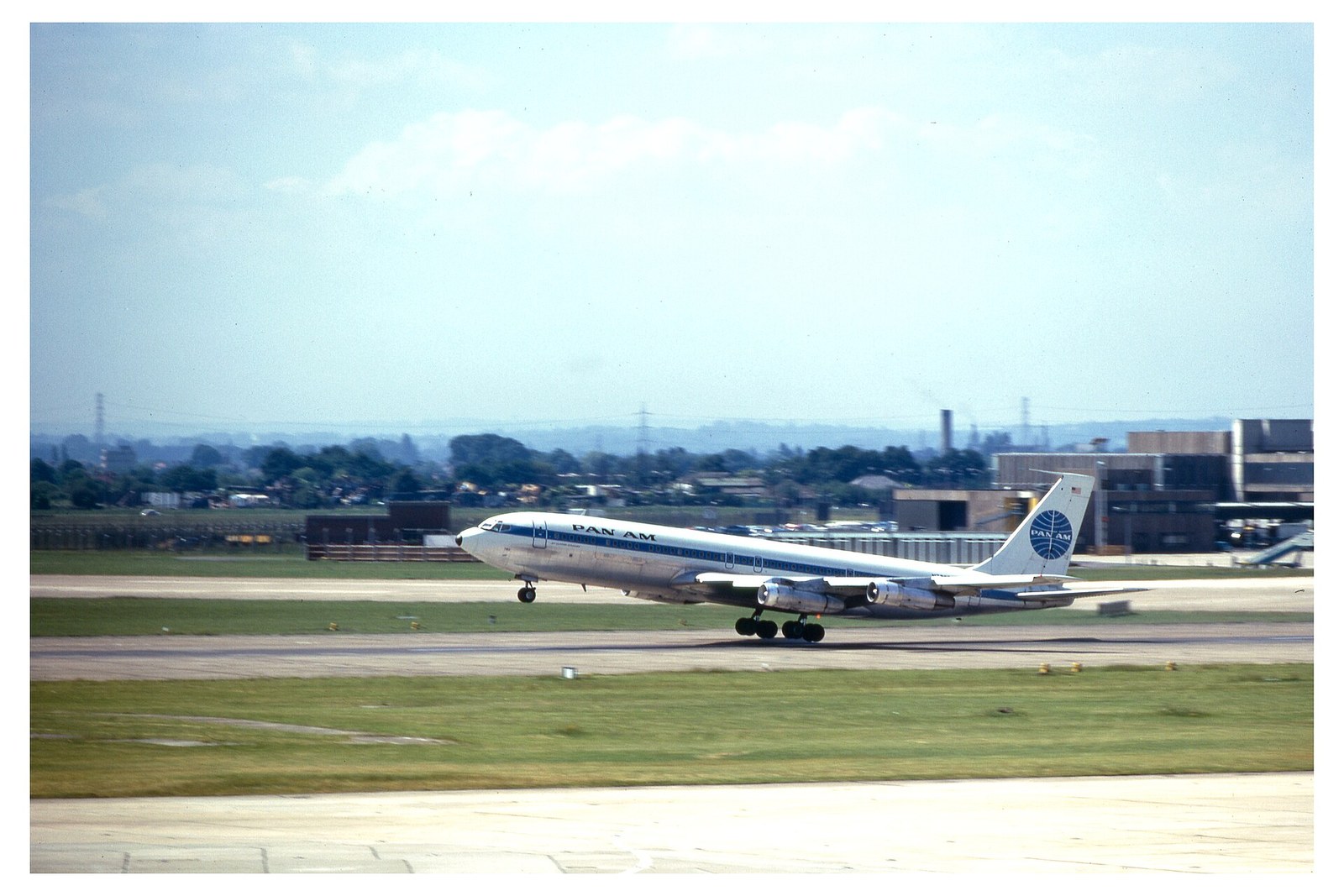
The crossing was not the clean run the occasion wanted. Clipper America stopped at Gander for fuel, met fog and unfavourable weather at the French end, and arrived at Le Bourget ninety-five minutes late, eight hours and twenty minutes out of New York. Pan Am’s timetable allowed seven hours and five minutes for the sector, and something over six of those hours was flying time. The number that mattered commercially sat beside it in the wire copy: piston aeroplanes took eleven hours on the same route.
October 1958
BOAC’s Comet 4 opened scheduled transatlantic jet services on 4 October 1958. Pan Am’s 707 followed on 26 October, twenty-two days later.
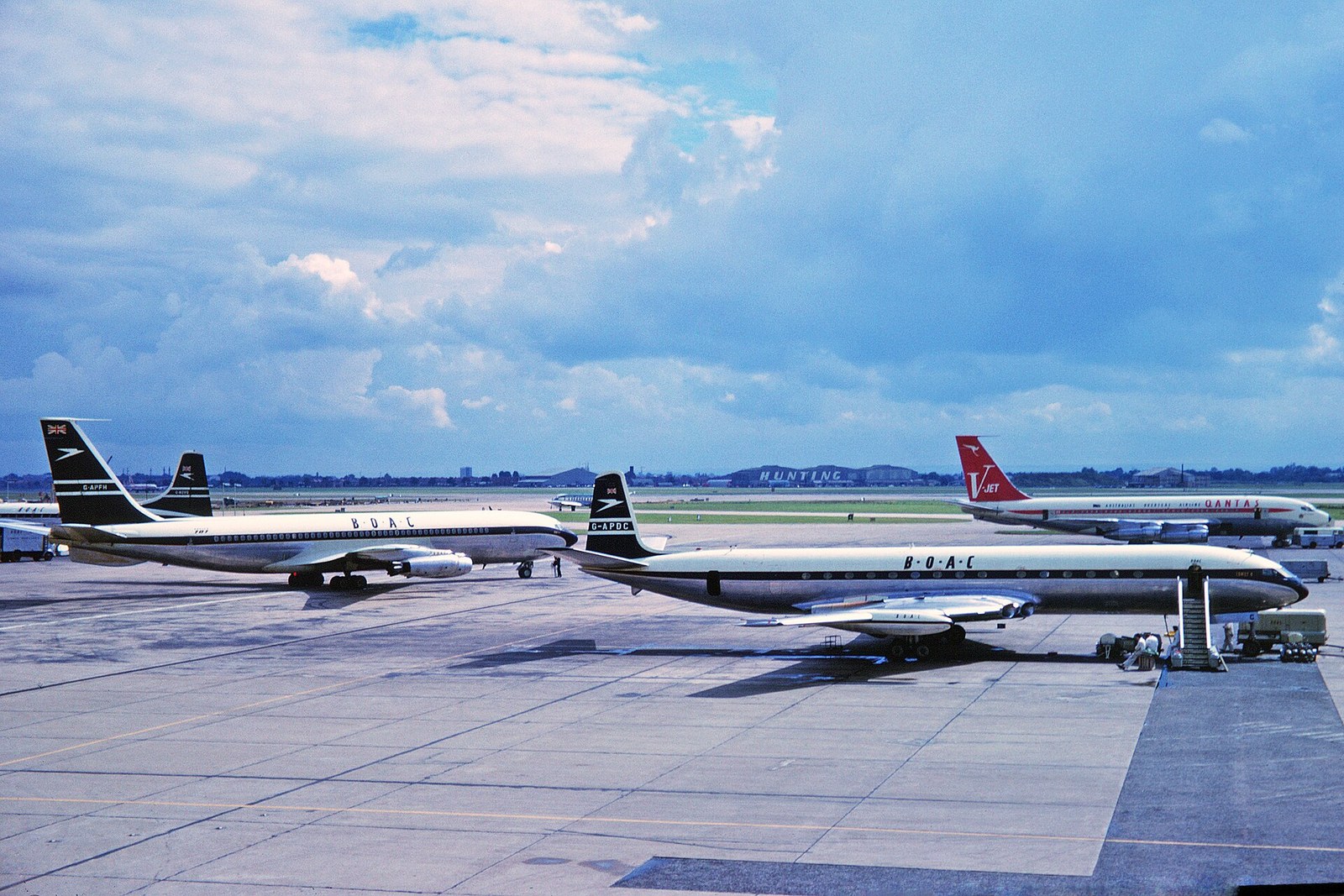
BOAC had taken both its Comet 4s on 30 September, each fitted with forty-eight seats. On the morning of the 4th, G-APDB left Idlewild at 7:01 under Captain Thomas Butler Stoney and landed in London six hours and twelve minutes later without stopping. The same morning G-APDC left Heathrow at a quarter to nine under Captain R. E. Millichap with thirty-one passengers, and took ten hours and twenty minutes including an hour and ten minutes at Gander. The Associated Press correspondent enjoyed himself: “What the British failed to do on water a few days ago, in the America’s Cup yacht races, they did in the air, beat the Americans.” Pan American, the report noted, had boasted that its bigger, faster Boeing would start the world’s first commercial jet flights across the Atlantic.
Westbound, neither aeroplane did it non-stop. The Comet 4 staged through Gander on the way out, and Pan Am’s inaugural 707 service took about eight and a half hours including a refuelling stop. Eastbound was another matter, as G-APDB had already shown.
The British lead was thinner than the date makes it sound. BOAC flew only two Atlantic services in the three weeks from 4 October, then cancelled its weekly schedule over a labour dispute. Both airlines began daily New York to London jet service on 16 November 1958, which is the date the Atlantic acquired a jet timetable rather than a jet occasion.
What else was flying
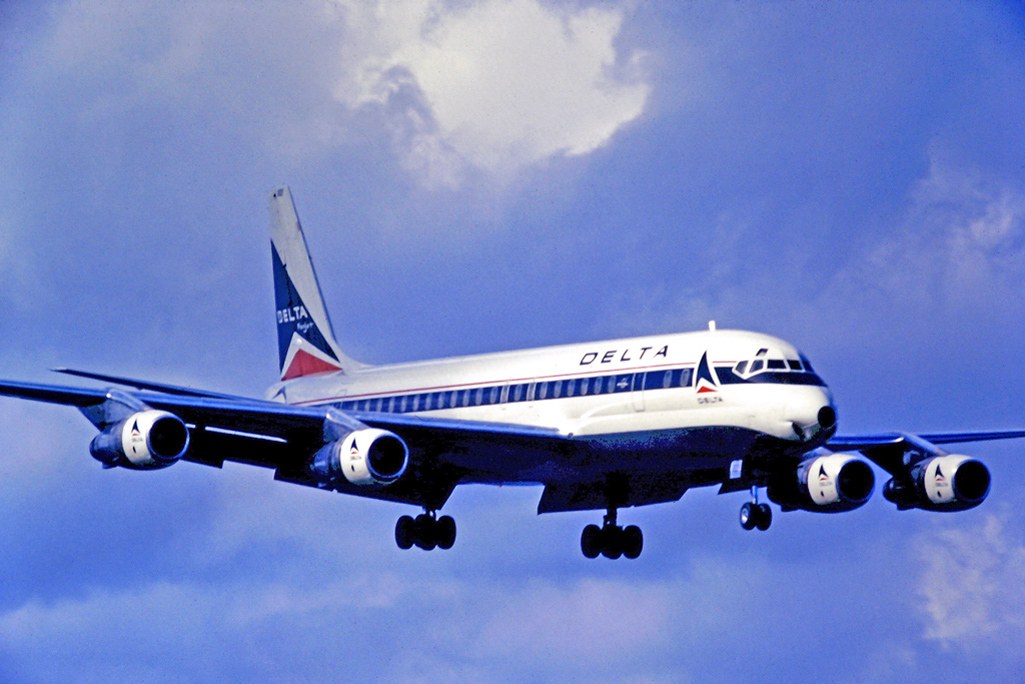
The Douglas DC-8 was the rival that mattered. It made its maiden flight on 30 May 1958 and entered service with United and Delta on the same day, 18 September 1959, Delta claiming the first departure with Flight 823 from Idlewild to Atlanta. Boeing’s own history says the 707’s greater wing sweep let it fly about 20 mph faster. What Douglas had, and Boeing did not, was room to grow. The DC-8-61 was nearly 37 ft longer in the fuselage and seated 259 all-economy, and the Series 70 took CFM56 engines and met the stiffer noise rules of the 1980s, which is why the DC-8 outlived the 707 in commercial service. A DC-8-43 also exceeded Mach 1 in a dive on 21 August 1961, the first jet airliner to do so, and not a 707.
Convair built the fast ones. The 880 entered service with Delta in May 1960 and the 990 Coronado with Swissair in 1962, the 990 cruising at Mach 0.84 behind anti-shock bodies that held down transonic drag, faster than either the 707 or the DC-8. Both seated five abreast where the 707 seated six, burned more fuel, and came with neither a freighter nor a stretch, and Boeing’s 720 was aimed at the same buyers. Around a hundred were built between the two types.
The Sud Aviation Caravelle entered service with SAS on 26 April 1959, engines at the back, nose and flight deck licensed from de Havilland and taken from the Comet. It flew the short fields and short sectors the 707 could not serve economically, sold a little over 280 aircraft, and left its rear-engine layout to the DC-9, the One-Eleven, the Trident and Boeing’s own 727. Range, payload and speed were what it lacked. The Tupolev Tu-104 entered Aeroflot service in 1956, two years before the 707, with roughly half the seats, a fraction of the range and no market outside the Soviet bloc.
The Vickers VC10 was designed to fly long range from short runways in the hot and high conditions of Africa and the Far East, because BOAC’s own 707s struggled fully laden at Addis Ababa and Nairobi. Rear-mounted Conways gave it a very quiet cabin and good short-field performance, against what the RAF Museum calls “very high fuel burn in the cruise which may explain why the aircraft attracted few overseas customers”. Fifty-four were built, into a market where the short runways it was designed for were being lengthened, largely because of the 707.
The arithmetic
What an airline buys is not speed. It is seat-miles per aeroplane per year, and the cost of producing them. The best matched comparison comes from the Civil Aeronautics Board’s operating-cost returns for 1965, matching one manufacturer’s jet against that manufacturer’s last piston airliner. It uses the DC-8 as the proxy for the 707, the DC-8-50 and the 707-320B being aeroplanes that did the same job.
| 1965 | DC-8-50 (jet) | DC-7 (piston) |
|---|---|---|
| Air speed | 479 mph | 286 mph |
| Average available seats | 125.5 | 77.0 |
| Available seat-miles per aircraft per year | 222.4 million | 81.5 million |
| Operating cost per available seat-mile | 1.13 cents | 1.98 cents |
| Net revenue per aircraft per year | $2,180,000 | $106,000 |
The piston cost per seat-mile is reconstructed from the table’s own columns rather than read off the page. The jet is 1.67 times as fast and carries 1.63 times as many people, and the two ratios multiply: one airframe produces 2.73 times the seat-miles in a year, at 57 per cent of the direct cost. The margin per seat-mile is multiplied by seven and a half, and the annual net revenue by twenty.
The capital account says it harder. A DC-8-50 cost $4.4 million in 1959 and a DC-7 $1.6 million in 1958. Set each aeroplane’s annual net revenue against its price and the jet returned close to half its own value every year, and the piston aeroplane about one part in fifteen. The piston fleets were not made obsolete by fashion but by arithmetic, faster than any airline’s depreciation schedule allowed for.
The passenger saw it as price. Yield on the international operations of United States carriers, the revenue actually collected per passenger-mile, was 6.55 cents in 1957 and 5.00 cents in 1970, a fall of 24 per cent in cash and 45 per cent in real terms. Domestic yield went the other way over the same years, from 5.31 cents to 6.00 cents. Anyone saying the jets cut fares has to say which fares, because on the Atlantic they fell and inside America they did not.
Volume followed. United States carriers flew 4.55 million international passengers in 1957 and 16.26 million in 1970, and revenue passenger-miles multiplied by 4.69. No piston fleet could have produced that many seat-miles at a price anyone would pay. That is the case for this article’s title, and it rests on three checkable things: six seats abreast instead of five, Atlantic block times roughly halved, and 1,010 airframes of one design taking both onto every route that would carry them.
The 707 did not invent the cheap seat. It made the cheap seat pay, by producing 2.73 times the seat-miles a year at 57 per cent of the cost per seat-mile.
What economy class actually was
Transatlantic economy class was filed in January 1958 to take effect on 1 April, and the aeroplanes that flew it were piston Super Constellations. The 707 carried its first fare-paying passenger in October.
| New York to London, as filed in January 1958 | One way | Return |
|---|---|---|
| Economy (new) | $252 | $453.60 |
| Tourist (raised) | $315 | $567 |
| First class (raised from $400) | $435 | |
| De luxe (raised from $450) | $485 |
The cheap fare was paid for at the other end of the aeroplane. First class and de luxe each went up by $35 at the same time, and the fifteen-day excursion fare was abolished. What the passenger got for the saving was set out without embarrassment: more seats per aeroplane, and the seats narrower. “There will be no liquor aboard, for sale or otherwise. No full meals will be served, but cold sandwiches, coffee, tea or milk will be available without charge.” The baggage allowance was forty-four pounds, the same as tourist.
The density is the point. KLM’s Super Constellations, which carried 61 passengers in tourist class, were to carry 97 in economy, and TWA planned all-economy flights in its own converted Super Constellations. Pan Am’s vice-president for traffic and sales, Willis G. Lipscomb, predicted that the previous year’s record of a million transatlantic air passengers would jump 20 per cent because of the fare. The travel editor who reported it thought it would put Europe within reach of hundreds who could not previously afford the extra tourist fare dollars. Nobody was talking about millions.
Share, not passengers
The ships did not empty. Passengers arriving in the United States by sea numbered 662,000 in 1955, 683,000 in 1957, 635,000 in 1958, 754,000 in 1960 and 867,000 in 1970. The line went up. Arrivals by air over the same years went from 1,178,000 to 9,172,000, and what collapsed was the sea’s share of the whole, from about 36 per cent to under 9.
The other half of the answer is what the ships had become. Cruise arrivals, counted separately from 1959, went from 142,000 to 569,000 by 1970, and taking them out of the sea total suggests that line voyages roughly halved while cruising quadrupled. A United States Naval Institute writer, looking back in 1968, put the crossing point of the two North Atlantic curves at 1957, a year before either the Comet 4 or the 707 carried a paying passenger across it. He reported that 86 of every 100 Atlantic passengers were by then going by air, and that Cunard had lost more than 40 million dollars on its passenger ships in six years while spending more than 80 million on the Queen Elizabeth 2, which is a cruise ship.
The jet set
The phrase is usually credited to the gossip columnist Igor Cassini, writing as Cholly Knickerbocker in the Hearst papers, as a replacement for cafe society. His own account of it, given in 1962, was that he used it “because it seemed appropriate in the age of the jet plane. I prefer it to cafe society because cafe society is outmoded.”
It escaped him quickly. On 7 June 1959 the Washington Sunday Star applied it to two American Airlines stewardesses working the airline’s inaugural jet service from Friendship Airport at Baltimore to Los Angeles: “Career girls are fast joining the jet set.” Within a year of the 707 entering service the words meant no more than people who fly on jets.
The number itself had become a commodity even earlier. Boeing’s own history records that requests poured in for permission to use “707” on consumer products, and that Jantzen titled its 1957 swimwear collection “the 707”, a year before an airline passenger had sat in one. Boeing’s claim for what followed is that travel by air eclipsed travel by rail and sea. The traffic figures support it.
What the accidents changed
Four accidents to 707s and 720s sit in the Federal Aviation Administration’s library of lessons learned from transport aeroplanes, each because a rule or a design changed afterwards.
On 14 May 1977 a Dan-Air Boeing 707-300, G-BEBP, was on approach to Lusaka at about 800 ft when the right horizontal stabiliser and elevator separated from the aeroplane. It pitched nose-down and dived into the ground. A fatigue crack had begun at the eleventh fastener hole in the rear spar upper chord, 14.25 in outboard of the stabiliser attachment pin, and had grown across about 60 per cent of the chord over an estimated 7,200 flights.
Why nobody was looking there is the engineering. The 707-300 had a third chord added to the rear spar to carry the loads of the larger stabiliser, and a stainless steel plate in place of part of the upper stabiliser skin. The plate stiffened the structure and raised the stress levels and load transfer in the inboard area of that chord. Fail-safe testing had been done on the two-chord -100 and -200 and was not repeated for the -300. Cracking was then found in 38 of the 521 707-300s in service.
Directives followed at once, ending with AD 79-10-16, which required a fourth chord to be added to the rear spar. The rule matters more. FAR 25.571, Amendment 45, took effect on 1 December 1978 and required damage tolerance evaluation of new transport aeroplanes: assume damage is present, and set inspections that will find it. The FAA says Lusaka is considered by many to be the final catalyst for it, and draws the lesson: “Increasing the strength or stiffness of a structural component has the potential to negatively impact the fatigue characteristics of that component.”
Three others left narrower marks. Lightning-induced ignition of the fuel and air mixture in a reserve tank destroyed a 707-121 near Elkton, Maryland, on 8 December 1963, and brought bonded fuel tank access panels, flame arresters in the vent system, and a minimum skin thickness over fuel tanks of about 0.080 in, where the skin of the lost aeroplane had been 0.064 in. The modern apparatus of lightning strike zoning followed from it. A 720B lost in the Everglades on 12 February 1963 brought the trim rules and section 25.255 on out-of-trim characteristics. The 707-321B that ran out of fuel at Cove Neck, New York, on 25 January 1990 brought standardised fuel phraseology, and seats: that accident was survivable, the FAA attributes the loss of life to seat structure failure, and it is the case cited for the 16 g dynamic seat standard.
The long tail
American airlines let the 707 go early. TWA Flight 4, Miami to New York on 30 October 1983, was the last scheduled 707 passenger service flown by a United States carrier: 79 passengers, two hours and forty minutes. A 707-320B for which TWA had paid 6.2 million dollars in 1966 was changing hands at 1.3 million in 1982.
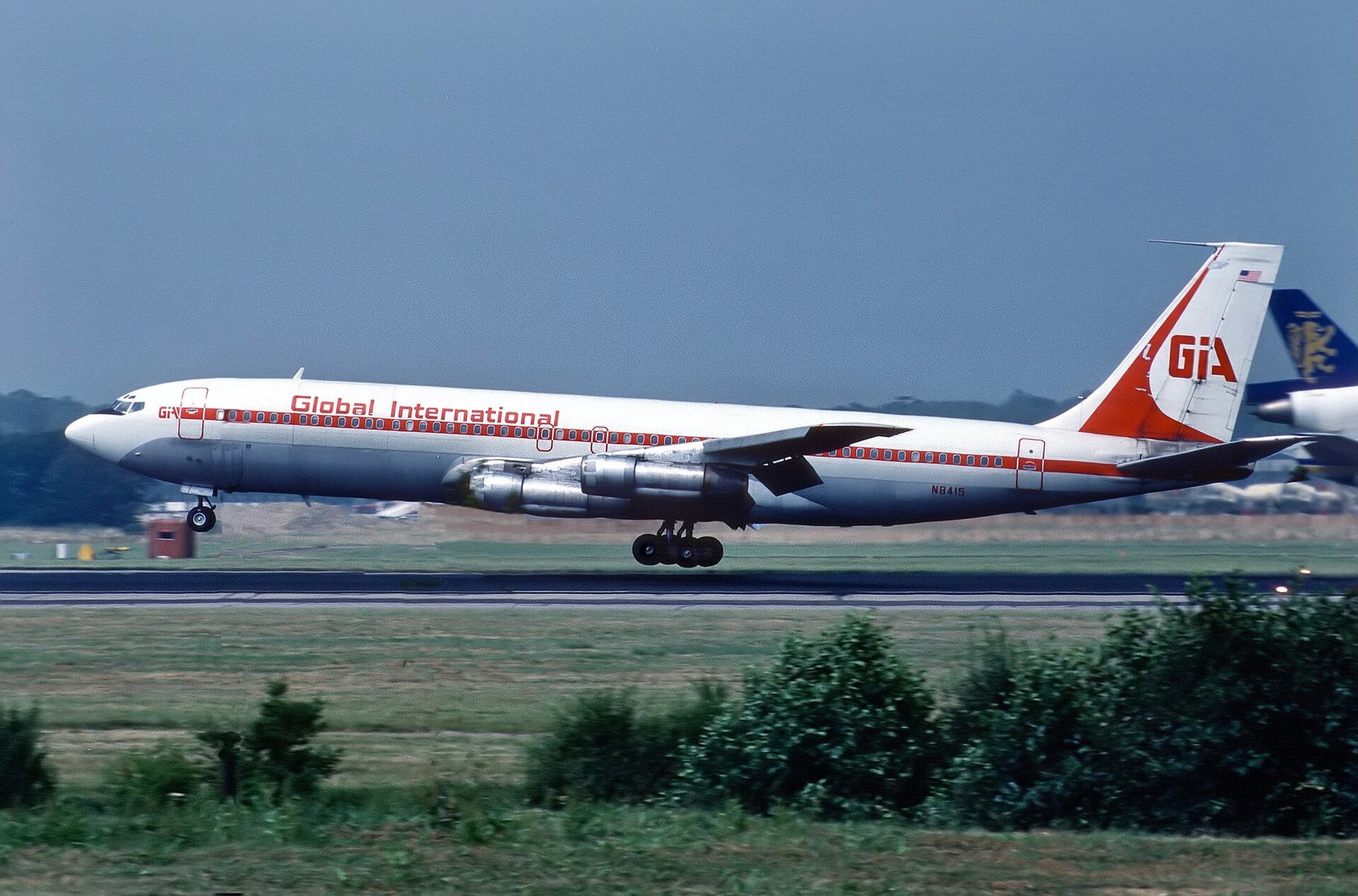
At that price it became somebody else’s asset. The order of the operator list is the story: the American majors, then the European flag carriers, then the Middle East, Asia, Africa and South America. Middle East Airlines flew 707s and 720s until the end of the 1990s, and Air Zimbabwe flew second-hand Lufthansa aircraft from 1985 to 1998. VARIG, LAN Chile, Ethiopian and Iran Air all operated the type.
What kept them working was freight. The 707-320C was convertible between passengers and cargo, and Boeing built more of that mark than of any other, which is why the type earned its last two decades carrying boxes. Saha Airlines of Iran suspended the last scheduled 707 passenger service in April 2013.
What finished it
The economics went first, and the failure is measurable. Robert Gordon’s figures, from Civil Aeronautics Board data, track the net revenue an aeroplane earned per available seat-mile. The 707-300B returned 0.0059 dollars in 1972 and the same in 1977. By 1982 it stood at minus 0.0022 and the 747-100 at 0.0127, and most United States airlines had grounded or retired their 707 fleets.
Boeing did not offer the airlines a re-engined 707, though the engineering was there to do it: the E-6 Mercury was built on the commercial 707 with four CFM56-2A-2 engines.
Then the rule closed the door. Under the Airport Noise and Capacity Act of 1990, 14 CFR section 91.853 barred any aeroplane subject to section 91.801(c) from operating to or from any airport in the contiguous United States after 31 December 1999 unless it had been shown to comply with Stage 3 or better noise levels. That caught subsonic jets over 75,000 lb, which caught the 707. Hush kits existed, and 172 Boeing 707s carried the Quiet 707 package by the late 1980s, but on an airframe of that age and fuel burn the work rarely paid.
Economics first, rules second. The 747 took the volume, the airframes went second-hand at a fraction of their price, and the deadline of 31 December 1999 closed the door on what was left in America.
What the 727, the 737 and the 747 took from it
Boeing’s own product history is specific about the inheritances. Passenger doors on the left side, at the front and at the rear of the cabin, became standard for subsequent Boeing jets. The 737 was given the same upper lobe fuselage as the 707 and the 727, so that the same upper deck cargo pallets fitted all three. Six abreast went forward as a selling point; the DC-9 seated five.
The 727 broke with the 707 where the 707 was wrong for the work. Designed for smaller airports with shorter runways than the 707 used, it took the Caravelle’s arrangement and hung its engines at the tail rather than under the wing.
The 737 went back to the 707’s layout, and Boeing’s reasons for putting the engines in pods under the wing are the engineering argument in three clauses: it buffered some of the noise, it decreased vibration, and it made the aeroplane easier to maintain at ground level. The 737 flew on 9 April 1967 and the 747 on 9 February 1969, the latter built because of reductions in airfares, a surge in air-passenger traffic and increasingly crowded skies.
The 707 did not invent the swept wing, the podded engine or the jet airliner. It settled their arrangement: a wing swept 35 degrees at quarter chord, engines in pods ahead of and below it, a pressurised tube of six-abreast seats, doors fore and aft on the left.
What survives
The type has left airline service, and no 707 has flown a scheduled passenger service since 2013. The Dash 80 is held by the Smithsonian National Air and Space Museum. It flew for the last time on 27 August 2003, to Washington Dulles, and went on display at the Steven F. Udvar-Hazy Center at Chantilly, Virginia. SAM 26000 went to the National Museum of the United States Air Force at Dayton in May 1998, and SAM 970 to the Museum of Flight in Seattle.
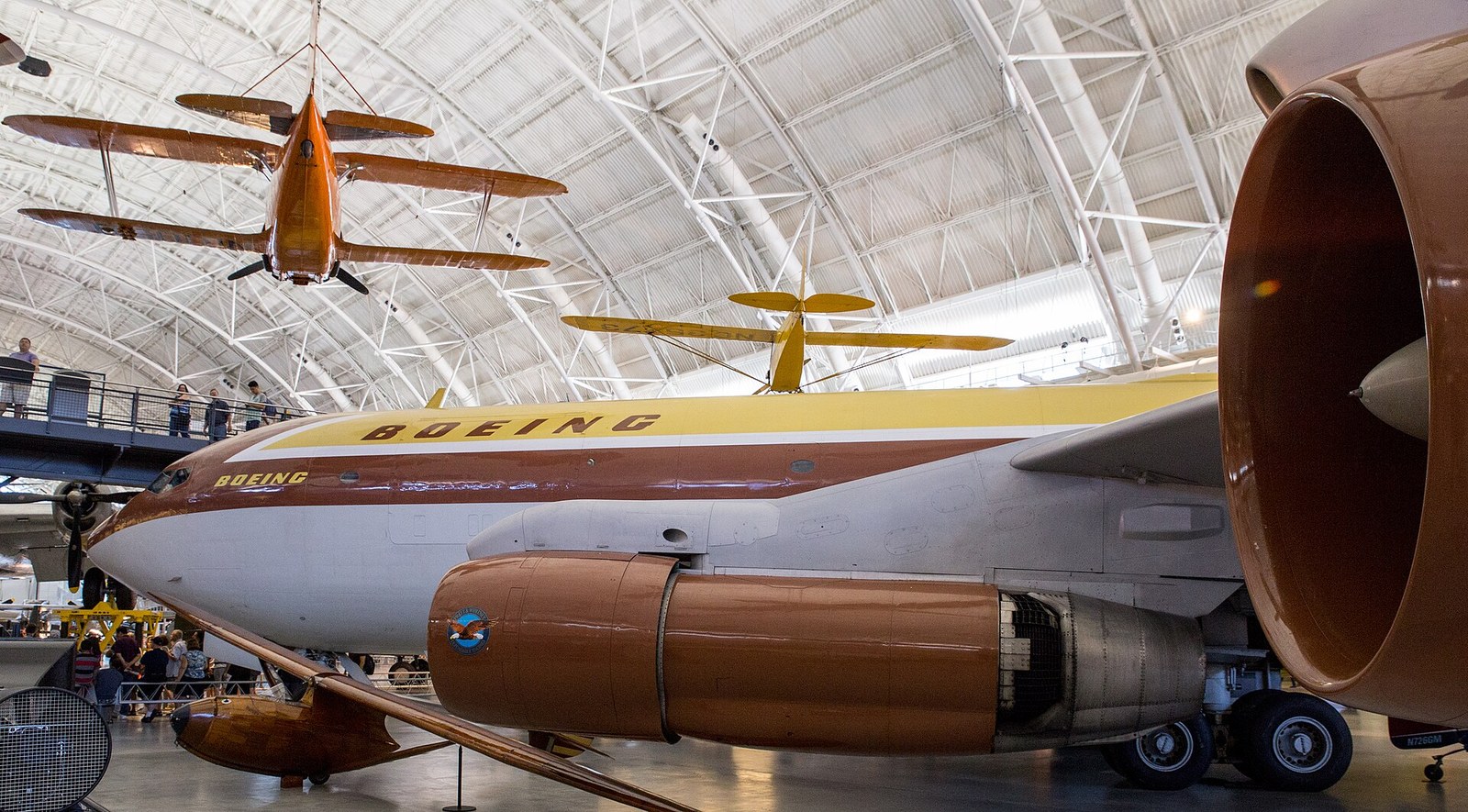
Photographing what is left of this generation is museum work and military work rather than airline work, and our guide to shooting civil airliners covers the apron and approach angles that still apply to the survivors. Our own aviation photographs are catalogued in the Piemags aviation archive, and the terms for reproducing one are set out on the licences page.
707-derived airframes are still flying in military service in 2026: the E-3 Sentry, the E-6 Mercury and a small number of tankers. Israel took delivery of its first KC-46A on 27 May 2026, to replace tankers built on 707 airframes.
The judgement in the title
“The jet that made mass air travel” is a judgement rather than a measurement, and it does not rest on being first at anything. The Comet flew first and carried the first fare-paying jet passengers, on 2 May 1952. The Tupolev Tu-104 entered Aeroflot service in 1956, and for part of 1956 to 1958 it was the only jet airliner flying scheduled services anywhere. BOAC’s Comet 4 opened scheduled transatlantic jet services on 4 October 1958, and Pan Am’s 707 followed twenty-two days later. The Douglas DC-8 did the same work at the same time, and 556 of those were built.
What the judgement rests on is quantity and shape. Boeing delivered 856 707s and 154 720s, 1,010 aeroplanes. The cabin was six abreast rather than five, a fifth more seats for the whole length of it. And Pan Am scheduled the crossing at seven hours and five minutes where the piston aeroplanes it replaced took eleven.
The second legacy has nothing to do with how many people were carried. Since the end of 1978 a new transport aeroplane has had to be shown to tolerate damage assumed to be present, and inspected on a schedule that will find it. That rule was written after a 707’s tailplane came off over Zambia, because a stiffening plate nobody had analysed moved the stress into a hole nobody was inspecting. The aeroplane is remembered for the seats. The rule it left behind decided how the fleet that replaced it would be inspected.
Questions people ask
When did the Boeing 707 first fly?
The first production 707 was N708PA, works number 17586, line number one, and it left Renton on 20 December 1957 with Tex Johnston flying, James Gannett in the right-hand seat and Tom Layne at the flight engineer’s panel. The weather closed in and the flight lasted seven minutes. A second flight the same day ran to an hour and eleven minutes.
Did Tex Johnston really barrel-roll a Boeing 707?
He rolled the Model 367-80, the prototype, not a 707, because no 707 existed in August 1955. On Sunday 7 August 1955 he flew it over the Gold Cup hydroplane races on Lake Washington, rolled it, turned round and did it again. Asked in Bill Allen’s office the next morning what he had thought he was doing, Johnston said: “Selling the airplane.”
Was the Boeing 707 the first jet airliner?
No. De Havilland’s Comet carried the first fare-paying jet passengers on 2 May 1952, six years earlier. The 707 was the first American jet airliner. The Tupolev Tu-104 entered Aeroflot service in 1956, and for part of 1956 to 1958 it was the only jet airliner flying scheduled services anywhere.
Which jet crossed the Atlantic first on a scheduled service?
BOAC’s Comet 4 opened scheduled transatlantic jet services on 4 October 1958. Pan Am’s 707 followed on 26 October, twenty-two days later. Neither did it non-stop at first. The British lead was thinner than the date makes it sound, because BOAC flew only two Atlantic services in the three weeks from 4 October and then cancelled its weekly schedule over a labour dispute. Both airlines began daily New York to London jet service on 16 November 1958.
Is the KC-135 a military Boeing 707?
No. The KC-135 is not a military 707 and the 707 is not a widened KC-135. They are cousins. Both descend from the Dash 80, whose fuselage was 132 inches across at its widest. The tanker is 144 inches wide, the 707’s upper lobe is 148 inches, and the tanker flew more than fifteen months before the first 707. On the 707 the whole fuselage including the cargo holds is pressurised. On the tanker the lower lobe carries fuel cells and is not.
How many Boeing 707s were built?
Boeing delivered 856 707s and 154 720s, 1,010 aeroplanes. Douglas built 556 DC-8s.
What engines did the Boeing 707 have?
Four, and which four depended on the mark. The 707-120 flew behind Pratt and Whitney JT3C-6 turbojets rated at 11,200 lb of thrust each dry and 13,500 lb with water injection. The 707-220 and 707-320 used the JT4A-3 at 15,800 lb, the 707-420 the Rolls-Royce Conway at 17,500 lb, and the 707-120B and 720B the JT3D-1 turbofan at 17,000 lb.
Why did early Boeing 707s use water injection?
Because turbojet thrust falls with air density, so it falls further on a hot afternoon and at an airport that sits high, and 11,200 lb of thrust each is thin under an aeroplane of 247,000 lb. Water raised the take-off rating to 13,500 lb, about a fifth more. It was not cooling the engine. The evaporating liquid takes heat out of the air, which gives a higher compressor pressure ratio for the same compressor work, and that raised ratio increases both the mass flow through the engine and the exhaust jet velocity. The water was demineralised, because ordinary water scales a compressor and a turbine.
Did the Boeing 707 make flying cheap?
Not by inventing the cheap seat. Transatlantic economy class was filed in January 1958 to take effect on 1 April, at 252 dollars one way from New York to London, and the aeroplanes that flew it were piston Super Constellations. What the jet did was make the cheap seat pay. Against the last piston airliners, one airframe produced 2.73 times the seat-miles in a year at 57 per cent of the direct cost per seat-mile.
Did the Boeing 707 kill the ocean liners?
It took their share, not their passengers. Arrivals in the United States by sea numbered 662,000 in 1955 and 867,000 in 1970, so the line went up. Arrivals by air over the same years went from 1,178,000 to 9,172,000, and the sea’s share of the whole fell from about 36 per cent to under 9. What the ships became was cruise ships: cruise arrivals, counted separately from 1959, went from 142,000 to 569,000 by 1970.
What finished the Boeing 707 in airline service?
The economics went first. Net revenue per available seat-mile for the 707-300B was 0.0059 dollars in 1972 and the same in 1977, and by 1982 it stood at minus 0.0022 while the 747-100 stood at 0.0127. Then the rule closed the door. Under the Airport Noise and Capacity Act of 1990, 14 CFR section 91.853 barred the type from any airport in the contiguous United States after 31 December 1999 unless it met Stage 3 noise levels. Hush kits existed, and 172 Boeing 707s carried the Quiet 707 package by the late 1980s, but on an airframe of that age and fuel burn the work rarely paid.
Are any Boeing 707s still flying?
The type has left airline service, and no 707 has flown a scheduled passenger service since 2013, when Saha Airlines of Iran suspended the last one in April of that year. 707-derived airframes are still flying in military service in 2026: the E-3 Sentry, the E-6 Mercury and a small number of tankers. The Dash 80 is held by the Smithsonian National Air and Space Museum, on display at the Steven F. Udvar-Hazy Center at Chantilly, Virginia.
Sources and further reading
- American Society of Mechanical Engineers, Historic Mechanical Engineering Landmark brochure for the Boeing 367-80. asme.org
- Smithsonian National Air and Space Museum, object record for the Boeing 367-80. airandspace.si.edu
- Smithsonian National Air and Space Museum, object record for the Pratt and Whitney JT3D turbofan. airandspace.si.edu
- HistoryLink, the Boeing 367-80 and the widening of the fuselage from 144 to 148 inches. historylink.org
- HistoryLink, Tex Johnston rolls the Dash 80 over Lake Washington, 7 August 1955. historylink.org
- Associated Press, Pan American orders 269 million dollars of jet transports, reported on the front page of the Evening Star, 13 October 1955. chroniclingamerica.loc.gov
- The new transatlantic economy fares, filed January 1958, reported in the Sunday Star of 19 January 1958, page A-30, with the full fare table by class. loc.gov
- BOAC opens transatlantic jet services, front page of the Evening Star, 5 October 1958. chroniclingamerica.loc.gov
- Pan American flies Clipper America to Paris, front page of the Evening Star, 27 October 1958. chroniclingamerica.loc.gov
- Robert J. Gordon, “Commercial Aircraft”, chapter 4 of The Measurement of Durable Goods Prices, National Bureau of Economic Research, using Civil Aeronautics Board operating cost data. nber.org
- Federal Aviation Administration, Lessons Learned from Transport Airplane Accidents: Dan-Air Boeing 707-321C G-BEBP, Lusaka, 14 May 1977, and the damage tolerance rule that followed. faa.gov
- United States Code of Federal Regulations, 14 CFR 91.853, the Stage 3 noise deadline of 31 December 1999. ecfr.gov
- Money in this article is given in the money of its own day. Where any historic sum is compared with the present, the basis is the United States consumer price index for all urban consumers, series CUUR0000SA0, 1982 to 1984 = 100, from the Bureau of Labor Statistics. bls.gov
- Boeing, Select Products in Boeing History, the company’s own product record for the 367-80, the 707, the 720, the 727, the 737 and the 747. boeing.com
- Federal Aviation Administration, Lessons Learned from Transport Airplane Accidents: Northwest Airlines 705, Boeing 720B N724US, Florida Everglades, 12 February 1963. faa.gov
