The F-35 Lightning II is one of the most photographed new military aircraft of its generation and one of the hardest to source well: air-to-air imagery with the type is rare, tightly controlled and in constant editorial demand. This guide, the fourth in our series for picture buyers, is built around a collection that answers that demand directly: a full air-to-air sortie with Belgian Air Force F-35As, flown over Arizona in March 2025 during the Belgian fleet’s training period, months before the first jets arrived in Belgium.
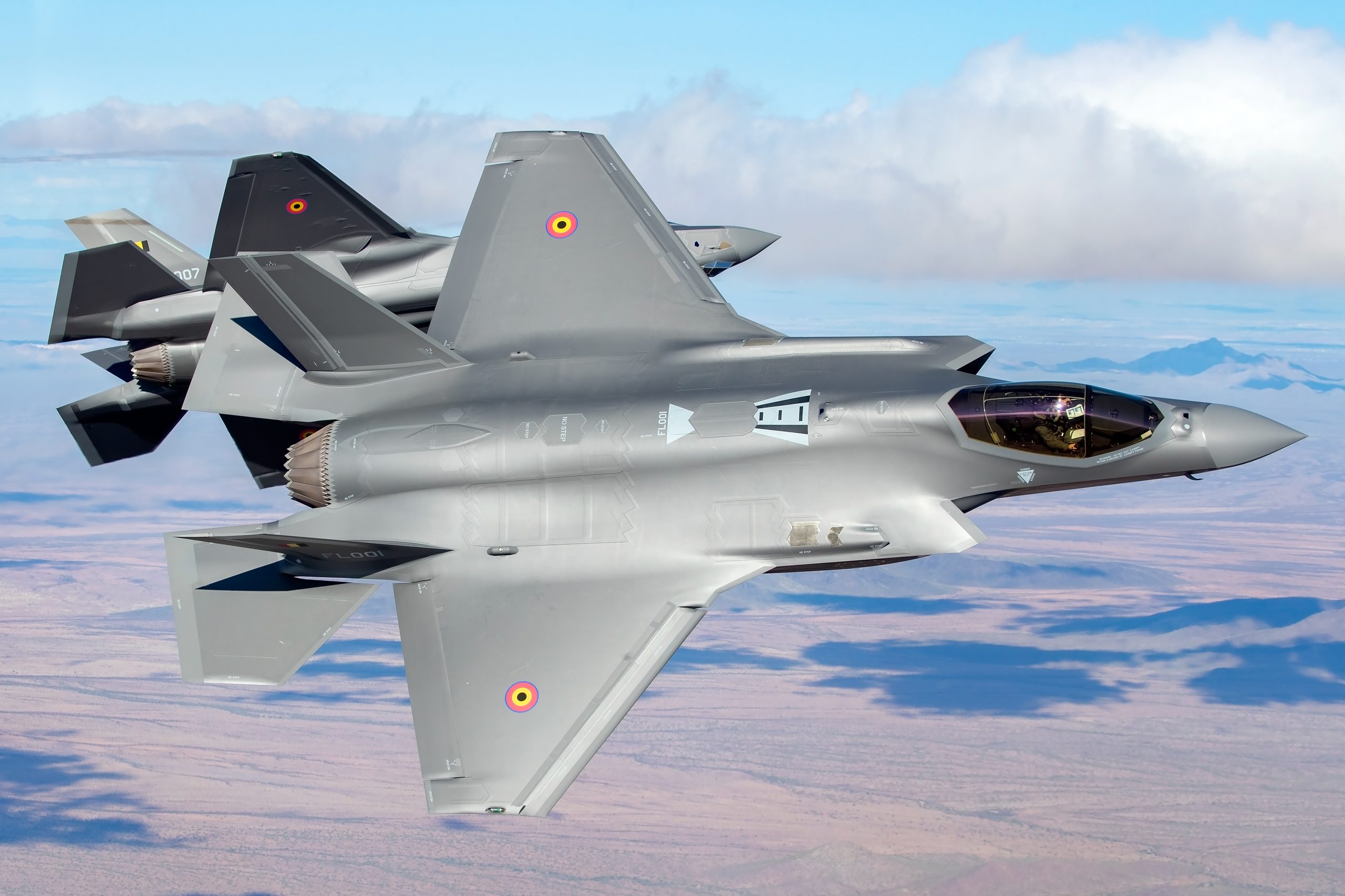
The scale explains the appetite. The Lightning II programme spans twenty customer nations and counting, three variants and a production run already in the thousands, which makes it the defining military aircraft story of its era and the one every defence desk returns to weekly. Every European air arm re-equipping with the F-35 generates the same publishing cycle: announcement features, delivery news, first-exercise coverage, and then a decade of defence journalism, reference titles and museum exhibits that all need strong imagery of the national jets. Ground photography at deliveries and airshows supplies most of it. What stays scarce is professional air-to-air of a specific nation’s aircraft, because a formation sortie with a fifth-generation fighter requires programme-level access that comes rarely and briefly. When it comes, the photography made in that window carries value for years, exactly the dynamic our aviation picture research guide describes for newsworthy airframes.
This guide covers the collection’s content, the Belgian programme timeline that gives the frames their news value, caption accuracy for a type with many operators, and the licensing route, with the same structure as our B-17 and Martin Mars buyer guides.
How to read this guide: picture researchers on deadline should go straight to the coverage, captions and licensing sections; editors planning defence or reference features will find the programme timeline and demand sections explain why briefing early pays; and readers here for the photographs have eight reasons on this page alone.
What this guide covers
- The collection: Belgian F-35As, Arizona, March 2025
- The Belgian programme in brief
- Why the timing matters
- What the coverage includes
- The camera ship era, and why it suits the F-35
- Photographing a fifth-generation shape
- How air-to-air with an F-35 is flown
- Why F-35 demand keeps compounding
- Captioning F-35 imagery correctly
- Uses: defence media, reference, museums, industry
- An angle guide for designers
- Beyond Belgium: the archive’s wider F-35 shelf
- Where else F-35 imagery comes from
- Three worked example briefs
- Technical quality and delivery
- Pairing independent and official imagery
- Licensing the images
- A buyer’s F-35 checklist
- The start of a long record
- Frequently asked questions
A word on the series itself, for readers arriving here first. These buyer guides exist because the questions picture desks ask are consistent, what is this, when was it taken, may I use it, how fast can I have it, and because an archive that answers them in public saves everyone the first three emails. The general method lives in the aviation picture research guide; each collection guide, B-17, Martin Mars, the F-35 and the F-4 Phantom, applies it to one shelf with worked examples. Use them in any order; the machinery is the same.
The collection: Belgian F-35As, Arizona, March 2025
The photography was flown air to air with Belgian Air Force F-35As over the Arizona desert in March 2025, during the period when Belgium’s first jets and crews were training with the international F-35 programme at Luke Air Force Base. The aircraft wear full Belgian markings, the roundels and tail flashes crisp on the type’s grey, and the serials, FL-series, are legible in the closer frames, including FL001, the first Belgian airframe.
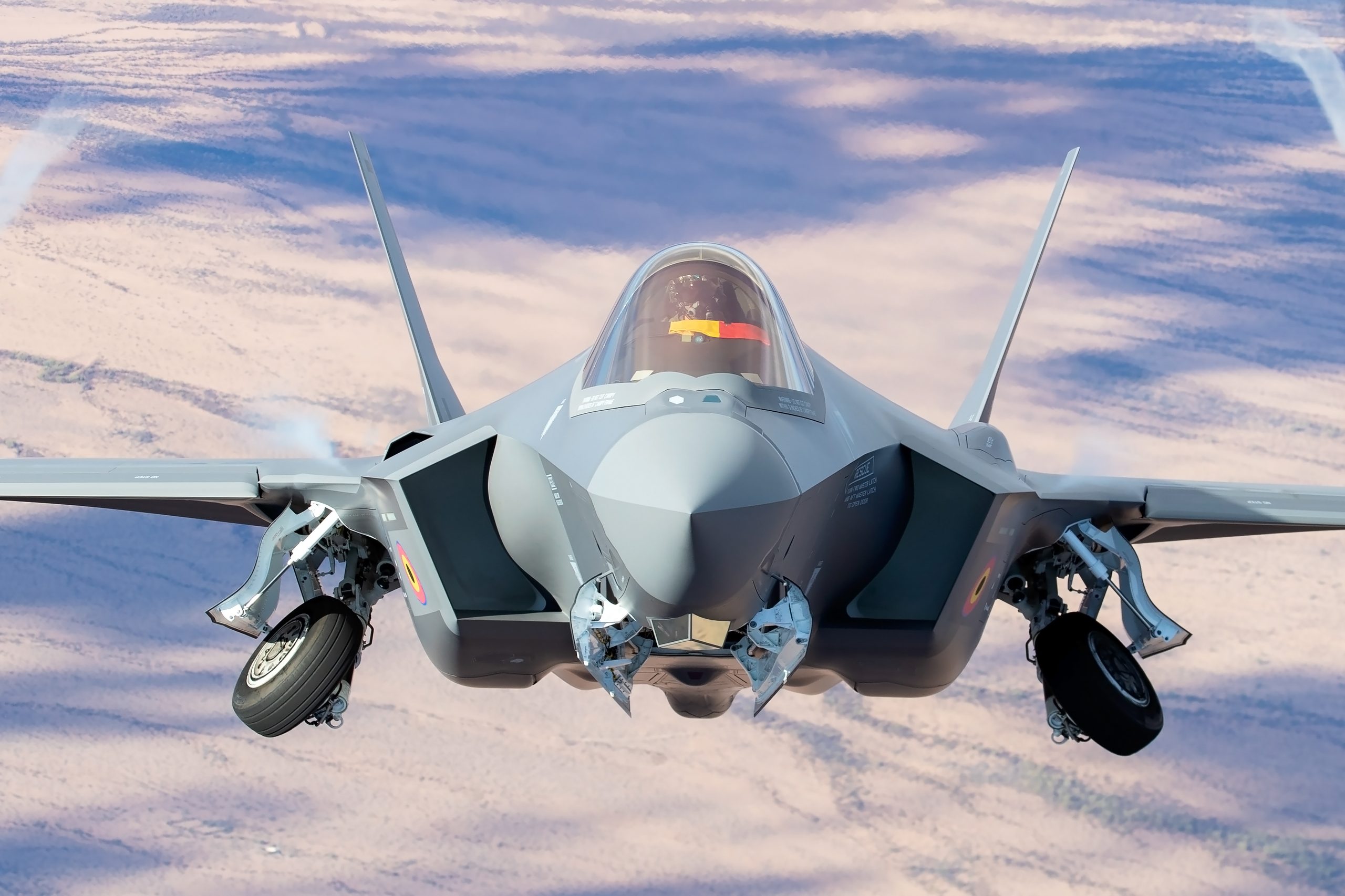
Access of this kind is the rarest commodity in modern military aviation photography. Fifth-generation formation sorties involve programme approvals, tanker or camera-ship coordination and safety cases that make them scarce even for the operators’ own media teams, and virtually inaccessible to independent photographers. This sortie was flown with that access granted, by Aviation Photo Crew, whose air-to-air work runs throughout these guides, and the provenance, who, when, where, with what permission, is documented and available to any licensing desk that asks.
Provenance details for diligence desks, stated once and plainly: the sortie was flown in March 2025 with programme awareness and operator cooperation, photographed by Aviation Photo Crew from a dedicated camera aircraft, and catalogued on landing with date, location and aircraft identities attached. Nothing in the collection derives from pooled or scraped material, every frame’s chain from camera to catalogue is documented, and the licensing desk answers who-when-where-with-what-permission questions by return. In defence publishing that paragraph is not boilerplate; it is the difference between an image a lawyer waves through and one that stalls a page.
Why the timing matters
Belgium’s F-35 timeline gives these frames their specific news value. Belgian jets trained in Arizona from December 2024; the first aircraft arrived on Belgian soil at Florennes in October 2025; and the fleet’s build-up, basing and first operational milestones will generate coverage for years. Photography of Belgian F-35As in the American training period, over the desert rather than the Ardennes, documents a chapter of the programme that closed when the jets crossed the Atlantic, and it can never be reflown.
That pattern repeats across Europe, and buyers should generalise it: for every F-35 nation there is a short training-era window, a delivery moment and a first-years period, and the archives that hold air-to-air from those windows hold the reference record. For Belgian-programme coverage specifically, this collection is that record, and our own F-35 Lightning II history post provides the type-wide context an editor may need beside it.
The collection also marks a milestone for the archive itself: the newest front-line type in the catalogue, photographed with the same discipline as the warbirds and classics that fill the rest of these guides. An archive that spans the Swordfish to the F-35, nine decades of naval and air power on one licensing desk, can serve a multi-era project from a single conversation, and increasingly that is exactly how the larger briefs arrive.
The Belgian programme in brief
The facts an editor needs beside these frames fit in a paragraph, verified in August 2026. Belgium originally committed to 34 F-35As and in July 2025 announced eleven more, taking the programme to 45 aircraft. Belgian jets and crews have trained at Luke Air Force Base in Arizona since December 2024, eight aircraft strong in the training fleet, and the first three jets for home basing landed at Florennes on 13 October 2025, with Florennes hosting the first operational squadron and Kleine-Brogel to follow. Eleven of the 45 had been delivered by that autumn.

Those numbers will move, which is itself a buyer’s point: procurement journalism dates quickly, photographs of the era do not. A feature written next year will update the delivery count and keep the pictures, and the caption discipline in this guide, nation, variant, place, date, is what lets an image outlive every revision of the text beside it.
What the coverage includes
The collection runs to more than a hundred catalogued frames from the sortie, published in the galleries. Angles cover singles and pairs: head-on frames over cloud and desert, close formation with gear down, topside pairs in echelon, rear quarters in dusk light, banking singles over the terrain, and overhead topsides that show the planform no ground camera can reach. Light runs from clean high sun to the pink and violet of desert dusk, giving both documentary and editorial moods from one operation.
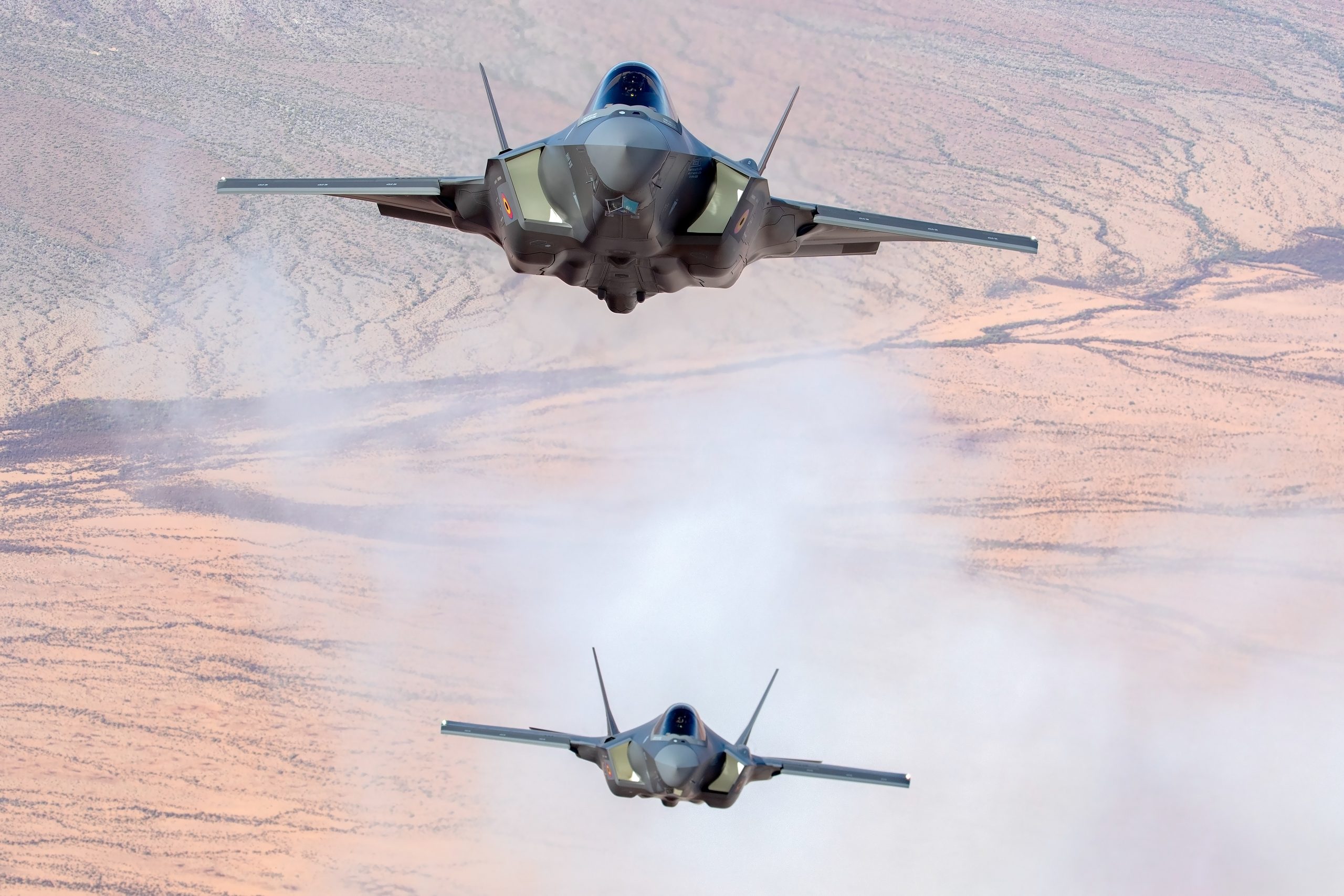
Consistency is the working advantage: one aircraft standard, one paint state, one date, which means multi-image features hold together without the mixed-fleet look that plagues F-35 picture research assembled from agency singles. And because the full take is archived behind the published selects, near-neighbour frames, a different wing position, a cleaner vapour moment, can be checked against a layout on request.
The camera ship era, and why it suits the F-35
Air-to-air photography’s working platforms, transports and tankers with ramps and panels, happen to suit fifth-generation subjects perfectly, because the jets already fly precise formation with tankers as daily routine. A photo sortie slots into patterns the pilots know, station-keeping off a ramp at briefed distances, and the resulting frames have the calm, held quality visible throughout this collection: no straining zoom from a display line, just an aircraft sitting exactly where it was asked to sit while the light is worked.
For buyers this translates into compositional room. Formation photography allows deliberate placement, aircraft low in frame for title space, pairs stepped for depth, terrain aligned beneath, that opportunistic photography cannot offer, and it is why archive air-to-air consistently out-performs grab shots at layout time. The design is in the flying before it reaches the page.
Photographing a fifth-generation shape
The F-35 photographs unlike anything earlier, and designers choosing frames benefit from knowing why. There are no external tanks, pylons or weapons on a clean jet, so the silhouette is pure planform and facet, and light does the talking: the type’s surfaces throw broad, soft reflections that change character completely between high sun and dusk, which is why this collection’s golden-hour frames look like a different aircraft from its midday ones. Choose by mood deliberately.
The absence of clutter also makes small details carry: the canopy’s gold tint, the roundels, the serial presentation, the luminous formation strips. Close frames reward large reproduction more than most subjects because there is nothing extraneous in them, and the gear-down head-on in this set is the working example, an aircraft reduced to shape, light and national identity.
How air-to-air with an F-35 is flown
Buyers increasingly ask how such photography is possible at all, and the answer belongs in this guide because it underwrites the licence. The sortie is planned like any formation flight: briefed positions, speeds, altitudes and light windows, with the camera aircraft flown by qualified formation pilots and the photography conducted through open ramps or optical panels. The F-35 adds programme-level clearances on top; nothing about the flying is casual, and nothing about the imagery is grabbed.
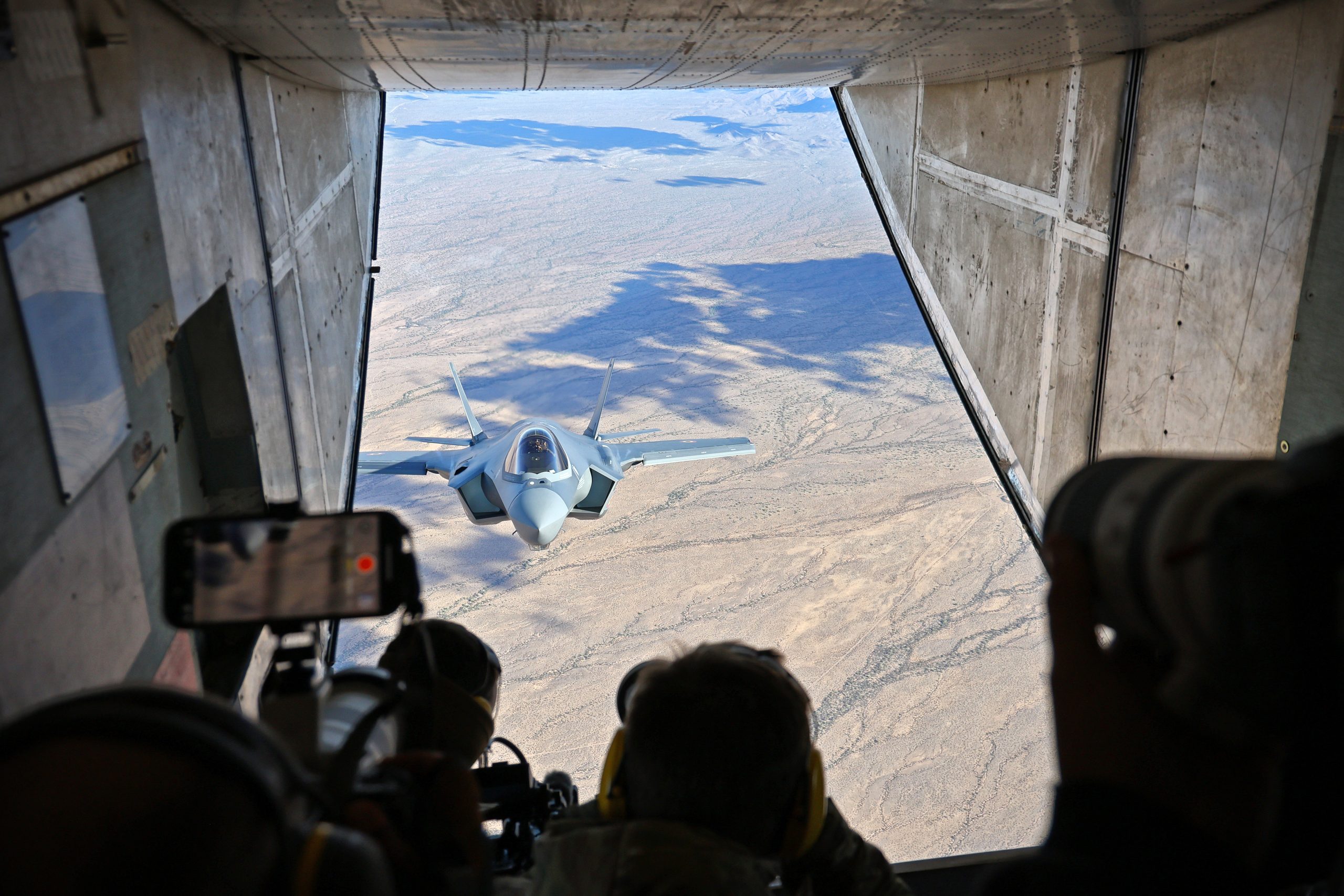
One frame in the collection shows that context deliberately, the jet seen past the camera crew at the ramp, and it earns its place for editorial use: features about defence photography, about the programme, or about how modern military imagery is made have exactly one honest illustration, and this is it.
One more asset class deserves naming: video-adjacent stills. Documentary and streaming production about the F-35 era relies heavily on official footage, and the still frames that intercut with it, sharper, quieter, differently lit, come from exactly this kind of sortie. Productions that license a small set of stills for rostrum and promotional use get imagery that grades cleanly against their footage while standing apart from it, and the licence, worldwide in perpetuity for a named programme, is the same shape as every documentary licence in this series.
Why F-35 demand keeps compounding
The F-35 is the most consequential defence programme of its generation, twenty operator nations and counting, and its editorial demand compounds rather than peaks. Every new customer decision, delivery, deployment, exercise and budget debate regenerates the coverage cycle across news, policy and reference publishing, in every operator’s national press at once. Museums and visitor centres are only beginning their current-generation galleries; school and reference publishers refresh their military aviation titles around it; and the type will fly for decades, which means the archives assembling strong imagery now are stocking a very long shelf.
Within that demand, the persistent gap is exactly what this guide describes: imagery that is specific, a named nation’s jets at a documented moment, and independent, licensed from the photographer with clean provenance rather than pooled from official release. Desks that plan around that gap, briefing early for the national angle they know their title will need, consistently publish stronger pages than desks that search on deadline.
Anniversary and milestone publishing will follow the fleet through its career: first Belgian operational declaration, first deployment, first exercise leadership, each a coverage moment that reaches back to the training era for its opening image. Desks that bookmark this collection now are stocking those future pages, and the archive’s same-day service applies whether the brief arrives this season or in 2035, when the first-decade retrospectives begin.
Captioning F-35 imagery correctly
The F-35 is flown by many nations in three variants, and caption errors travel fast. The discipline for this collection is simple because the facts are documented: Belgian Air Force F-35A Lightning II, photographed air to air over Arizona in March 2025, during the Belgian fleet’s training period at Luke Air Force Base; the first Belgian jets arrived in Belgium in October 2025. Serials where legible, FL001 and squadron mates, can be stated from the frames themselves.
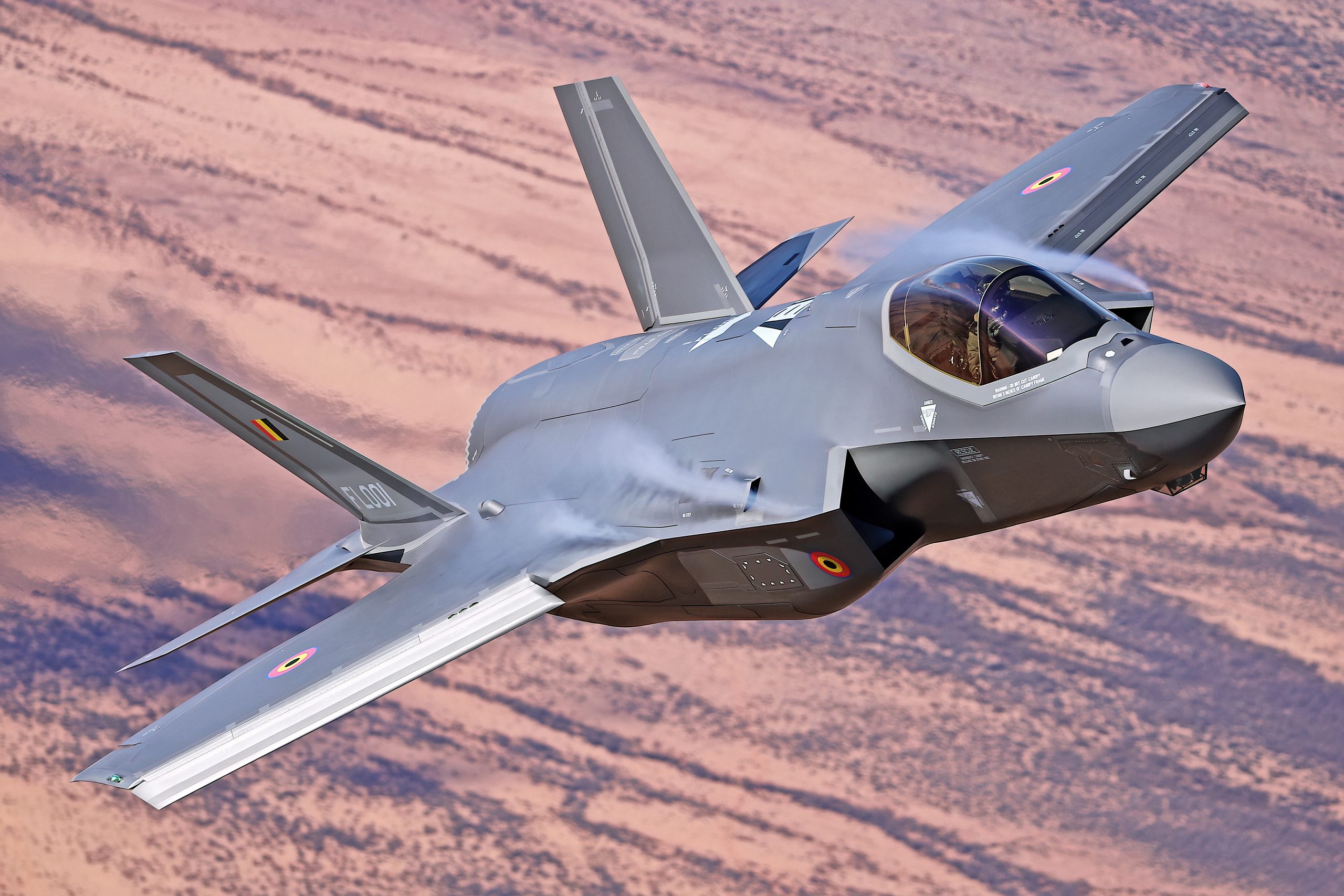
The general traps: do not caption an F-35A as a B or C, the variants differ visibly in ways aviation readers check; do not attach a training-era photograph to a story about home-base operations without dating it; and treat any statement about the aircraft’s systems or capabilities as text for your defence correspondent, not your caption. A caption that names nation, variant, place and date is complete, correct and future-proof.
Exclusivity, as with the Mars collection, means something here. Training-era Belgian air-to-air is a closed set; a publisher or institution that needs a signature frame protected for a jacket, a campaign or a gallery can buy protection that the market cannot erode, because no competitor can commission the missing sortie. The conversation belongs at a project’s start, and the archive prices it plainly against the frame’s uniqueness rather than theatrically against its fame.
Uses: defence media, reference, museums, industry
Defence and news media are the obvious first market: Belgian and NATO air-power stories, European rearmament coverage, and the type’s endless procurement journalism all need national-fleet imagery that agencies rarely hold beyond delivery-day ground shots. Reference publishing, the annuals, type monographs and partworks, needs exactly the topside and formation angles this collection leads with. Museums and visitor centres building current-generation exhibits license large-format frames where no airframe can be displayed. And the aerospace industry itself, primes, suppliers and training organisations, uses editorially sourced imagery of operator fleets in contexts their own product photography cannot cover.
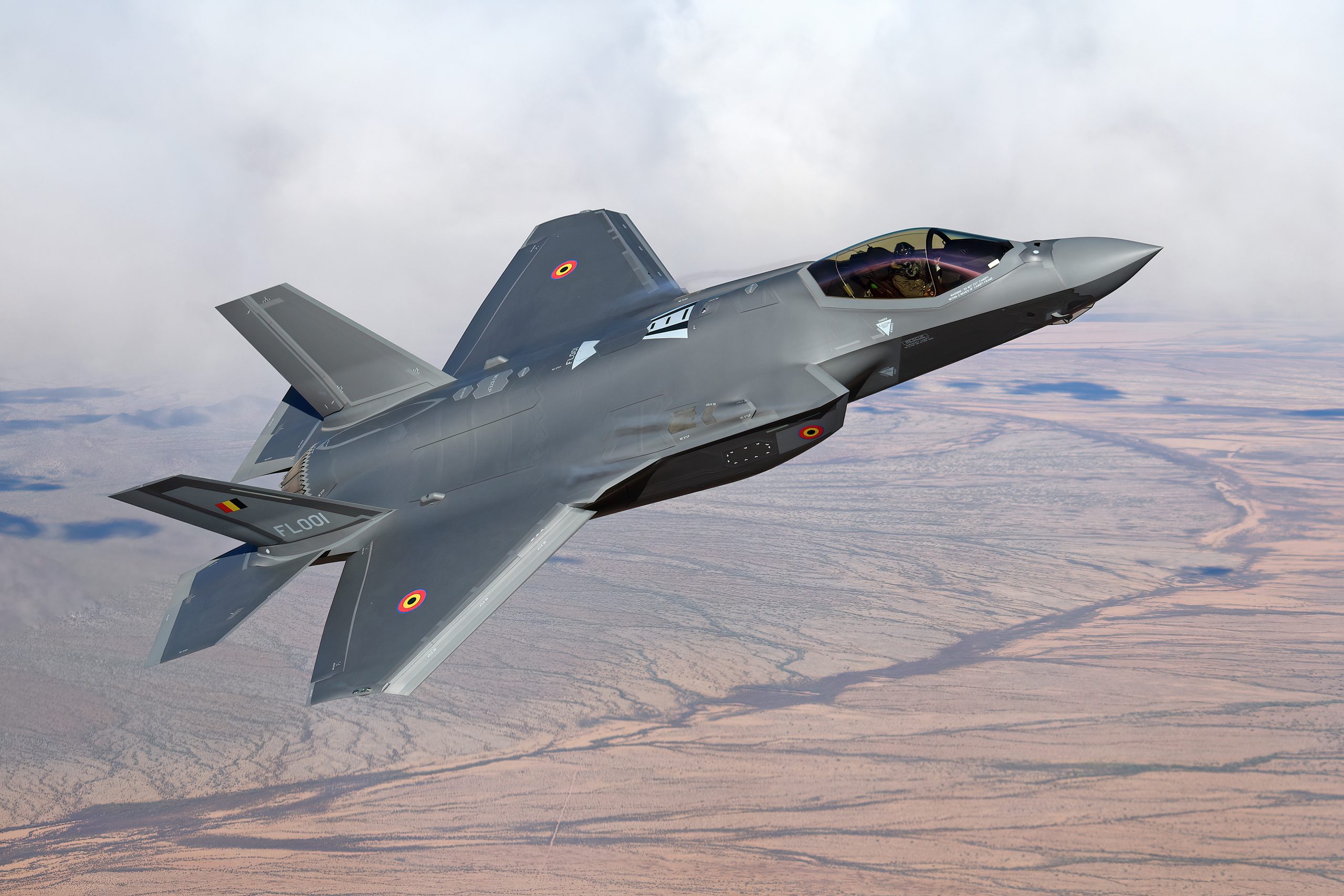
Education and enthusiast publishing complete the set, and for all of them the Belgian angle adds a second life: as the Florennes fleet grows and Belgian jets appear at European shows, retrospective interest in the training era grows with it, the same appreciating-archive pattern the Mars guide describes, applied to a fleet at the start of its story rather than the end.
Two cautions belong in the uses list. First, operational-security common sense: everything in this collection was photographed with access and clearance, and shows nothing not on public display at any airshow; buyers repurposing imagery into speculative infographics about capabilities are on their own editorial ground, not the photograph’s. Second, currency: fleet markings and unit badges evolve, and a caption dated March 2025 keeps a feature honest however the Belgian fleet’s presentation changes.
An angle guide for designers
Head-on frames carry the type’s menace and are natural covers; the gear-down close-up is the singular opener, near enough to count the fasteners the type takes such trouble to hide. Topside pairs serve spreads and reference, the angle least seen and most asked for. Dusk rear quarters are the mood set, chapter openers and exhibition walls. Banking singles are the workhorse editorial frames, dynamic with clean backgrounds. And the ramp frame is the behind-the-scenes illustration for anything about the photography itself. Title space lives generously in the cloud and sky backgrounds; say the ratio and the recommendation comes back matched to it.
Sequencing for multi-frame features follows the series’ standard advice with one F-35 twist: because the clean jet is so uncluttered, alternating close and distant frames matters more than with older types, or six pictures read as one. A proven spine: head-on opener, programme-context paragraph beside the ramp frame, topside pair across the spread, dusk single to close. Detail crops of canopy and markings fill between without repeating silhouettes.
The camera-ramp frame deserves one more word because editors keep finding new uses for it. Beyond photography features, it has served as the honest illustration for media-access journalism, for defence-communication training material, and for the growing genre of how-is-this-made content that platforms reward. It is the collection’s least glamorous frame and among its most licensed, which says something true about the modern market: provenance is not just paperwork any more, it is a subject.
Beyond Belgium: the archive’s wider F-35 shelf
The Belgian sortie is the collection this guide is built on, but the archive’s F-35 coverage is European in scope. Royal Danish Air Force F-35As have been photographed air to air during Danish Airpower media flying, US Air Force and US Navy Lightnings appear in the RIAT and Sun n Fun collections, and the type’s European show appearances add ground and display coverage each season. A brief that needs another operator’s jets, or the type generally rather than nationally, should simply say so; the same catalogue discipline applies across all of it.
That breadth matters most to reference and museum projects covering the European transition as a whole: one archive, one caption standard and one licensing conversation across Danish, Belgian and visiting-force Lightnings beats assembling the same spread from four sources with four styles of paperwork. And as other European fleets reach their own delivery milestones, the same access that produced the Belgian collection is pursued for them; briefs lodged early help decide where the camera ship goes.
Where else F-35 imagery comes from
Honesty section, as in every guide. Official military and programme imagery is abundant, free and often excellent, and for many news uses it is the right answer; its constraints are the queue of everyone else using the same frames, and captions and clearances aimed at the releasing service’s priorities. Agency coverage supplies deliveries, airshows and exercises from the ground, comprehensively. Enthusiast photography fills the gaps at variable quality and provenance.
Independent, professionally flown air-to-air of a specific nation’s F-35s, licensed from the photographer with documented access, is the shelf that stays nearly empty, which is precisely why this collection is catalogued and offered the way it is. Most serious F-35 features will mix sources; the role of this one is the frames nobody else has.
Education publishing rounds out the demand as it does in every guide: the F-35 is the aircraft on the posters of the next generation of enthusiasts, and curriculum, careers and STEM material about modern aerospace reaches for exactly these clean, dramatic frames. The educational licence conversation is deliberately simple, and the honest captions travel into classrooms unchanged, which is precisely where caption discipline matters most.
Three worked example briefs
A Belgian weekly is closing a cover feature on the Florennes build-up. The brief: Belgian jets, national markings prominent, portrait-capable frame with title space, national print and digital rights for one issue, deadline tomorrow. Answer: the head-on frames over cloud and desert, supplied same day with the training-era caption ready.
A reference publisher is building the type monograph’s operator chapters. The brief: one strong image per operator, topside or formation preferred, worldwide print and ebook across a multi-year edition life. Answer: the topside pair and echelon frames, licensed for the edition with serials confirmed for the plate captions.
A museum is designing a European air-power gallery panel on fifth-generation transition. The brief: large-format dusk frame, ten-year single-site display licence, file prepared for a three-metre wall. Answer: the rear-quarter and topside dusk frames, proofed at wall size, with the programme timeline supplied for the panel text.
Technical quality and delivery
Professional full-frame digital masters supporting double-page print and exhibition enlargement uncropped; high-resolution JPEG standard, TIFF on request; captions, credit and identification embedded, with the honest formulation from the captions section ready to paste. The credit line is Aviation Photo Crew. Same-day replacement from the archived take applies when a layout needs a neighbouring frame, and exhibition-scale files are prepared for the wall size rather than exported blind.
Pairing independent and official imagery
The strongest F-35 features mix sources on purpose. Official imagery covers what only the services can reach, carrier decks, weapons work, cockpit views, and it is free; independent air-to-air covers the national-fleet specificity and visual quality official pools rarely prioritise; agency ground coverage supplies events. The pairing rules from this series apply with one addition: label official imagery as such in credits, because readers and rivals check, and a page that mixes credited independent work with clearly credited official material reads as reporting, while a page of unlabelled pool shots reads as a press release.
Beside historical content the pairing is generational: our F-35 history post and this collection already work together on this site, and the same combination, type story plus national fleet imagery, is the template for any publisher’s F-35 chapter.
Licensing the images
The standard editorial shape: use, size, territory, duration and exclusivity, agreed in writing before delivery, commercial uses discussed case by case, and the UK IPO’s plain-language guidance remains the reference for anyone needing convincing about found images. Browse the galleries, read our licences, and send the brief; the Piemags archive stands behind for wider projects.
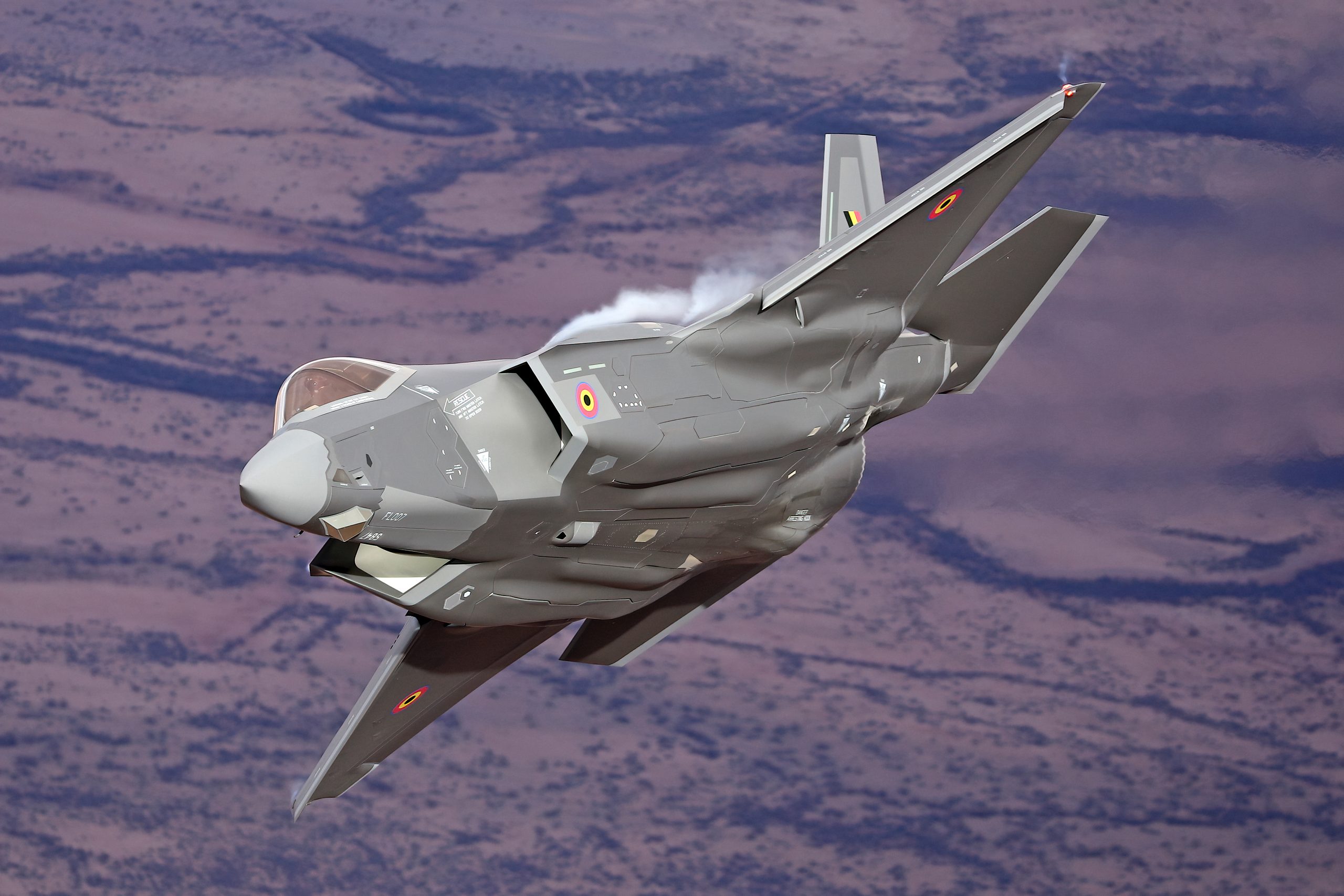
For this collection specifically, say whether your story is Belgium, the programme, or the type, because the ideal frames differ: national markings forward for Belgium, the ramp and formation context for the programme, and the clean topsides for the type. As with every guide in this series, the archive would rather send the right frames than the famous ones, and a same-day answer is the working standard.
A buyer’s F-35 checklist
Six questions before licensing any F-35 image, from any source. Which nation and which variant, stated, not assumed? When and where was it taken, and does that match the story’s tense? Is the source’s access documented, official pool, agency ground coverage, or independent air-to-air? Does the resolution support the final size uncropped? Does the licence cover the actual use, territory, duration and any exclusivity the design depends on? And is the credit agreed? The frames in this collection arrive with all six answered in the embedded metadata; for the wider market, the checklist is the desk’s protection.
The seventh question is the series’ refrain: does the image serve the story or decorate it? The F-35 photographs so well that decoration is the constant temptation, and the strongest defence pages we see use fewer, better frames, each anchored to a dated fact. That is what this collection was flown to supply, and the same-day brief-answering described throughout these guides is how it reaches the page.
The start of a long record
The Mars guide in this series closed a story; this one opens it. The Belgian F-35 fleet will fly for decades, gather squadrons, deployments, anniversaries and eventually its own history titles, and the photographs of its first training spring in Arizona will sit at the front of every one of them. Archives are built by being there at the beginnings as well as the endings, and the March 2025 sortie was flown on exactly that reasoning.
For the picture desks reading this series in order: the pattern is now visible. Finite archives appreciate, beginnings become reference, provenance is the product, and the brief, subject, use, size, territory, duration, deadline, is the whole machinery. Send one, about this collection or anything the galleries hold, and the answer comes back the same day, which is where every one of these guides has been pointing all along.
Requesting images. Email sales@piemags.com with the subject you need, the medium, the territory, the print run or audience, and your deadline. That is enough to quote against. Licensing terms are set out on the Piemags licences page.
Frequently asked questions
What does this F-35 collection show?
Belgian Air Force F-35A Lightning IIs photographed air to air over the Arizona desert in March 2025, during the Belgian fleet’s training period at Luke Air Force Base, including FL001. Singles, pairs, formation, gear-down close-ups, topsides and dusk frames, all from one catalogued sortie.
Why is air-to-air F-35 photography so rare?
Because it requires programme-level access: formation clearances, camera-ship coordination and safety cases that come rarely even for operators’ own media teams. When such a sortie is flown, the photography from it becomes the reference record for that fleet and period.
Why does the March 2025 date matter?
It places the photographs in the closed chapter of Belgium’s F-35 story: the American training era before the first jets arrived at Florennes in October 2025. Training-period air-to-air of the Belgian jets can never be reflown, which gives the frames lasting documentary value.
Can I license these images for news or defence coverage?
Yes, editorial licensing is their purpose: use, size, territory, duration and any exclusivity agreed in writing before delivery, with same-day answers to complete briefs and rush handling around news deadlines.
Can I use them in a book, partwork or reference title?
Yes. The topside and formation angles are exactly what reference publishing needs, and the single-sortie consistency means multi-image features hold together visually without the mixed-fleet look of agency-assembled sets.
How should F-35 photographs be captioned?
Name the nation, variant, place and date: Belgian Air Force F-35A, air to air over Arizona, March 2025, during the fleet’s Luke AFB training period. Never mix up the A, B and C variants, and never attach a training-era frame to a home-base story without dating it.
Are the serials identifiable?
Yes, in the closer frames, including FL001. Where a serial is legible it can be stated in the caption; where it is not, the caption stays at nation and variant, which is complete and correct.
What resolution are the files?
Professional full-frame digital masters supporting double-page print and exhibition enlargement uncropped, delivered as high-resolution JPEG with TIFF available, captions and credit embedded.
Do commercial or advertising uses need extra clearance?
Commercial uses raise the usual questions of trademarks and endorsement in any genre, and with current military subjects they deserve particular care. The archive will say plainly what a proposed use needs; editorial use in journalism, books, documentaries and exhibitions is the simple case.
What about official F-35 imagery, is it not free?
Much official imagery is free and good, and for many uses it is the right answer. Its constraints are that everyone uses the same frames and the captions serve the releasing service. Independent air-to-air of a specific nation’s jets is what stays scarce, and that is this collection’s shelf.
Can I see how the photography was made?
Yes, one published frame shows the F-35 from the camera ship’s ramp with the crew working, and it is licensable like the rest, the honest illustration for any feature about how modern military aviation photography happens.
How do I license an image?
Browse the collection at professionalaviationphotography.com, read the options on the our-licences page, and send the brief: subject, use, size, territory, duration, deadline, exclusivity if it matters, and whether your story is Belgium, the programme or the type.
