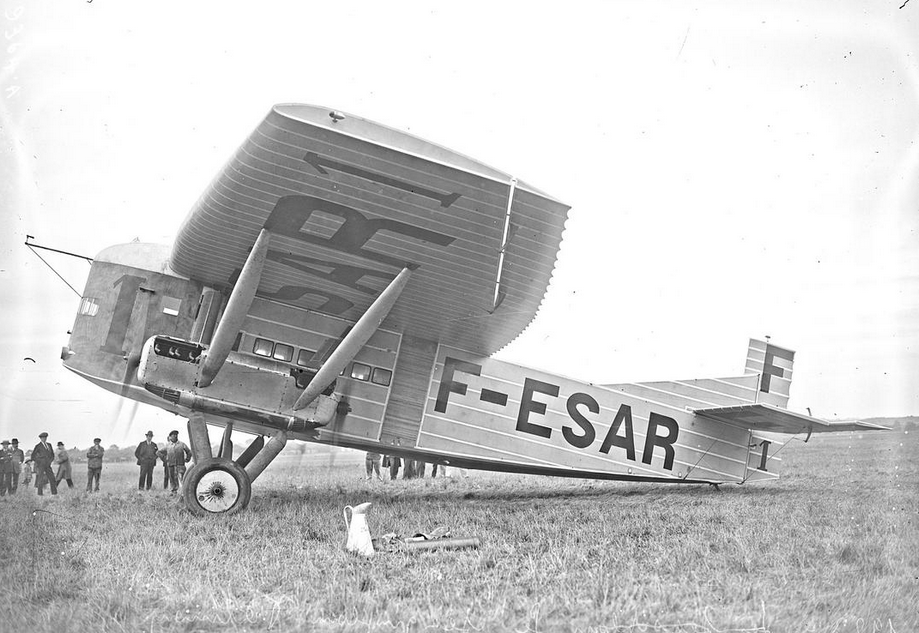
For a few extraordinary years before the First World War, France was the centre of the flying world. While the Wright brothers guarded their patents across the Atlantic, it was on French airfields, Issy-les-Moulineaux, Port-Aviation at Juvisy, the great meeting ground at Reims, that aviation became a public spectacle, a sport and an industry all at once. We’ve spent recent months digitising a collection of press photographs from this period, and the deeper we got into them, the more it struck us how little of this material is widely seen today.
The photographs make far more sense once you know the story unfolding around them, and it is quite a story. In the space of a single generation France went from watching a visiting American circle a racecourse near Le Mans to sending the mail across the South Atlantic on a schedule. This guide walks through that quarter of a century, the pioneers, the great meetings, the races, the war and the long-distance years, and explains along the way how the press photographers of Paris came to fix so much of it on glass.
What this guide covers
- Wilbur Wright at Le Mans: the shock of 1908
- Henry Farman and the first kilometre
- The Voisin brothers and the first aircraft factory
- Santos-Dumont and the Demoiselle
- The race across the Channel
- Reims 1909: the Grande Semaine d’Aviation
- Inside the collection: the meeting years on glass
- The French abroad: Paulhan takes the meeting on the road
- Racing years: Deperdussin and the Schneider Trophy
- Roland Garros and the Mediterranean
- France at war: SPAD, Guynemer and Fonck
- The White Bird and Atlantic fever
- Aéropostale: the line above the sea
- Record breakers: the Question Mark and the Blériot 110
- Timeline: French aviation firsts, 1908 to 1932
- The press agencies behind the plates
- From the plates to the archive
- Frequently asked questions
Wilbur Wright at Le Mans: the shock of 1908
It is easy to forget how contested the Wright brothers’ claims still were in Europe at the start of 1908. They had flown at Kitty Hawk in December 1903, but years of secrecy while they pursued patents and buyers meant that much of the French aeronautical press simply did not believe them. Some newspapers went as far as calling Wilbur a bluffeur, a bluffer, and French experimenters pressed on in the conviction that the real conquest of the air would happen on their side of the Atlantic.
On 8 August 1908, at the Hunaudières horse-racing course just south of Le Mans, Wilbur Wright answered them in under two minutes. His first European demonstration was short, two circuits of the field, but the way he flew them changed everything. Where French machines of the day staggered around wide, flat, skidding turns, Wright banked smoothly and precisely, carving figures over the grass with a control no European pilot could match. Onlookers, Louis Blériot among them, were stunned. Ernest Archdeacon, one of the loudest sceptics, publicly admitted that France owed the brothers amends, and the editor of L’Aérophile wrote that all doubts had been dissipated.
Wilbur moved to the military camp at Auvours, east of Le Mans, and spent the autumn stretching every record in the book while thousands came out to watch. The flights became a society event as much as a technical one. Hart O. Berg, the Wrights’ business agent in Europe, managed the stream of visitors, and in October 1908 Queen Margherita of Italy was among the celebrities photographed at Le Mans watching the American at work. On 31 December 1908 he stayed aloft for 2 hours and 20 minutes, covering 124.7 kilometres around a triangular course to win the first Michelin Cup and a 20,000 franc prize. The deeper effect was on the French designers in the crowd. They absorbed the lesson of proper lateral control, went back to their workshops, and within eighteen months had built machines that would leave the Wrights behind.
Henry Farman and the first kilometre
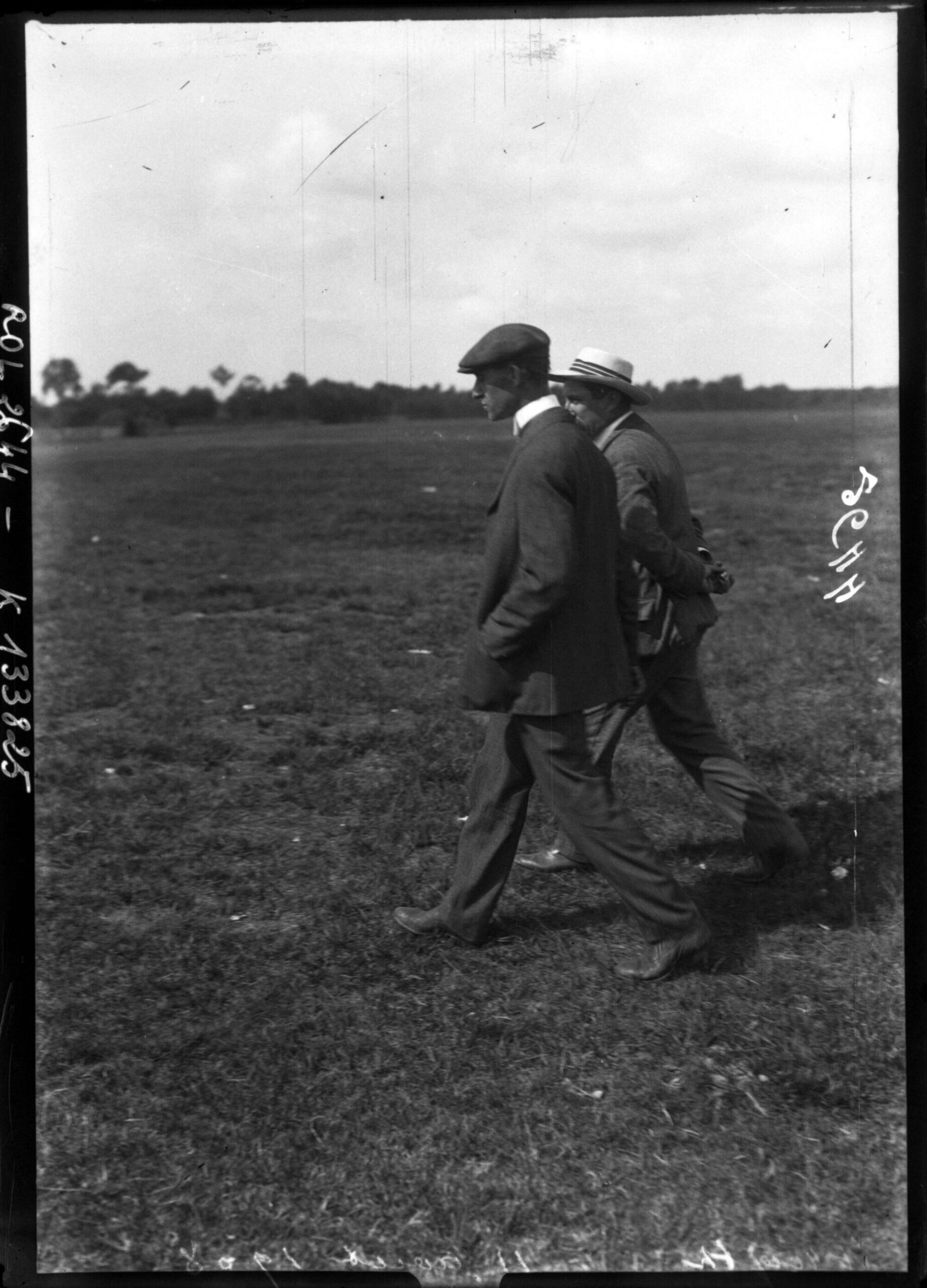
Months before Wilbur’s arrival, France had already celebrated a landmark of its own. On 13 January 1908, at the military parade ground of Issy-les-Moulineaux on the south-western edge of Paris, Henry Farman took his Voisin biplane around a one kilometre closed circuit in 1 minute and 28 seconds, rounding a pylon and returning to his starting point in front of official observers from the Aéro-Club de France. It was the first officially witnessed closed-circuit kilometre flown by a heavier-than-air machine in Europe, and it won him the 50,000 franc Grand Prix d’Aviation funded by Henri Deutsch de la Meurthe and Ernest Archdeacon, a prize that had stood unclaimed since 1904.
Farman was a thoroughly Parisian figure with an English name, born in Paris to English parents and already famous as a champion cyclist and motor racer before he ever touched an aeroplane. He kept pushing through 1908. On 30 October he flew 27 kilometres from the army camp at Bouy to Reims in about twenty minutes, the first genuine cross-country flight in Europe and the moment the aeroplane stopped being a fairground machine and hinted at becoming transport.
He was soon building aircraft under his own name, and with his brother Maurice the Farman firm grew into one of the giants of French aviation, turning out trainers by the thousand during the war and the lumbering Goliath airliners and long-distance machines after it. A Farman Goliath appears in our own collection, being readied in 1919 for a flight towards Dakar, which is a neat piece of continuity: the man who flew the first kilometre lived to put his name on aircraft reaching for other continents.
The Voisin brothers and the first aircraft factory
The machine Farman flew that January was not his own design. It came from the Billancourt workshop of Gabriel and Charles Voisin, whose company, Appareils d’Aviation Les Frères Voisin, founded on 5 November 1906, is generally regarded as the world’s first commercial aircraft factory. Gabriel had learned his trade building gliders for Ernest Archdeacon and had spent 1905 in a short-lived partnership with Louis Blériot before buying his partner out and setting up with his brother.
The Voisins’ great insight was commercial as much as technical. Rather than guarding a single experimental machine, they built sturdy pusher biplanes and sold them to anyone with the money and the nerve. The sculptor Léon Delagrange took one, Farman another, and the rivalry between the two customers through 1908 dragged European records upward month by month, each man goading the other to fly further and longer. The aircraft carried their owners’ names, Voisin-Delagrange, Voisin-Farman, an early sign that flying was becoming a market as well as an adventure.
Voisin machines remained a fixture of the meeting circuit for years, and the company’s descendants appear throughout our collection, including the hydroplane experiments on the Seine. Gabriel Voisin himself survived the aviation business he helped invent and later became celebrated all over again as a builder of luxury motor cars.
Santos-Dumont and the Demoiselle
No account of these years can leave out Alberto Santos-Dumont, the Brazilian who had already made himself the most famous man in Paris with his little airships, and who in October 1906 made the first officially witnessed powered aeroplane flight in Europe with his ungainly 14-bis. By 1908 and 1909 he had moved to the opposite extreme of design with the Demoiselle, a tiny monoplane built around a reinforced bamboo boom, with the pilot slung beneath the wing.
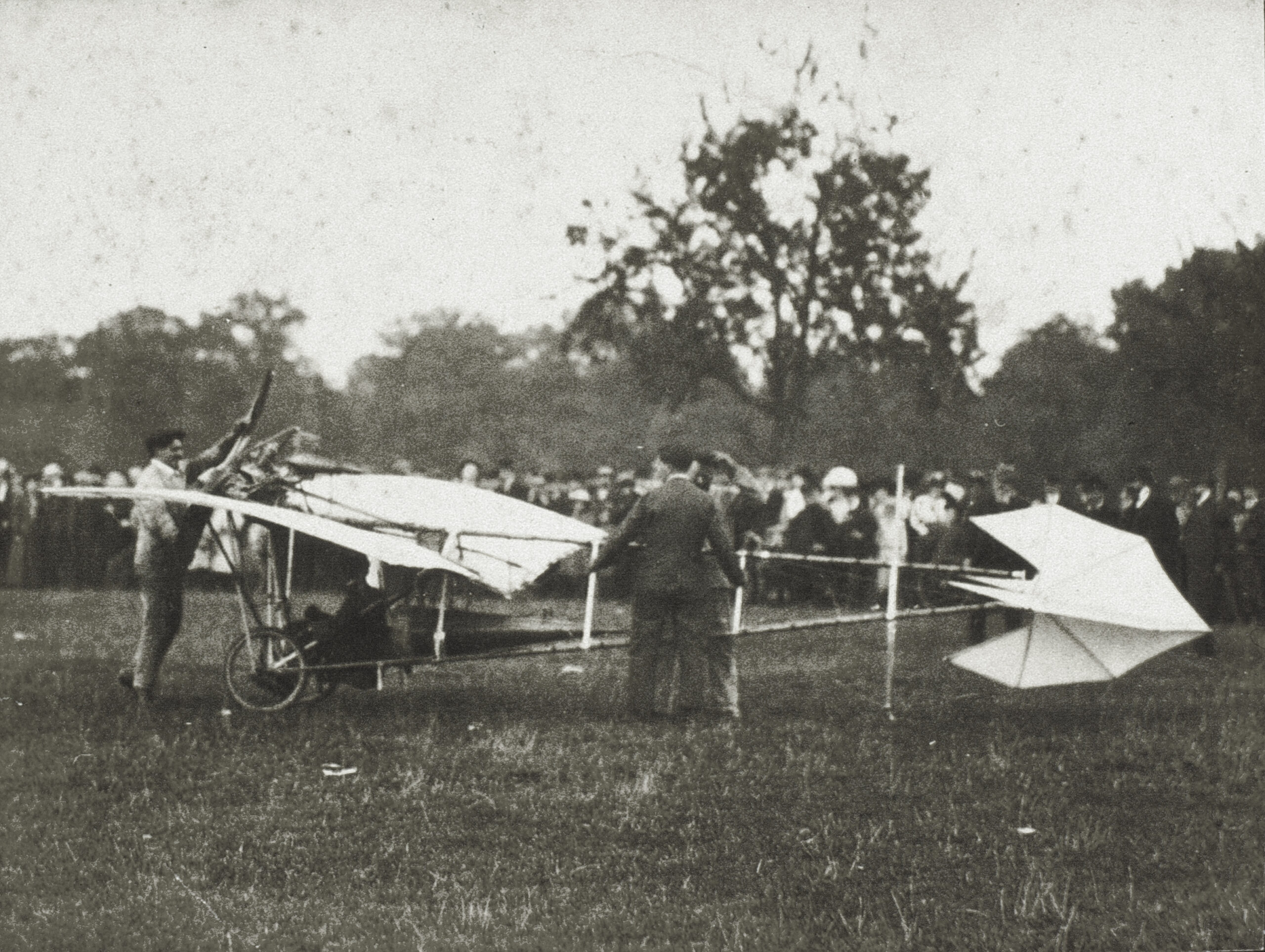
The Demoiselle mattered for two reasons. It flew well for its size, and Santos-Dumont gave it away. Consistent with his belief that aviation should belong to everyone, he released the drawings freely, and Popular Mechanics published plans in June 1910, so that amateurs on both sides of the Atlantic could build their own. It became one of the first aircraft offered to ordinary buyers rather than wealthy patrons, and its silhouette, named for the damselfly, remains one of the most charming of the era. Dozens were built from those published drawings, which makes the Demoiselle a fair claim to be the start of the homebuilt aircraft movement.
The race across the Channel
By the summer of 1909 the Daily Mail’s £1,000 prize for the first aeroplane crossing of the English Channel had turned the Calais coast into a camp of rival aviators. The favourite was Hubert Latham, an Anglo-French sportsman flying the beautiful Antoinette IV monoplane, whose slender fuselage and paddle-shaped propeller made it the most elegant machine of its day. On 19 July 1909 Latham set out first, and about thirteen kilometres out his engine failed. He put the Antoinette down on the sea, where it floated well enough for him to be picked up by the French destroyer Harpon, the first man ever to attempt the crossing and the first to ditch an aeroplane in the Channel.
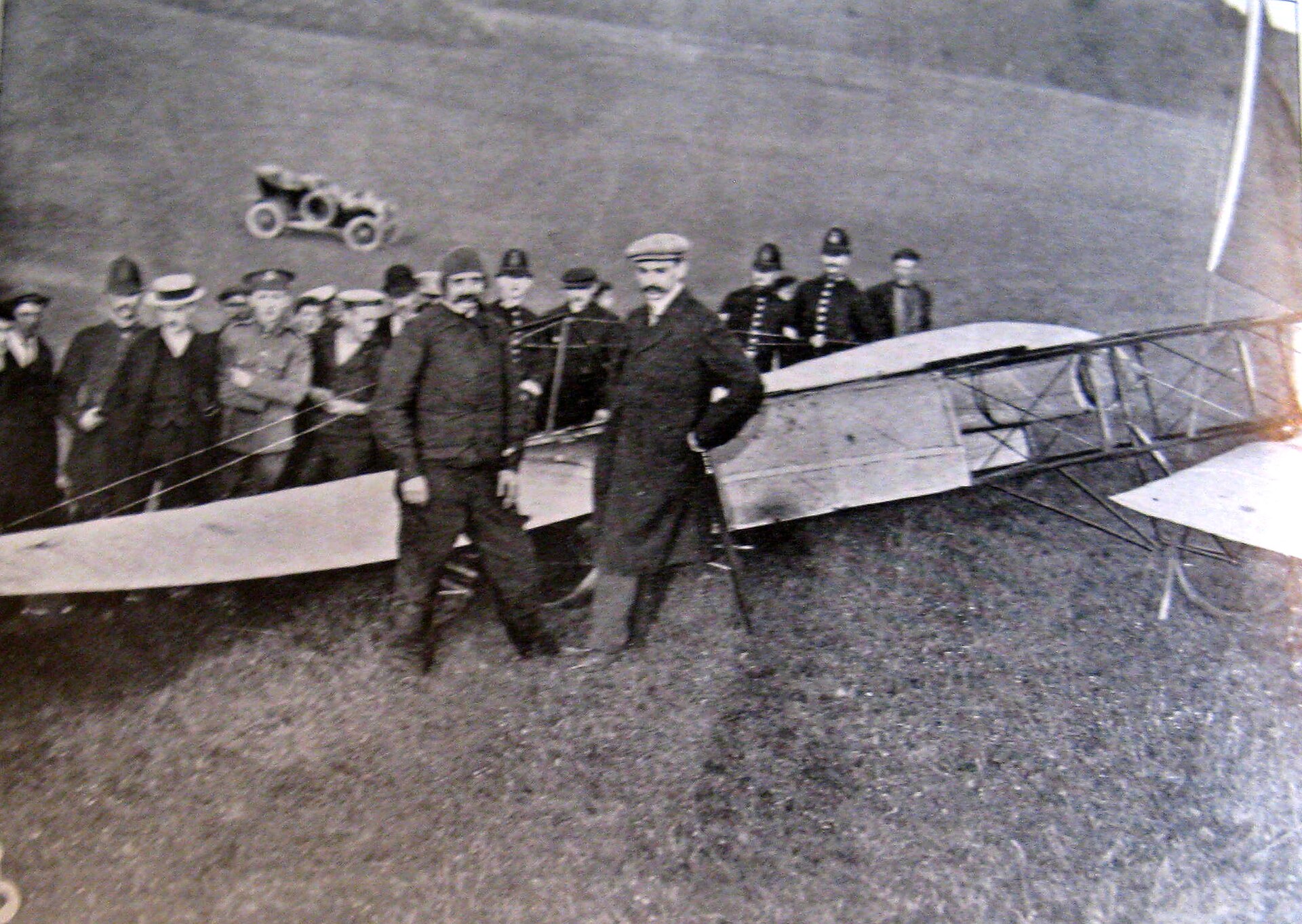
Six days later, at dawn on 25 July 1909, Louis Blériot took off from Les Baraques near Calais in his Type XI monoplane, powered by a three-cylinder Anzani engine of just 25 horsepower. Thirty-six and a half minutes later he arrived over Dover, where gusting wind forced a heavy landing that damaged his undercarriage and propeller. It hardly mattered. The Channel had been flown, Blériot was a hero on both coasts, and orders for the Type XI poured in. Latham tried again on 27 July in an Antoinette VII and was brought down by engine failure within sight of Dover, a gallant second failure that only added to his fame.
We tell the full story of the man, from acetylene headlamps to the cliffs of Dover, in our companion piece on Louis Blériot and the first Channel crossing.
Reims 1909: the Grande Semaine d’Aviation
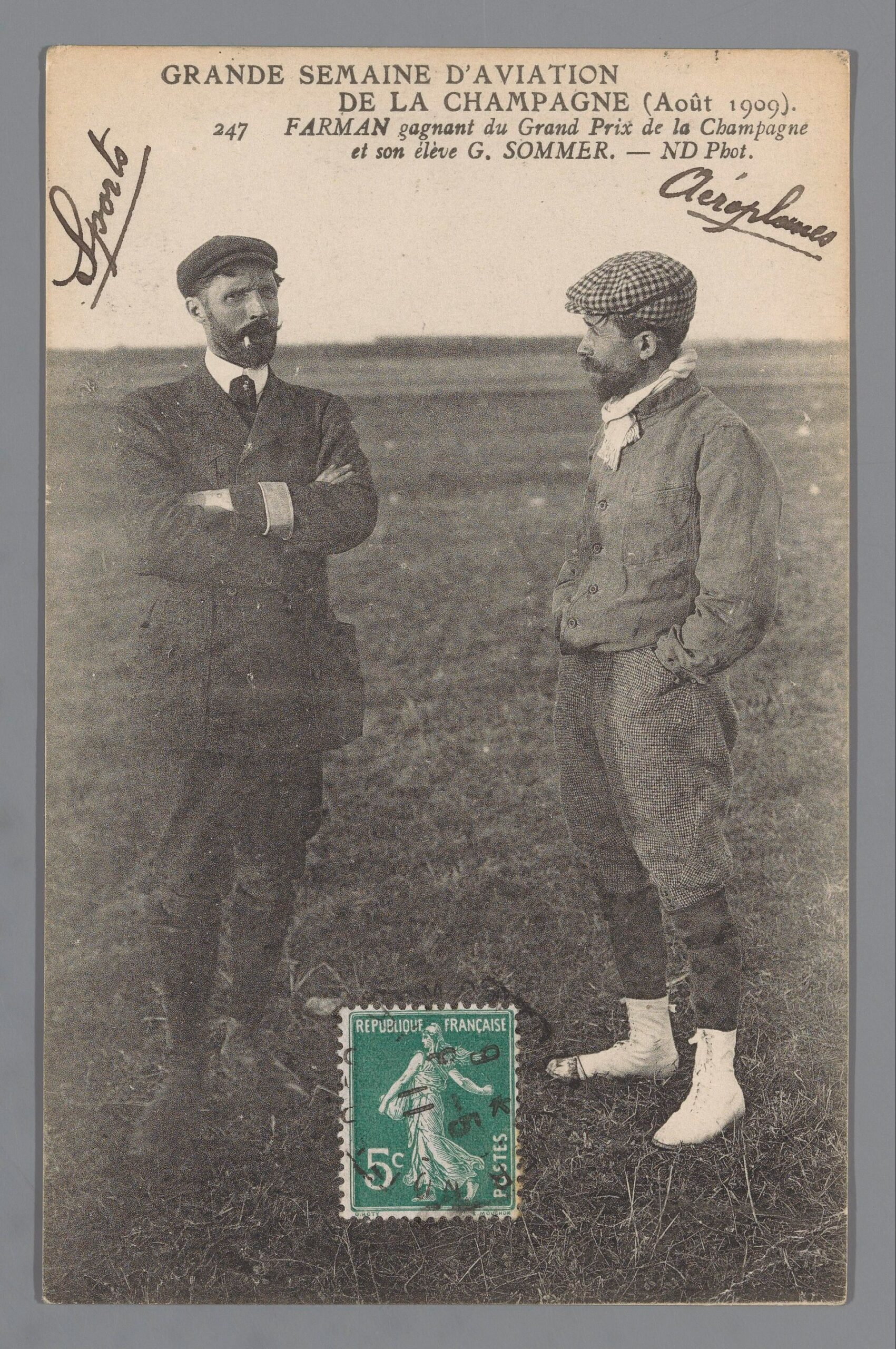
A month after the Channel flight, the whole movement gathered on the plain of Bétheny outside Reims for the Grande Semaine d’Aviation de la Champagne, held from 22 to 29 August 1909 and bankrolled by the great champagne houses under a committee chaired by the Marquis de Polignac. It was the first great international flying meeting, and nothing like it had ever been staged. Around half a million spectators passed through over the eight days, President Armand Fallières came to look, and among the foreign visitors was David Lloyd George, then Britain’s Chancellor of the Exchequer.
The flying matched the occasion. A ten kilometre rectangular course marked out by pylons ran in front of the grandstands, and nearly every world record fell during the week. Henry Farman won the Grand Prix de la Champagne by flying 180 kilometres non-stop in a little over three hours, a world distance record, and added the passenger prize by lapping the course with two passengers aboard, taking home 63,000 francs as the meeting’s biggest winner. Hubert Latham took the altitude prize at 155 metres, an astonishing height for the time. And in the event everyone remembered, the first Gordon Bennett Cup for outright speed, the American Glenn Curtiss beat Louis Blériot by the barest of margins over two laps.
Reims proved to the public, and to the governments watching, that the aeroplane was real, practical and improving at frightening speed. Within a year, imitations of the Grande Semaine were being staged across Europe and America, from the Riviera meetings on the French coast to Dominguez Field in Los Angeles, and the flying meeting settled in as the great public entertainment of the age.
Inside the collection: the meeting years on glass
This is the world our own plates come from, and it is worth letting them speak for themselves.
The collection runs from 1908, when powered flight in Europe was only a couple of years old, through to the long-distance ambitions of the early 1930s. Its heart is the pre-war “meeting” era, the air shows that pulled tens of thousands of spectators out to watch fragile biplanes haul themselves around pylon courses. The Grande Semaine d’Aviation at Reims in August 1909 was the first of the great ones, and the shots of the hangar line at Bétheny, rival machines parked wingtip to wingtip, catch a moment when nobody yet knew which design would win. The makers read like a roll-call of early flight, Farman, Breguet, Nieuport, SPAD, Caudron, Voisin, Blériot, sitting alongside names that have all but vanished, like Schreck, Paul Schmitt and the curious Appareil Fernandez.
The water-flying images are some of the most charming. There’s a Voisin hydroplane actually called Le Canard paddling about on the Seine at Boulogne-Billancourt in 1911, the Monaco seaplane meetings with Breguet and SPAD floatplanes being craned in and out of the harbour, and a lovely frame of Eugène Renaux taking a Farman seaplane around a lighthouse at the Saint-Malo meeting in 1912. The aviators are here too, Louis Paulhan over Port-Aviation, Henri Rougier’s Voisin at the 1910 Nice meeting, Georges Kirsch and his Nieuport at the 1920 Gordon Bennett Cup at Étampes.
The French abroad: Paulhan takes the meeting on the road
One of the aviators in our plates, Louis Paulhan, is also the best reminder that France exported this whole spectacle. A former balloonist and mechanic who rose to fame at the 1909 meetings, Paulhan spent the following year showing the world what the new French machines could do. On 29 October 1909 he made the first official powered flight at Brooklands in Surrey, flying a biplane built by the Farman works. In January 1910 he crossed the Atlantic by ship for the Dominguez Field meet outside Los Angeles, the first great air meeting in the United States, where the surviving photographs show him steering his Farman past a tethered balloon above the grandstands and carrying passengers aloft, among them one of the first American women to fly in an aeroplane.
His most famous exploit came that spring. The Daily Mail had offered £10,000, a fortune, for the first flight of the 185 miles from London to Manchester with no more than two stops, completed inside 24 hours. The English pilot Claude Grahame-White set off first on 23 April 1910 but was defeated by engine trouble and high winds, his machine wrecked on the ground at Rugby. Paulhan arrived, unloaded his Farman III, and on 28 April 1910 landed it near Didsbury to claim the prize at the end of a really dramatic pursuit. Britain’s first long-distance air race had been won by a Frenchman on a French aeroplane, and nobody in Britain missed the point: the newspapers that had once mocked the very idea of flying now asked loudly why England had nothing to match the machines from across the Channel.
Racing years: Deperdussin and the Schneider Trophy
Once the basic problem of flight was solved, France turned to speed. The sharpest instrument of that pursuit came from Armand Deperdussin, a silk broker turned aircraft magnate whose Société pour les appareils Deperdussin, founded in 1910, employed the brilliant young engineer Louis Béchereau. Béchereau’s streamlined racers with their moulded monocoque fuselages were years ahead of their time, and in 1912 a Deperdussin became the first aeroplane to exceed 100 miles per hour in level flight. On 29 September 1913 Maurice Prévost pushed the world speed record to 203.85 kilometres per hour in one at Reims, the first time any aircraft had officially passed 200 kilometres per hour.
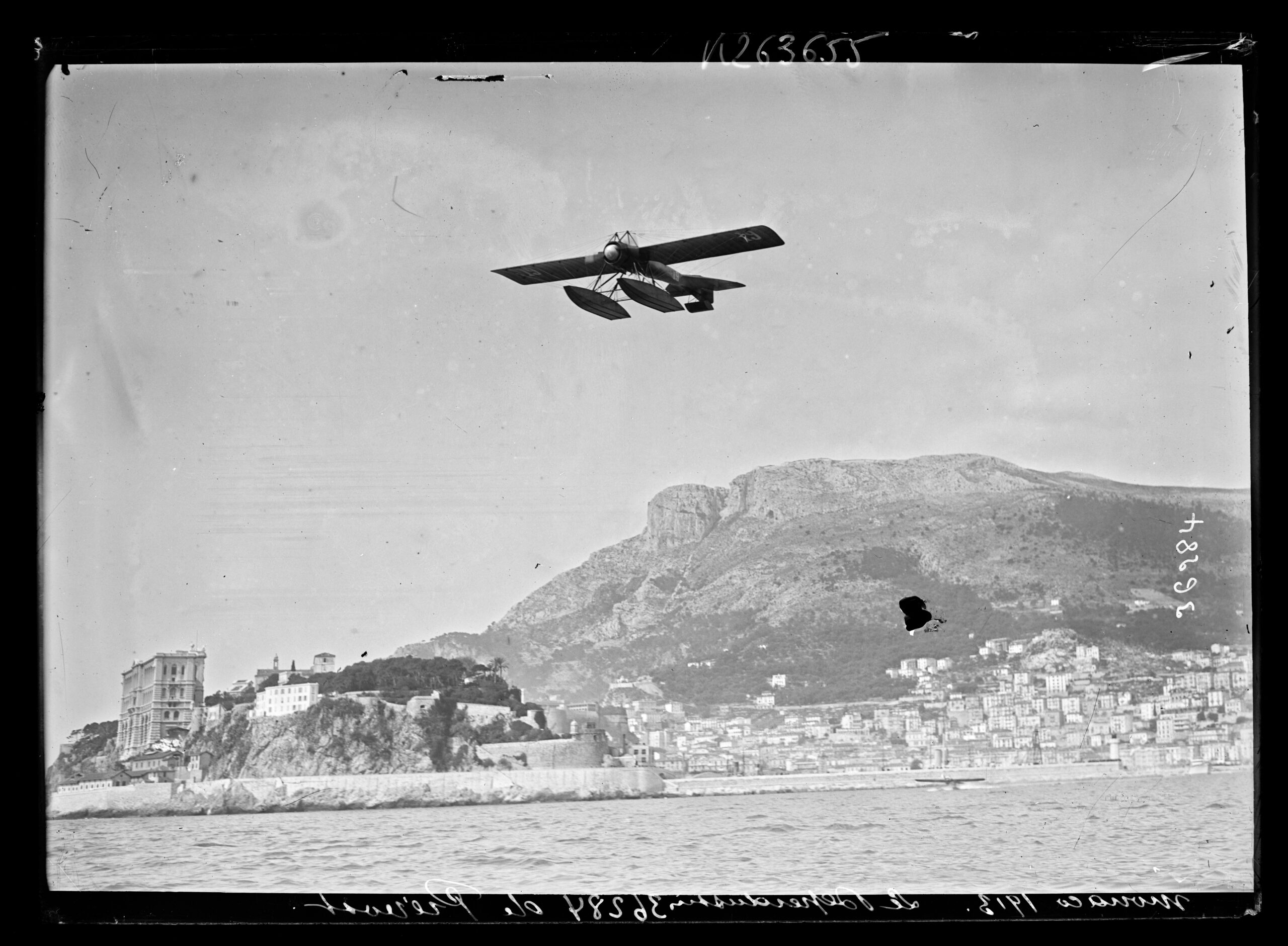
That same year the racing calendar gained the event that would shape fighter design for a generation. Jacques Schneider, heir to a French armaments family and a keen balloonist, announced his Coupe d’Aviation Maritime in 1912 to encourage seaplane development, and the first race was flown at Monaco on 16 April 1913. Prévost won it for France in a float-equipped Deperdussin at an average of 73.56 kilometres per hour, a figure held down by a 50 minute penalty delay after he misjudged the finish and had to complete it again. From this modest start the Schneider Trophy grew into the fiercest technical contest in the world, and the line of development it drove ran through the great Supermarine racers of the late 1920s to the Supermarine Spitfire.
Deperdussin himself fell to a spectacular fraud scandal, and in 1914 Louis Blériot took over the failing firm, keeping its initials but renaming it Société pour l’Aviation et ses Dérivés. The world would come to know those initials very well: SPAD.
Roland Garros and the Mediterranean
The pre-war years closed with two feats that showed how far the aeroplane had come since the first kilometre at Issy. On 23 September 1913 Roland Garros took off at 5.47 in the morning from Fréjus-Saint-Raphaël on the Côte d’Azur in a Morane-Saulnier G and turned south over open water. Seven hours and fifty-three minutes later he landed at Bizerte in Tunisia, having flown almost 800 kilometres to complete the first crossing of the Mediterranean by aeroplane. He had left France with just over 200 litres of fuel and nursed two engine problems on the way; fewer than ten litres remained in the tank when he arrived. It was one of the boldest flights yet made, out of sight of land in a machine whose engine no one would have insured.
That same month the crowds discovered aerobatics. Adolphe Pégoud, a test pilot for Blériot, had become the first pilot in Europe to jump from his own aircraft by parachute in August 1913, flew sustained inverted flight on 1 September, and on 21 September looped a Blériot XI at Buc, believing the loop to be the world’s first. In fact the Russian military pilot Pyotr Nesterov had quietly looped a Nieuport near Kiev on 9 September, twelve days earlier, so the strict priority is contested and most historians now give it to Nesterov. The fame, though, went to Pégoud, whose repeated public demonstrations proved that an aeroplane could leave normal flight and recover safely, a lesson every fighter pilot of the coming war would owe him.
France at war: SPAD, Guynemer and Fonck
The war that began in August 1914 ended the meetings and turned the whole French industry to military production. Out of Béchereau’s drawing office at the renamed SPAD came the sturdy, fast fighters that carried France through the second half of the war, the SPAD VII and then the SPAD XIII, of which 8,472 were built, with orders for around 10,000 more cancelled at the Armistice. They equipped not only the French escadrilles but American squadrons too.
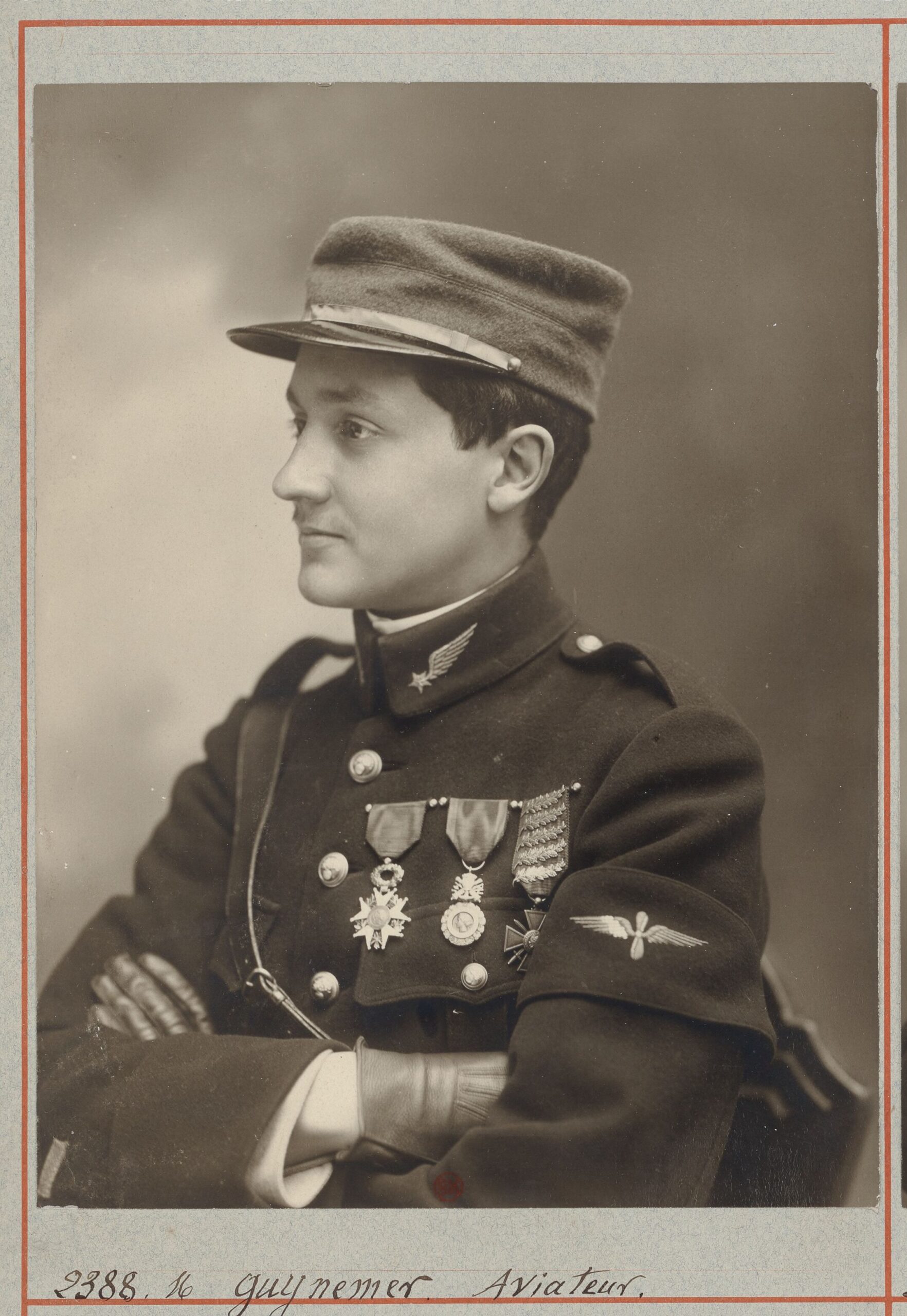
Two names dominate the French fighter story. Georges Guynemer, frail, intense and adored by the public, scored 53 confirmed victories with the famous Cigognes, the Storks group, before failing to return from a patrol over Poelcapelle in Flanders on 11 September 1917; France mourned him almost as a saint. René Fonck, a cooler and more calculating marksman, survived the war with 75 confirmed victories, fifteen times the score needed to be called an ace, making him the highest-scoring Allied fighter pilot not just of that war but of all time. And the war took the pioneers too: Pégoud, the great aerobat, became one of the earliest fighter aces and was shot down and killed in 1915, and Roland Garros, whose experiments with forward-firing guns helped invent the fighter itself, died in combat in the last weeks of the conflict.
When peace came, the survivors and the factories both needed something new to do. France gave them two answers: records and airmail.
The White Bird and Atlantic fever
In the 1920s the Atlantic replaced the Channel as the prize that obsessed aviation, and France came agonisingly close to winning it.
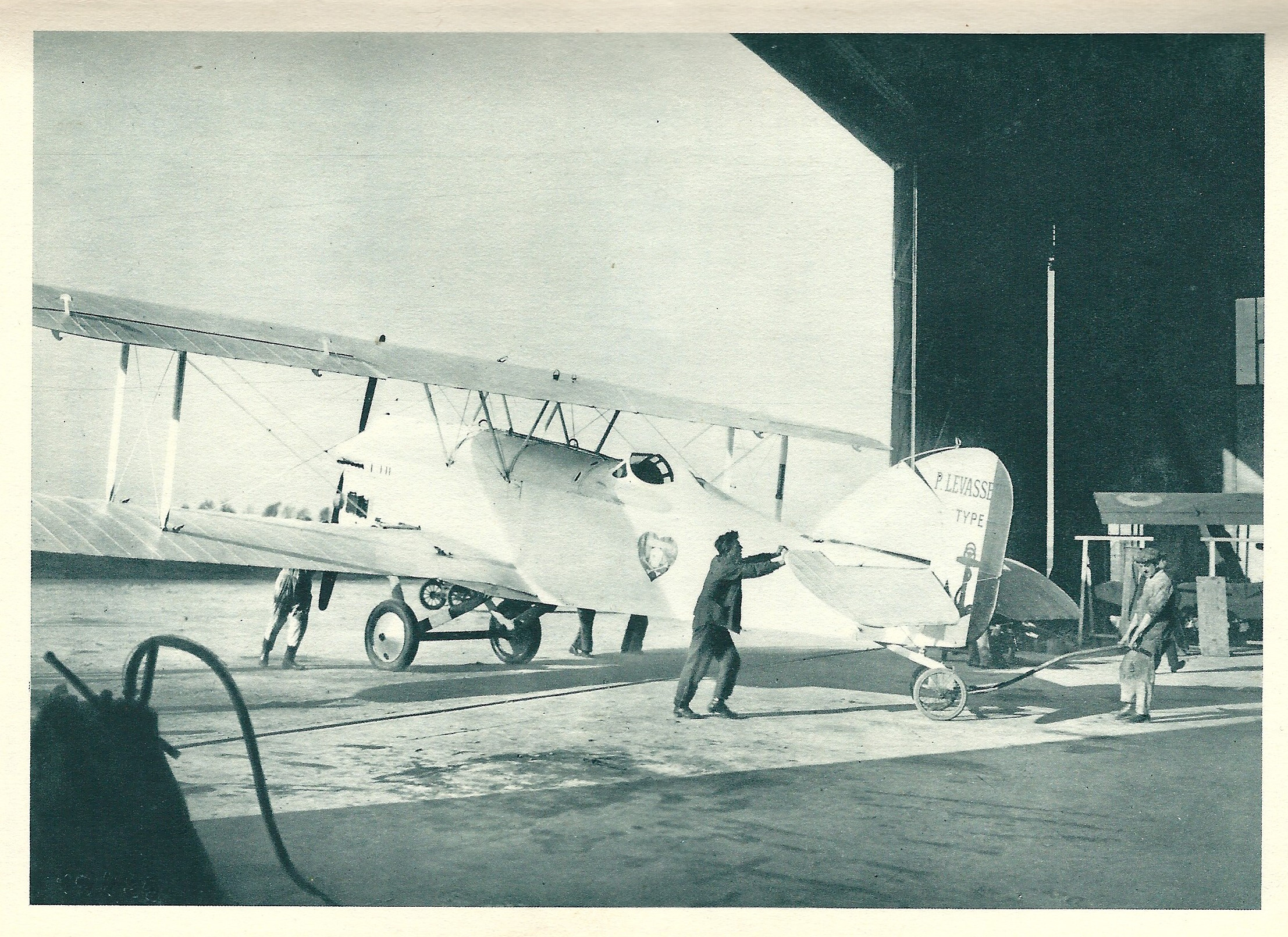
One photograph stops you cold. Charles Nungesser and François Coli, readying the Levasseur L’Oiseau Blanc, the White Bird, at Le Bourget in 1927, taken only days before they lifted off for New York and were never seen again. It remains one of aviation’s great unsolved mysteries. Not far from it sits the Farman Goliath being prepared in 1919 for a flight to Dakar, an early reach toward the great trunk routes that would soon become Aéropostale.
Nungesser and Coli left Le Bourget on 8 May 1927, heading west against the prevailing winds. Less than a fortnight later, on 21 May, Charles Lindbergh arrived at the same airfield from the opposite direction, having flown from New York alone, and the crowd that engulfed him included many who had waited there in vain for the White Bird. The east-to-west crossing the two Frenchmen died attempting would not be conquered from Paris for another three years.
Aéropostale: the line above the sea
The airmail story began in Toulouse, where the industrialist Pierre-Georges Latécoère formed his Lignes Aériennes Latécoère at the end of 1918 with a plan most people thought mad: to carry the post from France down the coast of Spain and Africa, and one day on to South America. Stage by stage the line grew, over the Pyrenees to Barcelona, on to Casablanca, and in 1926 across the Sahara to Dakar in Senegal. The pilots who made their names on it joined young: Jean Mermoz, a decorated but penniless ex-military flyer, came aboard in 1924 and learned the trade on the Pyrenees crossings to Barcelona before graduating to the desert sectors. The desert legs were flown over hostile country where a forced landing could mean capture and ransom, and the company posted Antoine de Saint-Exupéry to run the lonely refuelling station at Cape Juby on the edge of the Spanish Sahara, an experience that turned a pilot into a writer.
In April 1927 Latécoère sold most of his airline business to Marcel Bouilloux-Lafont, and the operation became the Compagnie Générale Aéropostale, the name under which it entered legend. Its pilots flew at night when night flying was barely understood, pushed the line down the coast of South America and over the Andes through a subsidiary, Aeroposta Argentina, and paid for it. In June 1930 Henri Guillaumet went down in the high Andes at Laguna Diamante and was given up for dead, then walked out through the snow and was found alive after nearly a week. Saint-Exupéry distilled those years into Vol de nuit, published in 1931 with a preface by André Gide, and it won that year’s Prix Femina.
The gap in the middle was the South Atlantic itself, where the mail still crossed by ship. On 12 and 13 May 1930 Jean Mermoz closed it, flying a Latécoère 28 floatplane named Comte-de-La-Vaulx from Saint-Louis in Senegal to Natal in Brazil, 21 hours and 10 minutes over open ocean with 122 kilograms of mail aboard. A letter posted in Toulouse could now reach Buenos Aires in days rather than weeks. Aéropostale itself did not long survive the financial storms of the early 1930s, but its routes, its pilots and its mystique passed into the new Air France in 1933.
Record breakers: the Question Mark and the Blériot 110
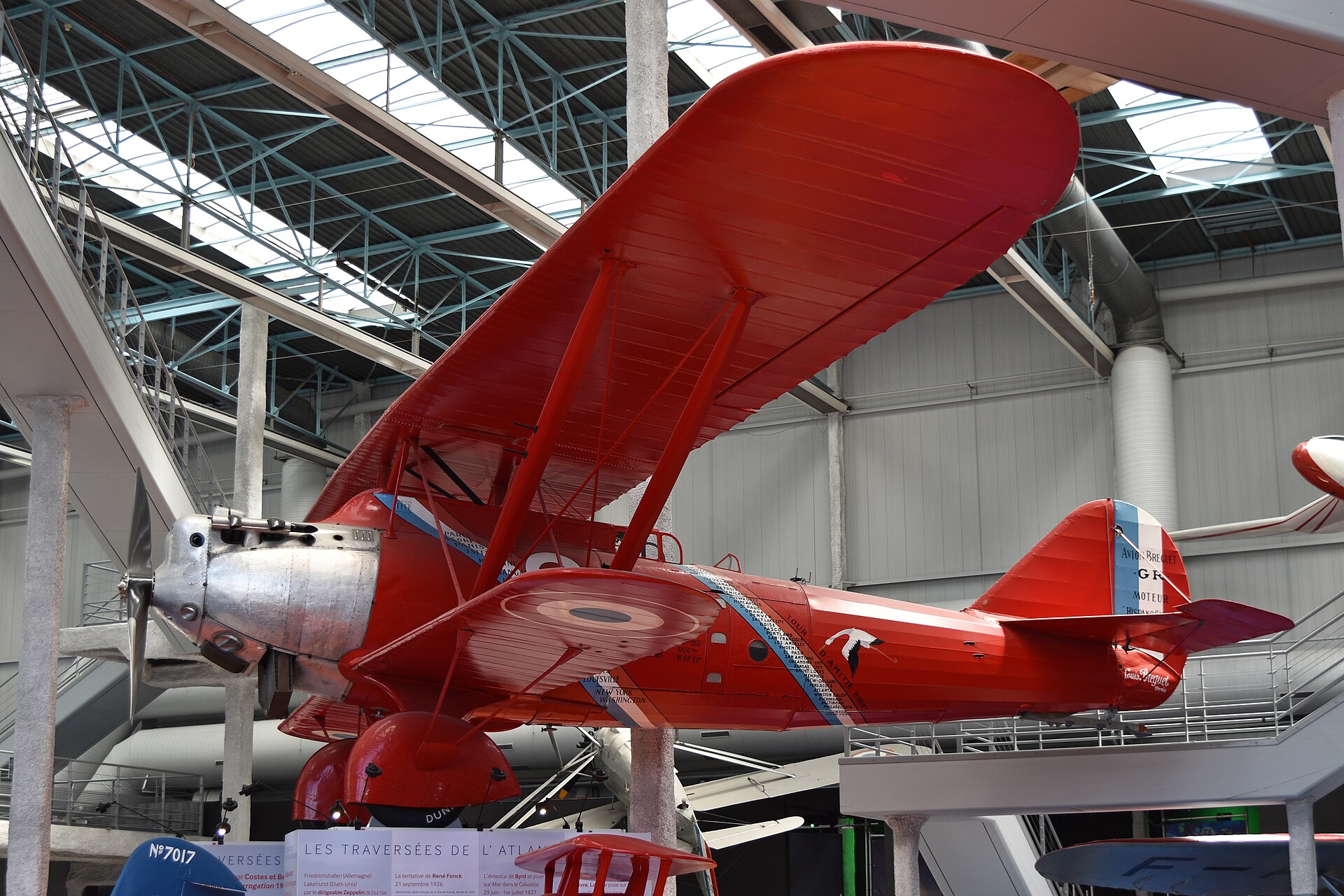
The unfinished business of 1927 was settled by a big red Breguet. The Breguet 19 TF Super Bidon, christened Point d’Interrogation, the Question Mark, first proved itself in September 1929 with a non-stop flight from Paris to Qiqihar in China of nearly 8,000 kilometres. Then, on 1 September 1930, Dieudonné Costes and Maurice Bellonte lifted it out of Le Bourget and turned west. A little over 37 hours later they landed at Curtiss Field, New York, the first aeroplane to fly from Paris to New York against the prevailing winds. A crowd of 25,000 met them, and the first man to shake their hands was Charles Lindbergh.
France also owned the endurance records of the era. Louis Blériot’s firm built a huge wooden monoplane, the Blériot 110, later named Joseph Le Brix after the naval aviator who died flying its great rival. Operating from Oran in Algeria, Lucien Bossoutrot and Maurice Rossi flew it round a closed circuit for 75 hours and 23 minutes in early 1931 to set a world distance record of 8,822 kilometres, then returned in March 1932 and stretched their own record to 10,601 kilometres in 76 hours and 34 minutes. A quarter of a century after the first wavering kilometre at Issy-les-Moulineaux, French crews were staying airborne for more than three days at a time.
Timeline: French aviation firsts, 1908 to 1932
| Date | Milestone |
|---|---|
| 13 January 1908 | Henry Farman flies the first official one kilometre closed circuit at Issy-les-Moulineaux, winning the 50,000 franc Grand Prix d’Aviation |
| 8 August 1908 | Wilbur Wright’s first European demonstration at Hunaudières, near Le Mans |
| 30 October 1908 | Farman flies 27 km from Bouy to Reims, Europe’s first cross-country flight |
| 25 July 1909 | Louis Blériot crosses the Channel in 36 and a half minutes, days after Hubert Latham’s first attempt ends in the sea |
| 22 to 29 August 1909 | Grande Semaine d’Aviation at Reims, the first great international air meeting, draws around half a million spectators |
| 28 April 1910 | Louis Paulhan wins the Daily Mail’s £10,000 London to Manchester race on a Farman III |
| 16 April 1913 | First Schneider Trophy race at Monaco, won by Maurice Prévost on a Deperdussin |
| 23 September 1913 | Roland Garros makes the first aeroplane crossing of the Mediterranean, Fréjus to Bizerte in 7 hours 53 minutes |
| 21 September 1913 | Adolphe Pégoud loops a Blériot XI at Buc, days after Nesterov’s loop in Russia |
| 29 September 1913 | Prévost sets a world speed record of 203.85 km/h at Reims, the first past 200 km/h |
| 1917 to 1918 | SPAD XIII enters service; 8,472 built. Fonck ends the war as Allied ace of aces with 75 victories |
| 8 May 1927 | Nungesser and Coli vanish over the Atlantic in L’Oiseau Blanc |
| 12 to 13 May 1930 | Jean Mermoz flies the first South Atlantic mail crossing, Saint-Louis to Natal in 21 hours 10 minutes |
| 1 to 2 September 1930 | Costes and Bellonte make the first Paris to New York flight in the Point d’Interrogation |
| 23 to 26 March 1932 | Bossoutrot and Rossi set a closed-circuit world distance record of 10,601 km in the Blériot 110 |
The press agencies behind the plates
None of this story would survive so vividly without the photographic press agencies of Paris, which grew up alongside aviation itself and treated it, from the start, as front-page material. The Agence Rol was founded in 1904 by the photographer Marcel Rol and specialised at first in sport, cycling, boxing and, very quickly, aeronautics. The Agence Meurisse followed in 1909, founded by the Belgian photographer Louis Meurisse, and Maurice-Louis Branger’s Photopresse agency, established around 1905 on the rue Cambon, covered everything from the Paris flood of 1910 to the international aviation exhibitions at the Grand Palais.
Their operators worked with plate cameras, exposing the events of the day onto glass negatives, which is why so much early aviation photography has such extraordinary resolution. The scale of their output is hard to grasp now. The Bibliothèque nationale de France alone holds more than 130,000 photographs from the Agence Rol, and the air and space museum at Le Bourget holds nearly 28,000 more from the agency’s aeronautical files. In 1937 Rol, Meurisse and the younger Mondial Photo Presse merged to face foreign competition, forming the agency SAFARA, and their combined archive of plates eventually reached the Bibliothèque nationale in 1961, where digitisation continues today; the Rol negatives from 1904 to 1927 can already be browsed on Gallica, the digital library of the BnF. Branger’s negatives, some 31,000 of them, passed to the Roger-Viollet agency the same year.
Photographs like the ones in our collection began life in exactly this world, shot for tomorrow’s paper, filed, and forgotten. The wonder is not that most were lost, but that any survived at all.
From the plates to the archive
Every image has been scanned at very high resolution from the original glass plates and period prints, which is why the detail holds up the way it does, rigging wires, the weave of the fabric, the faces in the grandstands. Press photographs like these were never made to survive; that any reached us in this condition is mostly down to luck.
We’re still working through the identifications, early French aviation is a deep and occasionally contradictory field, and we’d really welcome corrections from anyone who knows it well. In the meantime the collection is online to browse, and individual images are available for licensing and as fine-art prints.
View the French Aviation Pioneers 1908-1932 collection →
If you would like to use any of the images, our licensing page explains the personal, editorial and commercial options, and every picture is also available as a fine-art print.
From glass plates to digital sensors, the craft of capturing aircraft keeps evolving. If you want to photograph today’s aircraft in flight, see our airshow photography tips and settings guide.
Frequently asked questions
Who were the leading French aviation pioneers of this era?
The period is associated with figures such as Louis Bleriot, the Voisin brothers, Henri Farman, Louis Paulhan, Roland Garros and Adolphe Pegoud, whose flights, aircraft and records shaped early European aviation.
Why is 1908 to 1932 called a golden age of French aviation?
France led much of the world’s early aircraft design, air racing and record-setting in these years, from the first cross-Channel flight to pioneering aerobatics and long-distance records, before aviation became a fully industrialised business.
What are glass-plate negatives?
Glass-plate negatives were the photographic medium of the period, using a light-sensitive emulsion coated on glass rather than flexible film. Surviving plates preserve remarkably sharp, detailed images of early aircraft and the people who flew them.
Who was Roland Garros?
Roland Garros was a French aviator best known for the first non-stop flight across the Mediterranean in 1913 and for early fighter development in the First World War. The Paris tennis stadium is named in his honour.
Who was Adolphe Pegoud?
Adolphe Pegoud was among the first pilots to fly a loop and to parachute from an aircraft, and he became one of the earliest fighter aces before he was killed in 1915.
Which press agencies photographed early French aviation?
Paris press agencies such as Rol, founded in 1904, Meurisse, founded in 1909, and Maurice-Louis Branger’s Photopresse covered the flying meetings and record attempts of the era with glass-plate cameras. Hundreds of thousands of their negatives survive in the Bibliothèque nationale de France and other collections.
Why was France the centre of early aviation?
For a few years before the First World War, France led the flying world while the Wright brothers guarded their patents across the Atlantic. French airfields such as Issy-les-Moulineaux, Port-Aviation at Juvisy and the great meeting ground at Reims turned aviation into a public spectacle, a sport and an industry all at once. The country produced a roll-call of early makers including Farman, Breguet, Nieuport, Voisin, Caudron and Bleriot.
What was the Grande Semaine d’Aviation at Reims?
Held near Reims in August 1909, it was the world’s first great international flying meeting, drawing crowds in the hundreds of thousands. Rival machines were parked wingtip to wingtip along the hangar line at Betheny at a moment when no one yet knew which design would win. It marked the point where the aeroplane went from music-hall curiosity to national spectacle.
Who were Nungesser and Coli?
Charles Nungesser and Francois Coli were French aviators who set off from Le Bourget in 1927 in the Levasseur aircraft L’Oiseau Blanc, the White Bird, attempting to fly to New York. They were never seen again, and their disappearance remains one of aviation’s great unsolved mysteries. A photograph of the pair readying the aircraft days before survives in the archive collection.
The archive behind these stories is now licensable directly: our guide to licensing early aviation photographs explains what the glass-plate collection holds and how publishers use it.
