A Saab JAS 39 Gripen was flying a display over Riddarfjärden, in the middle of Stockholm, early in the afternoon of 8 August 1993, in front of the crowds at the city’s Water Festival. Coming out of a slow turn the pilot put in a brief full right stick, felt what he later described as a tremendous lurch to the right, and corrected. The aircraft began to wallow in roll and pitch. Within about two and a half seconds the pitch oscillation was too big to stop.
He ejected. Still in the attitude it had departed in, the aircraft went on and hit Långholmen just east of the southern abutment of Västerbron, more or less flat on its wings, and burned. He came down in the water by Pålsundsbron, unhurt. Around fifteen people on the ground said they had been injured; one woman spent about three weeks in hospital with burns to her face, forearms and hands. Several bicycles were destroyed.
Four and a half years earlier the same pilot had crashed the first prototype on landing at Linköping. And the Swedish accident investigators, in the report on the second crash, wrote: all JAS 39 aircraft had the same built-in imperfection in the control system.
What is on this page
- Why Sweden builds its own fighter
- Jakt, Attack, Spaning
- Unstable by design
- Flight six, and the runway at Linköping
- The finding against FMV and Saab
- The display over Stockholm
- The imperfection
- After the grounding
- The A, B, C and D reach the squadrons
- South Africa and the arms deal
- Leases, sales, and a Swiss referendum
- Brazil builds it
- Libya, and what the Riksdag allowed
- The E is a different aeroplane
- Ukraine, document by document
- Where the 4,700 dollar figure came from
- The Draken and the Viggen
- The C fleet at readiness
- The order book now
- Frequently asked questions
- Sources and further reading
The Saab JAS 39 Gripen: key facts
- What JAS stands for: Jakt, Attack, Spaning. Fighter, strike and reconnaissance in one airframe.
- The decision: carried in the Riksdag on 4 June 1982 by 172 votes to 167.
- The contract: a fixed price with Industrigruppen JAS, set at 25.7 billion kronor at February 1981 prices for 140 aircraft through the year 2000, and adjusted to 24.9 billion in 1983.
- The consortium: Saab-Scania, Volvo Flygmotor, Ericsson, SRA Communications and Förenade Fabriksverken.
- Maiden flight: prototype JAS 39-1, 9 December 1988.
- Layout: delta wing with canard foreplanes, aerodynamically unstable, flown through a fly-by-wire system with a short-travel centre stick.
- Road basing: on Saab’s dispersed-basing page the E takes off from a 16 metre by 500 metre road strip and lands on 600 metres.
- The two accidents: prototype 39-1 at Linköping on its sixth flight, and 39.102 over Stockholm four and a half years later.
- Engine: one Volvo RM12 of 80.5 kN on the C and D, one General Electric F414G of 98 kN on the E.
- Hardpoints: eight on the C and D, ten on the E. The 27 mm gun is on the single-seat C only.
- Export operators of the C and D: the Czech Republic, Hungary, South Africa and Thailand. The UK Empire Test Pilots’ School has used the type for test pilot training.
- On order for the E and F: Sweden 60, Brazil 36, Colombia 17, Ukraine 16, Thailand 4.
Why Sweden builds its own fighter
Sweden’s parliament debated it on 3 and 4 June 1982. Its defence committee agreed on the concept; what it split on was whether the aircraft should be imported or developed at home.
As a member put it in the chamber, the case for building at home was that foreign aircraft would be dearer and less well suited to Swedish requirements, and that buying one would also mean several thousand jobs disappearing within the Swedish defence industry. The case against came from the left: it still holds, one speaker said, that a continued Swedish aviation industry requires increased defence costs. He wanted licence production of a foreign aircraft examined instead.
A Social Democratic speaker put numbers on his objection: unpriced development costs of one to two billion kronor, about a billion for rationalisation forgone at the procurement agency, a billion in advances for production after 2000, and a total, he said, of 33 to 35 billion by the year 2000 against the government’s declared 25.7.
The division came on 4 June 1982. On the aircraft procurement the committee’s proposal carried by 172 votes to 167. In the debate the day before, an opposition member had accused the government of forcing the decision through with a majority of one; several divisions in the wider defence package the following day went 170 to 169.
Jakt, Attack, Spaning
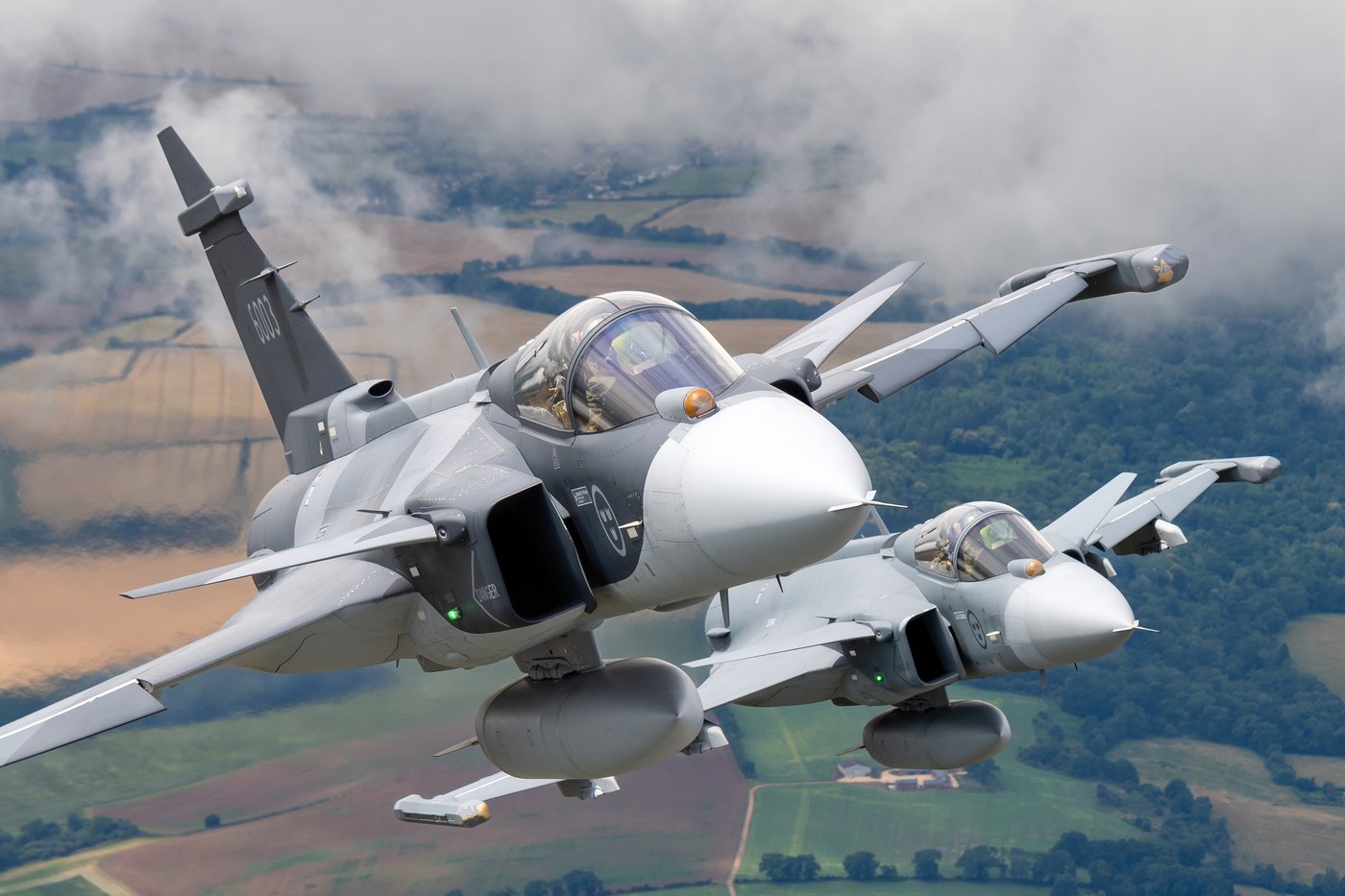
JAS is three Swedish words. Jakt is the fighter role, attack is strike, spaning is reconnaissance. The idea was that one aeroplane would do all three, and the 1982 debate sets out the reasoning: large economic advantages and greater combined effect if every aircraft can handle all three functions, and clearly greater flexibility than a system in which squadrons have tasks within only one.
On 30 June 1982 the outgoing government set the economic frame at 25.7 billion kronor at February 1981 prices, for the development and acquisition of 140 aircraft through the year 2000, weapons, support equipment and reserves included. The deal was a fixed-price contract with Industrigruppen JAS, a consortium of Saab-Scania, Volvo Flygmotor, Ericsson, SRA Communications and Förenade Fabriksverken, covering development, production of 140 aircraft, maintenance systems, weapons integration and guarantees that extended to operating costs. The 1983 proposition adjusted the frame down to 24.9 billion.
The defence minister told the chamber that a fixed-price contract existed and that the suppliers had made far-reaching economic undertakings during the negotiations. He also drew a line about who would decide any changes to the basic version: it is a purely political examination of the possibilities against the costs, to be made by the government.
Sweden bought a fighter and a fighter industry in the same decision, on a fixed price, from a consortium of five Swedish companies.
Unstable by design
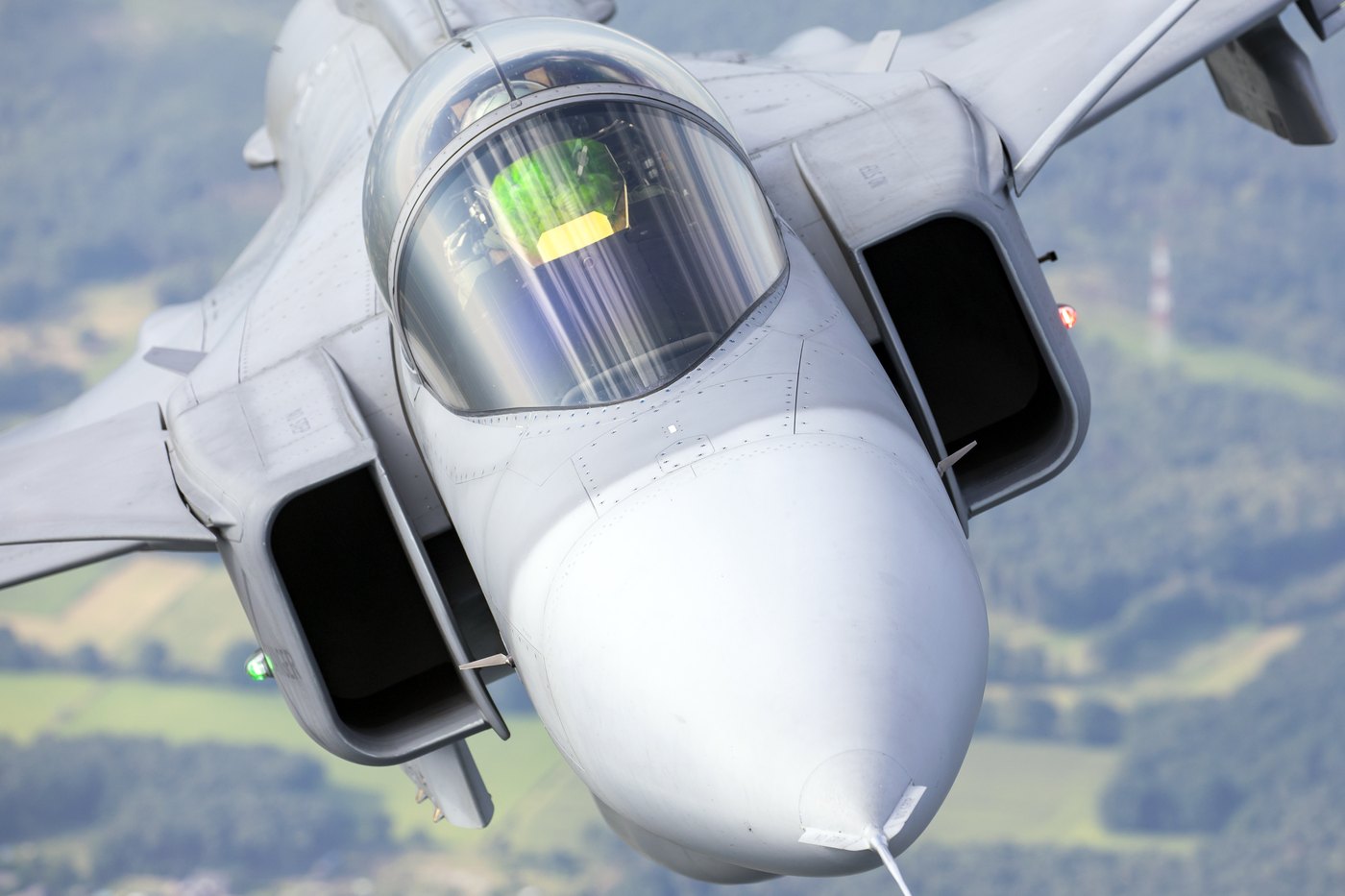
A Gripen will not fly without its computers. The accident report of 1993 states the position flatly: since the JAS 39 is an aerodynamically unstable aircraft, the pilot shares the control surfaces with the stabilisation system, and the aircraft’s instability imposes an unconditional requirement that there must always be control authority left over for the stabilisation function.
The layout is a delta wing with canard foreplanes, control surfaces both ahead of and behind the centre of gravity. The same report notes what the software does with that: performance can be improved by drag minimisation, asymmetric control-surface angles and the like. What the pilot holds is a short-travel centre stick, described in the report as a mini-stick placed on the cabin centreline. The control stick restrains the pilot only to a small degree. What limits his possible control inputs is his ability to make large and rapid arm and hand movements.
With the arrival of electrical control systems, they said, the possibility increased of designing control laws that give good performance across a larger envelope, and that possibility has made the control laws in an aircraft like the JAS 39 very complex. The negative result of the complexity is that control can be disturbed by a fault or an unexpected signal from one of the sensors. The positive, they said, is that redundancy exists.
The report then turns from the aeroplane to the country: control laws are developed by highly specialised systems engineers, and in our country that competence exists only in a few people within Saab.
Flight six, and the runway at Linköping
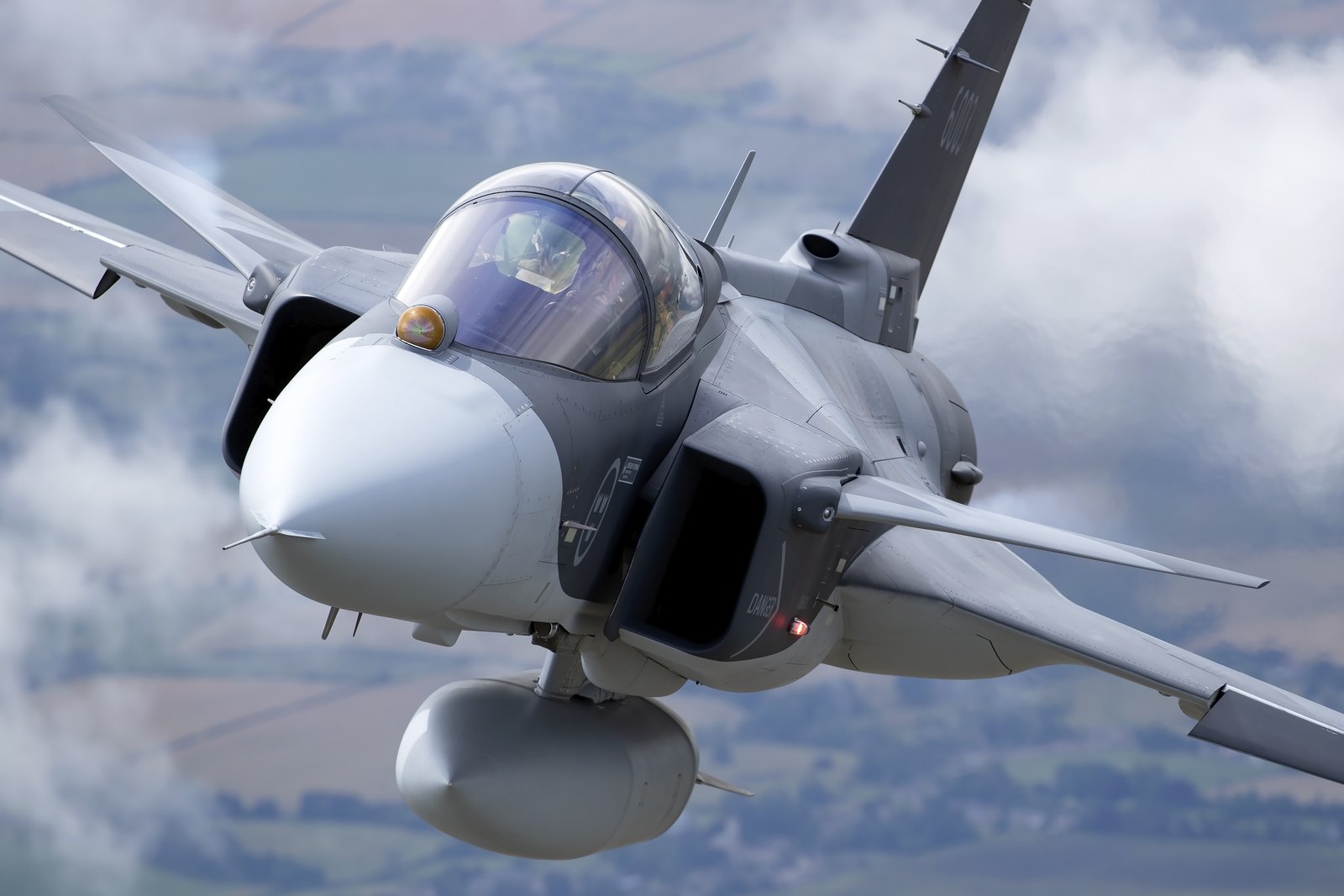
Prototype JAS 39-1 first flew on 9 December 1988. On 2 February 1989 it took off from Saab’s field at Linköping at 10.36 for its sixth flight, with 5.3 hours on the airframe, carrying a dummy missile on each wingtip rail and, for the first time, a camera pod on the centre fuselage pylon. Pilots had raised sixteen remarks on the first five flights and fourteen modifications had been made after the first.
Until the landing, the flight went entirely to programme. On the approach the aircraft began to oscillate in roll. The pilot countered with small to moderate stick inputs, then increased them to maximum as he came lower. At between fifteen and ten metres it started to oscillate in pitch as well. He countered, his inputs rising quickly to full deflection, and the oscillations diverged. He lit the afterburner to go around. It hit the runway with its left wingtip, the main gear and the nose. He reached for the ejection handle and grabbed in the wrong place. It slid off the runway rolling violently and stopped inverted about 85 metres clear of it. The airfield fire service put out a small fire in the engine exhaust and got him out with a fractured left elbow and muscle strains.
The software did not fail. The investigation results show, the report concluded, that the test aircraft functioned without remark in all relevant technical respects and that the control system behaved in the manner intended for it.
What went wrong was gain. The primary problem, the analysis says, was that the sum of the gain in the system became too high at the frequency at which the system is prone to oscillate in pitch, and the pilot’s own gain was twice the gain that by calculation produced instability. The stated cause is that the stick work in pitch exceeded the values assumed when the control system was sized, so the stability margins were exceeded at the critical frequency.
The contributing factors were listed as the gustiness of the wind, strong yaw-roll coupling in that aircraft, the control system’s short roll time constant, the stick’s large mechanical bandwidth, and a control system sized at that frequency in a way that permitted too high a gain. The findings also record that the actual wind in the final phase of the landing exceeded the wind restriction then in force for the aircraft.
The finding against FMV and Saab
No criticism could be directed at the way airworthiness work had been conducted up to the first flight; from the first flight onwards it had been conducted less well. In its role as airworthiness authority, the procurement agency had not acted forcefully and clearly enough. Planning of the envelope opening was incomplete. Between test pilots, test engineers and system designers the division of roles was not sufficiently well defined. Development simulations of the control system had been used to far too limited an extent, and verification of the control system in that aircraft had not been carried out in a flying simulator at all.
Had the data from the take-off and landing on flight two been evaluated for stability margins, time delays, rate limits and the test pilot’s stick work, the test flights would probably have been stopped, pending a revised control system programme.
The investigators also recorded that among the test pilots for the first six flights there was none with sufficient training in handling-qualities flight testing, and that too many test pilots, three, had been engaged over those six flights.
They made no recommendations. On a considered view, they wrote, the deficiencies were being dealt with within both the procurement agency and Saab in such a way that flight safety did not require any.
The display over Stockholm
Over Stockholm the aircraft was 39.102, a production machine, flown by the Skaraborg Wing and the procurement agency’s test flying organisation. It was flown under test rules because the type certification decision required production aircraft to be flown by the same routines as test aircraft.
It took off at 13.51, climbed to 8,000 metres, lost one of its indicators so the electronic map would not display, came down to 300 metres and ran in over Riddarfjärden. The display opened with a flypast and a wingover, another flypast at about 300 metres and 500 km/h, then a right turn at about 700 km/h in which the load briefly reached 7.2 G. He pulled up into a wingover to slow down for the next item, a 360 degree turn to the left at low speed.
That turn was flown with reheat lit, between 275 and 300 km/h, at a mean angle of attack of 21.7 degrees and about 2 G. Above 20 degrees of alpha the roll autotrim disengages by design, which meant he was holding about two degrees of right stick to keep the bank constant. Rolling out, he moved the stick from that offset position, and it briefly reached full travel and produced a considerably higher roll rate than in rehearsal.
Now the control surfaces were moving at their maximum rate, which introduced growing delays between what he asked for and what the aircraft did. Those delays produced a pilot-induced oscillation in both pitch and roll. After a few cycles the pitch oscillation diverged. He pulled back to correct a nose-low attitude and the aircraft departed to a very high nose attitude at low speed.
The stated cause runs: the accident was caused by an imbalance in the control system. The imbalance allowed the pilot to give such control commands that the control surfaces did not have time to produce the expected aircraft response. The resulting time delays led to a combined pilot-induced oscillation in roll and pitch. The control system was unable to limit the command signals, which meant that the size of the pitch oscillations continuously increased. The sum of the pilot’s and the stabilisation system’s control commands made the pitch oscillations, within about 2.5 seconds, so large that the pitch motion could finally not be limited. The departure happened at so low an altitude that the pilot had no possibility of regaining control.
The imperfection
Four things had to be in balance and were not: the change of flight path the pilot commands, the properties of the stick, the sizing of the control laws, and the limits of the control surface mechanisation. Under a heading that translates as “the imperfection”: the pilot could, through the stick, put so much signal into the control system that it saturated before the control surfaces had time to give the expected response.
It had been seen before. During development of the control system edition fitted to that aircraft it had been established that the aeroplane could be made to depart, but the margin was judged sufficient, so the characteristic was not entered in the pilot’s manual and did not become known to all pilots. The investigators called that judgement reasonable, and then said it should have gone further: given what was already known about pilot-induced oscillation when control surfaces hit their rate or deflection limits, the characteristic should have prompted a deeper analysis. The rate-limiting problem during landing had been thoroughly analysed, and those results showed unambiguously that an increased tendency to pilot-induced oscillation arises when rate limits are reached.
The aircraft’s control system had a characteristic which in certain situations could lead to an accident. The only thing required for an accident was a triggering factor. All JAS 39 aircraft had the same built-in imperfection.
The warning system did not help. Finding 17 records that the control system warning was presented to the pilot only after the aircraft had become uncontrollable. The investigators call what happened to him a cliff effect: he lost control without warning, because the manoeuvre load limiter could not hold the angle of attack and no information about the saturation had reached him.
Finding 11 says the pilot did not observe the height and alpha limits set for the display. Findings 28 and 29 say the control system permitted the imbalance and that every aircraft in the fleet had it. All three are in the same document, and the report opens its analysis by rejecting single-cause explanations: the cause of an accident is almost never a single event, and accidents happen when several apparently insignificant factors work together in an unfavourable way.
| 2 February 1989 | 8 August 1993 | |
|---|---|---|
| Aircraft | JAS 39-1, the first prototype, sixth flight, 5.3 hours flown | 39.102, a production aircraft, flown under test rules |
| Where | Landing at Saab, Linköping | Display over Riddarfjärden, Stockholm |
| Pilot | Lars Rådeström, born 1944. 4,032 hours military plus about 400 civil | Not named. Born 1944, 4,364 hours military, 115 of them on the JAS 39, and previously in the 1989 accident |
| Cause as stated | Divergent pitch oscillation because stick work exceeded the values assumed in sizing the control system | An imbalance in the control system that let the pilot saturate it before the surfaces could respond |
| Injuries | Pilot: fractured left elbow and muscle strains | Pilot unhurt. About fifteen people on the ground reported injuries; one woman hospitalised about three weeks |
| Recommendations | None, the deficiencies being already in hand | Four, to the Chief of the Air Force |
After the grounding
All JAS 39 flying stopped that day. A potential airworthiness remark was formally raised, which revoked the flight test permits on every aircraft of the type.
Getting a new flight test permit fell to the procurement agency, which required a review of the airworthiness process for test aircraft, a rapid investigation of flight test operations including how deviations in the control system should be handled, an investigation of the control system itself, and a review of human and machine research in Swedish industry and research centres bearing on the aeroplane. Saab ran a system safety review of every significant subsystem, assessed by a group drawn from Saab and the agency.
The problem, in the group’s words, was that the pilot was free to give larger and faster control commands than were required and than the system could deal with; the system solution had not managed to create a natural and effective limitation of commands too large and too fast for it at low speeds. An information channel should be created, the group said, between the pilot and the system, telling him the system was starting to overload. Older control systems gave the pilot that information naturally through a stick mechanically coupled to the surfaces. A corresponding channel in the Gripen would in itself be desirable, but the drawbacks of the added complexity were judged to outweigh it.
The changes listed before the next flight included new directives and rules for the handling-qualities review group, a new section within flight dynamics for control law concepts, a reference group of experts from the United States and England, removal of the time delay on the control system warning, and software changes to make the aircraft’s response softer. Then tighter restrictions before further envelope opening, tighter deviation reporting, sharper validation routines, and additions to the pilot’s manual.
Two Swedish accident reports, four and a half years apart. The first found the control system working exactly as designed and the stick work outside what the design had assumed. The second found the design itself out of balance, on every aircraft in the fleet.
The A, B, C and D reach the squadrons
Production aircraft 39.102 was on the books of the Skaraborg Wing at Såtenäs by August 1993, flying under the procurement agency’s test rules. Founded in 1940, the wing has often been the first in the country to get new aircraft, the Hercules and the Viggen among them, and it now houses Gripencentrum, the Armed Forces’ central unit for all Gripen pilot training, Swedish and export.
The year the Gripen was formally declared operational with the Swedish Air Force is usually given as 1996, and no Swedish government source giving a date was found for this article.
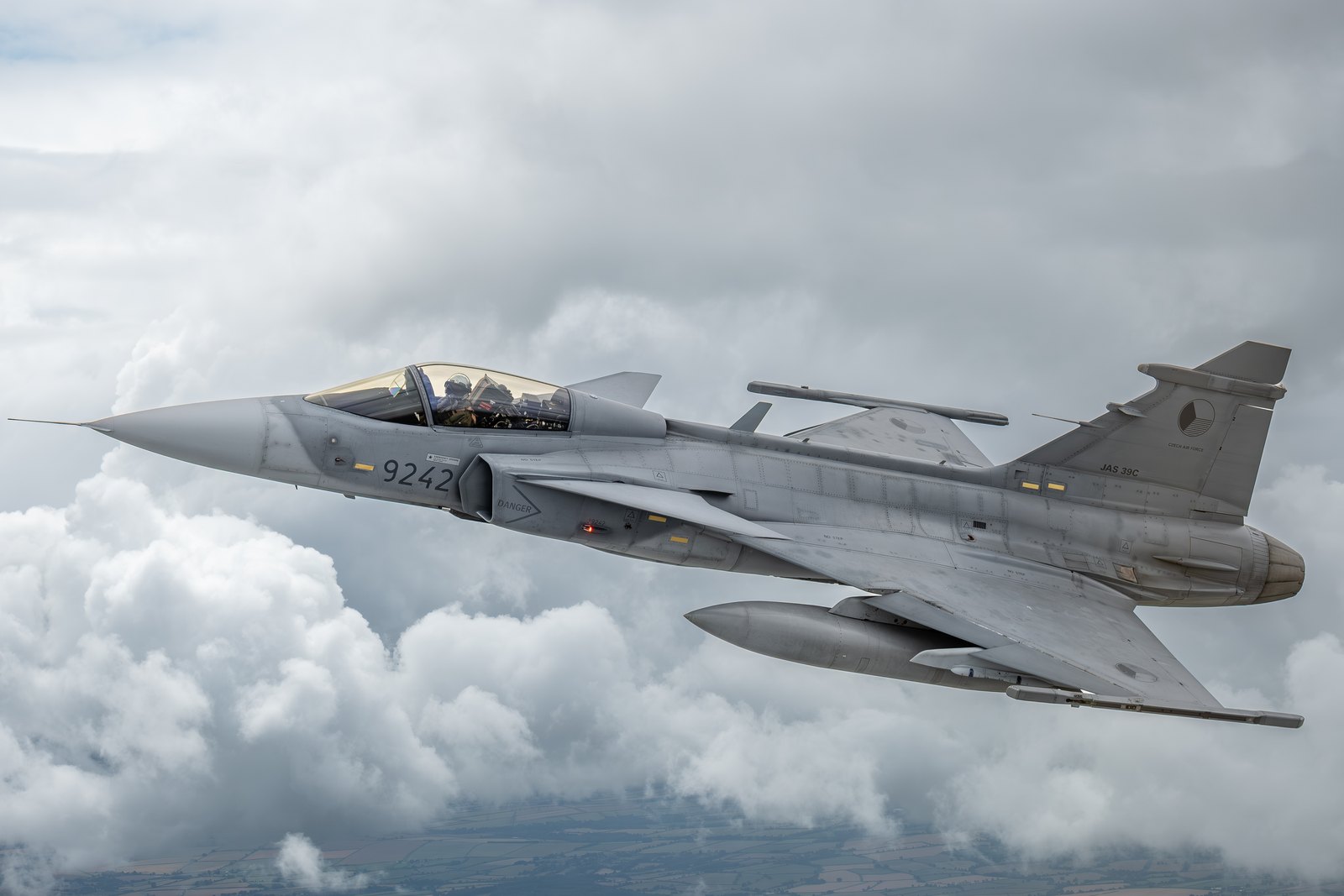
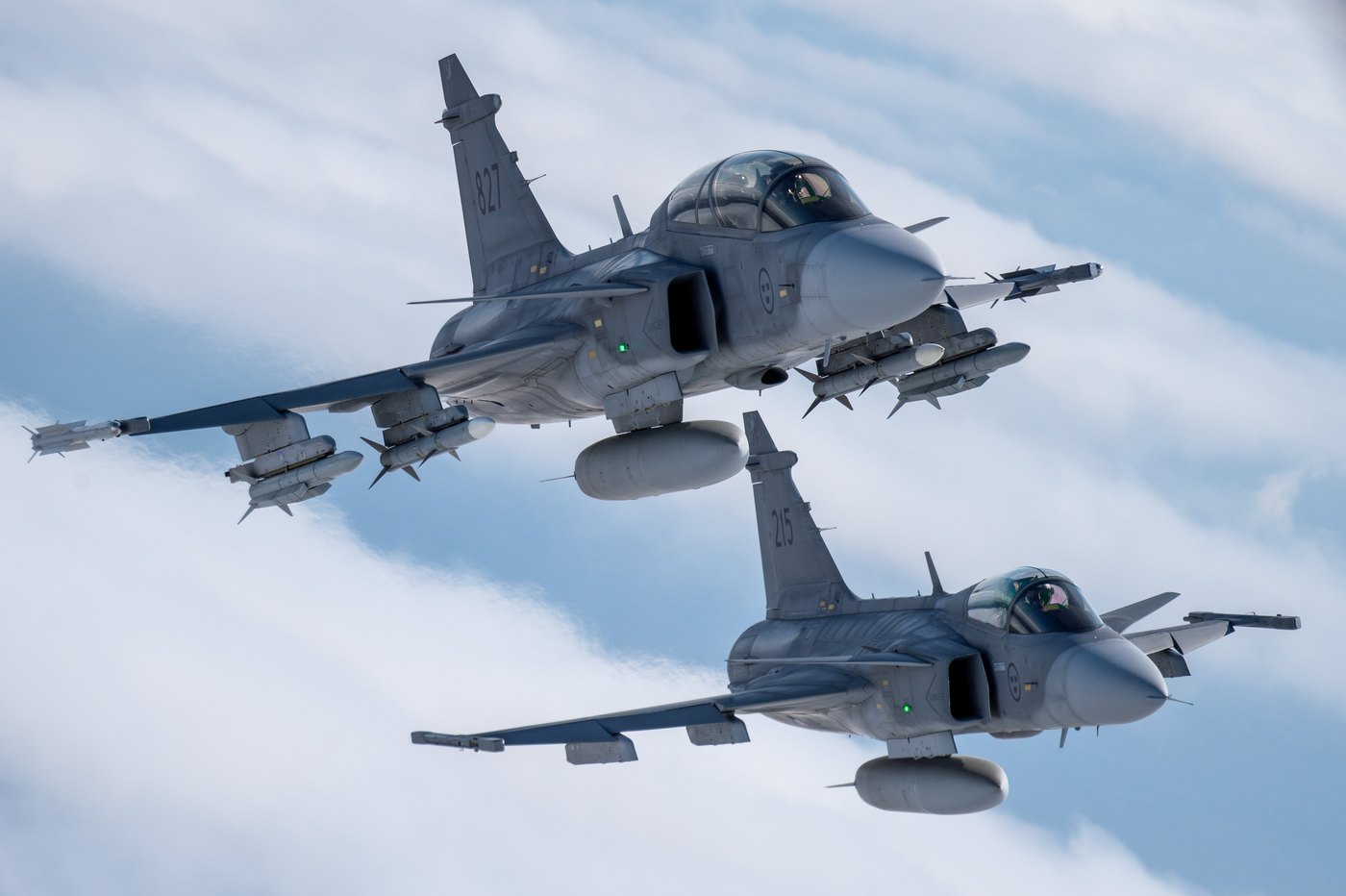
The A was the single-seat production version and the B its two-seater. The C is the NATO-interoperable standard and the basis of every export sale of the older generation; the D is its two-seater. Saab’s figures for both C and D give air-to-air refuelling, a tactical datalink, eight hardpoints, 80.5 kN of thrust, a maximum take-off weight of 14,000 kg and a ten-minute combat turnaround, with the 27 mm gun on the C only. Later the Czech and Hungarian fleets were brought to the MS20 standard, which added bomb delivery options and air-to-air radar modes, and the Hungarian aircraft to MS20 Block 2, which brought IRIS-T, GBU-49 and Meteor.
South Africa and the arms deal
South Africa bought the Gripen outright, as part of the Strategic Defence Packages at the end of the 1990s. At a cost of 29 billion rand over twelve years, the South African cabinet decided to acquire aircraft, corvettes and submarines. Flight testing finished in early 2008 and the first aircraft was delivered shortly afterwards. The last was contractually delivered in late 2011.
What happened around that purchase has been through two official processes and is still not settled. On 16 June 2011 Saab published the result of an internal investigation into a South African consultant contract it said it had not known about. Its review found that approximately 24 million rand was paid from BAE Systems to the joint offset vehicle and transferred to the South African consultant shortly afterwards. Håkan Buskhe, then chief executive, said the transactions had never entered into the accounts, and that a person employed by BAE Systems had without Saab’s knowledge signed a contract unknown to Saab, signed transactions unknown to Saab, and signed the audited and apparently inaccurate financial statement for 2003. That material went to the Swedish National Anti-Corruption Unit.
Set up to examine the whole arms package, the Seriti Commission reported findings that were made public in April 2016. On 21 August 2019 a full bench of the High Court of South Africa reviewed and set those findings aside. The court held that the commission had asked one central witness only extremely generalised questions despite serious corruption allegations, had barely probed another despite evidence from the Serious Fraud Office, had improperly refused to admit a report on a clearly inaccurate understanding of the law of privilege, and had refused to examine a related trial record. Its formulation was: an investigation must have been conducted with an open and enquiring mind.
No official inquiry’s exoneration of the arms deal now stands, because the one that gave it was set aside. No court has found that the Gripen purchase itself was procured by corruption. And Saab has itself disclosed money passing through the offset vehicle to a consultant without entering its accounts.
Leases, sales, and a Swiss referendum
Prague did something unusual: it rented its air force. On 9 June 2004 the Czech Ministry of Defence decided to take twelve new single-seat Batch C Gripens and two new two-seat Batch D, fourteen in all, on a ten-year lease from the Swedish government, at a total contract value of 19.65 billion koruna. Through the lease the package took in flight simulators, mission planning systems, pilot equipment, training, spares and logistics maintenance, with an offset programme valued at 130 per cent of the lease contract.
On 18 April 2005 the first six aircraft arrived at Čáslav. Eight Czech pilots had gone through initial training between August 2004 and January 2005, first solo in October 2004. In 2014 the lease was extended through 2027, with the MS20 upgrade included, and by 2020 the fleet had accumulated close to 30,000 flying hours.
Hungary took a similar route and finished it differently. Saab dates the Hungarian lease to February 2003 and the first deliveries to Kecskemét to 21 March 2006, fourteen aircraft, twelve C and two D. On 23 February 2024 the Swedish government announced that Hungary would buy four more, and that the original fourteen, held under a lease-purchase arrangement, would become fully owned by Hungary in early 2026, with Swedish support and logistics running from 2026 to 2036. Ulf Kristersson’s line in the announcement was that the Gripen is a source of Swedish pride and one of the assets Sweden will bring to NATO.
Thailand bought through the Swedish state. Selling an integrated air defence system with Saab as sub-supplier, the procurement agency contracted for six aircraft in February 2008 and six more in November 2010, twelve in all, with two Saab 340s, one of them carrying the Erieye radar, and a command and control system. On 22 February 2011 the first six flew from Sweden to Wing 7 at Surat Thani. In August 2025 Thailand ordered four Gripen E and F.
Colombia signed on 15 November 2025 for seventeen Gripen E and F, fifteen single-seat and two two-seat, at 3.1 billion euros, for delivery between 2026 and 2032.
Saab’s Swedish serial production order of December 2013 covered, alongside the Swedish aircraft, the delivery of 22 new Gripen E to Switzerland if Switzerland decided to buy them. Swiss voters were asked on 18 May 2014 and said no, with 46.59 per cent voting yes. Switzerland kept flying the F/A-18 Hornets it already had, and has since chosen the F-35A to replace them.
| Country | How | Quantity | Key dates |
|---|---|---|---|
| South Africa | Purchase, within the Strategic Defence Packages | Gripen C and D | Delivered from 2008, last aircraft contractually delivered late 2011 |
| Czech Republic | Ten-year lease from the Swedish government, 19.65 billion koruna | 12 C and 2 D | Decided 9 June 2004, first six delivered 18 April 2005, extended in 2014 through 2027 |
| Hungary | Lease converting to ownership, then purchase | 12 C and 2 D, plus four more | Lease from 2003 on Saab’s account, delivered from 21 March 2006, owned outright from early 2026 |
| Thailand | Purchase through the Swedish procurement agency | 12 C and D, then 3 E and 1 F | Ordered February 2008 and November 2010, first six delivered 22 February 2011; E and F ordered 25 August 2025 |
| Brazil | Purchase with technology transfer and local assembly | 28 E and 8 F | Selected 18 December 2013, contract 27 October 2014, deliveries from 2020, first Brazilian-built aircraft 25 March 2026 |
| Colombia | Purchase | 15 E and 2 F | Contract 15 November 2025, deliveries 2026 to 2032 |
| Ukraine | Contract between Saab and the Swedish procurement agency | 16 E | Signed 30 June 2026, deliveries to the agency 2029 to 2030 |
Brazil builds it
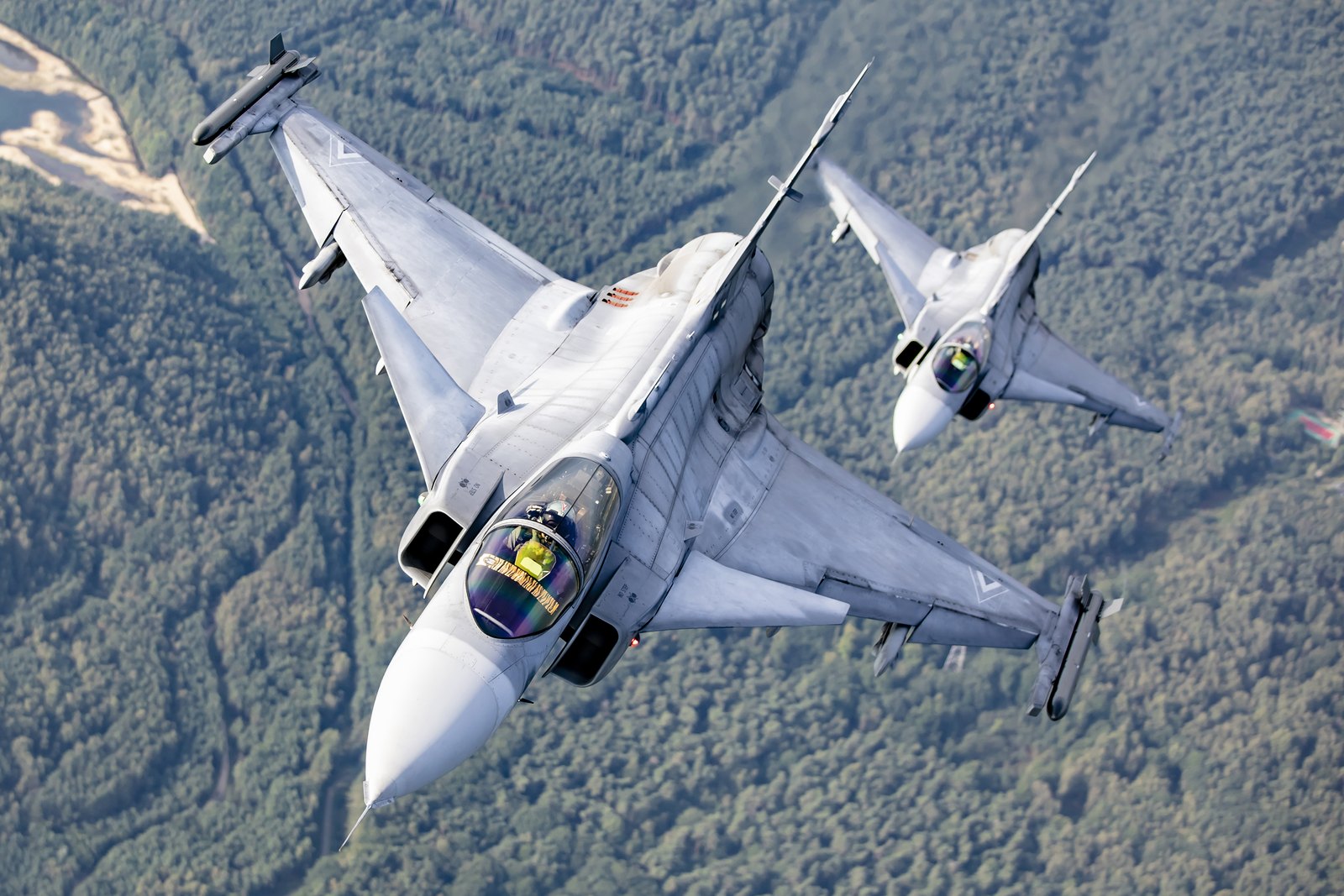
Brazil chose the Gripen NG through the F-X2 competition on 18 December 2013 and signed on 27 October 2014 for 36 aircraft, 28 single-seat and eight two-seat, at about 39.3 billion kronor. A separate industrial co-operation contract signed the same day covered technology transfer to Brazilian industry over roughly ten years, with Embraer as strategic partner and Brazilian industry responsible for producing the two-seat variant. Both contracts came into force on 10 September 2015, and Brazilian engineers and technicians were to start training in Sweden that October.
Saab, Embraer and the Brazilian Air Force presented the first supersonic fighter produced in Brazil on 25 March 2026, at Embraer’s complex at Gavião Peixoto in São Paulo state, with President Lula there. Embraer builds it on a Brazilian and international supply chain, with aerostructures from Saab’s own facility at São Bernardo do Campo, and Saab says another fourteen aircraft under the current contract will follow the same production model. Deliveries had begun in 2020 and eleven aircraft had been handed over by that date, ten of them with the First Defense Group at Anápolis, where the type had been standing quick reaction alert since February 2026.
Saab rolled out the first two-seat Gripen F at Linköping on 2 June 2026, with Brazil as launch customer and, in Saab’s account, hundreds of Brazilian engineers and technicians trained through the technology transfer programme.
Libya, and what the Riksdag allowed
Sweden deployed the Gripen to enforce the no-fly zone over Libya in 2011. That deployment is the only one the type has had in the sources read for this article.
On 29 March 2011 the proposition went to the Riksdag, and was approved on 1 April. It asked for authority to place at most 250 people at disposal for at most three months, to help uphold a no-fly zone under the UN Security Council’s resolution. The contribution itself was to be about 130 people.
By June the force in the field was at most eight JAS 39 Gripen, one TP84 transport with air-to-air refuelling capability, and supporting resources. And the government told parliament what the aircraft were not doing: the Swedish aircraft contributed only to upholding the no-fly zone and had no task of attacking ground targets. So far, it said, the Swedish aircraft had mainly flown reconnaissance missions, and their reconnaissance capability had been appreciated.
A second phase, from 27 June 2011, asked for at most five Gripens for aerial reconnaissance with refuelling support, a maritime boarding capability of at most forty people to enforce the arms embargo, and at most ten for information operations, at most 180 people in total. The arithmetic behind five aircraft is given in the document: the ambition was two two-ship missions a day, and to guarantee four aircraft continuously you need five in theatre. The second proposition repeats it: combat missions against ground targets will not be carried out.
The E is a different aeroplane
Saab rolled out the Gripen E on 18 May 2016 and flew it on 15 June 2017. Aircraft 39-8 left Linköping at 10.32 on the Thursday morning and flew for forty minutes over eastern Östergötland. It retracted and extended the undercarriage. The pilot, Saab experimental test pilot Marcus Wandt, said the flight was just as expected and the aircraft’s performance matched the simulations.
| Gripen C | Gripen E | |
|---|---|---|
| Length | 14.9 m | 15.2 m |
| Span | 8.4 m | 8.6 m |
| Maximum take-off weight | 14,000 kg | 16,500 kg |
| Maximum thrust | 80.5 kN | 98 kN |
| Hardpoints | 8 | 10 |
| Combat turnaround | 10 minutes | 15 to 25 minutes |
The engine went from the Volvo RM12 to a General Electric F414G. The sensors went to an active electronically scanned array radar, an infra-red search and track set, an electronic warfare suite and new datalinks.
Saab describes an avionics architecture that separates mission system functionality from flight-critical software, so that software can be updated within hours without requiring recertification of the flight-critical systems. Set that against finding 22 of the 1993 report, which said the complexity of the control laws had made it difficult to fully illuminate their function at review, and the split looks like an answer to a problem the Swedish state had already had to investigate twice. That reading is mine; neither Saab nor the investigators make the connection.
Worth 16.4 billion kronor, the 2013 Swedish serial production order was written as the modification of 60 Gripen C to Gripen E. Saab’s public material does not say plainly whether Swedish Gripen E are new airframes or rebuilt ones.
Ukraine, document by document
Between October 2025 and June 2026 Sweden and Ukraine produced a letter of intent, a memorandum of understanding, a joint announcement and a contract. The figures attached to each are different, and the number that circulates belongs to the earliest and least binding of them.
Volodymyr Zelenskyy and Ulf Kristersson signed a Letter of Intent at Linköping on 22 October 2025 concerning co-operation in the field of air capabilities. It contains no aircraft numbers at all. It expresses an intent to hold regular consultations, to promote exchange of knowledge and training, and notes that future co-operation may include discussions on availability, financing models, industrial participation and multinational frameworks. Its clause V says the letter reflects political will but does not create legal or financial obligations. The figure of 100 to 150 aircraft, which is the one everyone repeats, was spoken at the press conference that day and is in no signed document.
Saab and the Ukrainian Defense Industry signed a memorandum of understanding at the Munich Security Conference on 13 February 2026 about their intention to collaborate in aviation and airborne surveillance.
At Uppsala on 28 May 2026 the two leaders announced that Ukraine intends to acquire an initial batch of up to 20 Gripen E and F, and that Sweden intends to donate up to 16 Gripen C and D. Saab’s own release that day says, in as many words, that at this point Saab has not signed any contract nor received an order relating to this.
On 30 June 2026 Saab signed a contract with the Swedish procurement agency for 16 Gripen E for Ukraine, worth about 24.6 billion kronor, for delivery to the agency in 2029 and 2030. The contract is between Saab and the Swedish state, not between Saab and Ukraine, which is the same structure used for Thailand.
| Date | Document | Aircraft named in it | Binding |
|---|---|---|---|
| 22 October 2025 | Letter of Intent, Sweden and Ukraine | None | No, and it says so |
| 13 February 2026 | Memorandum of understanding, Saab and Ukrainian Defense Industry | None | No |
| 28 May 2026 | Joint announcement at Uppsala | Up to 20 E and F to be acquired, up to 16 C and D to be donated | Intent. Saab confirms no contract |
| 30 June 2026 | Contract, Saab to the Swedish procurement agency | 16 Gripen E | Yes. 24.6 billion kronor, delivery 2029 to 2030 |
Sixteen Gripen E are on contract for Ukraine, signed on 30 June 2026 between Saab and the Swedish procurement agency, for delivery in 2029 and 2030. The 100 to 150 figure was spoken at a press conference, not written into anything.
Where the 4,700 dollar figure came from
Everyone quotes about 4,700 dollars an hour for the Gripen, and it is usually credited to Saab. It is not Saab’s number. Saab’s own product page claims low flight hour costs and gives no figure at all.
Edward Hunt, an analyst at IHS Jane’s, produced it, and the trade press ran it on 3 July 2012. It covered fuel used, pre-flight preparation and repair, and scheduled airfield-level maintenance together with the associated personnel costs. Hunt said at the time that any such figure can only be regarded as indicative and that there is no single correct answer, and the figures in the same piece for aircraft not yet in service were projections made with no in-service data behind them.
It is a fourteen-year-old analyst estimate of part of the cost, and it is a fleet average. Setting it beside a measured figure published for another aircraft today compares two different things.
The Draken and the Viggen
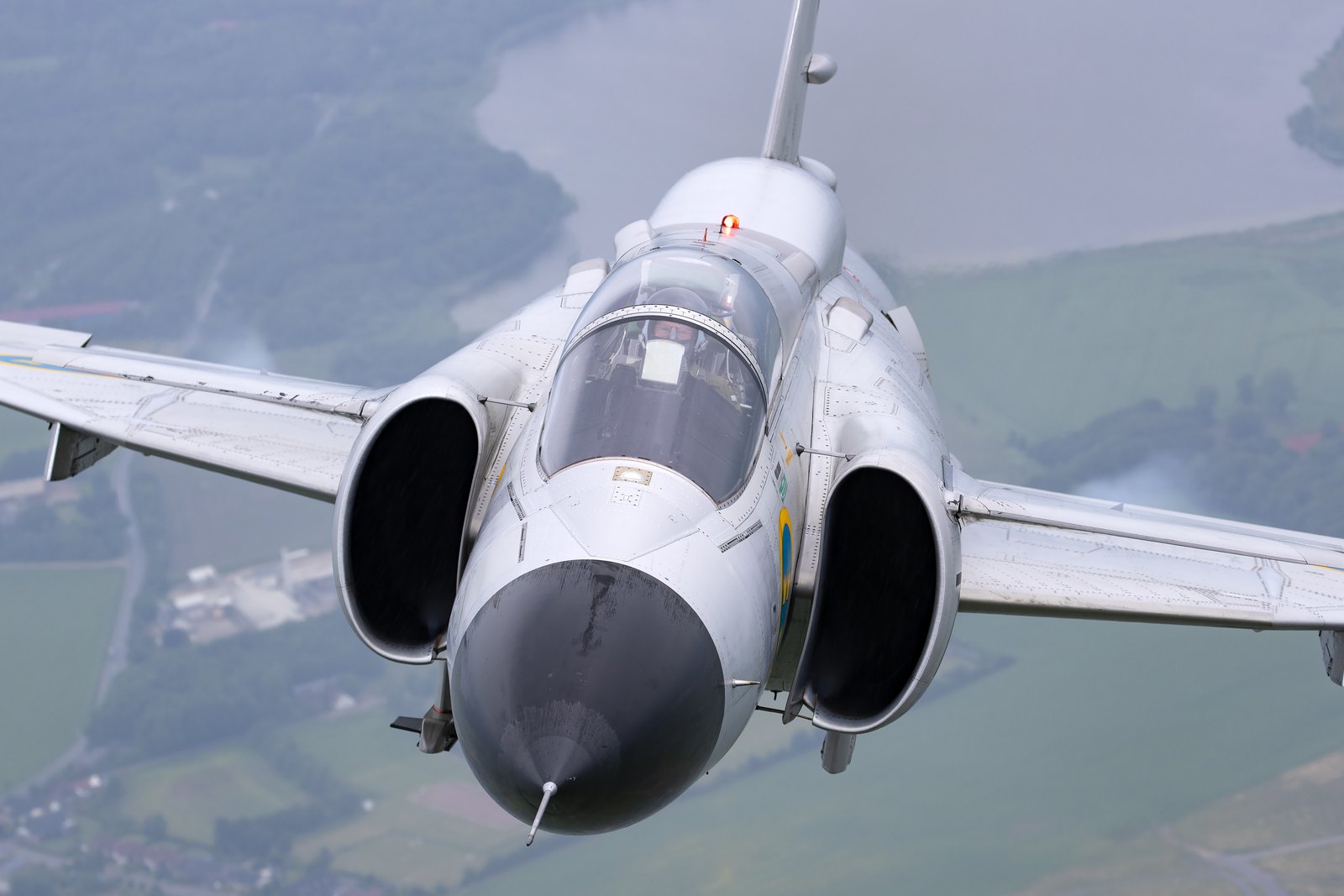
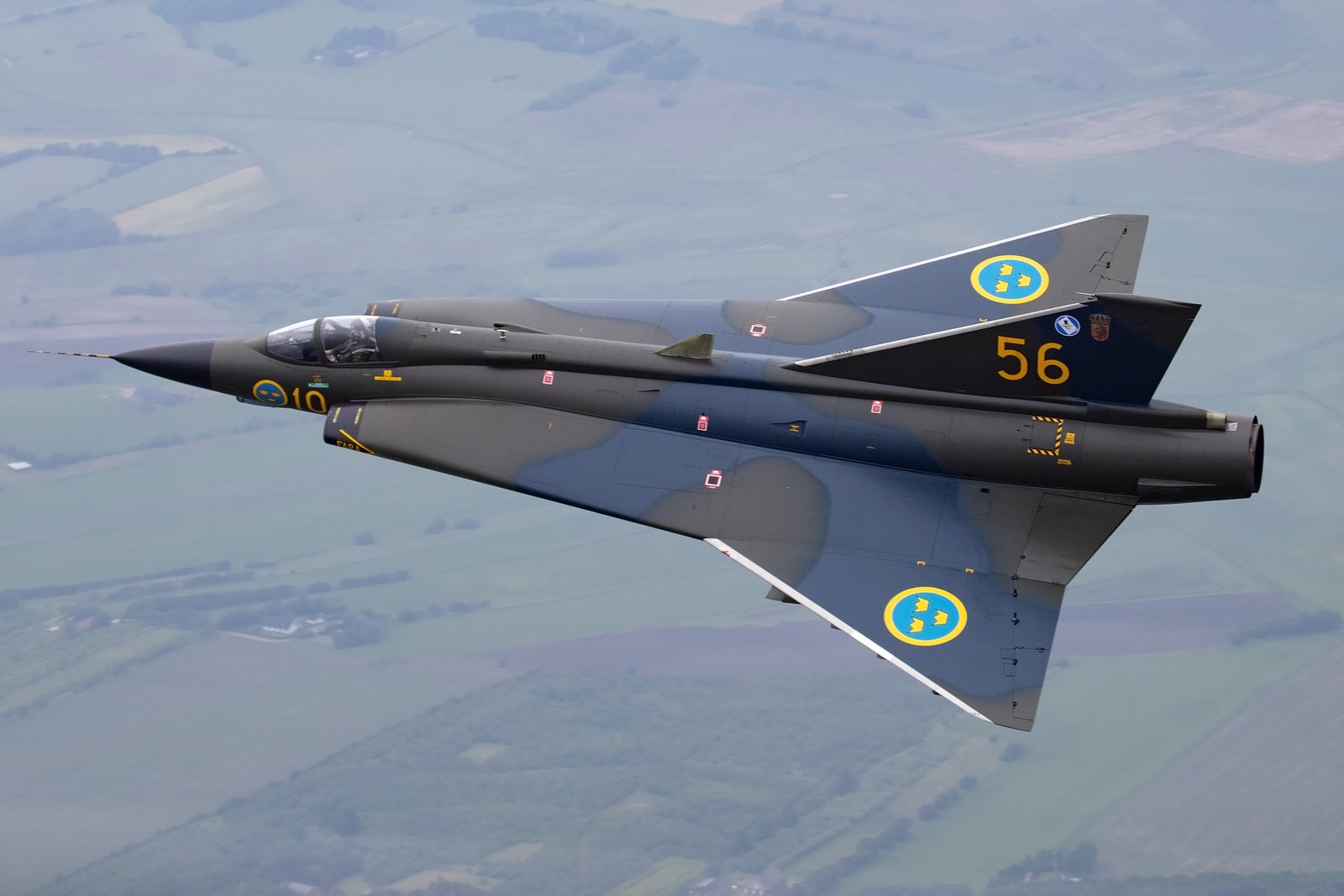
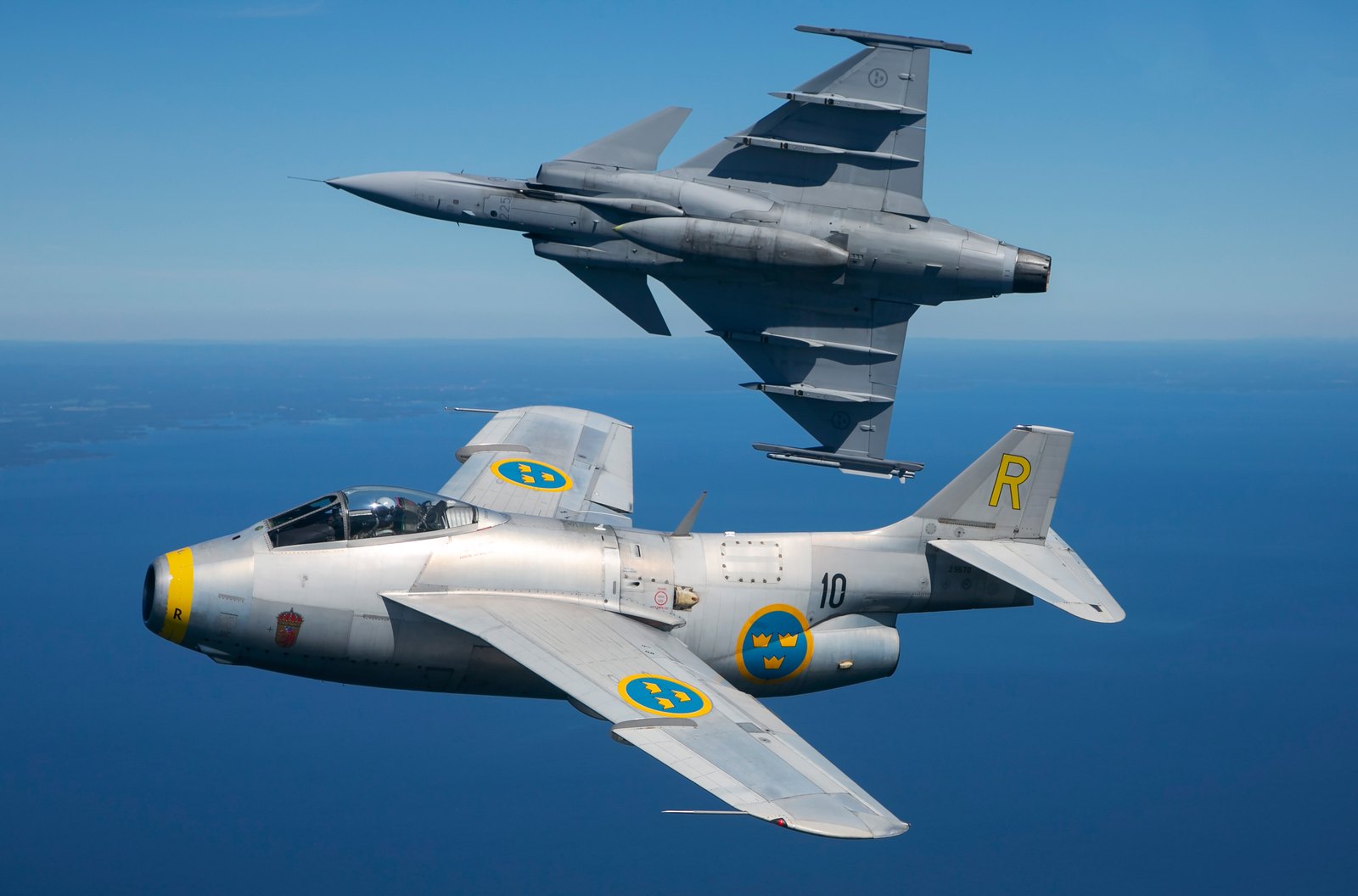
The Gripen is the latest in a line of Saab jets. Three of the earlier ones are still flying, with the Swedish Air Force Historic Flight, out of the same wing at Såtenäs that flies the Gripen, and all three are in the photographs on this page.
Sweden wanted a supersonic aircraft that could climb quickly to high altitude and meet nuclear-armed bombers. Saab tested the aerodynamics with a scaled research aircraft, the Saab 210, about thirty per cent smaller than the real thing; a full-scale prototype flew in October 1955 and series deliveries began in December 1959. Its double delta wing, like the tailless one on the Dassault Mirage 2000, is the shape you can see from directly above: a very sharply swept inner panel and a shallower outer one. The Air Force Museum notes the J 35A’s ceiling of about 13,000 metres was found insufficient, so Saab lengthened the rear fuselage on the rest of the A-model to take a better afterburner, which is the origin of the short and long Adams. Drakens were exported to Denmark, Finland and Austria.
The museum also records the thing that shaped all of them: the Draken worked very well at low speed and could land on the air force’s road bases.
Saab’s account of the dispersed basing system calls it a Cold War tactic developed by the Swedish Air Force to disperse fighters throughout Swedish territory, making it difficult and costly for an enemy to attack them on the ground, and says the Gripen was shaped by it. Saab’s figures for the E are take-off from a road strip 16 metres wide and 500 metres long, landing on a 600-metre road without a tailhook or a brake chute, and refuelling and rearming in no more than ten minutes. Saab’s product page for the E gives a combat turnaround of fifteen to twenty-five minutes; both figures are Saab’s, from different pages.
No Swedish Armed Forces or museum page found for this article gives the number of road strips or base complexes, so no figure appears here.
The C fleet at readiness
The C and D are now the middle-aged part of the fleet, and most of what they do is sit at readiness.
Czech Gripens fly quick reaction alert from Čáslav and have taken part in several NATO air policing rotations, including four months over the Baltic that finished in January 2020 with five aircraft and 75 air and ground personnel deployed.
Hungary has done the same job. Saab’s account of one Baltic deployment has Hungarian Gripens scrambled on 22 occasions and their pilots logging more than 400 flying hours in four months.
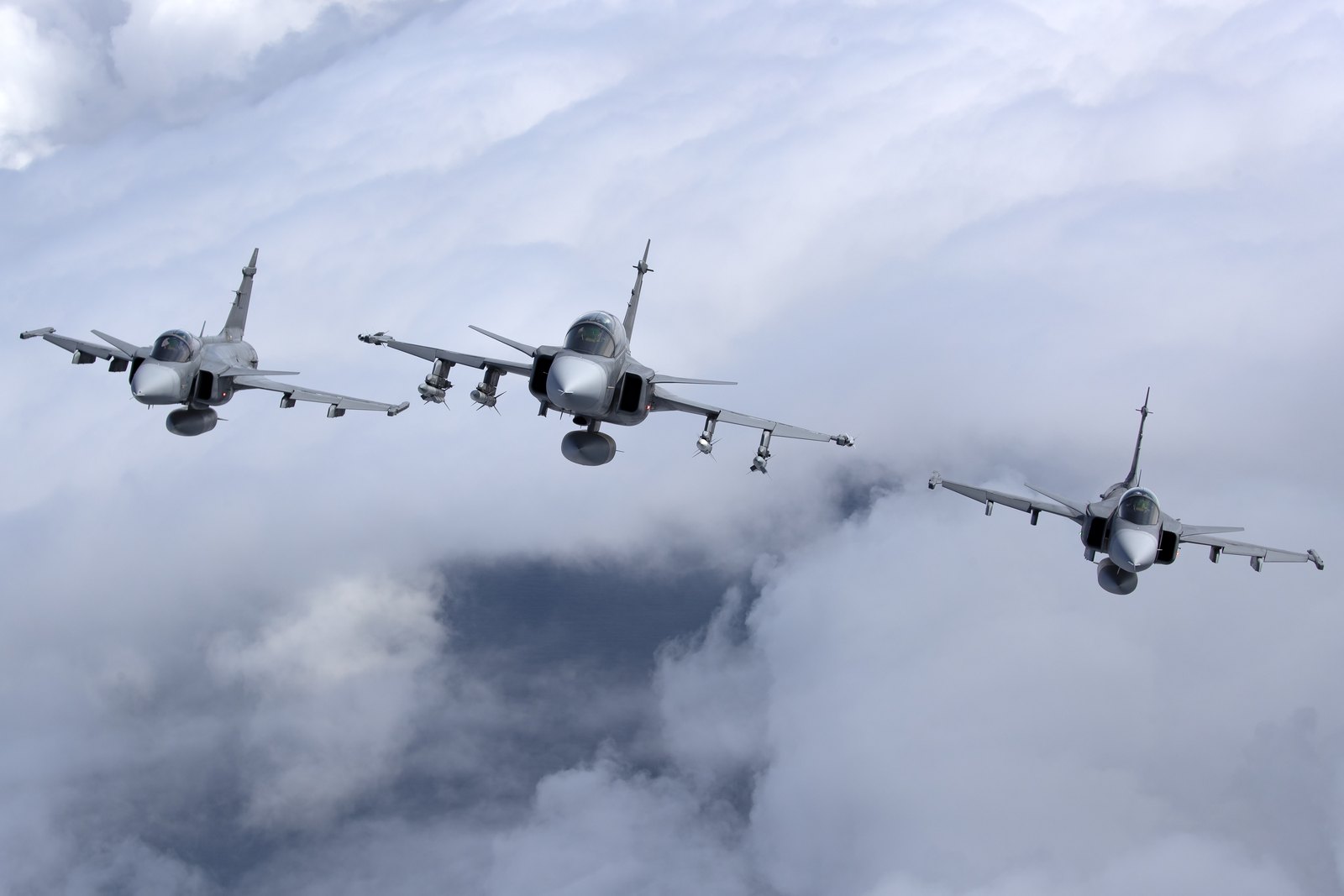
These frames were all shot from a second aircraft in formation, which is air-to-air work. The frames are available to licence.
The order book now
Serial deliveries of the Gripen E began on 24 November 2021 with six aircraft, four for Brazil and two for Sweden. On 20 October 2025 the type formally entered Swedish Air Force service with the Skaraborg Wing at Såtenäs, with one aircraft, against a Swedish order of 60. That date, and the quotations that went with it, were reported in the trade press rather than announced by the Swedish Armed Forces. The wing commander was quoted calling it the beginning of a new chapter in Swedish aviation history, and the defence minister noting that studies were already under way to prepare for the generation after it.
On order now: 60 for Sweden, 36 for Brazil of which eleven were delivered by June 2026, four for Thailand, seventeen for Colombia, and sixteen for Ukraine through the Swedish procurement agency. Trade press reported in July 2026 that Sweden intends to buy another twelve to replace aircraft pledged to Ukraine, which would take its fleet to 72; that has not been confirmed by a Swedish government source.
Brazil’s Gripen E have been standing quick reaction alert from Anápolis since February 2026, covering the airspace over the federal government district. Hungary’s fourteen older aircraft became Hungarian property in early 2026 and four more were on the way.
Forty-four years after a Swedish parliament voted by five to build its own fighter rather than buy one, Sweden is selling the result to Brazil, Colombia, Thailand and Ukraine, and building some of it in São Paulo.
Frequently asked questions
What does JAS stand for in JAS 39 Gripen?
Jakt, attack and spaning: the Swedish words for the fighter, strike and reconnaissance roles. The idea, as it was put to the Riksdag in 1982, was that every aircraft should handle all three functions, which would give clearly greater flexibility than squadrons each doing one job. Saab now describes the pilot as able to change role while airborne or work in several at once.
Why does Sweden build its own fighters?
Because a Swedish parliament decided it should, narrowly. The argument made in the chamber in June 1982 was that foreign aircraft would be dearer and less well suited to Swedish requirements, and that buying abroad would cost several thousand jobs in Swedish defence industry. The opposing case was that a Swedish aviation industry could only be paid for by higher defence budgets. The vote on the aircraft went 172 to 167.
When did the Gripen first fly?
On 9 December 1988, when prototype JAS 39-1 made its maiden flight. That aircraft was destroyed on its sixth flight, crashing on landing at Linköping on 2 February 1989 after a divergent pitch oscillation. The pilot suffered a fractured elbow. The Gripen E flew for the first time on 15 June 2017, flown by Saab experimental test pilot Marcus Wandt.
What caused the Gripen crash over Stockholm in 1993?
An imbalance in the control system, according to the Swedish accident investigators. The pilot could put more signal into the system through the stick than the control surfaces could answer, which produced growing time delays and then a pilot-induced oscillation in roll and pitch. Within about 2.5 seconds the pitch oscillation could not be stopped. The report also records that the pilot did not observe the height and angle of attack limits set for the display.
Was the 1993 crash pilot error or a software fault?
Neither on its own. The report opens its analysis by stating that the cause of an accident is almost never a single event. It finds that the pilot exceeded the display’s height and alpha limits, and separately that the control system permitted an imbalance which in certain situations could lead to an accident, that only a triggering factor was needed, and that all JAS 39 aircraft had the same built-in imperfection.
Was the same pilot in both Gripen crashes?
Yes. The 1989 report names its pilot as Lars Rådeström, born 1944, and sets out his career. The 1993 report does not name its pilot but gives the same year of birth and the same career track, and states that he had previously been involved in the accident with JAS 39-1 in 1989.
Can a Gripen operate from a road?
Yes, and it was built to. Saab gives the Gripen E a road strip 16 metres wide and 500 metres long to take off from, 600 metres of road to land on without a tailhook or brake chute, and no more than ten minutes to refuel and rearm. Saab’s product page for the E gives fifteen to twenty-five minutes for a combat turnaround, so the two Saab figures do not agree. The requirement is older than the Gripen: the Swedish Air Force Museum records that the Draken could land on the air force’s road bases too.
Which countries fly the Gripen?
Sweden, the Czech Republic, Hungary, South Africa, Thailand and Brazil. The UK Empire Test Pilots’ School has used the type for test pilot training. Colombia signed for seventeen Gripen E and F in November 2025 for delivery from 2026, and sixteen Gripen E are under contract for Ukraine. The Czech and Hungarian aircraft were originally leased from the Swedish state rather than bought.
How many Gripens is Ukraine getting?
Sixteen are under contract. Saab signed with the Swedish Defence Materiel Administration on 30 June 2026 for 16 Gripen E for Ukraine, worth about 24.6 billion kronor, for delivery to the agency in 2029 and 2030. A joint announcement on 28 May 2026 covered an intent to acquire up to 20 and to donate up to 16 older aircraft. The figure of 100 to 150 came from a press conference, not from any signed document.
What is the difference between the Gripen C and the Gripen E?
A bigger engine and a new set of eyes. The E takes a General Electric F414G of 98 kN against the Volvo RM12’s 80.5 kN, and carries an active electronically scanned array radar and an infra-red search and track set. On Saab’s two product pages it is also 30 cm longer, 20 cm greater in span, 2,500 kg heavier at maximum take-off weight, and has ten hardpoints against eight.
Does the Gripen really cost less to fly than other fighters?
Not on this figure, which is not a measurement. About 4,700 dollars an hour came from IHS Jane’s analyst Edward Hunt in July 2012, covering fuel, pre-flight preparation and repair, and scheduled airfield-level maintenance with associated personnel costs. It is a fleet average, and Hunt said any such figure can only be regarded as indicative. Saab’s page claims low flight hour costs and gives no number.
Has a Gripen ever been in combat?
Sweden deployed Gripens to enforce the no-fly zone over Libya in 2011, and that is the only combat deployment in the sources read for this article. The Swedish government told its parliament that the aircraft had no task of attacking ground targets and had mainly flown reconnaissance missions. No Gripen of any operator has been credited with an air-to-air kill in any source consulted here.
What came before the Gripen?
The Saab J29 Tunnan, the Saab 35 Draken and the Saab 37 Viggen. The Draken came from a requirement to climb fast and high against nuclear-armed bombers; its first full-scale prototype flew in October 1955 and deliveries began in December 1959. All three still fly with the Swedish Air Force Historic Flight, and all three are in the photographs on this page.
Sources and further reading
- Statens haverikommission, Rapport RM 1989:1, the crash of JAS 39-1 at Linköping
- Statens haverikommission, Rapport ML 1993:3, the crash of 39.102 at Långholmen
- Riksdagens protokoll 1981/82:166, 4 June 1982
- Riksdagens protokoll 1981/82:165, 3 June 1982
- Regeringens proposition 1982/83:119, om riktlinjer för JAS-projektet
- Regeringens proposition 2010/11:111, Swedish participation in Libya
- Regeringens proposition 2010/11:127, the second phase in Libya
- Saab, Gripen C-series product page
- Saab, Gripen E-series product page
- Saab, first flight of the Gripen E, 15 June 2017
- Saab, This is Gripen E, 18 May 2016
- Saab, serial production order for Gripen E, 18 December 2013
- Letter of Intent between Ukraine and Sweden, signed 22 October 2025, the full text.
- Saab, Ukraine and Sweden take steps towards Ukrainian Gripen acquisition, 28 May 2026
- Saab, contract signed for 16 Gripen E for Ukraine, 30 June 2026
- Ministry of Defence of the Czech Republic, the supersonic aircraft decision of June 2004
- Saab, fifteen years of Czech Gripen operations, April 2020
- Government Offices of Sweden, Hungary to purchase four Gripen aircraft, 23 February 2024
- Saab, contract with Brazil for 36 Gripen NG, 27 October 2014
- Saab, first Gripen E produced in Brazil, 25 March 2026
- Saab, contract with Colombia for 17 Gripen E and F, 15 November 2025
- Saab, Gripen E and F order for Thailand, 25 August 2025
- Saab, internal investigation into a South African consultant contract, 16 June 2011, Saab’s account of payments that never entered its books.
- Corruption Watch and Another v Arms Procurement Commission and Others [2019] ZAGPPHC 351
- Saab’s closing submissions to the South African Commission of Inquiry
- Swedish Airforce Historic Flight, the J29 Tunnan
- Flygvapenmuseum, the Saab 35 Draken
- Saab, Gripen designed for dispersed air basing, August 2020, the manufacturer’s figures for road-strip operation.
- Försvarsmakten, Skaraborgs flygflottilj F 7
