The Fairey Swordfish was the aircraft that should not have worked: an open-cockpit fabric biplane, cruising below 110 mph, that entered service in 1936 and was obsolete on paper before the war began. It then crippled the Italian battle fleet at Taranto, jammed the Bismarck’s rudders, fought the U-boats from tiny merchant carriers, outlived the aircraft designed to replace it, and served until the war in Europe was won. Its crews called it the Stringbag, and it sank more enemy shipping than its makers ever dreamed.
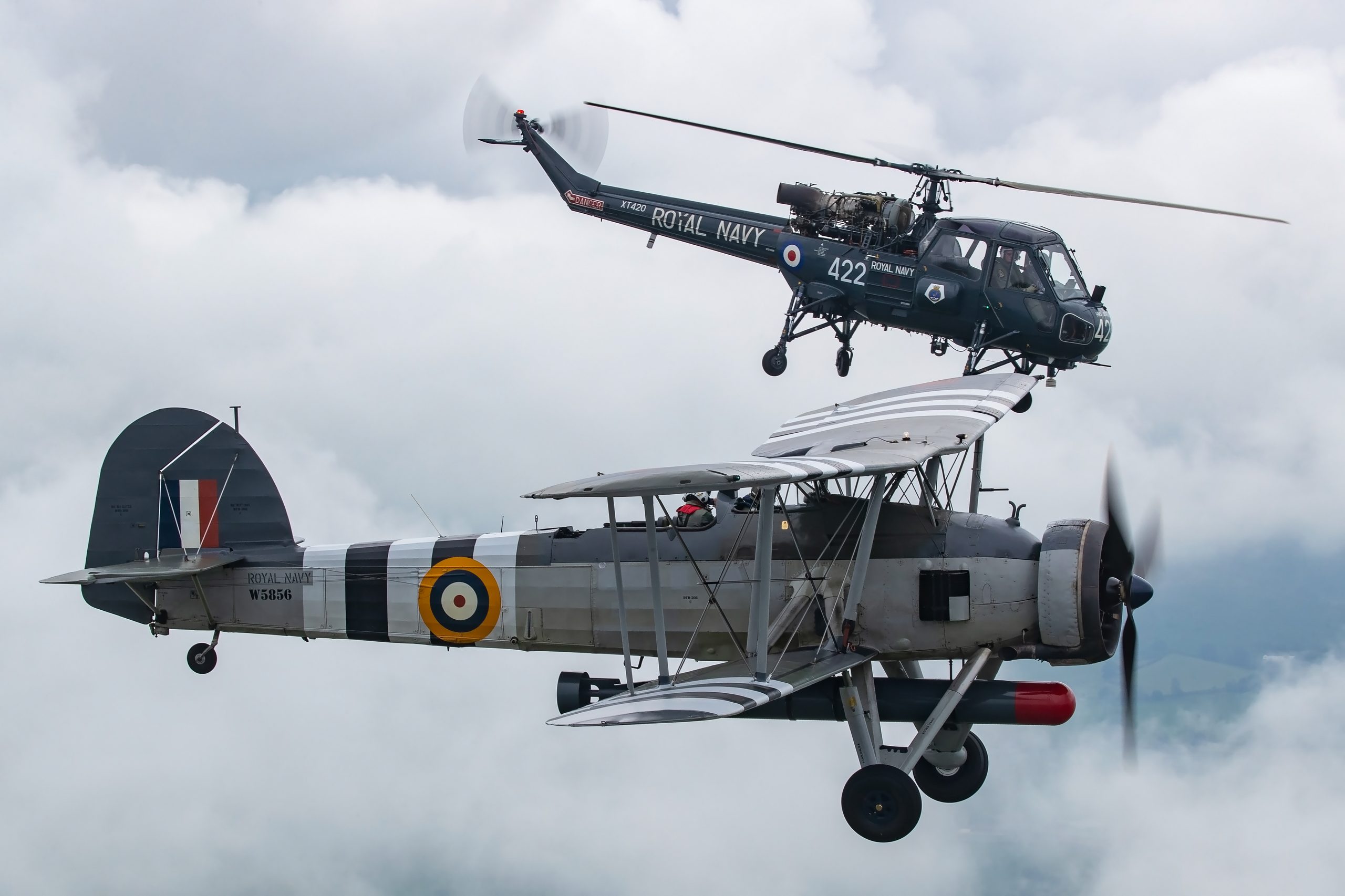
Every air arm has one aircraft whose legend rests on being unreasonable, and for the Fleet Air Arm it is the Swordfish. The Americans have their rugged machines and the Luftwaffe its sleek ones; the Royal Navy’s most consequential aircraft of the war looked like it had taxied out of 1918 and simply refused to stop. Nothing about it belongs in the Second World War: the struts, the wires, the three men sitting in the open behind a radial engine, the torpedo slung between fixed wheels. Yet the unreasonable aeroplane kept doing what sleek modern types could not, and by 1945 the joke had inverted; the biplane had outlasted its own replacement and earned the affection of everyone who flew it.
This guide tells the story properly: where the Stringbag came from and why it stayed a biplane, the night at Taranto that changed naval warfare, the Bismarck chase, the sacrifice of the Channel Dash, the long unglamorous victory over the U-boats, and where you can still see a Swordfish fly today, including the aircraft in these photographs, which is the oldest of them all. Facts are checked against Navy Wings, the Imperial War Museums, the US National WWII Museum and the standard references, with contested points flagged.
What this guide covers
- Origins: the Stringbag takes shape
- Design: slow on purpose
- Three men in the open
- Taranto: the night that changed naval war
- The Bismarck: a torpedo in the rudders
- The Channel Dash: Esmonde’s last flight
- The Atlantic war: rockets, radar and MAC ships
- Production and variants
- Fairey Swordfish specifications
- Survivors: the Stringbag that still flies
- Photographing the Swordfish today
- Legacy
- Frequently asked questions
A note on scope: the Swordfish story ranges from Norwegian fjords to Malta convoys to the Indian Ocean, and no single article holds all of it. This one follows the spine, the design, the three defining actions, the Atlantic victory and the survivors, and flags the contested points as it goes, because the Stringbag’s legend has accumulated its share of myths and deserves better than repeating them.
Origins: the Stringbag takes shape
The Swordfish began as a Fairey Aviation private venture for a torpedo-spotter-reconnaissance aircraft, three jobs in one airframe. The first prototype was lost in a spin in 1933; its strengthened successor, the TSR II, first flew on 17 April 1934, and the production Swordfish entered Fleet Air Arm service in 1936, first with 825 Naval Air Squadron, a unit whose name will return in this story twice, at the Bismarck and in the Channel.
Why a biplane, with the monoplane era in full flood? Because the requirements rewarded one. A carrier aircraft must fly slowly and predictably at the deck, lift heavy loads from short runs, and survive rough handling at sea, and the biplane bought all three. The name came later and perfectly: not, as usually assumed, from the rigging, but from the string shopping bags of the day, because like them the Swordfish seemed able to accommodate anything the Navy asked it to carry.
The prototype era left one more detail worth keeping. Fairey’s TSR designation stood plainly for the three jobs, torpedo, spotter, reconnaissance, and the Navy’s decision to buy an honest compromise rather than three specialists shaped everything the type became. Multi-role is treated as a modern idea; the Swordfish was flying the concept, complete with its trade-offs, before the word existed.
Design: slow on purpose
The numbers invite mockery and miss the point. A 690 horsepower Bristol Pegasus radial pulled a fabric-covered metal frame to a maximum of about 139 to 143 mph with a torpedo, and crews joked that top speed was achieved going downhill. Three men, pilot, observer and telegraphist air gunner, sat in open cockpits behind a windscreen each, in whatever the North Atlantic was offering that day.
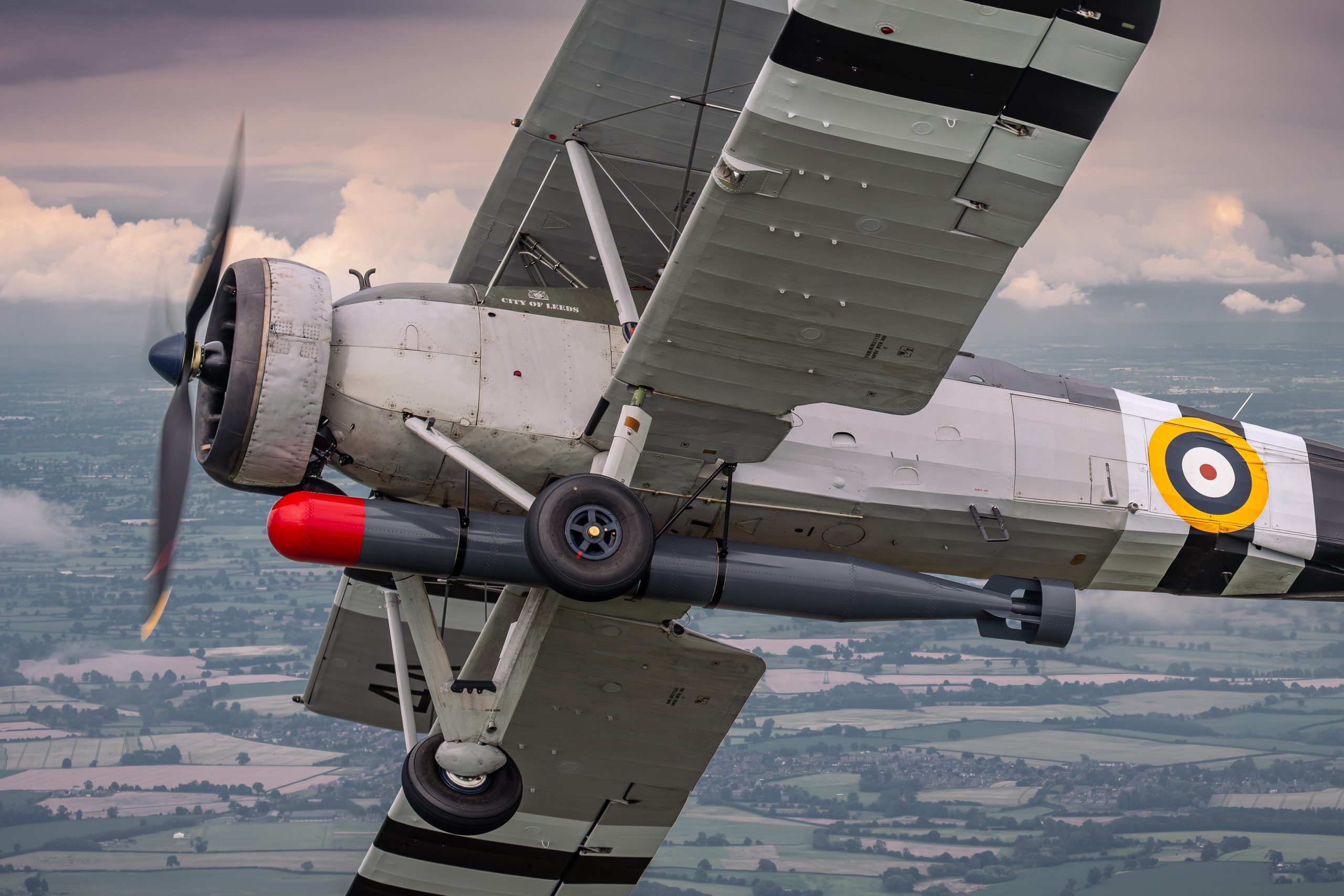
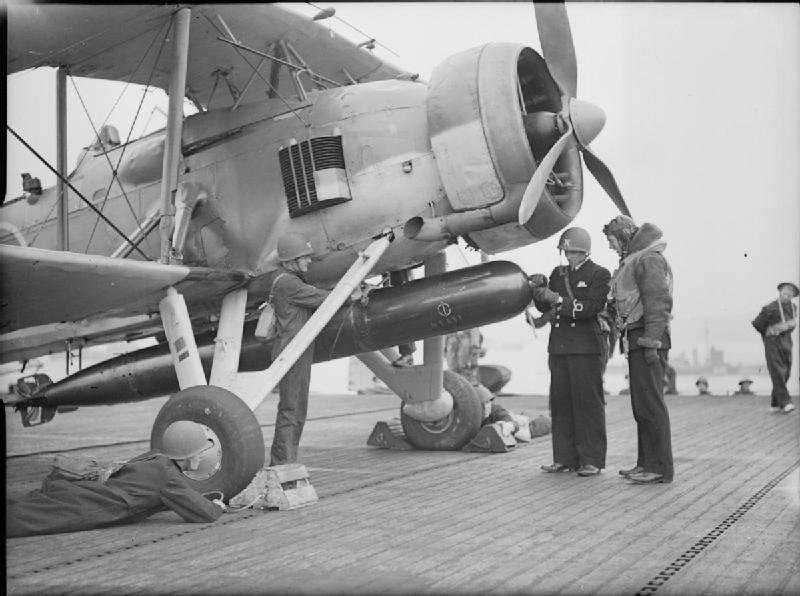
But the slowness was capability. A Swordfish could land on a heaving deck in weather that grounded every faster type, could be dived vertically without protest, and turned tightly enough that fighters overshot before they could aim. It is often said, though the evidence is anecdotal, that warship gunners found so slow a target really difficult, their fire-control predictors assuming attackers came faster. What is certain is the load list: an 18 inch torpedo of around 1,600 pounds, or a mine, or bombs, or four depth charges, and from 1943 eight rocket projectiles under a strengthened lower wing, plus flares, radar and anything else the Navy could strap on. The Stringbag earned its name in ordnance.
Two names thread through everything that follows, and meeting them now helps. Eugene Esmonde, an Irish-born career naval aviator, led 825 Squadron’s Swordfish at the Bismarck and again in the Channel, and his DSO and posthumous Victoria Cross bracket the type’s finest and darkest hours nine months apart. And W5856, a Blackburn-built Mk I that missed those actions but wore the war’s colours ever after, would outlast every sister ship and squadron to become, ninety years on from the prototype, the flying memorial in this article’s photographs. History posts usually separate the machines from the people; the Swordfish never managed the distinction.
Three men in the open
Understanding the Swordfish means understanding where its crews sat. The pilot flew from the front cockpit behind a small windscreen; behind him the observer worked the navigation that brought a biplane back to a moving carrier across hundreds of miles of empty sea, with a chartboard, a drift sight and no electronics worth the name; and behind the observer the telegraphist air gunner worked the wireless and the single Lewis gun. All three sat in the open, in gear that never quite kept the North Atlantic out, for sorties that could stretch past three hours.
Naval flying of that era was navigation first and everything else second, and the Swordfish’s greatest safety feature was the observer’s skill. Finding Bismarck in filthy weather, or a convoy at night, or Taranto’s harbour mouth at midnight, was done with a pencil, and the type’s crews regarded the aeroplane’s honesty, no vices, no surprises, as their margin for doing hard sums in freezing air. Affection for the Stringbag starts exactly there.
Taranto: the night that changed naval war
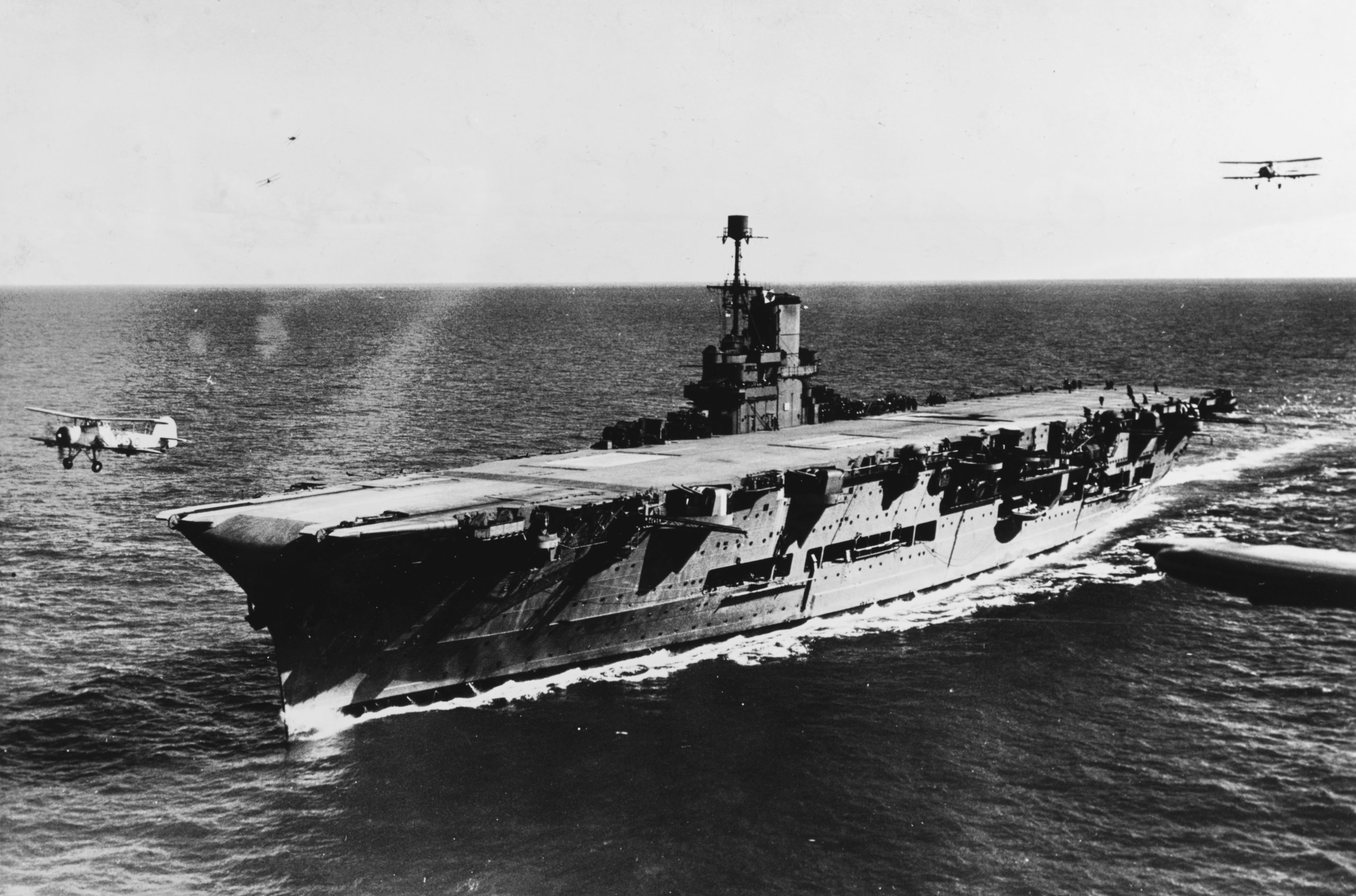
On the night of 11 to 12 November 1940, twenty-one Swordfish flew off HMS Illustrious in two waves against the Italian fleet in its defended home anchorage at Taranto; twenty reached the target. They came in low through balloon cables and the fire of hundreds of guns, dropped flares and torpedoes rigged for the shallow harbour, and left three battleships resting on the bottom or crippled: Littorio hit by three torpedoes, Caio Duilio beached with one, Conte di Cavour torpedoed and effectively lost to the war. The cost was two aircraft, with Lieutenant Commander Kenneth Williamson and his observer taken prisoner, and Lieutenants Bayley and Slaughter killed.
In one night, half the Italian battle line was out of action, and naval warfare had quietly changed owners: it was the first time carrier aircraft alone had defeated a fleet, without the opposing ships ever sighting each other. Admiral Cunningham drew the lesson immediately. So, more ominously, did others. Japanese planners studied Taranto closely, an officer travelling to Italy to investigate, though Japan’s own shallow-water torpedo work predated the raid; Taranto informed Pearl Harbor rather than inspired it, and the careful version of that sentence is the true one.
The tactical detail of Taranto rewards attention because nothing about it was improvised. The torpedoes were 18 inch Mark XIIs fitted with Duplex magnetic pistols and rigged to run in a harbour barely forty feet deep, a problem the Japanese would solve their own way a year later. Flare-droppers silhouetted the battleships for the torpedo aircraft; bombers hit cruisers, destroyers and the seaplane base to spread the defences. Five squadrons’ worth of crews, from Illustrious and the absent Eagle, executed a plan the Fleet Air Arm had been refining for years, and the execution, not luck, is why three Italian battleships settled into the mud for the loss of two biplanes.
The Bismarck: a torpedo in the rudders
In May 1941 the Swordfish twice found the Bismarck when nothing else could reach her. On the night of 24 to 25 May, nine aircraft of 825 Squadron led by Lieutenant Commander Eugene Esmonde flew off HMS Victorious into filthy weather and put one torpedo into the battleship’s side, minor damage, but first blood, and a DSO for Esmonde. Then, on the evening of 26 May, with Bismarck a day from air cover and the Home Fleet losing the chase, Ark Royal’s Swordfish got their turn.
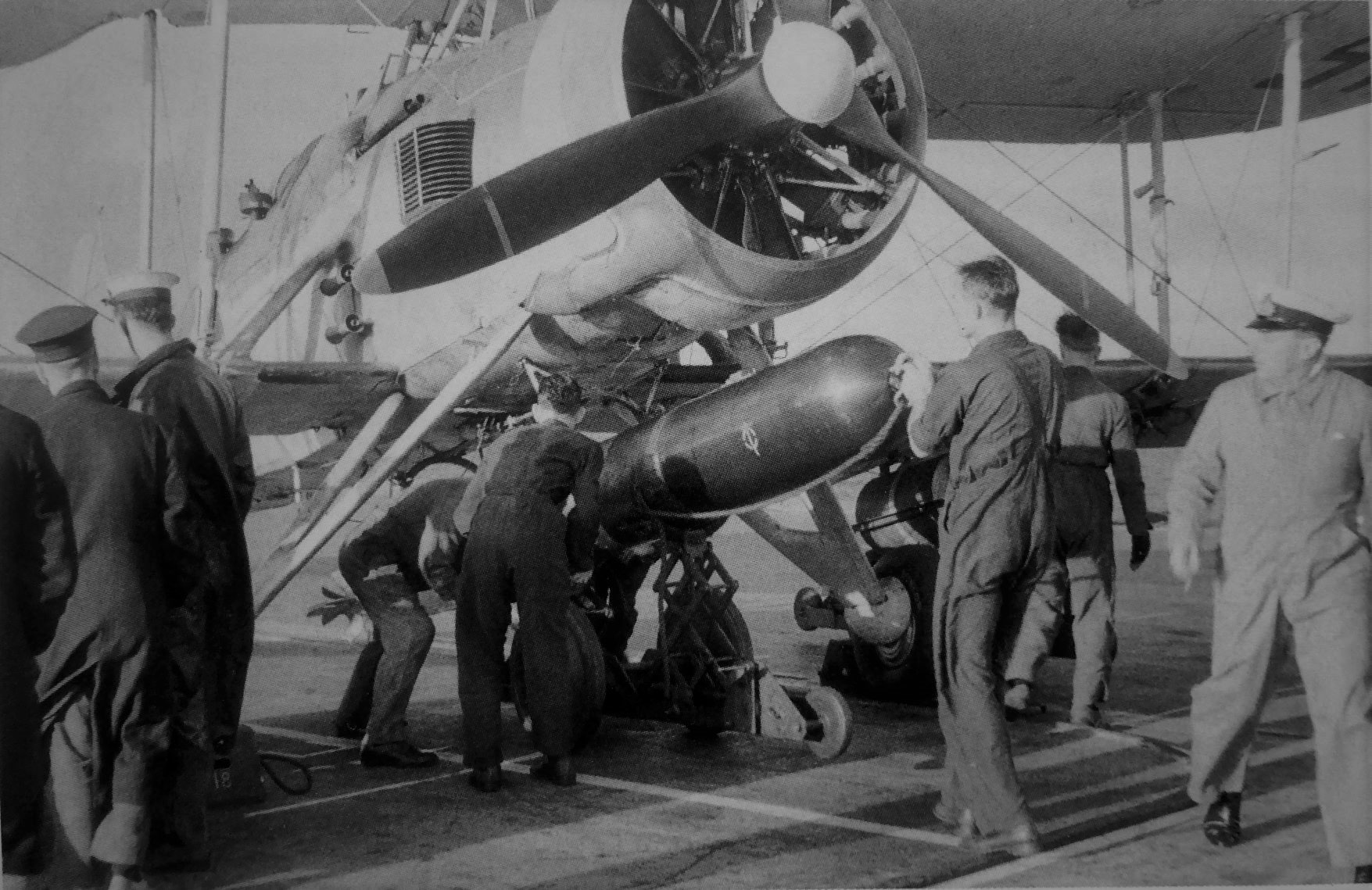
The day had already produced the war’s most fortunate failure: a first strike had attacked the shadowing cruiser HMS Sheffield by mistake, and the torpedoes’ magnetic pistols detonated in the sea, a fault discovered at the cost of nothing but embarrassment, and fixed by switching to contact pistols for the second attempt. At dusk fifteen Swordfish attacked through cloud and gale in ones and twos. Two torpedoes hit: one amidships against the armoured belt, and one right aft, which wrecked the steering gear and jammed the rudders. Bismarck could no longer hold a course away from the guns of the Home Fleet, and the next morning she was caught and sunk. The crippling hit has popularly been credited to Sub-Lieutenant Jock Moffat, though no definitive wartime record was made and the family of fellow pilot Kenneth Pattisson maintains the credit belongs to him; what is beyond dispute is that a fabric biplane had decided the fate of the most powerful warship in the Atlantic.
The Bismarck episode also preserved the war’s best deadpan. The first strike’s attack on HMS Sheffield, through cloud and mistaken recognition, ended with the cruiser dodging six torpedoes from her own side; her captain, declining to return fire, signalled Ark Royal with studied restraint, and the Duplex pistol problem the mistake exposed was fixed within hours. Militaries learn fastest when embarrassment and luck arrive together, and rarely has the combination mattered more: had the faulty pistols gone against Bismarck, there would have been no second chance before Luftwaffe cover arrived.
The Channel Dash: Esmonde’s last flight
Nine months later, 825 Squadron and Esmonde met the war at its cruellest. On 12 February 1942 the German battleships Scharnhorst and Gneisenau and the cruiser Prinz Eugen ran the English Channel in daylight, and six Swordfish, all that stood ready at Manston, were ordered against them. The fighter escort largely failed to arrive; one squadron of ten Spitfires met them and was drawn into combat. Esmonde led the six in anyway, through the fleet’s flak and a screen of fighters.
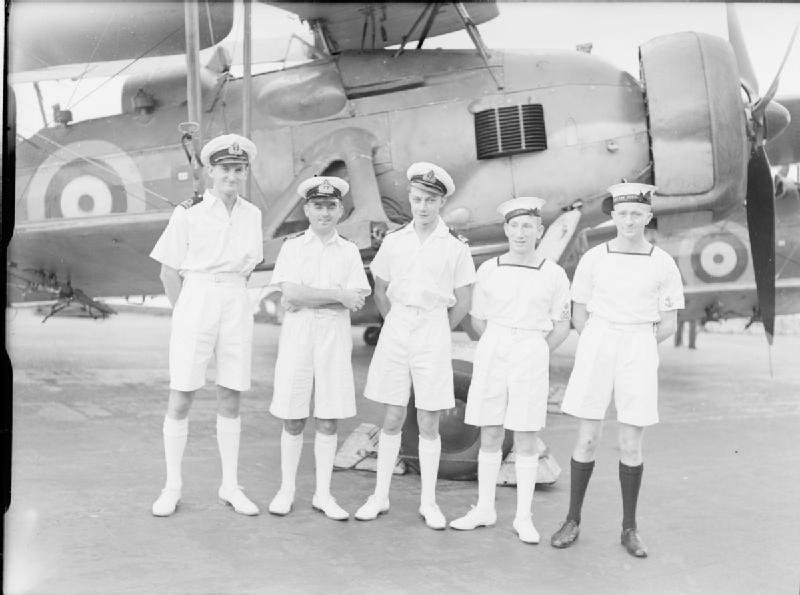
All six Swordfish were shot down. Thirteen of the eighteen aircrew were killed, five pulled from the Channel, and no torpedo found its mark. Esmonde, last seen holding his burning aircraft on its attack run, was awarded a posthumous Victoria Cross, the Fleet Air Arm’s first of the war. The action stands where courage and futility meet: everyone from Ramsay downward knew the six could not survive unescorted, the crews included, and they went. Even the German gunners are recorded as being appalled by the courage of it.
Esmonde’s Victoria Cross citation closed with the sentence his service remembered: his squadron went in knowing what awaited them. The five survivors included four decorated officers pulled wounded from the sea, and the last man, unable to be saved, is commemorated with the twelve others on memorials that still receive wreaths each February. The Channel Dash failed as an attack and endures as a measure: of what the Fleet Air Arm asked of eighteen men in six biplanes, and of why the Royal Navy has never quite spoken of the Swordfish as merely an aeroplane since.
The rescue of the five survivors adds the story’s one mercy: launches and destroyers pulled them from a freezing February sea, most of them wounded, and their accounts kept the action’s memory honest for decades afterwards. The torpedoes missed; the going, as the survivors themselves insisted, was the point. The Channel Dash crews are still commemorated each February, more than eighty years on.
The Atlantic war: rockets, radar and MAC ships
The Swordfish’s longest campaign had no famous nights, and won. From 1943 the type flew convoy protection from escort carriers and from MAC ships, merchant grain carriers and tankers given a skim of flight deck and three or four Swordfish, the only aircraft docile enough to operate from them in Atlantic weather. Armed with depth charges, centimetric radar and the new rocket projectiles, the biplanes made daylight surfacing lethal along the convoy routes.
The scores tell the story with proper modesty. A Swordfish floatplane from HMS Warspite had claimed the war’s first Fleet Air Arm U-boat back in April 1940; a Swordfish delivered the first rocket kill of the war against U-752 in May 1943; and in one September 1944 voyage, aircraft from HMS Vindex sank four U-boats. In total the type was credited with between 14 and 22 U-boats depending on how shared kills are counted, more than any other Fleet Air Arm aircraft. And in the campaign’s quietest statistic lies its meaning: the convoys the Stringbags circled overwhelmingly got through.
The Swordfish also went to sea without carriers at all. Float-equipped aircraft flew from battleships and cruisers as catapult spotters, and one of them wrote the type into the anti-submarine record early: during the Norwegian campaign in April 1940, HMS Warspite’s Swordfish floatplane caught U-64 on the surface and sank her, the Fleet Air Arm’s first U-boat kill, while also spotting the battleship’s guns onto a flotilla of German destroyers at Narvik. Torpedo bomber, rocket carrier, radar hunter, gunnery spotter, floatplane: the string bag was never empty.
Production and variants
Fairey built 692 Swordfish and then handed the line to Blackburn Aircraft at Sherburn-in-Elmet, which built 1,699 more, aircraft their crews inevitably nicknamed Blackfish, for a total of 2,391, with some sources counting 2,396. The Mk I of 1936 gave way in 1943 to the Mk II with its strengthened, metal-skinned lower wing for rockets, and the Mk III carrying centimetric radar in a pod between the undercarriage legs, at the price of the torpedo it no longer had room to sling. A Canadian training conversion with an enclosed cabin, informally the Mk IV, acknowledged what the North Atlantic had always thought of open cockpits.
The last Swordfish left the line on 18 August 1944, and the type’s intended successor tells the best joke in its biography: the Fairey Albacore, designed to replace it, entered service in 1940 and left front-line service in 1943, two years before the Swordfish it was meant to retire. The last operational Swordfish squadron, 836, disbanded on 21 May 1945, with the war in Europe won and the convoys safe.
Life aboard the MAC ships deserves its own sentence in any Swordfish history. The 836 Squadron flights that worked from them, including the crews of LS326, still flying today, operated three or four aircraft from decks around 400 feet long on ships still carrying grain or aviation spirit, with no hangar on the tankers and maintenance done lashed down in the open Atlantic. It was the least glamorous flying of the naval war and among the most valuable, and no other operational aircraft in the world could have done it.
Fairey Swordfish specifications
| Specification | Swordfish Mk I |
|---|---|
| Crew | 3: pilot, observer, telegraphist air gunner |
| Wingspan | 45 ft 6 in (13.87 m) |
| Length | 35 ft 8 in (10.87 m) |
| Engine | Bristol Pegasus IIIM3 nine-cylinder radial, 690 hp; late aircraft 750 hp Pegasus 30 |
| Maximum speed | About 139 to 143 mph (224 to 230 km/h) with torpedo |
| Range | Around 522 miles (840 km) with torpedo |
| Service ceiling | 16,500 ft (5,030 m) |
| Guns | One fixed .303 in Vickers; one .303 in Lewis or Vickers K in the rear cockpit |
| Main ordnance | One 18 in torpedo of around 1,600 lb, or mine, bombs, 4 depth charges; 8 rocket projectiles from the Mk II |
| Number built | 2,391 (some sources 2,396): 692 by Fairey, 1,699 by Blackburn, 1934 to 1944 |
Read the table twice and the aircraft’s secret appears: there is nothing in it that a determined engineer of 1918 could not have understood, and nothing in it that stopped the type doing more damage to enemy fleets than aircraft twice as modern. Requirements, not fashions, decide what works at sea.
One more figure belongs in the reckoning. The Swordfish stood in front-line service from 1936 until a fortnight past VE Day, a nine-year operational career through the fastest decade of change aviation has ever seen, and it finished that career doing a job, the MAC-ship convoy patrol, that had not existed when it was designed. Adaptability, not performance, is the rarest quality in a combat aircraft, and no aircraft of the war had more of it per pound.
Counting the type’s victories understates the arithmetic that mattered most: presence. A convoy with Swordfish overhead forced every shadowing U-boat down, blind and slow, whether or not a single depth charge fell, and the escort’s work was done by the silhouette as much as the sinkings. Air power over the Atlantic was measured in submarines that never attacked, and by that measure the biplane’s contribution is larger than any tally can show.
Survivors: the Stringbag that still flies
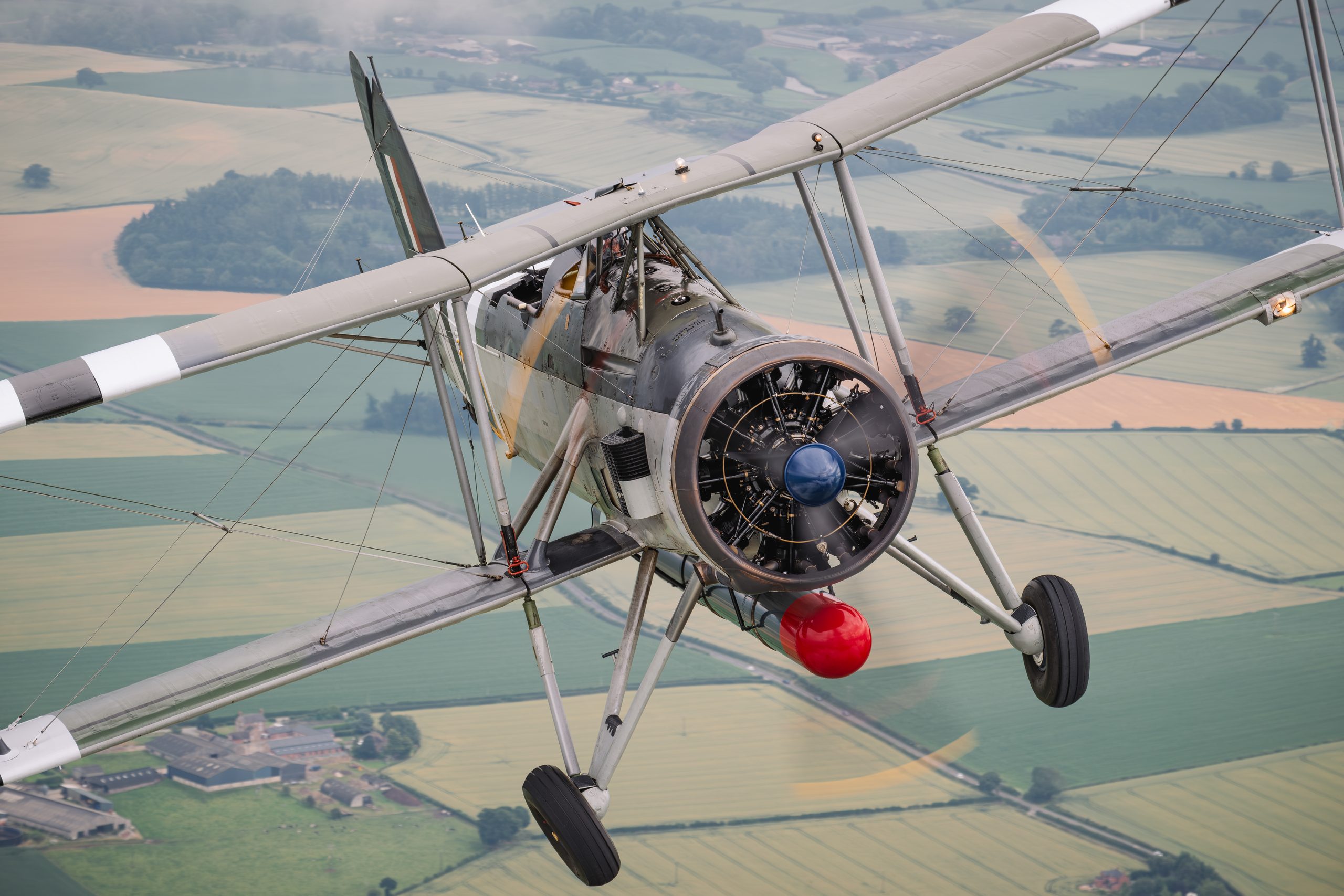
Of nearly 2,400 built, around a dozen Swordfish survive worldwide, and the marvel is that any fly at all. The flying flagship is the aircraft photographed for this article: W5856, the oldest Swordfish in existence, Blackburn-built, first flown on Trafalgar Day 1941, a veteran of Gibraltar service and Canadian training, restored by British Aerospace and flying with Navy Wings at RNAS Yeovilton. For the 2024 season she wore D-Day invasion stripes, the scheme in these frames, honouring the type’s war; she displayed as recently as the 2026 season, including at the Cosford air show.

Her stablemate LS326, a genuine North Atlantic MAC-ship veteran that later starred in the film Sink the Bismarck!, is maintained in flying condition at Yeovilton and was formally gifted by the MOD to the Fly Navy Heritage Trust in 2025, though W5856 has carried the bulk of recent display flying. A third example, Mk III HS554, is privately owned and under long-term restoration at White Waltham. For static survivors: the Fleet Air Arm Museum at Yeovilton displays a composite Mk II, IWM Duxford holds Mk III NF370 with genuine 1944-45 operational service behind it, and Canada, which trained thousands of Swordfish crews, keeps examples at Shearwater, Ottawa and Wetaskiwin, with others in Malta and Texas. Those static survivors are a photographic problem of their own, and our guide to photographing aircraft in museums and hangars deals with the low light and awkward spaces they sit in.
The custody of the flying survivors tells its own small history. The Royal Navy Historic Flight, formed in 1972, flew the Swordfish pair for nearly fifty years until it stood down in March 2019, and the aircraft passed to the Navy Wings charity and the Fly Navy Heritage Trust, W5856 and her stablemates moving to the civil register in 2020 and LS326 formally gifted, still in flying condition and valued at close to half a million pounds, by vote of Parliament in January 2025. Few aircraft anywhere have their continued flying underwritten quite so formally, and the seriousness is the point: these are the Fleet Air Arm’s memory with a Pegasus in front.
The 2024 season’s invasion stripes carried their own anniversary weight: painted for the eightieth anniversary of D-Day, they honour the Swordfish squadrons that patrolled the invasion’s flanks against E-boats and submarines through June 1944, night work in the Channel that rarely makes the highlight reels. The scheme in these photographs is therefore not decoration but citation, and captions that use these frames should say so; the aircraft is wearing its type’s service record. Frames of W5856 from this sortie are licensed through the Piemags aviation archive, and the terms they are supplied under are set out on the licences page.
Photographing the Swordfish today
Photographing W5856 air to air, as these frames were flown, is period photography made new: the same silhouette that closed on Bismarck, held in the viewfinder over English fields. The Swordfish rewards the camera differently from any other warbird, because the drama is in the detail, the wires, the struts, the crutch and torpedo, the open cockpits, and close formation work shows what no airshow crowd line can. Sorties of that kind have a discipline of their own, set out in our guide to how air-to-air pictures are made.
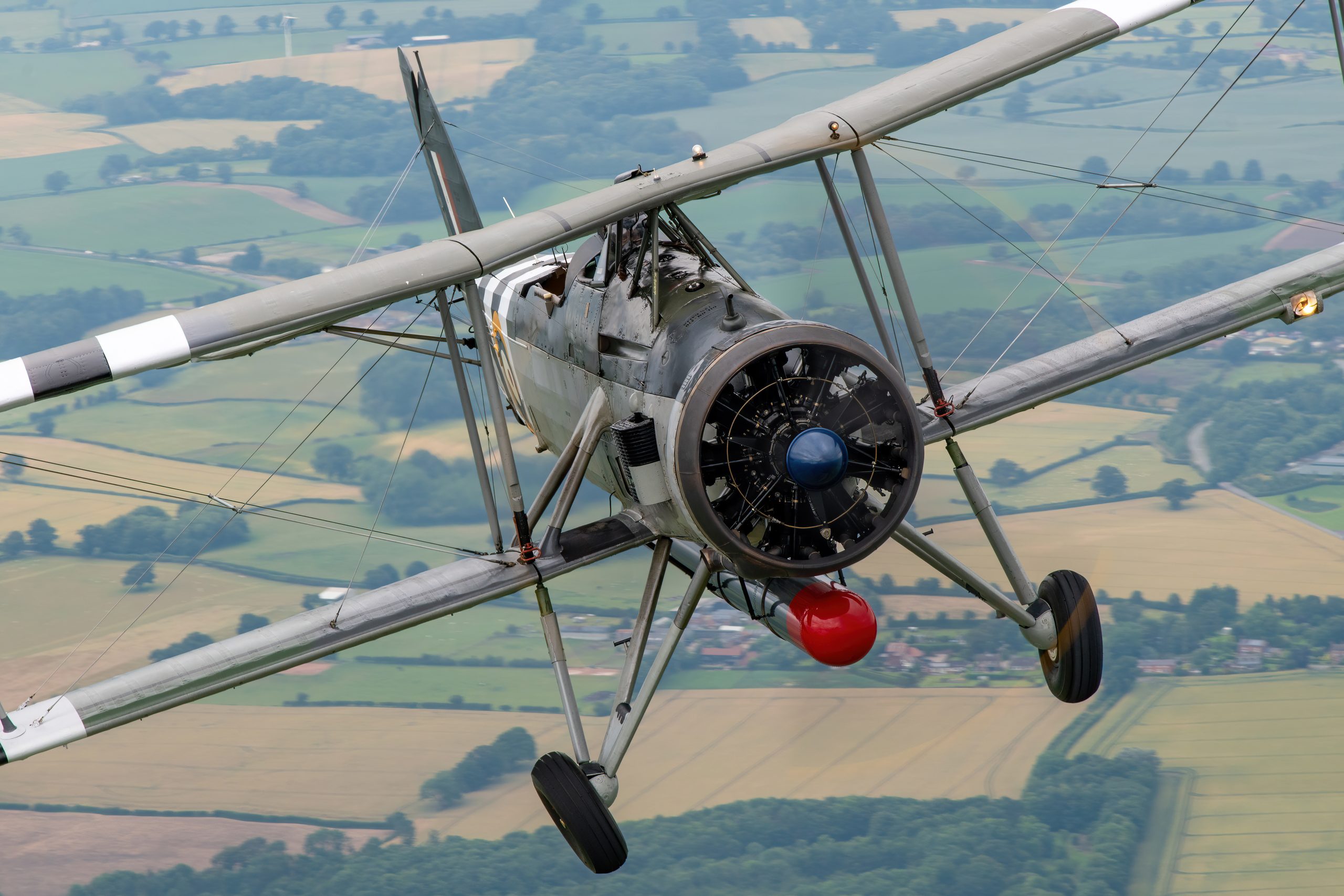
The craft notes are inverted from fast-jet work. The subject is so slow that the camera ship, not the Swordfish, sets the problems, and shutter speed can sit lower than for any other radial type, 1/160 second and below, keeping the big three-blade propeller fully alive, per our guide to propeller blur and shutter speed. From the ground, the type’s display season with Navy Wings makes it a regular at UK airshows, and our guide to warbird photography covers making the most of those passes; the biplane’s slowness, for once, gives every photographer on the fence time to compose properly.
For the photographer at a summer airshow, one practical postscript: the Swordfish is the rare display subject that improves with longer lenses and patience, because its passes are slow enough to work the details, the crew, the torpedo crutch, the sunlight through fabric, rather than snatching a silhouette. Treat a Navy Wings booking in an airshow programme as a session, not a flypast.
Legacy
The Swordfish’s legacy needs no inflation, and honesty improves it. It was one of the last biplanes in front-line service with any air arm, and the Fleet Air Arm’s last, flying operationally until the month of victory in Europe. The popular claim that it sank more Axis tonnage than any other Allied aircraft circulates widely and has never been rigorously established; the type’s documented record, Taranto, Bismarck, the convoy war, needs no such garnish.
What the Stringbag actually teaches is why it is loved. Wars are not won by the newest thing; they are won by the thing that works, crewed by people who trust it. The Swordfish could find a fleet at night, carry any weapon in the inventory, land on a pitching postage stamp in an Atlantic gale, and bring its three men home through weather and fire. Nothing else in 1940 could do all of that, and the fact that it did it with fixed wheels and fabric wings is not the embarrassing part of the story. It is the story.
The Stringbag’s cultural afterlife has been quieter than the Spitfire’s and deeper than most. LS326 starred as herself in the 1959 film Sink the Bismarck!, the reason a working MAC-ship veteran survived at all; the Taranto raid is taught in naval colleges on three continents; and every Navy Wings display puts the actual shape, wires and all, in front of crowds whose grandparents it protected. For publishers and picture desks the type sits squarely in the demand pattern our picture research guide describes: perennial editorial appetite, tiny modern-image supply, and a story, Taranto to Bismarck to the convoys, that sells itself.
Frequently asked questions
Why was the Fairey Swordfish called the Stringbag?
Not for its rigging, as usually assumed, but for the string shopping bags of the day: like them, the aircraft seemed able to accommodate anything. Crews watched it cleared for torpedoes, mines, bombs, depth charges, rockets, flares and radar, and the name followed.
Why was the Swordfish a biplane so late in the 1930s?
Because carrier requirements rewarded one. A biplane gave very low landing speeds, docile handling and a strong structure for deck operations, and could lift heavy loads from short decks. The layout that looked obsolete on land was close to ideal at sea.
What happened at Taranto?
On the night of 11 to 12 November 1940, twenty-one Swordfish from HMS Illustrious attacked the Italian fleet at anchor, disabling the battleships Littorio, Caio Duilio and Conte di Cavour for the loss of two aircraft. It was the first defeat of a fleet by carrier aircraft alone, and Japanese planners studied it before Pearl Harbor, though their own shallow-water torpedo work predated the raid.
Did a Swordfish really cripple the Bismarck?
Yes. On 26 May 1941 fifteen Swordfish from HMS Ark Royal attacked in atrocious weather and scored two hits, one of which jammed Bismarck’s rudders, leaving her unable to escape the Home Fleet, which sank her the next morning. The hit is popularly credited to Jock Moffat, though the attribution was never officially recorded and remains debated.
What was the Channel Dash?
On 12 February 1942 six Swordfish of 825 Squadron, led by Eugene Esmonde, attacked the German battleships Scharnhorst and Gneisenau in the Channel after their fighter escort largely failed to arrive. All six were shot down and thirteen of eighteen aircrew died. Esmonde received a posthumous Victoria Cross, the Fleet Air Arm’s first of the war.
How many U-boats did Swordfish sink?
Between 14 and 22 depending on how shared kills are counted, more than any other Fleet Air Arm type. The tally includes the war’s first rocket-projectile sinking, U-752 in May 1943, and four U-boats sunk by HMS Vindex’s aircraft in a single 1944 voyage.
What were MAC ships?
Merchant Aircraft Carriers: grain ships and tankers fitted with rudimentary flight decks, carrying three or four Swordfish while still hauling cargo. Only an aircraft as slow and docile as the Swordfish could work from them in Atlantic weather, and they helped close the air gap that U-boats exploited.
How many Swordfish were built?
2,391 by the standard count, some sources say 2,396: 692 by Fairey and 1,699 by Blackburn, whose aircraft were nicknamed Blackfish. Production ran from 1934 to August 1944, and the type outlived the Albacore designed to replace it.
How fast was the Swordfish?
About 139 to 143 mph flat out with a torpedo, with cruising speeds far lower, and crews joked the maximum required going downhill. The slowness was operationally useful: it made deck landings possible in dreadful weather, and it is often said that warship gunners struggled to aim at so slow a target.
When did the Swordfish retire?
The last operational squadron, 836, disbanded on 21 May 1945, days after victory in Europe, with training use continuing briefly after. It was the Fleet Air Arm’s last operational biplane and among the last in front-line service anywhere.
Do any Swordfish still fly?
Yes. Navy Wings at RNAS Yeovilton flies W5856, the world’s oldest surviving Swordfish, which wore D-Day invasion stripes for the 2024 season and has displayed into 2026; its stablemate LS326, a genuine Atlantic convoy veteran, is maintained in flying condition. A privately owned Mk III is under long-term restoration at White Waltham.
Where can I see a Swordfish in a museum?
The Fleet Air Arm Museum at Yeovilton displays a Mk II, and IWM Duxford holds a Mk III that flew operationally in 1944 and 1945. In Canada, examples are held at Shearwater, the Canada Aviation and Space Museum in Ottawa and the Reynolds-Alberta Museum, with further survivors in Malta and the United States.
